When deciding between the two flagship ten-quart dual-basket fryers from Ninja, the defining difference rests on exterior construction versus internal power distribution: one appliance is built with a heavy-duty stainless steel exterior housing and certified PFAS-free non-stick coatings, while the other features an all-black shell paired with specialized wattage management designed to balance uneven cooking loads across its dual compartments.
Select the Ninja DZ401 if you prioritize durable stainless steel styling and documented non-toxic basket surfaces that integrate seamlessly with professional kitchen appliances. Opt for the Ninja DZ302 if you regularly cook uneven combinations of proteins and sides that benefit from adaptive wattage distribution.
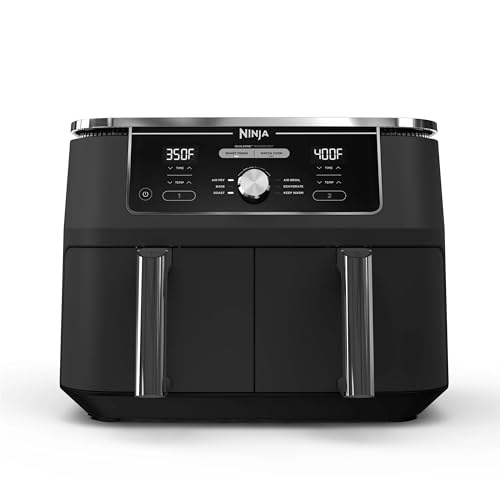

Ninja DZ401 vs Ninja DZ302 at a Glance
| Feature | Ninja DZ401 | Ninja DZ302 |
|---|---|---|
| Total Capacity | 10 Quarts (Two 5-Qt Baskets) | 10 Quarts (Two 5-Qt Baskets) |
| Total Wattage | 1690 Watts | 1690 Watts |
| Exterior Material | Stainless Steel and Plastic | Metal and Plastic |
| Inner Liner Material | Stainless Steel | Plastic |
| Power Allocation System | Standard DualZone (Match Cook & Smart Finish) | IQ Boost with Match Cook & Smart Finish |
| Temperature Range | Up to 450°F (Minimum not listed) | 100°F to 450°F (Listed as 105°F in overview) |
| Appliance Weight | 19.8 lbs | 18.7 lbs |
| Dimensions (D x W x H) | 13.9″D x 17.1″W x 12.8″H | 17.1″D x 14.65″W x 12.87″H |
| Food Contact Coating | 100% PFAS-Free Non-Stick | Non-Stick (PFAS status not listed) |
| Included Preset Programs | 6 (Air Fry, Broil, Roast, Bake, Reheat, Dehydrate) | 6 (Air Fry, Broil, Roast, Keep Warm, Dehydrate, Bake) |
| Best For | Stainless kitchen setups and non-toxic coating priorities | Asymmetrical cooking loads requiring adaptive power |
Exterior Build Quality and Kitchen Aesthetics
Countertop placement and material resilience represent a significant point of contrast when examining the ninja dz401 vs dz302 build quality. The DZ401 is engineered with a stainless steel outer shell and stainless steel inner elements, resulting in a 19.8-pound chassis finished in a modern grey tone. This metal construction provides high resistance to exterior cosmetic scuffs, resists heat discoloration around the ventilation seams, and matches the brushed metallic surfaces found on upscale ranges and dishwashers. Cooks considering larger multi-function countertop units like the one detailed in our ninja dz401 vs sp101 comparison will note that the exterior metal housing of the DZ401 provides the same industrial durability.
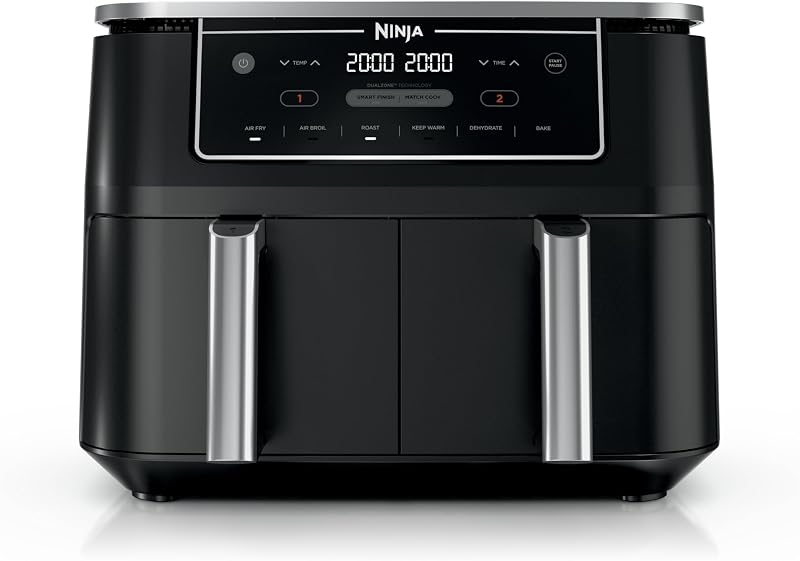
In contrast, the DZ302 uses an exterior blend of black metal and molded plastic, bringing the overall weight down to 18.7 pounds. The high-gloss black finish provides a uniform, discreet aesthetic that blends into darker kitchen cabinetry but shows oil splatters and smudges more readily than brushed metal. The interior cavity of the DZ302 is listed with plastic components rather than the stainless steel found inside the DZ401 chassis. While this lighter structural footprint makes moving the machine around the counter easier, it offers less overall structural mass than the steel-clad alternative.
For cooks focused strictly on aesthetic longevity and rugged casing materials, the DZ401 offers an authentic metallic presence. The DZ302 remains functional and clean in appearance, yet its reliance on plastic exterior trims and internal surfaces gives it a more utilitarian feel on the kitchen counter.
Edge: Ninja DZ401 because its stainless steel exterior and interior liner offer greater structural durability and better match modern metal kitchen appliances.
Power Distribution and the IQ Boost Feature
Both air fryers draw an identical 1690 watts of electrical power at 120 volts, but they route that available energy to the heating elements differently when using separate baskets. In standard dual-basket operation, appliances typically divide power evenly between zones. However, when one basket holds a massive cut of meat requiring high thermal saturation and the opposite basket holds delicate vegetables, an even 50/50 split can result in extended cook times for the main protein.
The ninja dz302 iq boost feature addresses this exact operational hurdle. When neither Match Cook nor Smart Finish is activated, IQ Boost intelligently diverts available wattage dynamically, funneling greater power toward the denser food load-such as a dense six-pound whole chicken-while metering lower wattage to the secondary basket holding a quick-cooking side. This dynamic energy channeling shortens total cycle time for asymmetric meals. Shoppers who study power delivery across different product tiers, as explored in the ninja dz071 vs dz302 breakdown, will recognize IQ Boost as an effective way to extract maximum performance from a 1690-watt circuit.
The DZ401 operates without the dynamic IQ Boost power routing system. While it handles twin six-pound chickens with rapid air delivery, its power distribution remains symmetrical across both chambers. If you are preparing a large roast in one compartment and a light side dish in the other without using synchronized finish timers, the DZ401 cannot actively channel surplus wattage into the primary protein compartment. As a result, the DZ302 executes uneven multi-item cooking tasks with greater thermal efficiency.
Edge: Ninja DZ302 due to its integrated IQ Boost system that optimizes wattage allocation between dense proteins and light sides.
Cooking Programs and Temperature Versatility
Operating flexibility across these two machines depends on their specific pre-programmed routines and low-temperature thresholds. The DZ401 comes configured with six dedicated functions: Air Fry, Air Broil, Roast, Bake, Reheat, and Dehydrate. It hits a maximum operating ceiling of 450°F, generating the intense dry heat necessary to crisp skins and brown meats quickly. However, the listing documentation for the DZ401 leaves its lowest temperature limit unspecified, focusing primarily on its top-end air-frying performance.
The DZ302 provides a slightly different preset configuration with Air Fry, Air Broil, Roast, Keep Warm, Dehydrate, and Bake, with the overview text also referencing Reheat and Max Crisp capabilities. Crucially, the DZ302 lists an expansive temperature span ranging from a low of 100°F (or 105°F depending on the preset mode) up to 450°F. This clearly defined lower boundary is essential for reliable fruit, herb, and jerky dehydration, as well as preserving delicate baked items without scorching them. Readers evaluating different entry-level and mid-range configurations in our ninja dz201 vs dz302 evaluation will appreciate how a confirmed low temperature baseline expands low-and-slow culinary options.
While both appliances deliver top-tier convection crisping at 450°F, the DZ302 offers a dedicated Keep Warm program alongside documented low-end thermal regulation. The DZ401 excels at daily reheating and crisping, but the broader documented range of the DZ302 gives it a slight utility advantage for specialty tasks.
Edge: Ninja DZ302 because of its documented low-temperature baseline down to 100°F and dedicated Keep Warm function.
Capacity and Basket Configuration for Family Cooking
Deciding between the ninja dz401 or dz302 for large families requires examining how their shared ten-quart cooking capacity is divided. Both appliances eliminate single-basket bottlenecks by utilizing two fully independent five-quart baskets. Each compartment features its own cyclonic convection fan and heating coil, preventing scent transfer when cooking distinct dishes simultaneously. Both units support Match Cook, which duplicates time and temperature settings across both baskets with a single press, providing a continuous ten-quart volume suitable for large batches.
In this ninja foodi 10 qt dualzone comparison, the raw meal-prep capacity between the two units is fundamentally neck-and-neck. The DZ401 states capability for two six-pound chickens cooked at once, finishing up to 30 percent faster than conventional ovens. The DZ302 specifies clearance for up to eight pounds of chicken wings or a six-pound whole chicken paired with a complete side dish. Both feature Ninja Smart Finish technology, which delays the start of the faster-cooking zone so that two dishes with radically different cooking durations and temperatures finish simultaneously.
For single-person households or smaller kitchens, compact models like those in our ninja af101 vs dz302 guide might suffice, but for large households, both of these ten-quart platforms excel. Because both units provide identical basket volumes, identical five-quart drawer dimensions, and the same Smart Finish convenience, they perform identically when scaling meals for groups.
Edge: Tie because both units provide identical ten-quart total capacities, dual five-quart baskets, and Smart Finish synchronization.
Countertop Footprint and Spatial Requirements
Countertop depth and upper-cabinet clearance often dictate which appliance can practically live in a modern kitchen. Interestingly, despite sharing identical internal capacities, the DZ401 and DZ302 differ significantly in their physical proportions. The DZ401 measures 13.9 inches deep, 17.1 inches wide, and 12.8 inches tall. Its broad, shallow architecture pushes outward along the counter width while demanding relatively little depth from front to back, keeping it clear of backsplash walls.
The DZ302 reverses these dimensional priorities, measuring 17.1 inches deep, 14.65 inches wide, and 12.87 inches tall. This configuration saves nearly 2.5 inches of horizontal frontage along your counter, making it easier to fit between other small appliances. However, its 17.1-inch depth requires a deeper counter space, particularly when factoring in the rear exhaust port clearance necessary for high-velocity heat venting. Those assessing alternative basket shapes as shown in the ninja dz071 vs dz401 comparison know that chassis depth directly dictates drawer extension space.
Choosing between these two forms depends entirely on your kitchen counter configuration. If your counters are shallow and you have ample linear counter run, the DZ401 fits with less overhang. If your countertop frontage is crowded and you have deep standard counters, the DZ302 leaves more side-to-side workspace available.
Edge: Tie because the DZ401 saves counter depth while the DZ302 saves counter width, serving different kitchen space constraints equally well.
Maintenance, Cleaning, and Food Contact Materials
Daily cleaning routines highlight a critical health and maintenance distinction between these dual-zone appliances. The DZ401 listing explicitly states that its non-stick cooking surfaces are manufactured to be 100% PFAS-free. For home cooks focused on minimizing fluorinated synthetic compounds in contact with high-temperature food, this documented material specification provides clear peace of mind. Both the cooking baskets and the removable crisper plates on the DZ401 feature this non-stick finish, with the crisper plates designated as dishwasher safe for rapid cleanup.
The DZ302 also includes two non-stick crisper plates that are dishwasher safe and easy-to-clean baskets. However, the manufacturer data for the DZ302 does not explicitly document a PFAS-free certification for its non-stick coatings. Furthermore, the listing identifies the inner chassis material of the DZ302 as plastic, compared to the stainless steel interior construction specified for the DZ401. Stainless steel cavity liners are inherently less prone to absorbing baked-on grease vapors over years of repetitive high-heat cycling.
Both models save substantial cleanup labor compared to scrubbing traditional oven roasting pans. Yet, the confirmed PFAS-free non-stick surface and stainless steel internal construction give the DZ401 a clear advantage in food-contact safety and long-term material resilience.
Edge: Ninja DZ401 due to its explicitly certified 100% PFAS-free non-stick surface and stainless steel interior construction.
Pros and Cons
Ninja DZ401

Pros
- Brushed stainless steel housing
- 100% PFAS-free non-stick surface
- Stainless steel interior liner
- Shallow 13.9-inch counter depth
- Twin five-quart independent baskets
Cons
- Lacks dynamic IQ Boost power routing
- Minimum temperature not listed in specifications
- Heavier at 19.8 pounds
Ninja DZ302
Pros
- IQ Boost dynamic wattage allocation
- Wide temperature span down to 100°F
- Narrow 14.65-inch counter footprint
- Includes dedicated Keep Warm preset
- Lighter 18.7-pound total weight
Cons
- Plastic interior cavity material
- PFAS-free coating status not specified
- Deep 17.1-inch chassis requires counter depth
Who Should Buy Each One
Choose the Ninja DZ401 If
- You want a brushed stainless steel exterior that coordinates with premium metallic kitchen appliances.
- You require cooking surfaces with verified 100% PFAS-free non-stick coatings.
- You have wide countertops with limited depth where a 13.9-inch deep unit fits better.
- You prefer a sturdier, heavier machine featuring stainless steel internal chassis materials.
Choose the Ninja DZ302 If
- You frequently cook asymmetric meals where one basket needs maximum power diverted via IQ Boost.
- You want an all-black exterior finish to match dark cabinetry or matte black hardware.
- You need a dedicated Keep Warm program and confirmed low-temperature functionality down to 100°F.
- You have narrow countertop space where a 14.65-inch wide chassis is easier to park.
Final Verdict
When assessing this ninja dz302 vs dz401 matchup, your selection hinges on whether you value exterior construction or adaptive wattage regulation. The Ninja DZ401 stands out for its high-grade physical construction. Its brushed stainless steel housing, stainless steel inner build, and documented 100% PFAS-free non-stick baskets provide superior long-term durability and material peace of mind. In any thorough ninja dz401 review, these exterior and non-toxic attributes make it the top choice for design-conscious home cooks who demand rugged materials.
On the other hand, the Ninja DZ302 claims victory in dynamic electrical execution. Its proprietary IQ Boost system solves the inherent limitation of dual-basket appliances by actively channeling wattage where dense meats need it most. When evaluating whether the model is worth it, buyers who frequently cook unbalanced main-and-side dishes or who rely on low-temperature dehydration down to 100°F will find the DZ302 to be the more flexible, performance-driven kitchen workhorse.
FAQ
Does the Ninja DZ302 or DZ401 have a larger cooking capacity?
Both air fryers share identical overall capacities of ten quarts, divided into two independent five-quart cooking baskets. Neither unit offers more basket volume than the other, and both can accommodate up to an eight-pound batch of chicken wings or two six-pound chickens simultaneously.
What does the IQ Boost feature do on the Ninja DZ302?
The IQ Boost system on the DZ302 monitors power distribution and dynamically routes extra wattage to the basket holding denser items when Match Cook or Smart Finish is not in use. This allows an uneven load, like a heavy roast alongside lightweight vegetables, to cook as quickly as possible without wasting power on the low-demand basket.
Are the baskets on both the DZ401 and DZ302 dishwasher safe?
The removable crisper plates for both the DZ401 and the DZ302 are explicitly listed as dishwasher safe. While the outer baskets feature non-stick surfaces designed for easy hand-washing, the DZ401 adds an extra level of assurance with a certified 100% PFAS-free non-stick coating.
Can both models cook two different foods at different temperatures at the same time?
Yes, both models feature Ninja DualZone Technology with independent heating zones, cyclonic fans, and separate controls for each basket. Both also include the Smart Finish function, which synchronizes the cooking cycles so that foods with completely different times and temperatures finish at the exact same moment.
Which air fryer takes up less countertop space?
The DZ401 is wider but shallower, measuring 17.1 inches wide and 13.9 inches deep. The DZ302 is narrower but deeper, measuring 14.65 inches wide and 17.1 inches deep. The DZ302 saves horizontal counter space, while the DZ401 leaves more depth for cutting boards and prep work in front of standard backsplashes.
Does the Ninja DZ401 include a Keep Warm setting?
The DZ401 specifies six main programs: Air Fry, Air Broil, Roast, Bake, Reheat, and Dehydrate. The DZ302 explicitly lists a dedicated Keep Warm program alongside its low-temperature baseline, whereas keeping food warm on the DZ401 typically requires using its low-heat Reheat setting.