The core distinction separating the original Noctua NH-D15 from the updated Noctua NH-D15 G2 comes down to thermal capacity driven by an upgraded heatpipe architecture and redesigned fan profile. While the original design relies on six heatpipes matched with dual NF-A15 140mm fans to manage enthusiast-grade heat, the second-generation iteration integrates eight heatpipes, twenty percent greater fin surface area, and novel NF-A14x25r G2 fans engineered to push thermal performance higher on dense, modern processor dies.
Builders running moderate workloads or standard modern desktop chips should pick the original NH-D15 for proven dual-tower stability without mechanical complexity. Enthusiasts pushing high-wattage modern silicon like top-tier Ryzen or Core Ultra processors should select the NH-D15 G2 to maximize thermal headroom and clear adjacent motherboard components.
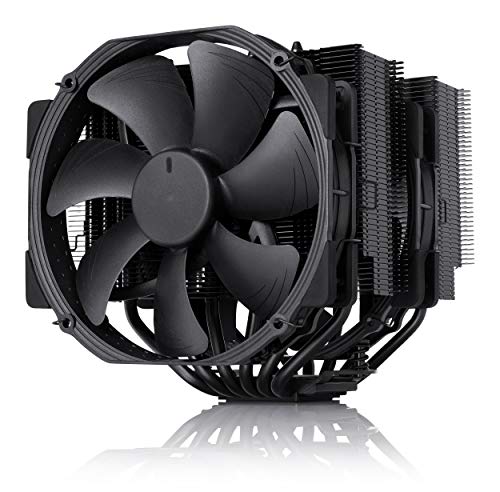

Noctua NH-D15 vs Noctua NH-D15 G2 at a Glance
| Feature | Noctua NH-D15 | Noctua NH-D15 G2 |
|---|---|---|
| Heatpipe Count | 6 copper heatpipes | 8 copper heatpipes |
| Included Fans | 2x NF-A15 HS-PWM 140mm | 2x NF-A14x25r G2 140mm |
| Maximum Airflow | 140.2 m³/h | 155.6 m³/h |
| Rated Noise Level | 24.6 dB | 24.8 dB |
| Maximum Rotational Speed | 1500 RPM | 1500 RPM |
| Thermal Compound Included | NT-H1 | NT-H2 |
| Mounting System | SecuFirm2 | SecuFirm2+ (Torx-based with NM-SD1 screwdriver) |
| RAM Clearance (Single Fan) | Not listed | 59mm (32mm with dual fans) |
| Cooler Dimensions (L x W x H) | 6.49″ x 5.91″ x 6.34″ (168mm highlighted) | 5.98″ x 5.91″ x 6.61″ (168mm highlighted) |
| Best For | Standard high-performance desktop builds | Extreme high-wattage desktop CPUs and crowded motherboards |
Heatpipe Architecture and Surface Area
Thermal absorption at the baseplate determines how effectively a large heatsink pulls concentrated heat away from dense processor dies. Evaluating the NH-D15 vs G2 heatpipes reveals a major structural shift between these generations. The classic NH-D15 uses six copper heatpipes that distribute thermal energy across two symmetrical fin stacks. For builders assessing standard configurations, as explored in our noctua nh-d15 vs nh-u12a comparison, this six-pipe array remains a robust baseline for high-power thermal management.
In contrast, the NH-D15 G2 expands the thermal layout to eight copper heatpipes and provides 20% more surface area across its cooling fins. The extra pipes allow the baseplate to channel heat away from localized hotspots much faster, preventing thermal saturation on power-hungry chips like the Core Ultra 285K or Ryzen 9 9950X. This expanded layout gives the G2 superior raw capacity when heat generation spikes abruptly under sustained rendering or compiling workloads.
This generational expansion means the G2 handles continuous heavy loads without thermal throttling where a six-pipe design would operate closer to its mechanical ceiling. The older model remains fully capable of handling standard thermal envelopes, but the extra heatpipe density in the revised model provides critical overhead on modern multi-die platforms.
Edge: Noctua NH-D15 G2 provides superior heat transfer thanks to its eight heatpipes and 20% increase in cooling fin surface area.
Fan Engineering and Airflow Capacity
Pushing air efficiently through dense fin arrays requires steady static pressure and high volume. In any head-to-head NH-D15 G2 vs NH-D15 breakdown, the fans represent the most visible mechanical upgrade. The original NH-D15 features two NF-A15 HS-PWM 140mm fans operating up to 1500 RPM, delivering an airflow capacity of 140.2 cubic meters per hour. These round-frame blowers have long set the benchmark for low-vibration dual-tower cooling.
The newer NH-D15 G2 introduces dual NF-A14x25r G2 140mm fans, also rated at a top rotational speed of 1500 RPM, but delivering an increased airflow capacity of 155.6 cubic meters per hour. This noticeable NH-D15 G2 airflow difference allows the cooler to cycle fresh air through the expanded fin array more aggressively. When looking at compact alternative designs in our noctua nh-d15 g2 vs nh-l9i breakdown, the raw volumetric delivery of these G2 fans highlights why full-size dual towers dominate heavy thermal tasks.
In practice, the additional 15.4 cubic meters per hour delivered by the G2 fans enables higher thermal extraction without needing higher rotational speeds. The original NF-A15 fans perform admirably, but the refined aerodynamic profile of the NF-A14x25r G2 units extracts more cooling performance per revolution.
Edge: Noctua NH-D15 G2 takes the lead with its higher 155.6 m³/h airflow capacity using next-generation fan blades.
Acoustic Tuning and Noise Profiles
Controlling decibel output while moving large volumes of air requires careful aerodynamic balancing. On paper, the NH-D15 vs NH-D15 G2 noise level specs appear remarkably close: the original model is rated at 24.6 dB, while the G2 registers slightly higher at 24.8 dB. Both units come equipped with low-noise adaptors that restrict maximum fan speeds for environments where silent operation takes precedence over peak throughput.
Where the models diverge is how they address acoustic resonance. Any detailed Noctua NH-D15 G2 review highlights the inclusion of a speed-offset feature between the two NF-A14x25r G2 fans. Running twin fans at the exact same rotational speed can generate subtle hums or acoustic beating frequencies inside a PC chassis. The G2’s deliberate rotational speed-offset mitigates periodic acoustic peaks, resulting in a sound profile that feels smoother to the human ear even if the absolute decibel rating is a negligible 0.2 dB higher.
The original NH-D15 remains an exceptionally quiet cooler that runs virtually silent at idle and restrained under load. However, the acoustic fine-tuning built into the G2 fan package provides cleaner sound characteristics in cases where twin 140mm fans push maximum air simultaneously.
Edge: Tie. The original NH-D15 holds a technical 0.2 dB lower acoustic rating, while the NH-D15 G2 counters with speed-offset acoustic tuning to minimize resonance.
Clearance and Component Compatibility
Dual-tower coolers are notorious for crowding adjacent motherboard components, particularly the primary expansion slot and memory modules. The original NH-D15 measures 6.49 inches in length, 5.91 inches in width, and 6.34 inches in height (highlighted at 168mm total installation height). Because of its wide, symmetrical profile, the outer fan frequently overhangs memory slots, forcing users to raise the fan upward or relocate it entirely in tight cases, as frequently noted in comparisons like the noctua nh-d15 vs thermalright peerless assassin 120.
The NH-D15 G2 adjusts physical proportions to 5.98 inches in length, 5.91 inches in width, and 6.61 inches in height, while maintaining the same 168mm highlighted clearance height. Noctua implemented an offset fin design with recessed lower fins on the G2 specifically to prevent interference with the top PCIe x16 graphics card slot on modern motherboards. Furthermore, the G2 listing explicitly details memory compatibility: it provides 59mm of RAM clearance in single-fan mode and 32mm when running both 140mm fans.
These tailored dimensions solve a persistent headache for system builders. By pulling the bulk of the heatsink slightly away from the primary expansion slot, the G2 fits more comfortably onto modern compact or densely populated motherboards without blocking the release latch on top PCIe cards.
Edge: Noctua NH-D15 G2 wins by integrating an offset fin layout and recessed lower fins for superior PCIe and RAM clearance.
Installation Hardware and Included Accessories
Mounting mechanism quality dictates both installation ease and contact pressure consistency over the CPU die. The original NH-D15 bundles Noctua’s classic SecuFirm2 mounting kit along with a tube of standard NT-H1 thermal compound. The listing notes support for Intel LGA1851, LGA1700, LGA1200, and LGA115x, alongside AMD AM5 and AM4 sockets, including an offset mounting option for AMD chips. It also features a 4-pin PWM Y-cable and two NA-RC7 low-noise adaptors.
The NH-D15 G2 upgrades the toolset to the SecuFirm2+ system, swapping out traditional Phillips screws for Torx-based fasteners and including a dedicated NM-SD1 Torx screwdriver in the package. It steps up the bundled thermal paste to high-grade NT-H2 compound. For Intel LGA1700 builders, the G2 package adds NM-ISW1 washers engineered to reduce CPU contact frame warping and optimize heat transfer across Intel’s elongated socket shape.
When buyers consider alternative high-performance options like those in our noctua nh-d15 g2 vs thermalright phantom spirit 120 overview, the specialized Torx mounting and anti-warp washers demonstrate Noctua’s hyper-focus on socket-specific contact pressure. The G2 accessory suite provides more tailored adjustments for the current generation of Intel and AMD processors.
Edge: Noctua NH-D15 G2 delivers a superior accessory kit with Torx mounting hardware, NT-H2 paste, and LGA1700 anti-warp washers.
Pros and Cons
Noctua NH-D15

Pros
- Proven 6-heatpipe dual-tower design
- Slightly lower 24.6 dB acoustic rating
- Includes NT-H1 thermal compound and SecuFirm2 kit
- 6-year manufacturer warranty and spare parts guarantee
Cons
- Symmetrical body can crowd top PCIe slot
- Lower 140.2 m³/h maximum airflow capacity
Noctua NH-D15 G2

Pros
- 8 heatpipes for superior heat dispersion
- 20 percent more cooling fin surface area
- Higher 155.6 m³/h airflow capacity
- Offset fin design clears top PCIe slot
- SecuFirm2+ Torx system with NM-ISW1 washers
Cons
- Heavier total weight at 1525 grams
- Marginally higher 24.8 dB noise specification
View Noctua NH-D15 G2 on Amazon
Who Should Buy Each One
Choose the Noctua NH-D15 If
- You run mid-range or previous-generation desktop processors that do not require an eight-heatpipe thermal array.
- Your case and motherboard layout easily accommodate a classic symmetrical 140mm dual-tower footprint without PCIe blocking.
- You prefer standard cross-head mounting fasteners and proven NT-H1 thermal compound for straightforward servicing.
- You are seeking proven, award-winning quiet dual-tower cooling supported by a 6-year manufacturer warranty and 6-year EU spare part availability.
Choose the Noctua NH-D15 G2 If
- You are cooling flagship, high-wattage desktop processors like the Ryzen 9 9950X or Core Ultra 285K that demand maximum heatpipe density.
- Your motherboard has a high top PCIe x16 slot that requires the G2 offset base design to maintain graphics card clearance.
- You want improved 155.6 m³/h airflow and speed-offset fan acoustics to eliminate harmonic hums under heavy system loads.
- You build on Intel LGA1700 or LGA1851 and want the included NM-ISW1 contact washers and SecuFirm2+ Torx installation system.
Final Verdict
For builders wondering is NH-D15 G2 worth it, the answer depends directly on the platform you intend to cool. The original NH-D15 remains an iconic benchmark in air cooling, delivering 140.2 m³/h of quiet airflow across six durable copper heatpipes. For standard multi-core systems, mainstream workloads, and builds where clearance around the top PCIe slot is unconstrained, the first-generation model continues to provide dependable, whisper-quiet performance backed by its 6-year manufacturer warranty.
However, the Noctua NH-D15 G2 is the clear technological step forward for demanding configurations. By combining eight heatpipes, a 20% increase in fin surface area, 155.6 m³/h airflow fans with acoustic speed-offset tuning, and an offset footprint that clears expansion slots, the G2 solves the thermal and clearance challenges of modern desktop computing. If you are building a workstation or top-tier rig around modern silicon, the G2 is the superior air cooling investment. For single-tower alternatives from the same maker, check out our guide on the noctua nh-d15 g2 vs nh-u12a.
FAQ
Is the NH-D15 G2 worth it compared to the original model?
The NH-D15 G2 is worth choosing if you run modern high-wattage processors like the AMD Ryzen 9 9950X or Intel Core Ultra 285K. The addition of eight heatpipes, twenty percent more fin surface area, and offset motherboard clearance addresses the intense localized thermal loads and tight clearances found in modern desktop hardware.
How does the NH-D15 G2 airflow difference impact system cooling?
The NH-D15 G2 airflow difference amounts to an increase from 140.2 m³/h on the original model up to 155.6 m³/h on the G2, despite both coolers topping out at 1500 RPM. This higher volume moves heat out of the larger fin stack more rapidly, improving sustained cooling under heavy computational loads without increasing rotational fan speed.
Should I choose the Noctua NH-D15 or NH-D15 G2 for AM5?
When deciding between the Noctua NH-D15 or NH-D15 G2 for AM5 processors, both coolers include dedicated offset mounting hardware for AMD sockets. However, the G2 model is specifically optimized for AM5 thermal profiles with its eight-heatpipe baseplate, making it the better choice for high-core-count Ryzen processors.
What is the mechanical difference in NH-D15 vs G2 heatpipes?
The original NH-D15 features six copper heatpipes traversing its two fin towers, whereas the NH-D15 G2 incorporates eight copper heatpipes. This greater heatpipe density allows the G2 to spread heat over twenty percent more fin surface area, reducing thermal bottlenecks over the processor contact zone.
How noticeable is the NH-D15 vs NH-D15 G2 noise level difference in everyday use?
The measured decibel ratings are nearly identical at 24.6 dB for the original and 24.8 dB for the G2. However, the G2 includes fans with a built-in speed-offset, which varies the rotational frequency slightly between the front and middle fans to eliminate periodic vibration beats, delivering a smoother acoustic profile under load.
Which cooler is better: Noctua NH-D15 or NH-D15 G2 for gaming?
When picking the Noctua NH-D15 or NH-D15 G2 for gaming, the G2 offers distinct advantages in motherboard spacing. Its offset base design prevents interference with the top PCIe x16 slot where high-end graphics cards sit, while its 155.6 m³/h airflow keeps high-performance gaming CPUs cool and quiet during prolonged sessions.


