Choosing between two premier air coolers comes down to physical clearance versus heatsink volume. The dual-tower footprint of the Noctua NH-D15 prioritizes expansive surface area and twin 140mm airflow for heavy continuous thermal dissipation, whereas the compact design of the Noctua NH-U12A solves the clearance puzzle by guaranteeing complete memory access and widespread case compatibility.
Choose the Noctua NH-D15 if your chassis provides ample internal width and you want maximum cooling surface area backed by dual 140mm fans. Choose the Noctua NH-U12A if you run tall memory kits, work inside space-constrained mid-tower cases, or need guaranteed clearance around the primary expansion slot.
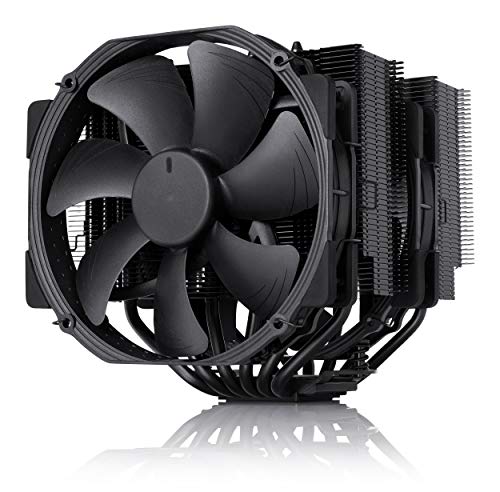

Noctua NH-D15 vs Noctua NH-U12A at a Glance
| Attribute | Noctua NH-D15 | Noctua NH-U12A |
|---|---|---|
| Cooler Architecture | Dual-tower heatsink | Compact single-tower heatsink |
| Installed Height | 168mm | 158mm |
| Dimensions (L x W x H) | 6.49″ x 5.91″ x 6.34″ | 4.92″ x 4.41″ x 6.22″ |
| Fan Configuration | Dual NF-A15 140mm fans | Dual NF-A12x25 120mm fans |
| Maximum Fan Speed | 1500 RPM | 2000 RPM |
| Maximum Rated Airflow | 140.2 m³/h | 102.1 cfm |
| Rated Acoustic Noise | 24.6 dB | 22.6 dB |
| Heatpipes | 6 copper heatpipes | Not listed |
| Memory Clearance Profile | Overhangs slots; requires fan adjustment | 100% RAM compatibility; zero overhang |
| Socket Compatibility | Intel LGA1851/1700/1200/115x, AMD AM5/AM4 | Intel LGA1851/1700/1200/115x, AMD AM5/AM4 |
| Warranty Coverage | 6 years | 6 years |
| Best For | Unrestricted chassis seeking maximum air volume | Compact builds requiring complete RAM clearance |
Heatsink Dimensions and Chassis Clearance
Chassis clearance dictates whether an enthusiast-class air cooler can even fit inside your build. The Noctua NH-D15 stands at an official height of 168mm with its item dimensions listed at 6.49 inches long, 5.91 inches wide, and 6.34 inches high. Because of its massive 140mm fan frames, standard mid-tower enclosures with side panels positioned close to the motherboard tray will struggle to close. If your build incorporates modules that sit tall on the motherboard, elevating the front fan increases that 168mm vertical requirement even further, pushing it outside the tolerances of standard cases. When comparing massive thermal hardware alongside ultra-low-profile solutions like the noctua nh-d15 vs nh-l9i, overall footprint remains the primary installation obstacle.
The Noctua NH-U12A scales these physical dimensions down to an easily manageable form factor. Listing a total height of 158mm alongside measurements of 4.92 inches long, 4.41 inches wide, and 6.22 inches high, the NH-U12A fits comfortably inside standard modern chassis without requiring side panel modifications. The 10mm reduction in vertical height sounds modest on paper, but in practice, that margin separates hardware that clears tempered glass side panels from components that collide with them. Modern compact mid-towers frequently designate 160mm as their strict thermal cooler limit, making the U12A an effortless drop-in choice.
Choosing between these two coolers on spatial constraints requires measuring your chassis width from the motherboard CPU surface to the side window. The NH-D15 demands substantial width and unhindered internal volume, penalizing builders who underestimate its bulk. The NH-U12A bypasses these spatial limitations completely, giving you enthusiast-tier cooling engineering inside a chassis profile traditionally reserved for basic single-fan towers.
Edge: Noctua NH-U12A delivers significantly better chassis clearance thanks to its 158mm vertical profile that fits standard mid-tower enclosures without side panel interference.
RAM and PCIe Component Compatibility
Motherboard component layout often causes assembly headaches when massive cooling fins overhang sensitive connection points. The Noctua NH-D15 wide 140mm dual-tower footprint stretches directly across the memory banks on standard ATX and Micro-ATX layouts. While the aluminum fin array features lower cutouts to assist with noctua nh-d15 ram clearance, the front NF-A15 140mm fan sits directly over the memory sockets. Installing tall heatspreaders or modules with integrated lighting forces you to mount the front fan higher on the cooling stack, which increases the cooler height well beyond the stock 168mm specification and risks hitting the case window. On smaller motherboards, the sheer width of the dual towers can also crowd the top PCIe slot.
The Noctua NH-U12A resolves memory interference through an asymmetrical heatsink design. The manufacturer highlights 100% RAM compatibility as a primary feature, guaranteeing that neither the heatsink fins nor the dual 120mm fans overhang the DIMM slots on mainstream desktop motherboards. You can install memory modules of any height, access the locking latches, or swap sticks freely without unclipping cooling fans or dismantling the heatsink assembly. Furthermore, the listing highlights that the cooler does not block the primary PCIe expansion slot on most ATX and Micro-ATX motherboards, preserving access for full-length graphics cards. Evaluating noctua nh-u12a ram clearance shows that it grants unmatched layout flexibility.
When assembling a system with high-profile components, the operational ease of the NH-U12A prevents unexpected hardware conflicts. With the NH-D15, you must plan your build around low-profile memory sticks or accept a shifted fan position. For users who swap hardware frequently or want their decorative memory kits fully visible, the compact footprint of the NH-U12A avoids the clearance compromises inherent to the larger dual-tower design.
Edge: Noctua NH-U12A takes the lead by guaranteeing complete memory slot access and avoiding PCIe card obstruction on mainstream desktop motherboards.
Fan Architecture and Airflow Performance
Moving air through stacked cooling fins requires a calculated balance between fan diameter, static pressure, and rotational velocity. The Noctua NH-D15 utilizes two NF-A15 140mm PWM fans engineered specifically for wide dual-tower heatsinks. Operating at a maximum rotational speed of 1500 RPM, these large-diameter fans push an impressive airflow capacity of 140.2 cubic meters per hour. The broad sweep of 140mm blades distributes air across both tower stacks simultaneously, allowing high thermal transfer without requiring rapid motor revolutions. When reading any comprehensive noctua nh-d15 review, the cooling throughput generated by these twin 140mm units stands out as the centerpiece of its engineering.
The Noctua NH-U12A takes a different approach by employing two state-of-the-art NF-A12x25 120mm fans in a high-pressure push-pull configuration. To compensate for the smaller frontal surface area, these premium 120mm fans spin at speeds up to 2000 RPM, delivering an airflow rating of 102.1 cfm. The tight blade-tip clearance and focused airflow profile allow the NF-A12x25 fans to drive air through a remarkably dense fin stack, rivaling larger cooling platforms. When comparing modern alternatives like the noctua nh-d15 vs thermalright peerless assassin 120, the focus on fan static pressure becomes a critical differentiator in compact cooling.
The practical divergence between these configurations appears in how they move air under stress. The NH-D15 achieves massive volumetric displacement across a wide surface area using lower fan speeds, creating a steady stream of moving air across the central chassis cavity. The NH-U12A relies on higher rotational velocity and focused static pressure to blast air through a tightly spaced array. Both coolers include 4-pin PWM support for automatic motherboard control along with Low-Noise Adaptors, but the NH-D15 moves more raw cubic volume per minute.
Edge: Noctua NH-D15 wins on raw airflow volume, pushing 140.2 m³/h through its dual 140mm fans at a moderate 1500 RPM ceiling.
Acoustic Profiles and Noise Levels
Acoustic performance often determines daily satisfaction with high-performance desktop hardware. In any head-to-head evaluation of nh-u12a vs nh-d15, sound output remains closely tied to fan size and operational RPM. The Noctua NH-D15 carries an official acoustic noise rating of 24.6 dB at its peak rotational speed of 1500 RPM. The lower-pitch tone produced by broad 140mm fan blades tends to blend into ambient background noise during moderate desktop tasks. Noctua includes two NA-RC7 Low-Noise Adaptors in the accessory kit, which throttle the maximum rotational speed to further dampen sound output for silent-enthusiast builds.
The Noctua NH-U12A achieves an even lower manufacturer noise rating of 22.6 dB, despite its dual NF-A12x25 fans spinning up to 2000 RPM under maximum load. The NF-A12x25 fan construction minimizes turbulence and motor resonance, enabling the cooler to maintain lower sound pressure figures while driving air through its dense fin stack. For buyers asking is nh-u12a worth it, the advanced acoustic profile of these flagship 120mm fans provides a strong argument. Even when looking across evolving product generations like the noctua nh-d15 g2 vs nh-u12a, the original U12A remains a benchmark for low operating decibels.
Evaluating noctua nh-d15 noise level against the NH-U12A reveals that the compact cooler maintains a 2.0 dB advantage at full throttle according to official specifications. While both models feature whisper-quiet idle operation through PWM speed management, the NH-U12A stays measurably quieter when its fans ramp up to full capacity during intense processor workloads. For silent-focused builds where every decibel counts, that lower sound rating is a meaningful advantage.
Edge: Noctua NH-U12A wins on acoustics with an official 22.6 dB noise ceiling, operating 2.0 dB quieter than the NH-D15 at peak load.
Thermal Dissipation Surface and Heavy Workload Headroom
Thermal headroom during continuous computational tasks depends on the overall surface area of the heatsink and the efficiency of heatpipe conduction. The Noctua NH-D15 features an extra-wide 140mm dual-tower layout equipped with 6 copper heatpipes. The base and heatpipes are constructed from copper, mated to aluminum cooling fins with soldered joints and finished with protective nickel plating. This expansive dual-tower layout distributes the thermal load across two independent fin banks. Comparing nh-u12a vs nh-d15 temps under heavy sustained multi-threaded rendering reveals that the sheer mass and area of the D15 fin array absorbs and dissipates prolonged heat spikes effectively.
The Noctua NH-U12A packs high-density engineering into its 120mm single-tower footprint. Noctua builds the heatsink using copper heatpipes and base, aluminum cooling fins, and soldered joints with nickel plating, matching the premium material standards of its larger sibling. The listing does not specify the exact heatpipe count for the NH-U12A, but highlights top-tier thermal performance within a 120mm size envelope. In any rigorous noctua nh-u12a review, the cooler demonstrates remarkable thermal absorption, keeping modern high-wattage desktop processors stable without requiring massive heatsink dimensions.
When considering nh-d15 or nh-u12a for gaming, both coolers easily handle modern gaming processors like AMD Ryzen 9000 or Intel Core Ultra chips. However, for continuous heavy rendering, video encoding, or overclocking where heat generation remains pinned at maximum levels for hours, the greater physical volume of the NH-D15 provides a larger thermal buffer. Exploring other heavy-duty air cooling match-ups like the noctua nh-d15 vs nh-d15 g2 illustrates that heatsink surface area remains the primary physical factor in absorbing severe thermal spikes.
Edge: Noctua NH-D15 takes the thermal dissipation edge through its extra-wide dual-tower heatsink and 6 heatpipes, providing superior physical surface area for prolonged heat loads.
Mounting Systems, Sockets, and Accessories
Both coolers share identical mounting architecture and accessory standards. Noctua equips both the NH-D15 and NH-U12A with the renowned SecuFirm2 mounting system, which simplifies installation across modern desktop sockets. Both models include out-of-the-box hardware compatibility for Intel LGA1851, LGA1700, LGA1200, and LGA115x, along with AMD AM5 and AM4. Each cooler features an offset mounting option designed specifically for AMD AM5 processors to optimize thermal transfer directly over the core compute dies.
The accessory bundles are similarly thorough. Both models supply high-grade NT-H1 thermal compound, dual Low-Noise Adaptors, a 4-pin PWM Y-cable for unified motherboard fan header control, and an all-metal Noctua case badge. Noctua backs both coolers with an identical 6-year manufacturer warranty and guarantees a 6-year spare parts availability duration in the European Union. While alternatives like the noctua nh-d15 g2 vs thermalright phantom spirit 120 compete across various mounting designs, Noctua maintains strict consistency across its own product lineup.
Because the retention brackets, socket hardware, bundled thermal compound, and warranty coverage match exactly, neither cooler holds a structural advantage in build kit quality or long-term manufacturer support. The installation experience follows the same clear SecuFirm2 workflow regardless of whether you choose the 140mm dual tower or the 120mm compact tower.
Edge: Tie. Both coolers feature the SecuFirm2 mounting kit, identical Intel and AMD socket support with AM5 offset mounting, bundled NT-H1 paste, and a 6-year warranty.
Pros and Cons
Noctua NH-D15

Pros
- Extra-wide dual-tower heatsink
- High 140.2 m³/h airflow capacity
- Six copper heatpipes
- Dual 140mm NF-A15 fans
- Includes NT-H1 thermal compound
Cons
- Tall 168mm clearance requirement
- Overhangs motherboard RAM slots
- Higher 24.6 dB noise rating
Noctua NH-U12A

Pros
- 100% RAM clearance guarantee
- Compact 158mm cooler height
- Ultra-quiet 22.6 dB noise level
- Dual high-speed 2000 RPM fans
- Will not block primary PCIe slot
Cons
- Lower airflow volume than D15
- Single-tower thermal surface area
Who Should Buy Each One
Choose the Noctua NH-D15 If
- Your desktop case has at least 168mm of vertical cooler clearance and generous internal width.
- You use standard or low-profile memory sticks that will not interfere with the 140mm front fan.
- You run continuous multi-threaded rendering workloads that benefit from maximum heatsink mass and dual-tower surface area.
- You want high airflow volume (140.2 m³/h) delivered by large 140mm fans operating at moderate 1500 RPM speeds.
Choose the Noctua NH-U12A If
- You utilize tall memory modules and demand guaranteed 100% RAM compatibility with zero slot overhang.
- Your chassis features a standard 158mm CPU cooler height restriction that blocks larger dual towers.
- You want a measurably quieter system, with Noctua rating the cooler at an ultra-low 22.6 dB ceiling.
- You require unobstructed access to the motherboard primary PCIe expansion slot on ATX or Micro-ATX layouts.
Final Verdict
For the majority of PC builders assembling a modern performance desktop, the Noctua NH-U12A emerges as the most practical choice. Its compact 158mm height fits standard chassis enclosures effortlessly, while its zero-overhang design eliminates memory clearance conflicts and protects access to the primary graphics card slot. Combined with an acoustic rating of just 22.6 dB from its dual NF-A12x25 fans, the NH-U12A provides top-tier cooling performance without forcing you to make structural compromises inside your computer case.
The Noctua NH-D15 remains the undisputed pick for enthusiasts operating expansive chassis who prioritize maximum thermal mass and airflow volume above all else. With its massive dual-tower heatsink, 6 copper heatpipes, and dual 140mm fans moving 140.2 m³/h of air, it delivers exceptional thermal buffering during prolonged, high-wattage computing tasks. If your chassis can accommodate its 168mm height and your memory modules sit low enough to avoid fan offset issues, the NH-D15 provides maximum air-cooling performance.
FAQ
Does the Noctua NH-D15 block the first PCIe slot on standard motherboards?
On certain standard ATX and Micro-ATX motherboards, the broad 150mm width of the NH-D15 can sit very close to or overhang the primary PCIe x16 slot. In contrast, the NH-U12A is specifically engineered with an asymmetrical layout that avoids encroaching on the top PCIe slot across mainstream desktop motherboard designs.
What is the exact height difference between the NH-D15 and NH-U12A?
The NH-D15 measures 168mm in standard installed height, whereas the NH-U12A measures 158mm. This 10mm difference allows the NH-U12A to fit inside standard mid-tower chassis that restrict CPU cooler height to 160mm, while the NH-D15 generally requires wider, enthusiast-grade cases.
Can tall RAM modules fit beneath the Noctua NH-D15?
While the NH-D15 heatsink fins feature lower cutouts to clear memory sticks, the front 140mm fan rests directly above the RAM slots. Installing tall modules requires shifting the front fan upward on the heatsink clips, which increases the total cooler height beyond 168mm and may prevent your computer case side panel from closing.
Do both coolers include thermal paste and mounting brackets for modern sockets?
Yes, both coolers include Noctua SecuFirm2 mounting hardware compatible with Intel LGA1851, LGA1700, LGA1200, and LGA115x, along with AMD AM5 and AM4 sockets. Both units also come packaged with a tube of high-grade NT-H1 thermal compound and Low-Noise Adaptors.
Which cooler runs quieter under maximum load?
According to official manufacturer specifications, the NH-U12A is rated at 22.6 dB, while the NH-D15 is rated at 24.6 dB. The specialized NF-A12x25 fans on the NH-U12A maintain lower acoustic levels even when spinning at their maximum 2000 RPM velocity.
Is the NH-U12A effective enough for modern high-wattage processors?
The listing explicitly highlights both the NH-U12A and NH-D15 as deluxe choices for modern flagship processors, including Intel Core and Core Ultra chips (such as the 285K, 265K, and 245K) and AMD Ryzen processors (such as the 9950X, 9900X, 9700X, and 9600X). The dual NF-A12x25 fans and high-density fin array deliver sufficient cooling power to keep high-end CPUs operating stably.


