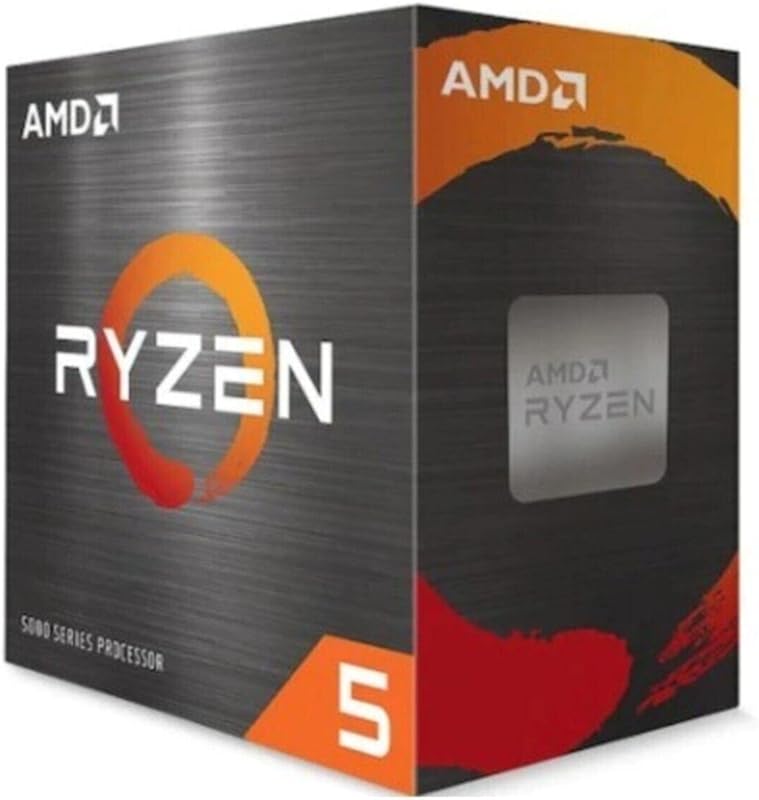
The decisive difference between the Nvidia RTX 4060 and the Nvidia RTX 4070 Ti lies in memory throughput and hardware scale: the RTX 4060 combines an 8GB memory buffer across a 128-bit bus inside a compact dual-fan chassis built for 1080p gaming, while the RTX 4070 Ti deploys a 12GB GDDR6X configuration across a 192-bit bus to deliver high-refresh rendering at 1440p and higher workloads.
Builders assembling a space-saving desktop for high-refresh 1080p play should choose the RTX 4060. Creative professionals and enthusiast gamers who need substantial memory bandwidth and higher clock frequencies for intense resolutions should choose the RTX 4070 Ti.


Nvidia RTX 4060 vs RTX 4070 Ti at a Glance
| Feature | Nvidia RTX 4060 | Nvidia RTX 4070 Ti |
|---|---|---|
| Graphics Coprocessor | GeForce RTX 4060 | GeForce RTX 4070 Ti |
| Video Memory | 8 GB GDDR6 | 12 GB GDDR6X |
| Memory Interface Width | 128-bit | 192-bit |
| Clock Speed | 2505 MHz | 2745 MHz |
| Card Dimensions | 7.83 inches L x 4.72 inches W | 12.09 inches L x 2.01 inches W |
| Cooling Fan Setup | Dual Fan (TORX Fan 4.0) | Dual Fan (Gaming X Slim) |
| Interface Bus | PCI-Express x16 (Gen 4) | PCI-Express x16 |
| Display Outputs | 3x DisplayPort 1.4a, 1x HDMI 2.1a | 3x DisplayPort 1.4a, 1x HDMI 2.1a |
| Listed Maximum Resolution | 7680 x 4320 | 4K |
| Best For | Compact 1080p gaming systems | High-refresh 1440p and heavy rendering |
Memory Configuration and Bus Width
The memory architecture of a graphics card dictates how quickly it transfers texture packs, geometry, and rendering assets into the GPU core. When evaluating the RTX 4060 vs RTX 4070 Ti VRAM setup, the physical configuration shows a significant structural divide. The RTX 4060 features an 8GB GDDR6 buffer operating across a compact 128-bit memory interface. This configuration is tuned specifically for 1080p gaming, where asset pipelines fit cleanly within an 8GB ceiling without requiring massive concurrent data streams. However, modern titles utilizing heavy ray tracing, uncompressed high-resolution textures, and extensive compute pipelines can push an 8GB buffer to its limit if pushed into higher resolutions.
By contrast, the RTX 4070 Ti steps up to a 12GB pool of premium GDDR6X memory running on a wider 192-bit bus. The integration of GDDR6X technology combined with an expanded bus width allows significantly larger data packages to flow into the processing engine simultaneously. Evaluating the RTX 4060 vs RTX 4070 Ti memory bus reveals why this matters in practice: as resolutions rise from standard 1080p to demanding 1440p or multi-sample anti-aliasing environments, the extra 4GB of capacity and expanded bus width prevent the stuttering associated with asset swapping over the PCI-Express lane. Shoppers comparing middle-tier options like the nvidia rtx 4060 ti vs 4070 encounter similar scaling trends, where memory width dictates longevity.
In creative suites, 3D modeling environments, and video rendering timelines, that 12GB GDDR6X pool grants breathing room that an 8GB card cannot provide. High-resolution video editing and complex CAD scenes require assets to reside directly on the card to prevent bottlenecks. The RTX 4060 handles mainstream digital media workflows well, but its 128-bit memory bus prioritizes efficiency over raw throughput. Users determining whether to deploy an RTX 4060 or RTX 4070 Ti for 1440p displays will find that the 12GB GDDR6X memory layout of the 4070 Ti provides the necessary headroom for sustained performance without texture compression compromises.
Edge: Nvidia RTX 4070 Ti due to its larger 12GB capacity, faster GDDR6X standard, and wider 192-bit memory bus.
Clock Speeds and Processing Capabilities
Beyond raw memory capacity, internal frequency and architectural architecture define how rapidly a GPU rasterizes frames and processes real-time effects. Both of these cards utilize NVIDIA’s Ada Lovelace architecture, giving them native access to fourth-generation Tensor cores, third-generation RT cores, and optical flow accelerators required for DLSS 3 frame generation. However, their factory clock speeds and internal processing tiers reflect completely different performance classes within the Ada generation.
The MSI GeForce RTX 4060 Ventus 2X Black OC comes tuned with a boost clock speed of 2505 MHz. This clock speed ensures stable, responsive frame generation in fast-paced titles, allowing the card to handle modern shader routines smoothly. In an everyday RTX 4060 review context, this engine delivers fluid performance in contemporary releases when paired with DLSS 3 artificial intelligence reconstruction, balancing compute speed against thermal generation. Its clock rate remains dependable across extended competitive sessions, operating inside an architecture focused on low power draw.
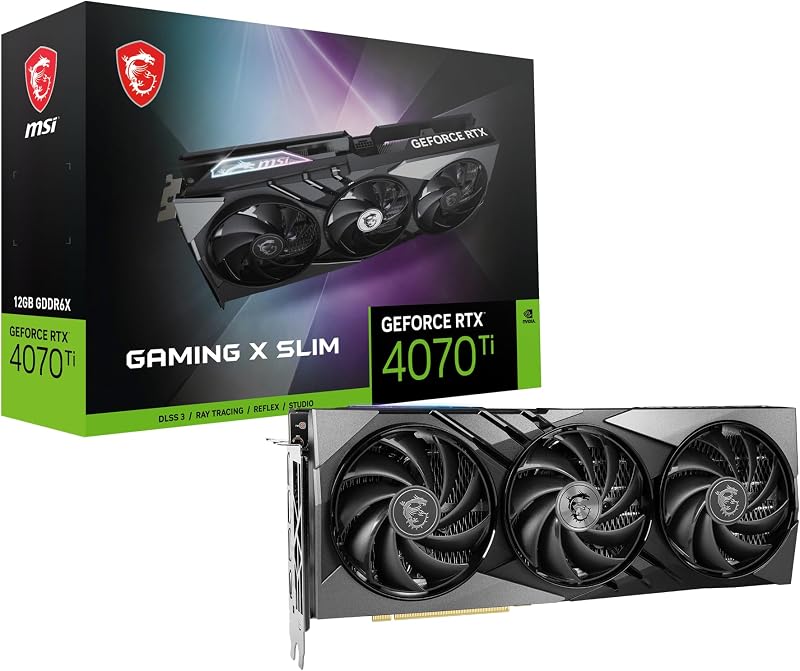
The MSI RTX 4070 Ti Gaming X Slim elevates compute capabilities further, providing an extreme boost clock of 2745 MHz out of the box. That 240 MHz frequency advantage, combined with a vastly larger core processor silicon tier, delivers immediate benefits in dense computational scenarios like path tracing and high-complexity physics simulations. In any RTX 4070 Ti review, this higher operating frequency translates directly to accelerated draw calls and shorter timeline rendering windows. Gamers reviewing nvidia rtx 4060 vs 4070 benchmarks will observe that each step up the Ada product line provides substantial clock speed and compute scaling, making the 4070 Ti an absolute powerhouse in high-stress gaming environments.
Edge: Nvidia RTX 4070 Ti because of its aggressive 2745 MHz boost clock speed and higher-tier Ada Lovelace silicon configuration.
Physical Dimensions and Chassis Compatibility
Raw graphics horsepower means little if the card physically fails to clear a computer case, blocks motherboard headers, or chokes air intake corridors. Physical dimensions represent one of the clearest practical dividing lines between these two graphics cards. System builders working with smaller form factors must inspect case clearance carefully before committing to either unit, as their external profiles serve opposite ends of the PC hardware spectrum.
The MSI RTX 4060 Ventus 2X Black OC features an exceptionally compact footprint, measuring 7.83 inches in length and 4.72 inches in width. At under eight inches long, this card slots comfortably into almost any mini-ITX, micro-ATX, or cramped pre-built OEM chassis. It does not require extended chassis bays, avoids sagging on standard dual-slot PCIe mountings, and leaves ample room for front-mounted intake fans, liquid cooling radiators, and tidy cable routing. For builders rehabilitating an older compact case or seeking an understated low-profile build, the RTX 4060 presents virtually zero installation friction.
Conversely, the MSI RTX 4070 Ti Gaming X Slim is an expansive hardware component. Measuring 12.09 inches in length and 2.01 inches in width, it demands a spacious mid-tower or full-tower chassis to accommodate its foot-long profile. While the Slim designation indicates a more managed thickness of roughly two inches to prevent blocking adjacent expansion slots, the 12.09-inch length can interfere with front-mounted radiator fans, liquid cooling reservoirs, or hard drive cages in small-to-midsize enclosures. Similar spatial questions arise when evaluating the nvidia rtx 4060 ti vs 4070 ti, highlighting that the 4070 Ti class of cards requires measured physical planning.
Edge: Nvidia RTX 4060 for its versatile 7.83-inch length that fits easily into standard, micro, and mini desktop cases.
Thermal Engineering and Cooling Hardware
Operating stability, component longevity, and acoustic output depend on the thermal architecture integrated into the graphics card. Both models feature dual-fan designs engineered by MSI, but they deploy distinct thermal technologies tailored to their respective power footprints and chassis formats.
The RTX 4060 Ventus 2X Black OC is equipped with MSI’s TORX Fan 4.0 technology, in which fan blades work in pairs to generate focused, high-pressure airflow directly into the heatsink fin array below. To maintain silence during casual use, the card incorporates Zero Frozr technology, completely halting the cooling fans when thermal thresholds remain low during web browsing, document editing, or light media consumption. Furthermore, the Ventus 2X includes a reinforcing backplate engineered with a flow-through ventilation design, allowing exhaust air to pass directly through the assembly to improve overall case convection.
The RTX 4070 Ti Gaming X Slim adapts thermal dissipation to manage the higher heat output produced by an elevated 2745 MHz clock rate and 12GB of GDDR6X VRAM. Although the specifications list a dual-fan deployment, its 12.09-inch length houses an elongated heatsink array designed to disperse heat across an extended surface area. The slim exterior allows airflow around neighboring expansion slots, ensuring that warm air does not stagnate beneath the card. Buyers researching mid-tier thermal designs like the nvidia rtx 4060 ti vs 4070 super will note that keeping higher-power silicon cool requires these larger fin stacks. The Ventus 2X cooling design on the 4060 remains a marvel of compact thermal tuning, but the sheer thermal dissipation surface area of the 4070 Ti manages sustained heavy workloads without thermal throttling.
Edge: Tie. The RTX 4060 excels in compact cooling efficiency with Zero Frozr and TORX Fan 4.0, while the RTX 4070 Ti effectively manages high thermal loads via its extended heatsink footprint.
Display Output and Resolution Ceilings
Connecting modern displays requires high-bandwidth video interfaces that support high refresh rates, multi-monitor productivity setups, and advanced color formats like HDR. When analyzing how these cards handle display configurations, their connectivity panels and maximum supported resolution specifications reveal different strengths for commercial, creative, and gaming environments.
Both graphics cards offer identical physical port layouts: three DisplayPort 1.4a connections alongside one HDMI 2.1a port. This standard interface array allows either card to run up to four simultaneous monitors, making both options highly capable for multi-display trading desks, flight simulator cockpits, or professional workstations. The HDMI 2.1a port provides high bandwidth capable of driving modern 4K gaming televisions at high refresh rates with variable refresh rate (VRR) support enabled.
A notable distinction appears in the maximum display resolution listed on each card’s technical sheet. The RTX 4060 documentation lists an absolute maximum display resolution of 7680 x 4320 (8K HDR support), highlighting its ability to drive ultra-high-definition industrial or professional displays over appropriate display cabling. The RTX 4070 Ti listing specifies a maximum display resolution of 4K. When deciding between the RTX 4060 or RTX 4070 Ti for gaming, physical frame rates at these high resolutions favor the 4070 Ti because of its 192-bit bus and 12GB GDDR6X frame buffer. For users comparing modern setups across the board, such as the nvidia rtx 4060 vs 4070 super, balancing display resolution limits against underlying compute power is critical. The RTX 4060 listing provides high display ceiling support, but the RTX 4070 Ti delivers the rendering engine required to make those high resolutions playable.
Edge: Nvidia RTX 4070 Ti because its 192-bit GDDR6X configuration delivers the actual horsepower required to render demanding 3D games and applications at 1440p and 4K resolutions.
Pros and Cons
Nvidia RTX 4060

Pros
- Compact 7.83-inch dual-fan design
- Zero Frozr silent fan-stop technology
- TORX Fan 4.0 focused airflow
- Supports up to 8K resolution output
Cons
- Narrow 128-bit memory bus
- 8GB VRAM limits 1440p headroom
View Nvidia RTX 4060 on Amazon
Nvidia RTX 4070 Ti
Pros
- 12GB high-speed GDDR6X memory
- Wider 192-bit memory interface
- High 2745 MHz boost clock speed
- Ideal for high-refresh 1440p gaming
Cons
- Long 12.09-inch card length
- Chassis clearance requires careful planning
View Nvidia RTX 4070 Ti on Amazon
Who Should Buy Each One
Choose the Nvidia RTX 4060 If
- You are assembling or upgrading a compact mini-ITX or micro-ATX desktop PC where card clearance is strictly limited to under 8 inches.
- Your gaming focus is primarily 1080p resolution, where an 8GB GDDR6 memory buffer and 128-bit bus deliver smooth, efficient frame rates.
- You want a quiet computing environment during desktop productivity, benefiting from the Zero Frozr fan-stop system.
- You require focused cooling air pressure inside a small enclosure via TORX Fan 4.0 hardware and a flow-through backplate.
Choose the Nvidia RTX 4070 Ti If
- You game primarily at 1440p or 4K and require a 12GB GDDR6X buffer to run modern graphic settings without asset stutter.
- You need the expanded bandwidth of a 192-bit memory interface for heavy video rendering, 3D animation, or compute-heavy creative tasks.
- Your system chassis has over 12.1 inches of horizontal clearance to easily accommodate a full-length performance card.
- You demand aggressive clock speeds out of the box, utilizing an extreme boost frequency of 2745 MHz for maximum frame generation.
Final Verdict
For gamers and creators demanding exceptional performance at 1440p and entry-level 4K, the Nvidia RTX 4070 Ti is the superior hardware pick. With 12GB of high-speed GDDR6X video memory, a wider 192-bit interface, and a rapid 2745 MHz boost clock, this card provides the computational horsepower and memory throughput required to run modern titles with ray tracing and advanced graphics settings fully engaged. While its 12.09-inch length requires a standard-to-large desktop case, the investment in spatial clearance pays off in robust computing capabilities and extended hardware relevance.
On the other hand, the Nvidia RTX 4060 stands out as the ultimate space-saving, low-friction upgrade for mainstream 1080p gaming systems. At only 7.83 inches long, it drops cleanly into almost any small form factor case while providing the architectural benefits of DLSS 3, TORX Fan 4.0 cooling, and silent Zero Frozr acoustic control. If you play on a standard 1080p monitor and need a card that runs cool inside tight physical confines without requiring chassis modifications, the RTX 4060 remains the smart, practical selection.
FAQ
Does the RTX 4060 have enough VRAM for modern gaming?
The RTX 4060 includes 8GB of GDDR6 memory on a 128-bit bus. For standard 1080p gaming, 8GB is sufficient to load textures, geometry, and post-processing filters in most modern titles. However, running games at 1440p or enabling extreme ray tracing features can push memory consumption past 8GB, making the 12GB buffer on the RTX 4070 Ti a safer choice for higher display resolutions.
Can the RTX 4070 Ti fit inside a small form factor PC case?
The MSI RTX 4070 Ti Gaming X Slim measures 12.09 inches in length and 2.01 inches in width. While it features a slimmed-down dual-slot profile compared to thicker cards, its 12-inch length will not fit inside most small form factor (SFF) or mini-ITX cases. Users must measure their chassis clearance from rear expansion slots to front fans before purchasing.
Which card is better for 1440p gaming?
The RTX 4070 Ti is significantly better suited for 1440p gaming. Its 12GB of GDDR6X memory and 192-bit memory interface deliver the bandwidth necessary to prevent frame drops and texture pop-in at 2560 x 1440, whereas the RTX 4060 is primarily optimized around a 1080p performance profile.
What display connections are available on both graphics cards?
Both the RTX 4060 Ventus 2X and RTX 4070 Ti Gaming X Slim feature three DisplayPort 1.4a outputs and one HDMI 2.1a port. Both cards can drive up to four concurrent displays, supporting multi-monitor productivity setups and modern high-refresh gaming displays with variable refresh rate capabilities.
How does memory bus width affect gaming performance between these two cards?
Memory bus width determines the amount of data that can travel between the graphics memory and the GPU processor each clock cycle. The RTX 4060 uses a 128-bit interface, while the RTX 4070 Ti features a wider 192-bit interface. The wider bus, paired with faster GDDR6X memory on the 4070 Ti, allows significantly higher data transfer rates, which prevents processing bottlenecks in graphics-intensive scenes.
Do both cards support DLSS 3 frame generation?
Yes, both the RTX 4060 and the RTX 4070 Ti are built on NVIDIA’s Ada Lovelace architecture. Both models contain fourth-generation Tensor cores and optical flow accelerators, giving them full native support for DLSS 3 frame generation and AI-accelerated performance rendering.