Choosing between the Nvidia RTX 4070 and the Nvidia RTX 4070 Ti Super hinges primarily on video memory capacity, memory bus bandwidth, and your target display resolution. While both graphics processing units share the advanced Ada Lovelace architecture, the RTX 4070 features 12GB of GDDR6X memory on a 192-bit bus optimized for high-refresh 1440p gaming, whereas the RTX 4070 Ti Super steps up to 16GB of GDDR6X on a wider 256-bit bus with higher clock speeds tailored for heavy 4K rendering.
Gamers wanting high-frame-rate performance at 1440p with lower overall system power requirements should select the RTX 4070. Enthusiasts seeking uncompromising 4K display output, maximum ray tracing settings, and higher VRAM headroom for intensive tasks should invest in the RTX 4070 Ti Super.


Nvidia RTX 4070 vs Nvidia RTX 4070 Ti Super at a Glance
| Feature | Nvidia RTX 4070 | Nvidia RTX 4070 Ti Super |
|---|---|---|
| GPU Series & Architecture | NVIDIA RTX 40 Series (Ada Lovelace) | NVIDIA RTX 40 Series (Ada Lovelace) |
| Video Memory (VRAM) | 12GB GDDR6X | 16GB GDDR6X |
| Memory Bus Width | 192-bit | 256-bit |
| Memory Clock Speed | 21000 MHz | 21000 MHz |
| Boost Clock Frequency | 2490 MHz | 2625 MHz |
| Display Outputs | 3 x DisplayPort 1.4a, 1 x HDMI 2.1a | 3 x DisplayPort 1.4, 1 x HDMI 2.1a |
| Cooling Hardware | Windforce (3x 80mm Fans, Graphene Nano Lubricant) | Windforce (3 Fans, Metal Backplate) |
| Card Dimensions | 10.28″L x 4.96″W | 10.28″L x 4.96″W |
| Recommended Power Supply | 650W | Not listed |
| Best For | High-Frame 1440p Gaming | High-Refresh 4K Gaming & Heavy Workloads |
Memory Bandwidth and VRAM Capacity
The core architectural divide between these cards is the RTX 4070 vs 4070 Ti Super VRAM difference. Video random-access memory serves as the high-speed cache holding frame buffers, geometry data, high-resolution texture maps, and ray tracing acceleration structures. When a game demands more memory than the card physically possesses, the system must page assets across system memory, leading to frame drops, micro-stutters, and degraded visual fidelity. The width of the memory bus directly governs how much raw data can pass between the memory modules and the graphics processor on every clock cycle.
On paper, the RTX 4070 comes equipped with 12GB of GDDR6X memory running on a 192-bit interface at a memory clock speed of 21000 MHz. By contrast, the RTX 4070 Ti Super expands the frame buffer to 16GB of GDDR6X memory and broadens the memory interface to a 256-bit bus, while maintaining the same 21000 MHz memory clock. That 33% increase in bus width allows significantly more data throughput per second. Buyers evaluating current lineups often compare intermediate models like the nvidia rtx 4070 super vs 4070 ti super to see where the 256-bit interface enters the product stack.
In practice, the additional 4GB of VRAM and the wider memory bus on the RTX 4070 Ti Super provide crucial headroom when running modern titles with complex texture packs or ray reconstruction enabled. The RTX 4070 handles current 1440p assets with ease, but the RTX 4070 Ti Super ensures that heavier memory loads do not encounter bandwidth bottlenecks during intensive multi-pass rendering cycles.
Edge: Nvidia RTX 4070 Ti Super offers an expanded 16GB GDDR6X pool on a wider 256-bit bus for superior throughput under heavy visual loads.
Target Resolution: 1440p vs 4K Gaming Performance
Choosing between the RTX 4070 or 4070 Ti Super for 1440p versus using the RTX 4070 or 4070 Ti Super for 4K gaming defines how these GPUs are meant to be deployed. Rendering games at 2560×1440 requires processing approximately 3.7 million pixels per frame, which matches the computing balance and memory pipeline of the RTX 4070. Stepping up to 3840×2160 quadruples the pixel count of standard high definition to over 8.2 million pixels, creating a massive computing overhead that demands sustained memory bandwidth and higher clock throughput.
When reviewing any RTX 4070 vs 4070 Ti Super benchmark comparison across various modern titles, the performance gap between these two models widens as screen resolution increases. At 1440p, the RTX 4070 operates comfortably in its sweet spot, delivering fluid frame rates across contemporary titles. However, when pushed to native 4K or ultra-wide resolutions, the RTX 4070 must work against its narrower 192-bit memory pipeline. The RTX 4070 Ti Super utilizes its 2625 MHz boost core clock and 256-bit bus to keep frame timing stable at 4K, making it far better suited for native ultra-high-definition displays. Gamers comparing earlier configurations in this tier can examine the nvidia rtx 4070 ti vs 4070 ti super to understand how the memory upgrade reshaped 4K capabilities.
Both graphics cards support maximum digital resolutions up to 7680×4320 across four simultaneous displays, but having the ability to send an 8K signal does not mean both render high-end gaming visuals equally well. For gamers wanting sustained high-refresh performance at 4K without sacrificing visual settings, the expanded hardware profile of the RTX 4070 Ti Super delivers the required processing headroom.
Edge: Nvidia RTX 4070 Ti Super dominates higher display resolutions thanks to its wider memory bus and superior pixel fill capabilities.
Boost Clock Speeds and Architectural Execution
Under the hood, both cards are based on Nvidia’s Ada Lovelace architecture, bringing architectural features such as DLSS 3 frame generation, dedicated hardware ray tracing cores, and advanced tensor execution units. However, examining the RTX 4070 vs 4070 Ti Super specs reveals clear differences in out-of-the-box clock speeds and hardware capabilities that influence raw frame processing.
The Gigabyte Windforce OC edition of the RTX 4070 features a factory boost clock speed of 2490 MHz. In comparison, the Windforce OC edition of the RTX 4070 Ti Super raises the boost clock speed to 2625 MHz, representing an increase of 135 MHz in core execution frequency straight out of the box. Furthermore, the RTX 4070 Ti Super listing specifically highlights 4th Generation Tensor Cores capable of up to 4X performance with DLSS 3 compared to brute-force rendering, along with 3rd Generation RT Cores providing up to 2X ray tracing performance. The listing also notes support for DLSS 3.5, which includes advanced ray reconstruction features.
While an individual Nvidia RTX 4070 review often highlights its exceptional efficiency and balanced Ada Lovelace implementation, an in-depth RTX 4070 Ti Super review demonstrates that higher factory clock frequencies and updated tensor features give the Ti Super an edge in compute-heavy production tasks. Readers debating whether to step up even further in this performance bracket can explore our nvidia rtx 4070 ti super vs 4080 breakdown. For buyers questioning is the RTX 4070 Ti Super worth it, the faster clock frequencies translate directly into reduced frame times across high-load gaming environments.
Edge: Nvidia RTX 4070 Ti Super delivers higher boost clock speeds and accelerated processing capabilities for ray tracing and artificial intelligence tasks.
Cooling Systems and Physical Build Quality
Thermal management is essential for modern graphics cards to sustain their peak boost clocks without throttling performance or generating distracting fan noise. Both cards in this comparison are Gigabyte Windforce OC models utilizing triple-fan open-air cooling systems, yet the listed cooling features exhibit subtle differences in their design documentation.
The RTX 4070 Windforce OC listing details a highly specified thermal assembly. It features three 80mm unique blade fans with alternate spinning mechanisms to reduce turbulence, active 3D fans that remain off during low-load conditions, and screen cooling where the heatsink extends beyond the printed circuit board for improved airflow. Additionally, the RTX 4070 incorporates Graphene Nano lubricant on its sleeve bearing fans, which extends fan lifespan and operates quieter than traditional ball bearings, alongside three composite copper heat pipes making direct contact with the GPU die. Its listed product weight is 930 grams.
For the RTX 4070 Ti Super Windforce OC, the listing highlights a triple-fan Windforce cooling system and emphasizes a rigid protective metal backplate that reinforces the physical structure of the card. However, specific details regarding fan diameter, bearing lubricant type, composite heat pipe counts, and overall weight are not specified in the listing data. Both graphics cards share identical physical exterior dimensions, measuring 10.28 inches long and 4.96 inches wide, ensuring they fit within standard desktop computer chassis without demanding ultra-wide clearance. Those exploring cooling implementations across other tiers can read our comparison of the nvidia rtx 4070 super vs 4070 ti.
Edge: Tie because both graphics cards use triple-fan Windforce cooling designs within identical physical case dimensions.
Power Requirements and System Compatibility
System compatibility extends beyond the physical space inside a PC case to include power delivery and motherboard connectivity. When integrating a new graphics card, builders must verify that their power supply unit has sufficient wattage capacity and that the motherboard supports the appropriate interface standards.
The RTX 4070 listing explicitly lists a recommended power supply of 650W, highlighting the card’s approachable power requirements for mainstream gaming builds. This allows users upgrading from older hardware generations to install the card into existing systems without needing to replace an adequate mid-tier power unit. In contrast, the RTX 4070 Ti Super product listing does not specify a recommended power supply wattage, meaning builders must research general platform guidelines separately before finalizing their build.
Regarding bus interfaces, the RTX 4070 Ti Super listing specifies a full PCI-Express x16 connection, whereas the RTX 4070 listing notes PCI-Express x4 within its technical specification table while referencing PCIe 4.0 in its title description. Both cards offer identical display output configurations consisting of three DisplayPort connections (DP 1.4a on the RTX 4070 and DP 1.4 on the Ti Super) and one HDMI 2.1a port. Both support HDCP 2.3 and can drive up to four displays simultaneously. For builders considering higher-wattage configurations, our guide on the nvidia rtx 4070 ti vs 4080 super outlines platform power scaling across the upper end of the Ada Lovelace lineup.
Edge: Nvidia RTX 4070 provides clear and accessible power requirements with a verified 650W power supply recommendation.
Pros and Cons
Nvidia RTX 4070

Pros
- 12GB GDDR6X memory for 1440p gaming
- Quiet Graphene Nano bearing fan lubrication
- Direct-touch composite copper heat pipes
- Verified 650W recommended power supply
Cons
- Narrower 192-bit memory bus width
- Lower 2490 MHz boost clock frequency
- Less VRAM headroom for native 4K
View Nvidia RTX 4070 on Amazon
Nvidia RTX 4070 Ti Super
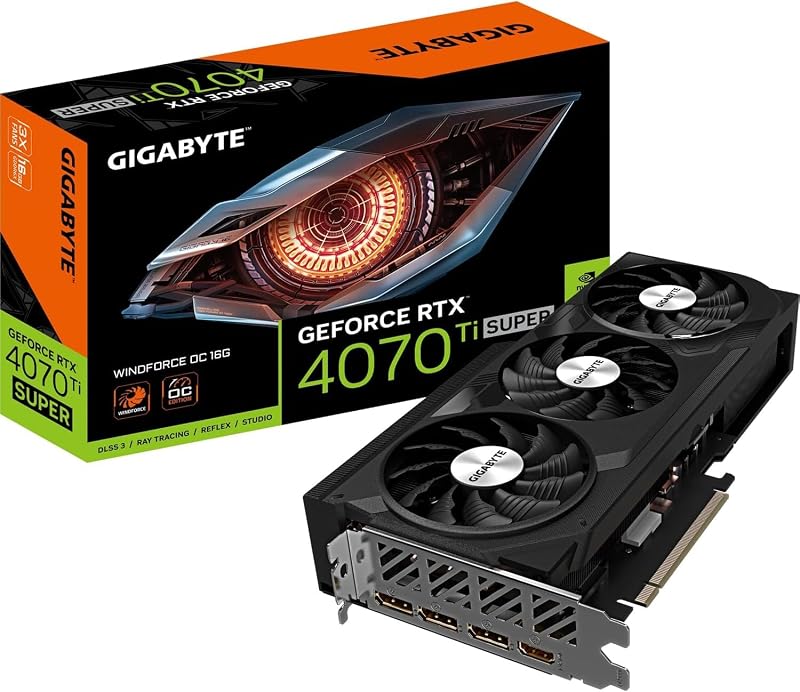
Pros
- 16GB GDDR6X high-capacity frame buffer
- Wider 256-bit memory bus width
- Faster 2625 MHz factory boost clock
- Rigid protective metal backplate
Cons
- Power supply requirement not listed
- Excessive bandwidth for standard 1080p setups
View Nvidia RTX 4070 Ti Super on Amazon
Who Should Buy Each One
Choose the Nvidia RTX 4070 If
- You primarily game at 1440p resolution where 12GB of GDDR6X VRAM easily covers modern visual assets.
- Your existing desktop PC utilizes a 650W power supply and you want to avoid purchasing a higher-capacity power unit.
- You want quiet, durable cooling supported by Graphene Nano sleeve bearing lubricant and direct-touch copper heat pipes.
- You want high-efficiency graphics power for modern titles without needing a full 256-bit memory bus interface.
Choose the Nvidia RTX 4070 Ti Super If
- You play on a native 4K display or use multi-monitor arrangements requiring greater memory bandwidth.
- You run graphically demanding games with high-resolution texture packs and comprehensive ray tracing effects.
- You want a higher factory boost clock speed reaching 2625 MHz out of the box for maximum processing throughput.
- You utilize creative, rendering, or artificial intelligence applications that benefit from 16GB of VRAM and a 256-bit bus.
Final Verdict
For the majority of PC gamers playing on standard 1440p monitors, the RTX 4070 remains the more sensible choice. Its 12GB GDDR6X frame buffer and 2490 MHz boost clock provide more than enough horsepower to drive modern titles smoothly, while its 650W power supply requirement ensures broad compatibility with existing desktop power units. The inclusion of specialized Graphene Nano fan bearings, direct-touch composite copper heat pipes, and a compact 10.28-inch length make it an exceptionally well-rounded option for standard gaming rigs.
However, when the target shifts to 4K gaming or heavy creative workloads, the RTX 4070 Ti Super decisively takes the lead. Its expanded 16GB VRAM capacity, wider 256-bit memory interface, and faster 2625 MHz boost clock provide the memory throughput and compute stability needed to prevent bottlenecks at higher resolutions. If you demand uncompromised performance at 4K with ray tracing enabled, the RTX 4070 Ti Super is the card to buy.
FAQ
What is the main RTX 4070 vs 4070 Ti Super VRAM difference?
The RTX 4070 features 12GB of GDDR6X memory running across a 192-bit bus width. The RTX 4070 Ti Super increases both capacity and throughput by offering 16GB of GDDR6X memory on a wider 256-bit bus width, providing significantly higher overall memory bandwidth for high-resolution assets.
Should I get the RTX 4070 or 4070 Ti Super for 1440p gaming?
For 1440p gaming, the RTX 4070 is exceptionally capable. Its 12GB VRAM capacity handles high-refresh 1440p gaming with ease. You only need the RTX 4070 Ti Super at 1440p if you plan to enable heavy ray tracing in every modern title or want to prepare for future transitions to 4K displays.
Can the Nvidia RTX 4070 run games smoothly at 4K resolution?
The RTX 4070 supports 4K and 8K display output resolutions up to 7680×4320 pixels. However, its 12GB VRAM pool and 192-bit bus width mean that running demanding modern games at native 4K with ultra settings may require lowering graphics settings or relying heavily on DLSS upscaling to maintain smooth frame rates.
Is the RTX 4070 Ti Super worth it for gamers upgrading from older graphics cards?
The RTX 4070 Ti Super is worth it for gamers who own high-refresh 4K monitors, utilize heavy texture packs, or run creative software requiring large memory buffers. Its 16GB VRAM on a 256-bit bus provides lasting performance headroom that 12GB cards cannot match at high resolutions.
What power supply wattage is recommended for these graphics cards?
The RTX 4070 listing specifies a recommended power supply of 650W. The RTX 4070 Ti Super listing does not specify a recommended power supply wattage, so builders should consult general system power calculators based on their complete hardware configuration.
Do both graphics cards fit in standard desktop PC cases?
Yes, both Gigabyte Windforce OC graphics cards share identical external measurements of 10.28 inches in length and 4.96 inches in width. These moderate dimensions allow both cards to install comfortably in standard mid-tower desktop cases without requiring specialized high-clearance enclosures.


