The single deciding factor between these two rugged drives comes down to peak transfer velocity versus sustained thermal endurance. The SanDisk Extreme Portable SSD delivers double the maximum theoretical read rate at up to 2000 MB/s for ultra-fast media ingest, while the Samsung T7 Shield caps its throughput at 1,050 MB/s but integrates a heavy-duty outer elastomer shell with Dynamic Thermal Guard to sustain write operations without heat-induced throttling.
Choose the SanDisk Extreme Portable SSD if your primary objective is clearing high-resolution photography cards and transferring large creative project files in the shortest possible window. Choose the Samsung T7 Shield if you plan to capture direct high-bitrate video in the field or require proven thermal stability across challenging outdoor environments.
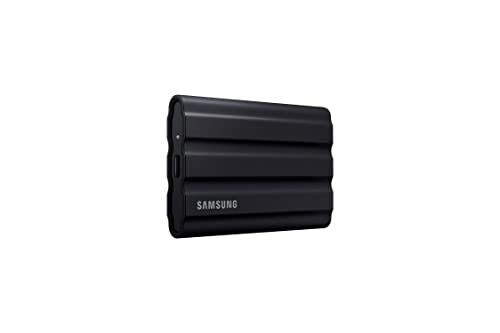

Samsung T7 Shield vs SanDisk Extreme Portable SSD at a Glance
| Feature | Samsung T7 Shield | SanDisk Extreme Portable SSD |
|---|---|---|
| Maximum Read Speed | Up to 1,050 MB/s | Up to 2000 MB/s |
| Maximum Write Speed | Up to 1,000 MB/s | Listing does not specify (write speed lower than read) |
| Host Interface | USB 3.2 Gen 2 (PCIe NVMe) | USB 3.0 / USB Type-C |
| Ingress Protection Rating | IP65 (tested at 100 kPa water flow, 8-hour dust) | IP65 (tested at 30 kPa water flow, limited dust) |
| Drop Resistance | Up to 9.8 feet (3 meters) | Up to 3 meters (9.8 feet) |
| Thermal Control | Dynamic Thermal Guard | Listing does not specify |
| Hardware Encryption | Yes (password protection via Samsung Magician) | 256-bit AES encryption (password protection) |
| Direct Mobile Video Capture | Supports iPhone 15/16 ProRes 4K at 60fps | Listing does not specify direct ProRes recording |
| Dimensions and Weight | 2.5-inch form factor (weight not listed) | 3.35″ x 2″ x 0.39″, 1.6 ounces |
| Best For | Outdoor filming and sustained direct-to-drive recording | Rapid photo offloads and ultra-lightweight travel |
Peak Transfer Speeds and Real-World Offload Performance
When measuring pure bandwidth, the SanDisk Extreme Portable SSD transfer speed creates an undeniable baseline advantage for fast-paced digital workflows. SanDisk equips this drive with throughput capabilities reaching up to 2000 MB/s, allowing content creators to move 1,000 high-resolution photos in under 60 seconds. For photographers ingesting hundreds of gigabytes of raw image files at the end of an event, cutting offload duration in half changes the pace of post-production. It allows creative assets to transition into editing scratch disks or cloud mirrors almost instantaneously, provided the host machine features a matching high-speed interface.
The Samsung T7 Shield operates across a USB 3.2 Gen 2 interface with PCIe NVMe architecture, achieving maximum sequential read speeds of 1,050 MB/s and sequential write speeds of up to 1,000 MB/s. While these metrics make the unit almost twice as fast as older external drives like the T5, they place it strictly in the standard Gen 2 throughput category. In our standard samsung t7 vs sandisk extreme portable ssd baseline evaluation, the 10 Gbps interface ceiling of the T7 Shield caps raw throughput at roughly one gigabyte per second regardless of host workstation capabilities.
In a direct Samsung T7 Shield vs SanDisk Extreme speed showdown, the SanDisk model establishes a clear lead for short-burst file transfers and studio-to-laptop transfers. The SanDisk listing does indicate that write speeds will measure lower than the 2000 MB/s read ceiling, but the read bandwidth alone accelerates file verification and editing ingest significantly beyond what the Samsung can deliver.
Edge: SanDisk Extreme Portable SSD, offering nearly double the maximum read throughput to cut media offload times down dramatically.
Thermal Management and Sustained Writing Workloads
Peak theoretical speeds tell only half the story when continuous heavy tasks enter the equation. When moving multiple terabytes or writing continuous data streams, solid-state drives generate substantial heat. Unchecked heat generation forces onboard controllers to trigger aggressive thermal throttling, dropping transfer rates down to a fraction of their advertised peaks to protect internal NAND flash modules from permanent thermal degradation.
This is where an in-depth Samsung T7 Shield review reveals its core engineering strength. Samsung equips the T7 Shield with proprietary Dynamic Thermal Guard technology. This firmware and hardware system actively manages drive temperatures under demanding workloads, minimizing performance degradation during extended write sessions. For creators handling direct multi-stream rendering or transferring immense video project archives, the T7 Shield maintains steady sequential performance over long periods rather than suffering the steep speed drops common in unshielded compact drives, a distinction also explored in our samsung t7 shield vs sandisk extreme pro portable technical comparison.
The SanDisk Extreme Portable SSD technical specifications do not mention a dedicated active thermal throttling manager or advanced heat-dissipation layer within its ultra-compact 0.39-inch shell. While the drive achieves stunning read speeds for rapid transfers, high-capacity sustained write operations in warm production environments may push its compact housing past optimal thermal thresholds. For sustained linear writing, internal temperature control outweighs brief peak throughput bursts.
Edge: Samsung T7 Shield, thanks to its specialized Dynamic Thermal Guard architecture that stabilizes sustained performance.
Environmental Protection and Rugged Enclosure Durability
Field production demands equipment that survives accidental drops, dust storms, and sudden rainfall. Both manufacturers market these drives as durable travel companions, backed by formal IP65 ingress ratings and certified drop protection, but the physical implementations and lab test parameters show meaningful differences.
A closer inspection of the Samsung T7 Shield vs SanDisk Extreme durability figures highlights Samsung’s meticulous environmental testing. The T7 Shield features a rugged outer elastomer enclosure designed to absorb severe impacts, verified to survive drops from up to 9.8 feet (3 meters). Furthermore, Samsung specifies that its IP65 rating was tested under demanding conditions: resisting an active water stream at 100 kPa of pressure for 3 minutes, alongside an 8-hour dust chamber test enduring 2kg/m³ of active dust at 2 kPa pressure. This rubberized coating cushions the drive against drops onto hard concrete, rock, or metal grating.
The SanDisk Extreme Portable SSD also carries an IP65 rating and provides drop protection up to 3 meters. However, its official specifications outline testing against water flow at 30 kPa for 3 minutes, with notes specifying limited dust contact. Similar build considerations emerge when comparing the sandisk extreme portable ssd vs crucial x9 pro, where enclosure material choices dictate long-term survivability. The SanDisk housing features a sleek plastic shell with a loop cutout, making it pocket-friendly, but the Samsung elastomer exterior offers noticeably superior shock dampening against abrasive surfaces.
Edge: Samsung T7 Shield, backed by higher water-pressure certification and a dense elastomer rubber bumper that absorbs heavy impact shock.
Direct Video Capture and Mobile Production Workflows
Modern mobile videographers increasingly rely on external SSDs as primary recording media rather than intermediate backup drives. Recent camera setups and modern smartphones can push raw video formats straight to USB-C storage, demanding continuous write verification and strict hardware compatibility.
The Samsung T7 Shield listing explicitly notes validated support for direct recording from the iPhone 15 Pro and iPhone 16 series, specifically handling high-bandwidth ProRes 4K video at 60 frames per second using the included USB-C cable. Because ProRes 4K60 footage demands relentless, uninterrupted data writes without dropped frames, Samsung’s in-house NAND and DRAM manufacturing guarantees predictable throughput that keeps pace with cinema-grade mobile recording codecs. This reliability makes the drive a staple for videographers who rig external drives directly to camera cages.
The SanDisk Extreme Portable SSD documentation lists compatibility across desktops, laptops, smartphones, and tablets, noting its speed to download AI content and high-resolution media clips. However, the listing does not explicitly certify ProRes 4K 60fps recording support or continuous write guarantees for direct capture. While the drive can easily store and edit footage after capture, shooters needing verified real-time recording hardware will appreciate Samsung’s direct certification, an asset discussed further in our samsung t9 vs sandisk extreme portable ssd workflow overview.
Edge: Samsung T7 Shield, offering certified, out-of-the-box support for uninterrupted iPhone ProRes 4K 60fps video capture.
Form Factor, Drive Management, and Security Tools
Physical footprint and software utilities define the day-to-day user experience. When packing a gear bag for field assignments, weight, physical dimensions, and management utilities play a decisive role in workflow efficiency.
The SanDisk Extreme Portable SSD excels in sheer compactness. Measuring 3.35 inches long, 2.0 inches wide, and an ultra-slim 0.39 inches thick while weighing a featherlight 1.6 ounces, it disappears into a shirt pocket, kit pouch, or camera bag divider. It features built-in 256-bit AES hardware encryption with password protection accessible via downloadable software on Windows 10+ and macOS v12+. For multimedia producers prioritizing minimal pack weight and discreet data transport, the SanDisk drive is almost weightless.
The Samsung T7 Shield adopts a slightly broader 2.5-inch external form factor wrapped in its thick elastomer protective shell. While palm-sized and highly portable, it lacks the ultra-thin, featherweight profile of the SanDisk unit. On the software front, Samsung provides the comprehensive Samsung Magician software suite. This platform allows users to run drive health diagnostics, monitor internal temperatures, protect data with hardware encryption, update device firmware, and manage operational status indicators. As demonstrated across evaluations like the samsung t9 vs sandisk extreme pro portable, dedicated drive maintenance software provides significant peace of mind for mission-critical storage.
Edge: SanDisk Extreme Portable SSD, thanks to its tiny 1.6-ounce footprint and ultra-slim profile for effortless everyday carry.
Pros and Cons
Samsung T7 Shield

Pros
- Dynamic Thermal Guard heat control
- Supports iPhone ProRes 4K 60fps recording
- Tested against 100 kPa water flow
- Rugged outer elastomer drop bumper
- Samsung Magician drive health tools
Cons
- Lower peak read speed at 1,050 MB/s
- Bulkier elastomer casing than SanDisk
View Samsung T7 Shield on Amazon
SanDisk Extreme Portable SSD

Pros
- Up to 2000 MB/s transfer speed
- Weighs only 1.6 ounces
- Ultra-slim 0.39-inch thickness
- Compatible with Sony PlayStation 5
- 256-bit AES hardware encryption
Cons
- Write speed lower than read speed
- Lower water pressure resistance rating
View SanDisk Extreme Portable SSD on Amazon
Who Should Buy Each One
Choose the Samsung T7 Shield If:
- You film video directly to external storage using an iPhone 15 or 16 in ProRes 4K at 60fps.
- You work in wet, dusty, or rugged outdoor locations where a thick elastomer shock bumper prevents drop damage.
- You edit heavy multi-layer video sequences that require active thermal mitigation via Dynamic Thermal Guard.
- You want complete drive diagnostics, health monitoring, and firmware management through Samsung Magician software.
Choose the SanDisk Extreme Portable SSD If:
- You need blisteringly fast read speeds up to 2000 MB/s to offload massive batches of raw photography in record time.
- You demand an ultra-compact drive that weighs only 1.6 ounces and fits easily into any small pocket.
- You need broad cross-device storage for Mac, PC, smartphones, and gaming consoles like the Sony PlayStation 5.
- You want built-in 256-bit AES hardware password encryption without the bulk of an oversized bumper.
Final Verdict
For the majority of content creators, videographers, and field professionals, the Samsung T7 Shield remains the superior overall choice. While it operates at a lower peak read ceiling of 1,050 MB/s, its sustained write reliability, rigorous IP65 environmental testing, impact-absorbing elastomer body, and verified ProRes 4K 60fps capture support make it far more dependable for heavy continuous workloads. The inclusion of Dynamic Thermal Guard ensures that long transfers do not crawl to a halt halfway through an essential ingest.
Conversely, the SanDisk Extreme Portable SSD is the undisputed winner when maximum read throughput and ultra-lightweight portability are the primary criteria. Photographers offloading thousands of raw images, travelers packing light, and users moving large files between modern high-speed systems will save valuable time using SanDisk’s 2000 MB/s transfer capabilities. If your workflow revolves around quick data transfers rather than punishing, long-duration write cycles, the SanDisk drive is well worth your investment.
FAQ
Is the SanDisk Extreme Portable SSD worth it over the Samsung T7 Shield for everyday backups?
Yes, if your host laptop or desktop supports high-speed USB data transfers, the SanDisk drive’s 2000 MB/s maximum read speed allows you to complete routine backups, photo transfers, and file offloads in roughly half the time required by the 1,050 MB/s Samsung T7 Shield.
Can I record ProRes 4K video directly to the Samsung T7 Shield?
Yes. The Samsung T7 Shield listing specifically verifies support for recording iPhone 15 Pro and iPhone 16 ProRes 4K video at 60 frames per second using the included USB-C cable, backed by sustained write speeds up to 1,000 MB/s.
Which drive provides better protection against drops and heavy weather?
While both drives carry an IP65 rating and 3-meter drop resistance, the Samsung T7 Shield provides greater real-world protection. Its heavy elastomer shell absorbs drops onto hard surfaces, and its water resistance was validated against a higher water flow pressure of 100 kPa compared to 30 kPa for the SanDisk.
Does the SanDisk Extreme Portable SSD work with gaming consoles?
Yes, the SanDisk Extreme Portable SSD lists explicit compatibility with gaming consoles including the Sony PlayStation 5, making it an excellent high-speed drive for storing and launching console titles.
Can I use Samsung Magician software with the SanDisk Extreme Portable SSD?
No. Samsung Magician is a proprietary drive management utility designed specifically for Samsung storage products. SanDisk uses its own downloadable companion application for managing 256-bit AES password encryption on Windows and macOS systems.
How do the physical sizes of these two portable drives compare?
The SanDisk Extreme Portable SSD is significantly lighter and thinner, measuring 3.35″ x 2″ x 0.39″ and weighing just 1.6 ounces. The Samsung T7 Shield features a standard 2.5-inch portable drive profile enclosed in a thicker rubber bumper, giving it a sturdier but slightly bulkier presence in hand.


