The single performance metric that separates the Samsung T7 Shield from the SanDisk Extreme Pro Portable is the maximum data interface bus, which dictates whether your workflow is capped at 1,050 MB/s or unlocked up to 2,000 MB/s. While both solid-state drives target creative professionals working in demanding field environments, that doubled ceiling dramatically shifts export times and direct recording flexibility depending on the host hardware you connect.
Choose the Samsung T7 Shield if you demand rock-solid thermal regulation, broad plug-and-play consistency across standard USB ports, and a shock-absorbing rubberized exterior. Choose the SanDisk Extreme Pro Portable if your computer setup features dedicated high-bandwidth USB 3.2 Gen 2×2 connectivity and you regularly move massive high-bitrate media libraries that justify pursuing peak transfer rates.
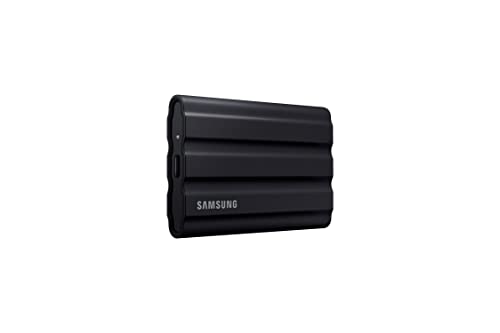
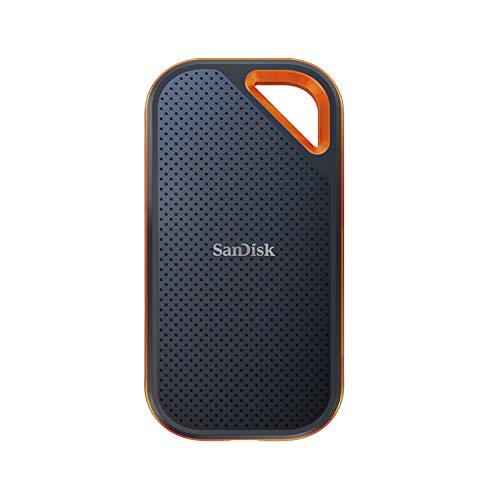
Samsung T7 Shield vs SanDisk Extreme Pro Portable at a Glance
| Feature | Samsung T7 Shield | SanDisk Extreme Pro Portable |
|---|---|---|
| Claimed Sequential Read | Up to 1,050 MB/s | Up to 2,000 MB/s |
| Claimed Sequential Write | Up to 1,000 MB/s | Up to 2,000 MB/s |
| USB Interface Standard | USB 3.2 Gen 2 (10 Gbps) | USB 3.2 Gen 2×2 (20 Gbps) |
| Ingress Protection Rating | IP65 (dust and water resistant) | IP65 (dust and water resistant) |
| Drop Protection Rating | Up to 9.8 feet (3 meters) | Up to 3 meters |
| Thermal Management | Dynamic Thermal Guard | Forged aluminum chassis heatsink |
| Available Capacities | 1TB to 4TB | Up to 4TB |
| Hardware Security | Hardware encryption supported | Not listed |
| Management Utility | Samsung Magician Software | SanDisk Memory Zone app |
| Best For | Everyday reliability and stable thermal workflows | Maximum 20 Gbps throughput on compatible ports |
Transfer Speeds and Real-World Throughput
Sequential read and write speeds dictate how quickly massive digital files ingest into your video timeline or offload from your production camera. The SanDisk Extreme Pro Portable advertises ceiling speeds reaching up to 2,000 MB/s for both reading and writing tasks by leveraging a high-speed NVMe solid-state core over a dual-lane interface. In contrast, the Samsung T7 Shield posts rated sequential read speeds of up to 1,050 MB/s and write speeds of up to 1,000 MB/s, utilizing a single-lane USB 3.2 Gen 2 connection. If you are comparing the samsung t7 vs sandisk extreme pro portable strictly on factory paper specifications, the SanDisk drive offers practically double the maximum file transmission ceiling.
Achieving those maximum figures in daily operations depends entirely on whether your host machine provides a matching bus. The SanDisk Extreme Pro Portable USB 3.2 Gen 2×2 interface requires a compatible motherboard port capable of running two physical 10 Gbps data lanes simultaneously. When connected to a standard 10 Gbps USB port, the SanDisk unit naturally drops back to the exact same bandwidth bracket occupied by the T7 Shield. When evaluating Samsung T7 Shield vs SanDisk Extreme Pro transfer speed under identical 10 Gbps connections, both portable drives operate near the practical limits of the bus, delivering brisk file ingest for standard creative production folders.
For high-resolution capture pipelines, picking between the Samsung T7 Shield or SanDisk Extreme Pro Portable for video editing often comes down to the host machine. If you edit high-bitrate footage from a workstation equipped with true 2×2 support, the SanDisk drive cuts multi-gigabyte project ingestion times down substantially. However, if your workstation only provides baseline 10 Gbps ports, the SanDisk model will yield no speed advantage over the T7 Shield, making the theoretical 2,000 MB/s ceiling an inaccessible feature.
Edge: SanDisk Extreme Pro Portable, because its USB 3.2 Gen 2×2 protocol achieves up to 2,000 MB/s on properly equipped host systems.
Thermal Design and Sustained Drive Performance
High-speed external NVMe drives generate substantial internal heat when handling continuous read and write operations, such as cloning full production cards or rendering complex timeline clips. If heat cannot dissipate efficiently, internal drive controllers automatically throttle transfer speeds to prevent hardware damage. Samsung tackles this mechanical reality by equipping the T7 Shield with proprietary Dynamic Thermal Guard technology, an internal firmware and component structure engineered to regulate thermal thresholds during extended, heavy file transfers.
SanDisk addresses heat dissipation through physical material engineering. The SanDisk Extreme Pro features a forged aluminum chassis specifically designed to act as an integrated heatsink, conducting heat outward away from the internal NVMe core to maintain elevated transfer rates. While the core interior is well protected, users often notice that metal heat sinks can feel warm to the touch during long file duplications, which confirms that thermal energy is being evacuated from the underlying components. Similar performance dynamics appear when evaluating the sandisk extreme pro portable vs crucial x10 pro in extended benchmarking cycles.
Both thermal implementations serve the crucial purpose of warding off sudden speed degradation midway through large project folders. The elastomer outer shell on the T7 Shield provides a tactile thermal barrier that makes the exterior comfortable to handle immediately after writing hundreds of gigabytes, whereas the SanDisk enclosure prioritizes rapid thermal conductivity straight through its forged aluminum frame. Readers tracking thermal stability through our samsung t7 vs t7 shield breakdown will note how crucial dedicated heat mitigation is compared to standard unshielded drives.
Edge: Samsung T7 Shield, because Dynamic Thermal Guard minimizes sustained throttling while the outer elastomer layer shields hands from direct heat conductivity.
Drop Resistance and Rugged Shell Construction
Field production demands hardware that survives incidental drops on concrete, exposure to sudden rain, and abrasive dust on set. Both the Samsung T7 Shield and the SanDisk Extreme Pro Portable carry official IP65 ingress protection ratings. This certification validates that both enclosures prevent particulate dust ingress from penetrating the internal electronics after continuous pressure exposure and resist low-pressure water streams projected from any angle, allowing both units to remain functional even when caught in sudden outdoor showers.
Impact absorption differs noticeably in exterior material selection and chassis layout. The Samsung T7 Shield is wrapped in an advanced outer elastomer layer that cushions falls from heights up to 9.8 feet. This rubberized coating acts as an integrated bumper across the entire footprint of the device, dampening mechanical shock before kinetic energy can reach the internal solid-state structure. Anyone researching Samsung T7 Shield drop test durability will find that this dense outer jacket prevents surface scuffs, denting, and connector strain when tumbling from production carts or tabletops.
SanDisk implements a dual-material construction consisting of a forged aluminum core combined with an outer silicone perimeter shell. This hybrid arrangement affords drop protection from up to 3 meters, which corresponds identically to the 9.8-foot rating provided by Samsung. SanDisk also molds an integrated carabiner loop directly into the corner of the forged frame, offering an easy way to hook the drive inside a camera bag or belt harness. While the exposed aluminum accents look refined, bare metal can pick up abrasions more readily than solid rubberized exteriors, as seen when comparing the sandisk extreme pro portable vs wd my passport ssd.
Edge: Tie, as both drives deliver matched IP65 water and dust resistance alongside 3-meter drop survival ratings.
System Compatibility and Mac Performance
Universal plug-and-play operation across desktop and mobile platforms is an essential requirement for field drives. The Samsung T7 Shield lists full hardware support for Windows PCs, Mac computers, Android mobile devices, gaming consoles, and tablets. Crucially for mobile videographers, Samsung explicitly certifies the T7 Shield for direct connection with the iPhone 15 Pro, enabling high-framerate Apple ProRes 4K video recording at 60 frames per second straight to the external drive using the included data cable.
When selecting the Samsung T7 Shield or SanDisk Extreme Pro Portable for Mac workstations, interface specifications create an important bottleneck. Modern Apple silicon computers support Thunderbolt and USB4, but historically do not support the USB 3.2 Gen 2×2 specification. As a result, when the SanDisk Extreme Pro is attached to a Mac Thunderbolt port, it cannot initialize its secondary 10 Gbps lane. The connection falls back to standard 10 Gbps operation, capping the SanDisk unit at approximately 1,050 MB/s rather than its marketed 2,000 MB/s throughput.
This technical limitation answers the common question: is SanDisk Extreme Pro Portable worth it for Mac-only creative houses? Unless you operate dedicated PC hardware equipped with native USB 3.2 Gen 2×2 expansion cards or motherboards, paying for unutilized interface headroom delivers no tangible speed boost over the T7 Shield on Apple computers. Those looking to cross-shop higher-tier models across multiple operating systems can also review our samsung t9 vs sandisk extreme pro portable analysis to see how interface bridging works on modern platforms.
Edge: Samsung T7 Shield, because its native 10 Gbps USB 3.2 Gen 2 profile delivers maximum performance on Mac without unsupported protocol limitations and explicitly supports iPhone ProRes capture.
Software Ecosystem and Hardware Data Protection
Maintaining long-term drive health requires reliable utility software for diagnostics, component firmware servicing, and security management. Samsung packages the T7 Shield with support for the Samsung Magician software suite. This platform provides an intuitive dashboard to monitor overall drive health, conduct diagnostic scans, execute critical firmware updates, and configure status LED settings. Furthermore, the T7 Shield integrates hardware encryption capabilities to safeguard sensitive production archives against unauthorized access.
SanDisk pairs its portable storage with the SanDisk Memory Zone application, accessible across desktop and mobile devices. This utility focuses on consumer file management, enabling automated file backups, local directory browsing, and one-tap tools to free up onboard device space. The Extreme Pro listing highlights that the hardware ships with updated firmware and includes a 5-year limited manufacturer warranty, providing long-term service backing against unexpected component failure.
From a hardware manufacturing perspective, Samsung highlights that all primary flash components, including DRAM, NAND memory, and controller firmware, are engineered and produced completely in-house. While the SanDisk Extreme Pro provides an extended 5-year warranty horizon, any standard Samsung T7 Shield review highlights the utility of Samsung Magician for maintaining firmware integrity. The balance between comprehensive diagnostic software and a 5-year hardware replacement warranty gives each drive a distinct advantage in post-purchase maintenance.
Edge: Samsung T7 Shield, due to its robust Samsung Magician diagnostic utilities, hardware encryption support, and complete in-house component integration.
Pros and Cons
Samsung T7 Shield

Pros
- Up to 1,050 MB/s read and write
- IP65 water and dust resistance
- Drop resistant up to 9.8 feet
- Dynamic Thermal Guard heat regulation
- IPhone 15 ProRes 4K direct recording
Cons
- Lacks 2,000 MB/s high-speed mode
- No built-in carabiner loop
View Samsung T7 Shield on Amazon
SanDisk Extreme Pro Portable

Pros
- Up to 2,000 MB/s read and write
- Forged aluminum heatsink chassis
- Integrated carabiner loop for travel
- IP65 water and dust resistance
- 5-year limited manufacturer warranty
Cons
- Requires USB 3.2 Gen 2×2 for full speed
- Caps at 1,050 MB/s on Apple Mac
View SanDisk Extreme Pro Portable on Amazon
Who Should Buy Each One
Choose the Samsung T7 Shield If
- You edit across Apple Mac computers or need certified ProRes 4K 60fps recording directly from modern smartphones.
- You want a thick, shock-absorbing elastomer jacket that resists drops from heights up to 9.8 feet without scratching gear in your bag.
- You prefer comprehensive desktop management software like Samsung Magician to handle drive diagnostics, firmware updates, and hardware encryption.
- Your projects run continuously for hours and benefit from the built-in Dynamic Thermal Guard to keep surface temperatures low.
Choose the SanDisk Extreme Pro Portable If
- Your primary editing station features a dedicated USB 3.2 Gen 2×2 port capable of driving full 2,000 MB/s transfers.
- You frequently ingest multi-hundred-gigabyte media dumps and want to cut transfer waiting periods in half on compatible PC systems.
- You want a forged aluminum heatsink chassis combined with a structural carabiner loop to secure the drive to field packs.
- You prioritize having a 5-year limited manufacturer warranty backing your external media drive.
Final Verdict
For the vast majority of consumers, creative professionals, and mobile shooters, the Samsung T7 Shield represents the more sensible and dependable portable solid-state drive. Its 1,050 MB/s sequential read ceiling hits the sweet spot for modern USB 3.2 Gen 2 connections across PC, Mac, iPad, and iPhone hardware without requiring specialized dual-lane ports to achieve advertised performance. Backed by an all-encompassing elastomer shell, an IP65 ingress rating, integrated hardware encryption, and Samsung Magician utility support, the T7 Shield handles rigorous field production while maintaining cool exterior handling via Dynamic Thermal Guard.
The SanDisk Extreme Pro Portable proves its worth when paired with a workflow specifically architected around USB 3.2 Gen 2×2 hardware. If your desktop rig or production laptop contains 20 Gbps USB ports, its ability to push sequential transfers up to 2,000 MB/s offers genuine time savings during data offloading. While Mac users will see the drive negotiate down to standard 10 Gbps speeds, PC power users with high-bandwidth interfaces and outdoor photographers who rely on the forged aluminum carabiner loop will find the SanDisk Extreme Pro to be a capable, high-throughput drive.
FAQ
Is SanDisk Extreme Pro Portable worth it for regular file backups?
The SanDisk Extreme Pro is only worth the investment for standard backups if your host computer features a dedicated USB 3.2 Gen 2×2 port. Without a 20 Gbps port, the drive runs at 10 Gbps speeds matching standard drives like the Samsung T7 Shield. If your machine only has standard USB ports, you will not access the extra throughput.
Which drive is better: Samsung T7 Shield or SanDisk Extreme Pro Portable for video editing?
For PC video editors with USB 3.2 Gen 2×2 connectivity, the SanDisk Extreme Pro Portable is faster because it handles up to 2,000 MB/s throughput for scrubbing high-bitrate media. For Mac editors and creators shooting ProRes video on mobile devices, the Samsung T7 Shield is preferred because Mac systems cap non-Thunderbolt drives at 10 Gbps, matching the T7 Shield’s reliable 1,050 MB/s ceiling.
How does the Samsung T7 Shield drop test durability compare to the SanDisk Extreme Pro?
Both manufacturers rate their drives for drop survival up to 3 meters (9.8 feet) onto hard surfaces. The Samsung T7 Shield relies on an all-encompassing outer elastomer rubber wrap that cushions impact across the entire chassis, whereas the SanDisk Extreme Pro uses a forged aluminum chassis with a silicone outer band and an integrated carabiner loop.
Can the SanDisk Extreme Pro Portable reach 2,000 MB/s on an Apple Mac?
No, the SanDisk Extreme Pro Portable cannot hit 2,000 MB/s on modern Apple Mac computers. Current Mac Thunderbolt and USB4 ports do not support the USB 3.2 Gen 2×2 dual-lane protocol. When plugged into a Mac, the SanDisk drive defaults to standard USB 3.2 Gen 2 speeds of roughly 1,050 MB/s.
Does the Samsung T7 Shield support direct recording on mobile devices?
Yes, the Samsung T7 Shield supports external recording directly from compatible smartphones, including Apple ProRes 4K video at 60fps on iPhone 15 Pro models. Samsung recommends using the included USB-C cable to maintain stable connection bandwidth during high-resolution recording sessions.
What capacity options are available for these two external drives?
The Samsung T7 Shield product listing notes storage capacities ranging from 1TB up to 4TB. The SanDisk Extreme Pro Portable listing offers high-capacity storage up to 4TB, allowing users on both sides to carry multi-terabyte libraries in a portable 2.5-inch class form factor.


