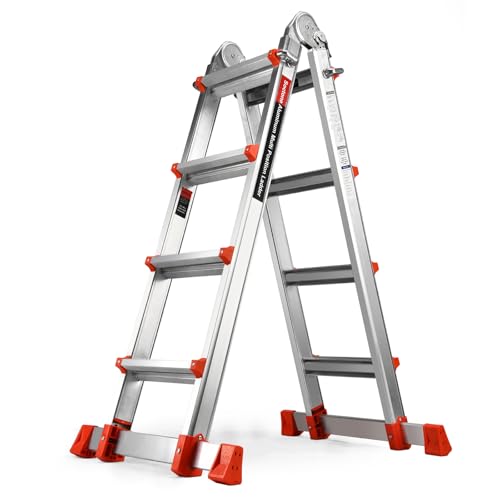
The choice between the Soctone Multi Position Ladder and the Louisville FE3220 comes down to whether your tasks demand self-supporting, adaptable versatility inside the home or dedicated, non-conductive vertical reach along exterior walls. The Soctone is a folding aluminum unit engineered to shift between step ladder, leaning extension, and multi-angle configurations while collapsing small enough for a closet. In contrast, the Louisville is a heavy-duty two-section fiberglass extension ladder built specifically to plant firmly against high exterior structures and provide non-conductive safety around utility wires.
Choose the Soctone if you need a lightweight, self-standing solution that adapts to interior spaces, stairways, and standard single-story home projects. Choose the Louisville if you are tackling exterior two-story maintenance, roof access, or any project that takes you near overhead electrical lines.

Soctone Multi Position Ladder vs Louisville FE3220 at a Glance
| Feature | Soctone Multi Position Ladder | Louisville FE3220 |
|---|---|---|
| Ladder Type | Multi-Position Telescoping | Extension Ladder |
| Primary Material | Aluminum Alloy | Fiberglass |
| Maximum Length / Reach | 14 feet | 20 feet |
| Duty Rating / Weight Capacity | 330 pounds | 300 pounds (Type IA) |
| Total Tool Weight | 24.7 pounds | Not listed |
| Electrical Safety | Conductive (Metal) | Non-Conductive (Fiberglass) |
| Locking Mechanism | Hinge Lock and Solid J-Lock | MAXLOCK and QuickLatch |
| Base / Feet Design | Stabilizer Bars with Wide Contact | Steel Swivel Safety Shoe with Metal Shield |
| Collapsed Dimensions | 17.3 inches W x 8.07 inches H | 120 inches W x 6 inches H |
| Best For | Indoor Repairs, Painting, and Compact Storage | Two-Story Exterior Walls and Electrical Hazards |
Working Reach and Vertical Elevation
Working elevation determines which ladder can physically complete the project on your property. The Louisville FE3220 ladder height spans up to 20 feet when fully extended, making it capable of reaching standard second-story windows, fascia boards, gutters, and roof edges. Because it functions as a two-section sliding extension ladder, you simply position the base at an appropriate angle against a structure and slide the fly section upward. For exterior contractors or homeowners managing tall perimeter walls, having 20 feet of structural length provides the necessary clearance to climb past gutter lines safely.
The Soctone Multi Position Ladder maxes out at a 14-foot total length in its fully extended straight-ladder orientation. When configured as a self-supporting A-frame step ladder, the working height is naturally lower, suited primarily for 8-to-10-foot ceilings, light fixture replacements, and standard drywall repairs. While the 14-foot extension reach can access single-story gutters or low shed roofs, it cannot safely deliver you to second-story rooflines. Shoppers weighing reach against storage often study comparisons like the werner mt-22 vs louisville fe3220 to gauge how multi-position reaches measure against traditional extension rails.
Evaluating your actual height requirements prevents working on unsafe upper rungs. If your primary objective is exterior painting or clearing pine needles from high gutters on a two-story residence, the 14 feet of the Soctone will fall short. However, for interior vaulted ceilings or single-story tasks, the 14-foot envelope is far easier to deploy without hitting ceiling drywall or interior furnishings.
Edge: Louisville FE3220, providing 20 feet of extension length to tackle exterior second-story elevations that the 14-foot Soctone cannot reach.
Material Construction and Electrical Safety
The core material of a ladder dictates not only its structural rigidity and weather resistance, but also its safety around electrical lines. In any Louisville FE3220 fiberglass vs aluminum comparison, the non-conductive nature of fiberglass is the defining advantage. The Louisville FE3220 uses structural fiberglass side rails designed specifically for situations where contact with live electrical wiring, overhead service drops, or electrical panels could occur. For professional trades and technicians working near residential power feeds, a fiberglass extension ladder is an indispensable safety barrier.
The Soctone is forged from high-quality aluminum alloy. Aluminum offers superior resistance to corrosion, rust, and extreme temperature swings without degrading, ensuring mechanical longevity when stored in unheated garages or damp outbuildings. However, aluminum is an electrical conductor. If you lean an aluminum ladder against a structure near incoming power lines, or use it while repairing an outdoor electrical junction box, you face a serious electrocution hazard. Homeowners seeking guidance often explore how fiberglass platforms compare across hybrid models in guides such as the little giant king kombo vs louisville fe3220.
While fiberglass offers critical electrical protection, it does require care to prevent ultraviolet degradation and rail cracking under direct sunlight over decades. Aluminum alloy retains its tensile strength under direct UV exposure without fiber blooming. For indoor renovations or dry carpentry far away from wiring, aluminum provides a clean, rust-free lifecycle. But whenever electrical work enters the equation, safety priorities decisively shift toward non-conductive fiberglass.
Edge: Louisville FE3220, because its non-conductive fiberglass construction protects users from dangerous electrical hazards.
Versatility and Configuration Options
A multi-position ladder solves architectural obstacles that an extension ladder simply cannot touch. The Soctone Multi Position Ladder utilizes dual hinge locks and solid J-locks to transform into several distinct configurations, including an A-frame step ladder, a straight extension ladder, and an uneven staircase platform. When deciding between the Soctone Multi Position Ladder or Louisville FE3220 for painting, the ability to set up an independent A-frame in the center of an open living room or paint a stairwell with staggered legs gives the Soctone an immense tactical advantage indoors.
The Louisville FE3220 is a dedicated extension ladder and cannot stand up on its own. It requires a firm vertical surface-such as an exterior wall, fascia board, or solid post-to lean against. This single-configuration design makes it unusable in the middle of a room for hanging ceiling fans, servicing recessed lights, or painting open ceilings where no leaning surface exists. Those assessing multipurpose systems frequently review the little giant velocity vs soctone telescoping multi-position ladder to understand how folding joints handle complex interior tasks.
When selecting the Soctone Multi Position Ladder or Louisville FE3220 for home maintenance, the variety of household tasks heavily favors the multi-position design. If your weekend chores bounce from trimming backyard hedges away from walls to clearing a chandelier or patching drywall above stairs, the Louisville cannot assist you. The Soctone handles the full spectrum of indoor standalone chores with four adaptable steps per section.
Edge: Soctone Multi Position Ladder, thanks to its multi-position capability to function as a self-supporting A-frame, staircase ladder, and leaning unit.
Weight Capacity and Base Stability
Climber confidence relies entirely on how solidly a ladder grips the ground and how much weight it can carry without deflection. The Soctone Multi Position Ladder weight limit is rated at an impressive 330 pounds, exceeding the standard Type IA benchmark. To combat the flex often felt in articulated aluminum ladders, the manufacturer added two wide stabilizer bars at the base. These bars expand the contact footprint with the ground, effectively improving anti-wobble stability by 36 percent. A solid J-lock and safety hinge system keep the telescoping rails rigidly locked in place under load.
The Louisville FE3220 carries an ANSI Type IA rating with a 300-pound load capacity, capable of supporting a tradesperson carrying tool belts and heavy materials. Stability on the Louisville comes from its custom-engineered hardware, featuring the patented MAXLOCK rung lock made from an advanced molecular polymer, paired with the QuickLatch system to secure the fly section during ascent. At the base, heavy-duty steel swivel safety shoes equipped with metal shields pivot to dig into soft turf or provide a flat, slip-resistant rubberized pad on solid asphalt and concrete.
Both ladders offer exceptional security within their intended environments. The Louisville feels remarkably rigid when fully extended against an exterior wall because its structural fiberglass rails minimize bounce, while its pivoting steel feet grip exterior terrain. However, in raw load bearing, the Soctone holds a 30-pound advantage over the Louisville, and its bolt-on stabilizer bars create a broad base that prevents side-to-side tipping on flat surfaces.
Edge: Soctone Multi Position Ladder, due to its higher 330-pound weight rating and dual stability bars.
Portability, Storage Footprint, and Transport
Handling and storing a ladder between jobs often determines how often you will actually pull it out of storage. The Soctone Multi Position Ladder weighs just 24.7 pounds and folds down to a compact footprint measuring 17.3 inches wide and 8.07 inches high. This collapsed size allows a single person to lift, carry through tight hallways, and store it in a standard utility closet, under a workbench, or inside the trunk of a compact car without requiring vehicle roof racks.
By comparison, the Louisville FE3220 features a retracted length of 120 inches (10 feet) across its base section. Transporting a 10-foot rigid frame requires a dedicated ladder rack on a van, an open pickup truck bed, or substantial roof rails on an SUV. Storing the FE3220 demands dedicated wall brackets along a garage wall, rafters in a barn, or an exterior shed. Readers interested in compact alternatives often compare traditional frames in the little giant velocity vs louisville fe3220 write-up to see how folding rails simplify storage.
The physical effort needed to deploy the Soctone makes it a far friendlier companion for quick domestic tasks. Maneuvering around tight interior door frames with a 24.7-pound folding unit eliminates the risk of gouging interior walls or knocking light fixtures. Transporting the Louisville is inherently a two-person chore or an exercise in careful exterior handling due to its rigid 10-foot transit profile.
Edge: Soctone Multi Position Ladder, offering a 24.7-pound lightweight frame that folds down to fit in car trunks and standard household closets.
Pros and Cons
Soctone Multi Position Ladder

Pros
- 330-pound load capacity
- Folds down to compact storage footprint
- Dual stabilizer bars reduce ground wobble
- Lightweight 24.7-pound aluminum frame
- Configures as self-supporting A-frame
Cons
- Conductive aluminum unsafe near live electrical wires
- 14-foot maximum height limits exterior roof access
View Soctone Multi Position Ladder on Amazon
Louisville FE3220

Pros
- Non-conductive fiberglass rails for electrical safety
- 20-foot reach covers two-story exterior walls
- Heavy-duty steel swivel safety shoes with metal shields
- Patented MAXLOCK molecular polymer rung locks
- QuickLatch system secures fly and base sections
Cons
- Rigid 120-inch collapsed length demands substantial storage
- Lacks self-supporting A-frame configuration
View Louisville FE3220 on Amazon
Who Should Buy Each One
Choose the Soctone Multi Position Ladder If
- You live in a home or apartment with limited storage and need a ladder that fits in a closet or car trunk.
- Your primary tasks are indoor projects like painting living rooms, servicing ceiling fixtures, or working on staircases.
- You require a self-supporting A-frame step ladder that does not need a vertical wall to lean against.
- You want a lightweight 24.7-pound aluminum frame that supports up to 330 pounds with stabilizer bars.
Choose the Louisville FE3220 If
- You need to reach second-story windows, siding, gutters, or roofs up to 20 feet high.
- You perform electrical maintenance, line repairs, or exterior tasks near live power feeds requiring non-conductive fiberglass rails.
- You have a work truck, utility van, or large garage capable of storing and transporting a 10-foot retracted ladder.
- You need industrial-grade steel swivel shoes to anchor securely into outdoor dirt, gravel, or uneven lawns.
Final Verdict
When assessing a Soctone Multi Position Ladder review against a Louisville FE3220 review, the decision hinges on matching the tool to your physical environment. The Louisville FE3220 vs Soctone Multi Position Ladder matchup is not a competition between identical designs, but between two distinct ladder formats. For homeowners seeking an all-in-one domestic tool, the Soctone Multi Position Ladder offers the greatest day-to-day practicality. Its 330-pound weight rating, compact 24.7-pound folding design, and ability to configure into self-supporting positions make it the ideal companion for indoor DIY, staircase painting, and low-level exterior maintenance.
However, when asking is Louisville FE3220 worth it, anyone facing two-story exterior elevation or overhead electrical lines will find that it is an essential investment. The Soctone cannot substitute for the Louisville FE3220 ladder height when you must climb 18 to 20 feet up a vertical wall, nor can aluminum match the life-saving non-conductive properties of fiberglass near utility lines. If exterior reach and electrical safety are mandatory for your property or trade, the Louisville FE3220 is the undisputed winner for the job.
FAQ
What is the difference in reach between the Louisville FE3220 ladder height and the Soctone ladder?
The Louisville FE3220 extends up to 20 feet in a two-section sliding configuration, providing sufficient height to reach second-story windows, eaves, and roofs. The Soctone Multi Position Ladder reaches a maximum straight extension length of 14 feet, which is geared toward single-story roofs, gutter cleaning on low structures, and standard 8-to-10-foot interior ceiling access when set in its A-frame mode.
Can the Soctone Multi Position Ladder be safely used for electrical work?
No, the Soctone ladder is constructed from aluminum alloy, which is a natural conductor of electricity. You should never use an aluminum ladder near power lines, overhead service lines, or live open circuits. For any task involving electrical repair or proximity to utility lines, the non-conductive fiberglass construction of the Louisville FE3220 is required to prevent electrical shock.
What is the Soctone Multi Position Ladder weight limit compared to the Louisville FE3220?
The Soctone Multi Position Ladder features a maximum load capacity of 330 pounds, reinforced by wide stabilizer bars at the base. The Louisville FE3220 is an ANSI Type IA rated ladder with a 300-pound duty rating. Both support heavy equipment, tool belts, and materials, though the Soctone is rated for an extra 30 pounds.
Which ladder is better suited for interior painting and home maintenance?
The Soctone Multi Position Ladder is vastly superior for interior painting and indoor repairs. Because it can open into an independent A-frame step ladder or adjust its legs for stairwells, you do not need a wall to lean it against. The Louisville FE3220 is an extension ladder that must lean against a structural surface, making it impractical for painting center ceilings or working in enclosed indoor rooms.
How do the locking systems compare on these two ladders?
The Soctone uses a combination of Safety Protection Hinge Locks and Solid J-Locks to secure the folding joints and telescoping rail sections into place. The Louisville FE3220 uses the MAXLOCK rung lock system, manufactured from a patented molecular polymer for high impact strength, combined with the QuickLatch system to secure the fly and base sections as you extend the ladder.
How do the storage requirements compare between both models?
The Soctone collapses down into a compact package measuring approximately 17.3 inches wide and 8.07 inches high, weighing 24.7 pounds, making it easy to store in closets or carry inside car trunks. The Louisville FE3220 has a retracted length of 120 inches (10 feet), requiring substantial ceiling rafters, dedicated garage wall space, and vehicle roof racks for transportation.