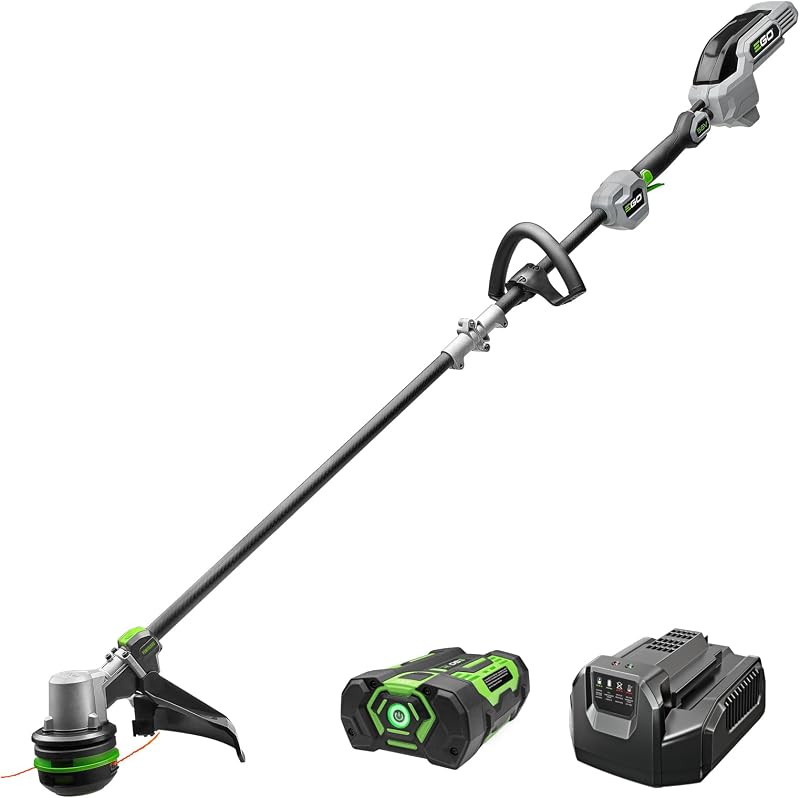
The choice between a string trimmer and a lawn edger comes down to whether your lawn needs flexible surface maintenance or deep structural boundary carving. A string trimmer relies on a flexible, high-speed nylon line designed to shear grass blades across uneven terrain and around obstacles where a mower deck cannot reach. In contrast, a dedicated edger utilizes a rigid, vertical steel blade engineered to slice through turf, dense root networks, and compacted topsoil to create a clean, physical separation between turfgrass and adjacent hardscapes.
Choose a string trimmer if you need a lightweight, all-around landscaping tool to maintain fence lines, clear weeds near delicate garden beds, and perform light perimeter touch-ups. Choose a dedicated lawn edger if you want sharply defined, professional border lines along concrete sidewalks and driveways or need to dig shallow garden trenches that a whipping nylon line simply cannot produce.



String Trimmer vs Edger at a Glance
| Attribute | String Trimmer | Lawn Edger |
|---|---|---|
| Primary Cutting Element | Flexible nylon line (0.065-inch diameter) | Rigid steel blade (7.5-inch diameter, up to 3/16-inch thick) |
| Cutting Width / Blade Diameter | 12 inches | 7.5 inches |
| Rotational Speed | 6,200 to 7,600 RPM | 4,700 RPM |
| Operating Depth | Surface level (above soil) | Adjustable from 1 inch to 1.5 inches deep |
| Tool Weight | 5.5 to 5.7 pounds | 14.0 to 14.1 pounds |
| Power Mechanism | 20V Cordless Lithium-Ion Battery | 12 Amp Corded Electric |
| Primary Function | Grass trimming, weed removal, light edging | Border carving, turf trenching, hardscape edging |
| Safe Near Obstacles | Yes (wooden posts, tree trunks, delicate vinyl) | No (metal blade risks damaging hard masonry and wood) |
| Best For | General yard maintenance and mobile trimming | Crisp driveway borders and garden bed trenching |
Cutting Mechanism: Trimmer Line vs Edger Blade
Understanding the fundamental difference in cutting mechanisms is essential when examining a string trimmer review or evaluating dedicated landscape tools. A string trimmer cuts grass by spinning a thin monofilament nylon line at exceptionally high rotational speeds. As seen on cordless tools like the WORX WG163, which runs at 7,600 RPM with a 0.065-inch line, or the BLACK+DECKER LST300 spinning at 6,200 RPM via a PowerDrive transmission, the line relies on kinetic velocity to slice green plant tissue cleanly. Because the flexible line yields upon striking hard objects, you can safely operate it flush against stone foundations, timber retaining walls, and wooden fence posts without chipping the structure or snapping the drive shaft.
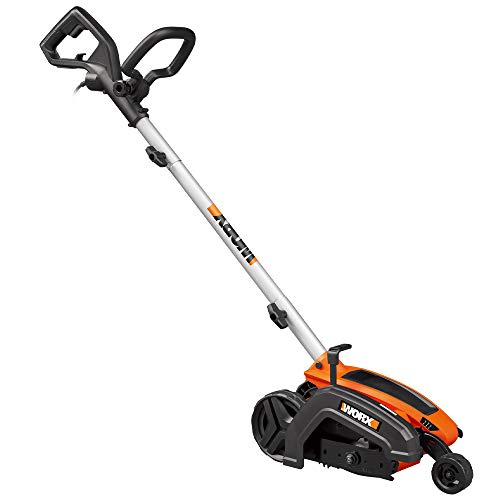
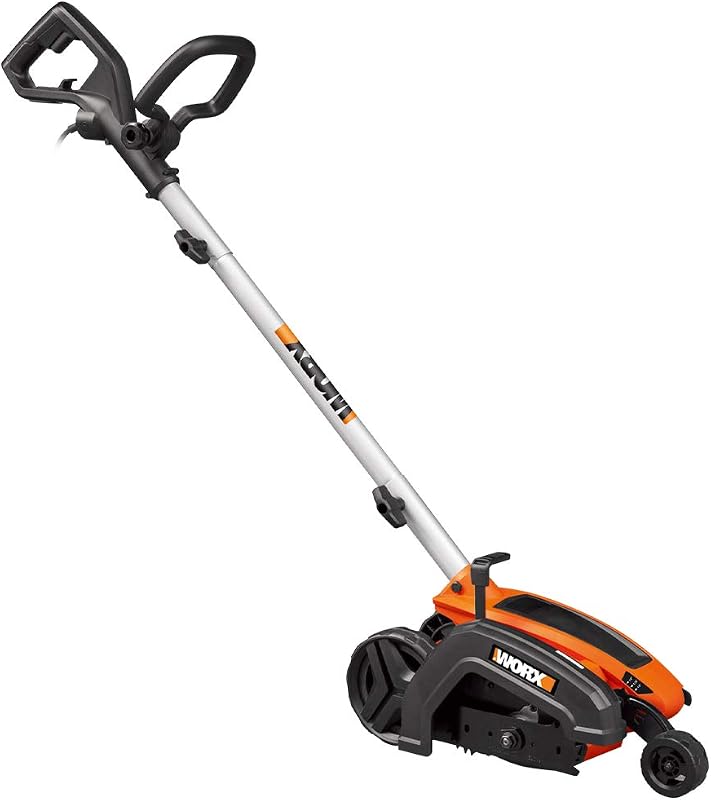
A dedicated lawn edger takes the opposite mechanical approach by spinning a solid, heavy-gauge steel blade in a vertical orientation. Tools like the WORX WG896 and the BLACK+DECKER LE760FF drive a 7.5-inch steel blade at 4,700 RPM powered by a continuous 12 Amp motor. Rather than merely clipping foliage, the 3/16-inch thick steel blade acts as a rolling saw. It shears through overgrown grass runners, dense thatch, and soil without deflecting. When comparing trimmer line vs edger blade dynamics, the steel edge does not wear down or snap off when encountering compact root mats, though it will spark or gouge concrete if forced directly against curbs.
In practice, the mechanical divergence creates an obvious split in capability. Trimmer line operates on forgiving flexibility, allowing sweeping motions across wide turf areas, but it shreds instantly when ground down against abrasive paving stones. An edger blade demands a rigid, linear path and requires careful alignment, but it delivers an uncompromising cut that severs tough roots and soil deposits that completely halt nylon line. When reading a comprehensive lawn edger review, the physical mass of the cutting tool remains the primary factor in separating boundary work from basic trimming.
Edge: Tie. String trimmers offer necessary flexibility and obstacle protection for general trimming, whereas heavy steel edger blades are required to cleanly sever stubborn subterranean roots.
Trenching Depth and Boundary Definition
When analyzing string trimmer vs edger cutting depth, the distinction between surface cutting and subsurface trenching becomes immediately evident. String trimmers are designed entirely for top-growth vegetation management. Even when equipped with rotating shafts or tilting cutter heads-such as the 90-degree tilting head on the WORX WG163-a string trimmer only clips grass down to ground level. If soil has crested over a concrete path, a spinning 0.065-inch nylon line will fray, snap, and scatter debris without penetrating the underlying dirt. It creates the illusion of an edge by removing visible foliage, but leaves the underlying root mat and encroaching turf shelf intact.
A dedicated lawn edger is engineered specifically to penetrate the earth and carve out a physical barrier. Both the WORX WG896 and the BLACK+DECKER LE760FF feature three-position blade depth adjustments, allowing operators to drop the blade 1 inch, 1-1/4 inches, or 1-1/2 inches deep into the soil. Dropping a rigid steel blade below grade severs the horizontal stolons and rhizomes of spreading turfgrass species. This prevents grass from creeping across the surface of concrete walkways. Additionally, this depth adjustment transforms tools like the BLACK+DECKER LE760FF into an effective trencher for installing landscape border edging, outdoor low-voltage lighting wire, or underground pet containment systems.
The practical result is a stark difference in border longevity. Edging with a string trimmer often requires weekly touch-ups because surface cuts do not stop root expansion. A dedicated edger creates a distinct, shadowed trench between the turf and the concrete that lasts for weeks before grass can bridge the gap. For homeowners wondering if a dedicated edger is worth it, the answer depends on whether your yard projects require deep soil penetration or simple surface foliage reduction. Homeowners who want distinct, architectural lines will find that surface-only tools fail to deliver that recessed, manicured channel.
Edge: Edger. With adjustable cutting depths up to 1.5 inches, dedicated edgers carve out true subterranean borders and trenches that a string trimmer cannot match.
Maneuverability, Weight, and Yard Ergonomics
Ergonomics and operational fatigue represent major trade-offs in the string trimmer vs lawn edger debate. String trimmers are engineered for effortless mobility across uneven terrain, steep inclines, and tight garden corners. The WORX WG163 weighs only 5.5 pounds, while the BLACK+DECKER LST300 weighs 5.7 pounds. Both feature adjustable auxiliary handles and telescoping shafts that allow users to sweep the tool back and forth for extended periods without shoulder strain. Their lightweight footprint makes it easy to lift the tool over flowerbeds, reach behind air conditioning units, or trim along hillside terraces where wheeled machines cannot balance.
Dedicated edgers are considerably heavier and structurally restricted to tracking along smooth surfaces. Weighing 14 pounds for the WORX WG896 and 14.1 pounds for the BLACK+DECKER LE760FF, these tools are nearly triple the weight of their string trimmer counterparts. While this added weight is beneficial for forcing the steel blade into hard-packed dirt without hopping out of the groove, it eliminates handheld maneuverability. You cannot lift a 14-pound trencher to trim weeds sprouting from an elevated planter wall, nor can you easily navigate it through a curved flagstone path.
For users debating a string trimmer or edger for small yard properties, weight and physical storage footprint are pivotal. A compact trimmer can hang flat on a garage wall hook and be operated comfortably by virtually any homeowner regardless of upper-body strength. Dedicated edgers require balanced floor rolling and dual-hand guidance, utilizing support wheels and specialized handles like the right- or left-hand assist grip on the BLACK+DECKER LE760FF. Similar handling dynamics can be seen when comparing other handheld trimmers in our ego st1623t vs stihl fsa 57 breakdown, where tool weight heavily influences long-term yard comfort.
Edge: String Trimmer. Weighing under 6 pounds, string trimmers offer superior handling, minimal user fatigue, and access to awkward yard angles that heavy edgers cannot reach.
Power Delivery and Mobility: Cordless Battery vs Corded Electric
The power delivery methods of these tools reflect their intended yard applications. The featured string trimmers rely on cordless 20V lithium-ion battery platforms that prioritize untethered range. The WORX WG163 includes two 20V Power Share batteries, allowing you to swap packs when one depletes, while the BLACK+DECKER LST300 includes a 2.0 Amp-hour lithium-ion pack providing steady power to its motor. This cordless design allows users to roam freely around acreage, traverse long perimeter fence lines, and cross driveways without dragging power cords or searching for exterior outlets.
Dedicated edgers require immense, sustained torque to drive steel through compacted dirt, stones, and roots without stalling. Consequently, models like the WORX WG896 and BLACK+DECKER LE760FF utilize high-draw 12 Amp corded electric motors. While a 12 Amp corded motor provides relentless power that will never experience battery fade or voltage sag mid-cut, it confines your working radius to the reach of an exterior-rated extension cord. The WORX WG896 features an integrated 1-foot cord that must connect to a heavy-duty cord, creating potential snags around shrubs, patio furniture, and garden statues.
Choosing between corded endurance and battery mobility depends on your property layout. Cordless battery power provides the grab-and-go convenience required for weekly maintenance, but overall operating time is tied directly to battery capacity. The continuous 12 Amp supply of corded edgers ensures you can dig hundreds of linear feet of border trenches through clay soil without losing rotational force. However, wrangling heavy electrical cords across damp grass introduces a distinct logistical hassle that cordless trimmers completely avoid, a contrast also explored when comparing battery platforms in the ego st1623t vs husqvarna 128ld guide.
Edge: String Trimmer. The untethered freedom of 20V cordless lithium-ion batteries outperforms the logistical limitations of dragging 12 Amp extension cords around the yard.
Precision Borders Along Sidewalks and Driveways
When the objective is establishing laser-straight lines along hardscapes, the structural design of the machine dictates the outcome. Choosing an edger or string trimmer for clean lines along concrete depends on how the tool guides itself. Dedicated edgers are purpose-built for tracking straight hard edges. The WORX WG896 incorporates a built-in cutting line indicator guide, while the BLACK+DECKER LE760FF features a pull-up edge guide that drops into the seam between the turf and the pavement. Combined with wide tracking wheels, these guides lock the tool into a stable, true path, producing razor-sharp, uniform borders even if the operator has unsteady hands.
String trimmers attempt to bridge this gap by offering secondary edging modes. The WORX WG163 features removable rubberized guide wheels that roll along the pavement when the shaft is rotated 90 degrees, while the BLACK+DECKER LST300 can be flipped into an upright orientation to clear sidewalk borders. However, because the spinning nylon line flexes and yields according to air resistance and grass density, the resulting line can waver. If you tilt the trimmer slightly off-axis, the line gouges uneven scallops into the turf, creating an irregular margin rather than a crisp trench.
For homeowners deciding between a string trimmer or edger for sidewalks, stability along flat masonry is decisive. While a 2-in-1 string trimmer is capable of clipping back grass hanging over the edge of a driveway, it cannot maintain the geometric perfection that a fixed steel blade produces. The rigid blade clears out built-up silt from expansion joints and pavement borders, leaving an open channel that looks professionally manicured. A trimmer line simply whips across the surface, trimming leaf blades while leaving underlying turf layers bulging against the concrete.
Edge: Edger. Dedicated guide wheels, cutting line indicators, and a non-deflecting steel blade deliver superior geometric lines along sidewalks and driveways.
Line Feeding and Maintenance Requirements
Tool upkeep and continuous operation highlight another key division in this comparison. String trimmers depend on continuous line replacement because the monofilament wears down and snaps during routine use. The WORX WG163 addresses this with a push-button Command Feed system that feeds additional line on demand, supported by a manufacturer program offering free replacement spools. The BLACK+DECKER LST300 uses an Automatic Feed Spool (AFS) that deploys line via centrifugal force without manual bumping. Despite these user-friendly conveniences, operators must still clear tangled spools, purchase fresh 0.065-inch line, and clean grass clippings out of the safety guards and motor housing.
Dedicated edgers eliminate the inconvenience of line feeding entirely by using a single, heavy-duty steel blade. A 7.5-inch steel blade, such as the EH1000 replacement blade used on the BLACK+DECKER LE760FF, can run for multiple seasons through tough soil and gravel before requiring sharpening or replacement. Edger maintenance generally involves checking the blade nut torque and occasionally clearing packed mud from the inside of the blade guard. The BLACK+DECKER model includes an accessible blade guard door specifically to allow quick mud removal and no-tool adjustments.
However, edgers pose higher mechanical resistance and blade wear when used in rocky soil. Hitting a buried stone with a 3/16-inch steel blade spinning at 4,700 RPM creates abrupt mechanical shock that can dull the blade edge or damage the drive gears over time. String trimmers experience zero mechanical shock when hitting rocks, as the line simply snaps or deflects harmlessly. Evaluating maintenance trade-offs is a common theme across lawn equipment, much like the operational comparisons detailed in our stihl fsa 57 vs husqvarna 128ld analysis. For simple mechanical longevity with no line feed mechanisms to troubleshoot, the edger platform is refreshingly direct.
Edge: Tie. Trimmers require frequent line reloading but handle hidden yard debris safely, while edgers use durable steel blades that require no feeding but risk impact damage against buried rocks.
Pros and Cons
String Trimmer

Pros
- Lightweight build under six pounds
- Cordless battery mobility without extension cords
- Wider 12-inch cutting diameter
- Safe around stone fences and tree trunks
- Quick conversion between trimming and wheeled edging
Cons
- Cannot penetrate soil or slice thick roots
- Nylon line wears quickly against concrete
- Runtime constrained by battery pack charge
View WORX 20V 12″ 2-in-1 Cordless String on Amazon
Edger
Pros
- Cuts deep grooves up to 1.5 inches
- Rigid 7.5-inch steel blade carves clean turf borders
- Continuous 12 Amp corded electric power
- Digs shallow trenches for garden borders and wiring
- Built-in guide wheels and cutting line indicators
Cons
- Heavier weight over 14 pounds
- Requires constant extension cord connection
- Cannot cut grass against delicate fences or walls
View WORX Electric Lawn Edger 12 Amp on Amazon
Who Should Buy Each One
Choose the String Trimmer If
- You need an all-in-one maintenance tool for general grass cutting around fences, mailboxes, and trees.
- You manage a small to medium-sized yard where lightweight handling under 6 pounds prevents physical fatigue.
- You want cordless freedom using interchangeable 20V battery packs without managing extension cords.
- Your landscaping includes fragile garden borders, delicate wood structures, or vinyl siding that steel blades would damage.
Choose the Edger If
- You demand clean, razor-sharp geometric borders along concrete sidewalks, curbs, and long asphalt driveways.
- You need to carve structural trenches up to 1.5 inches deep for flowerbed borders, edging strips, or low-voltage wire installation.
- Your turf has overgrown hardscape edges with thick root networks that shred standard 0.065-inch nylon trimmer line.
- You have accessible exterior power outlets and prefer continuous 12 Amp motor torque over managing battery charge levels.
Final Verdict
For the vast majority of homeowners maintaining an average residential property, the string trimmer is the superior primary purchase. Tools like the WORX WG163 and BLACK+DECKER LST300 offer essential versatility that no lawn care routine can skip. Their ability to sweep across open turf, clear weeds from fence lines, navigate around delicate deck posts, and quickly convert into wheeled light-duty edgers makes them indispensable for weekly upkeep. The cordless portability and featherlight sub-6-pound weight make routine yard chores fast, safe, and comfortable.
However, a string trimmer cannot replace a dedicated lawn edger when structural boundary restoration is required. If your property features extensive concrete walkways with invasive turf encroachment, or if you need to slice true 1.5-inch trenches for garden boundaries and ground wires, machines like the WORX WG896 and BLACK+DECKER LE760FF are unmatched. While heavier and tethered to an extension cord, a dedicated edger produces the crisp, architectural borders that give professional landscape jobs their signature polished look.
FAQ
Can a string trimmer completely replace a dedicated lawn edger?
A string trimmer can handle light maintenance edging along sidewalks if it features a rotating head or guide wheels, but it cannot replace an edger for heavy-duty work. String trimmers only cut grass foliage at surface level and cannot penetrate soil or slice through dense root networks to establish a deep, long-lasting trench.
Will using a string trimmer against concrete sidewalks damage the tool?
Using a string trimmer against concrete will not damage the tool motor, but the abrasive masonry surface will rapidly wear down or snap the 0.065-inch nylon line. This requires frequent line advancing using push-button command feeds or bump heads, consuming spools much faster than open-field grass trimming.
How deep should a dedicated lawn edger cut along a driveway?
For standard sidewalk and driveway edging, setting the blade depth to approximately 1 inch or 1-1/4 inches is ideal. This depth successfully severs lateral grass runners and roots without contacting buried rocks, striking utility pipes, or excessively wearing down the steel blade.
Is an edger blade safe to use around wooden fence posts and trees?
No, a dedicated edger blade should never be used against wooden fence posts, tree trunks, or delicate landscape walls. The rigid 7.5-inch steel blade spins at high RPM and will deeply gouge wood, strip protective tree bark, or chip stone masonry. Use a flexible string trimmer for trimming near sensitive obstacles.
Why does an edger cut better lines than a string trimmer with wheels?
An edger delivers cleaner lines because its rigid steel blade does not flex or deflect when encountering thick soil, thatch, or roots. Combined with an integrated edge guide and a dedicated tracking wheel system, the edger maintains a precise, consistent vertical path that flexible nylon line cannot duplicate.
Can I use a dedicated lawn edger to install underground dog fences?
Yes, dedicated edger-trenchers like the BLACK+DECKER LE760FF are designed to dig shallow trenches up to 1-1/2 inches deep. This makes them effective for burying low-voltage landscape lighting wire, irrigation tubing, and invisible pet containment cables in soft to medium soil.