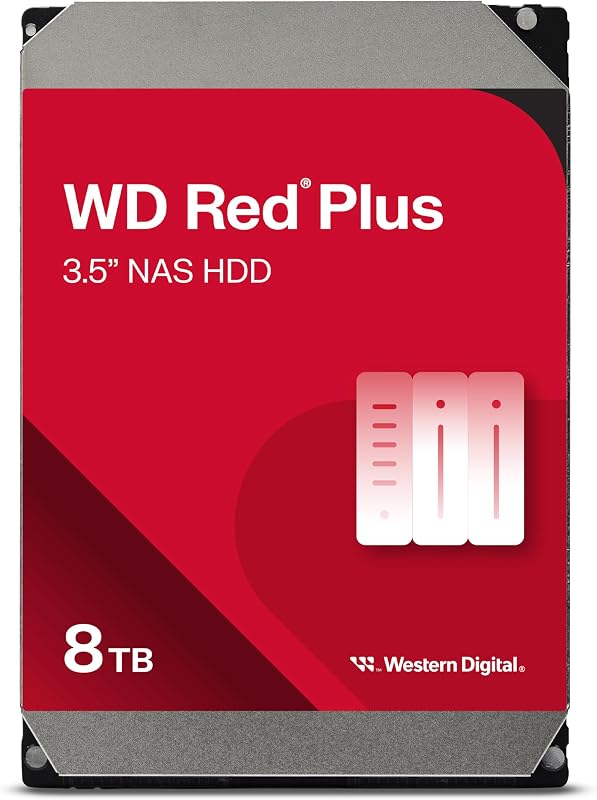
The single deciding factor between the WD Red Plus 8TB and the Seagate Exos X18 is the balance between operating acoustics in small spaces and continuous enterprise-grade throughput. Western Digital tunes this Red Plus drive with a slower spindle speed for lower vibration inside desktop enclosures, while Seagate engineers the Exos line to survive non-stop multi-user access inside dense enterprise server racks.
Choose the WD Red Plus 8TB if you need a quiet, low-vibration mechanical drive tailored for a network-attached storage box sitting in a home office or living room. Choose the Seagate Exos X18 if you run intense enterprise workloads, require massive multi-terabyte capacity scaling, and demand a five-year warranty.


WD Red Plus 8TB vs Seagate Exos X18 at a Glance
| Feature | WD Red Plus 8TB | Seagate Exos X18 |
|---|---|---|
| Digital Storage Capacity | 8 TB (8000 GB) | 16 TB |
| Rotational Speed | 5640 RPM | 7200 RPM |
| Interface | SATA 6.0 Gb/s | SATA 6.0 Gb/s |
| Hardware Form Factor | 3.5-inch | 3.5-inch |
| Workload Rate / MTBF | 180 TB/year | 2.5 million hours MTBF |
| Firmware Optimization | NASware firmware | Seagate Secure technology |
| Enclosure Capability | Up to 8 bays | Dense rack architectures |
| Listed Transfer / Read Rate | 215 MB/s data transfer rate | 215 MB/s read speed (261 Mb/s listed transfer) |
| Warranty Coverage | 3-year limited warranty | 5-year limited warranty |
| Best For | Quiet home NAS and SOHO media servers | Heavy enterprise storage and high-load servers |
Spindle Speed and Acoustic Presence in Living Spaces
Rotational speed dictates how much noise and physical vibration a hard drive produces while spinning platters and moving internal read-write heads. The WD Red Plus 8TB RPM speed is set to 5640 RPM, a deliberate design choice aimed at reducing turbulence inside the metal housing. In home offices, living rooms, or media closets, high-frequency motor whine and loud head chatter can quickly turn an ambient server into an irritating distraction. A drive operating at 5640 RPM produces less physical friction, enabling quieter 24×7 background execution.
By comparison, the Seagate Exos X18 spins at 7200 RPM, the traditional baseline for data center components. That rapid rotational velocity ensures sectors pass underneath the heads faster, but it also generates noticeable seek chitter and resonance. When evaluating the WD Red Plus vs Exos noise level, enterprise drives like the Exos X18 expect to live inside sound-dampened server rooms or dedicated equipment closets with active rack fans. If an uninsulated multi-bay NAS sits next to your workspace, multiple 7200 RPM drives will make their mechanical presence known during parity checks and automated backups.
Thermal dissipation also tracks closely with rotational speed. The slower motor on the WD Red Plus draws less sustained operational friction, keeping operational heat lower across tight enclosure arrangements where airflow is constrained. The Exos X18, while engineered for efficient rack integration, relies on steady ambient cooling to counteract the heat generated by its high-speed motor. For users building a desktop enclosure where silent background operation is paramount, the lower spindle speed of the Western Digital model avoids excessive noise issues entirely.
Edge: WD Red Plus 8TB, because its 5640 RPM motor operates with significantly lower acoustic noise and vibration in desktop NAS environments.
Workload Endurance and Continuous Operation Ratings
Drive endurance ratings define the volume of data you can write, read, and rewrite without exceeding the component’s tested operational boundaries. The WD Red Plus 8TB specifications state support for up to a 180 TB per year workload rate. Western Digital defines this metric through annualized read and write volume over 8,760 power-on hours, making it appropriate for typical small business file sharing, streaming personal media libraries, and nightly system images across SOHO setups. Those considering other consumer-tier alternatives might compare the seagate ironwolf 8tb vs wd red plus 8tb to evaluate workload differences across NAS tiers.
The Seagate Exos X18 leaves consumer NAS limitations behind, stepping straight into hyper-scale cloud and enterprise metrics. Rather than quoting a standard consumer workload limit, Seagate rates this enterprise drive for a 2.5 million hour Mean Time Between Failures (MTBF). It is built to run Big Data applications, transactional database queries, and continuous analytical sweeps where disks process data around the clock with zero idle time. The internal actuators and motor components are reinforced specifically to withstand non-stop read-write thrashing.
Surpassing a drive’s workload threshold does not mean immediate failure, but operating a drive far beyond its engineered threshold elevates mechanical wear over time. If your network storage operates primarily as an archive that receives daily backups and streams movies on demand, 180 TB per year is more than adequate. If your storage pool serves dozens of concurrent virtual machines, heavy torrenting, or transactional customer databases, the enterprise-grade construction of the Exos X18 gives you the mechanical margin needed to run heavy arrays safely.
Edge: Seagate Exos X18, because its enterprise engineering and 2.5 million hour MTBF handle relentless multi-user workloads that far exceed a standard 180 TB/year rating.
Warranty Coverage and Long-Term Protection
The manufacturer warranty provides a window into the operating life the engineers expect under continuous use. Western Digital backs the WD Red Plus 8TB with a 3-year limited warranty, matching the industry baseline for consumer-tier NAS hardware. This coverage covers early mechanical faults, board failure, or manufacturing defects over the initial three years of ownership, provided the drive is operated within Western Digital’s regional terms and workload ceilings.
The Seagate Exos X18 warranty extends coverage to a 5-year limited warranty, accompanied by integrated Seagate Secure technology. Two additional years of factory warranty protection offer meaningful peace of mind for buyers deploying drives into production clusters. In any multi-drive array, hard drive failures will happen eventually; knowing that an enterprise drive remains eligible for manufacturer replacement well into year four and five lowers total operational risk. Shoppers weighing enterprise hardware against standard performance lines often examine the wd black hdd 6tb vs seagate exos x18 to see how warranty terms diverge.
Security features also differentiate enterprise offerings from residential components. The Exos X18 incorporates Seagate Secure hardware features designed to safeguard sensitive data during retirement or repurposing. While home media hoarders might rarely invoke enterprise cryptographic erase protocols, small businesses holding critical financial or client records gain tangible value from hardware-level data protection. Combined with the longer five-year warranty period, Seagate provides a noticeably higher level of investment defense.
Edge: Seagate Exos X18, because its 5-year limited warranty provides two additional years of coverage over Western Digital’s 3-year term.
Firmware Tuning and Multi-Bay Enclosure Integration
Firmware dictates how a hard drive communicates with host RAID controllers, manages read errors, and handles vibration from neighboring disks. The WD Red Plus 8TB includes specialized NASware firmware tailored explicitly for RAID-optimized NAS systems housing up to 8 drive bays. A primary role of NASware is handling error recovery controls; standard desktop drives may stall for minutes attempting to recover a corrupted sector, leading RAID controllers to drop them from an array. NASware limits this error recovery window, keeping the drive online and maintaining the integrity of ZFS, Synology Hybrid RAID, or traditional RAID pools.
The Seagate Exos X18 relies on enterprise-grade firmware tailored for high-density architectures, low latency, and consistent response times through advanced caching algorithms. Enterprise server racks pack dozens of hard drives into a single chassis, producing severe structural resonance. The Exos X18 firmware is designed to manage intense multi-drive vibration in dense rack systems where high capacity and rack efficiency matter most. Readers looking at other high-capacity alternatives can review the wd red plus 8tb vs toshiba n300 8tb to see how competing drives balance bay limits against performance.
The distinction between 8-bay limits and open rack scalability comes down to chassis design. Western Digital explicitly rates this Red Plus drive for up to 8 bays, making it an ideal candidate for common consumer 2-bay, 4-bay, and 8-bay desktop appliances. The Exos X18 is unrestricted in bay count, allowing you to populate enterprise shelves holding 24 or 48 drives without crossing manufacturer operational tolerances. For compact consumer towers, NASware ensures hassle-free plug-and-play compatibility, but Exos firmware allows limitless physical scaling.
Edge: WD Red Plus 8TB, because its specialized NASware firmware is directly targeted and tuned for plug-and-play operation in 1-to-8 bay desktop NAS units.
Data Throughput and Latency Performance
Throughput speeds dictate how rapidly your storage array can ingest massive system backups or perform sequential file transfers across a local area network. In the Western Digital listing, the WD Red Plus 8TB specifies a maximum data transfer rate of 215 MB/s (alongside an anomalous read speed listing of 445 bytes per second). That 215 MB/s transfer rate easily saturates a standard 1-Gigabit Ethernet connection (which caps out around 115 to 125 MB/s) and delivers strong performance during large sequential reads or writes on faster network interfaces.
The Seagate Exos X18 listing outlines a 215 MB/s read speed, a media speed of 550, a listed data transfer rate of 261 Mb/s, and a 7200 RPM rotational speed. Beyond raw megabytes transferred per second, rotational speed plays a vital physical role in transactional response times. Because platters inside the Exos complete a rotation in 8.3 milliseconds compared to the 10.6 milliseconds required by a 5640 RPM drive, the Exos reduces rotational latency. For random read and write operations, such as running a database or serving files to many network users simultaneously, lower latency provides faster request resolution. Comparisons like the toshiba n300 8tb vs seagate exos x18 reflect how 7200 RPM enterprise disks outperform slower consumer drives in concurrent operations.
When selecting between Seagate Exos X18 vs WD Red Plus 8TB for multi-user tasks, seek times heavily influence day-to-day usability. While both drives handle large sequential media files effortlessly, the Exos X18 and its improved enterprise caching architecture maintain lower latency under heavy transactional pressure. The WD Red Plus provides steady, dependable streaming for small teams, but the Exos X18 handles complex, fragmented read-write traffic without getting bogged down.
Edge: Seagate Exos X18, because its 7200 RPM rotational speed delivers lower access latency and higher sustained responsiveness under multi-client loads.
Pros and Cons
WD Red Plus 8TB
Pros
- Quiet 5640 RPM low-vibration operation
- Tuned specifically for 1-8 bay desktop NAS
- NASware firmware optimizes RAID and ZFS rebuilds
- Lower power-on heat output in tight enclosures
Cons
- Workload rate capped at 180 TB per year
- Shorter 3-year limited warranty coverage
View WD Red Plus 8TB on Amazon
Seagate Exos X18

Pros
- Fast 7200 RPM rotational speed reduces latency
- 5 million hour MTBF enterprise reliability rating
- Extended 5-year limited manufacturer warranty
- Engineered for dense, high-vibration server racks
Cons
- Audible seek chatter and operational noise
- Requires active cooling and rigid mounting
View Seagate Exos X18 on Amazon
Who Should Buy Each One
Choose the WD Red Plus 8TB If
- Your NAS sits inside a home office, living room, or bedroom where 5640 RPM acoustic dampening is required.
- You are populating an appliance with between 1 and 8 drive bays for family photo backups, media streaming, or SOHO file archiving.
- Your planned write and read traffic remains well within the rated 180 TB per year workload ceiling.
- You manage RAID arrays built on ZFS or standard desktop RAID architectures that benefit from NASware firmware.
Choose the Seagate Exos X18 If
- You run demanding server applications, virtual machines, or heavy multi-user databases that require 7200 RPM low-latency response times.
- You want a generous 5-year limited warranty backed by a 2.5 million hour MTBF reliability rating.
- Your equipment is installed inside an isolated server rack, basement, or closet where acoustic noise and vibration are not an issue.
- You need the massive capacity of a 16TB enterprise drive to maximize rack storage density.
Final Verdict
Choosing between the WD Red Plus 8TB and the Seagate Exos X18 requires matching your physical deployment environment to your workload profile. For most residential users and small home office environments, the WD Red Plus 8TB is the smarter, more practical purchase. Its 5640 RPM rotational speed minimizes annoying operational noise and mechanical vibration, while its NASware firmware delivers seamless compatibility with popular 1-to-8 bay desktop NAS enclosures. Unless you are running an aggressive commercial server in your bedroom, the acoustic comfort and balanced 180 TB/year endurance of the Red Plus align perfectly with daily personal storage needs.
The Seagate Exos X18 claims absolute victory when the criteria shift to heavy computational workloads, enterprise durability, and extended warranty protection. With its 7200 RPM motor, 2.5 million hour MTBF rating, and 5-year limited warranty, the Exos X18 outclasses consumer drives in sustained read-write operations and heavy multi-tenant hosting. If your storage sits in a dedicated equipment space where motor noise is irrelevant, or if you need massive 16TB density to expand a production server, the Exos X18 provides true commercial-grade endurance. You can also compare traditional high-performance desktop options in our wd red plus 8tb vs black hdd 6tb breakdown to see how desktop drives differ from dedicated network storage.
FAQ
Can I use both the WD Red Plus 8TB and Seagate Exos X18 in the same RAID array?
While you technically can combine both drives in a software RAID or JBOD pool because both use standard SATA 6.0 Gb/s interfaces, it is not recommended. The WD Red Plus spins at 5640 RPM while the Seagate Exos X18 spins at 7200 RPM, which creates mismatched latency and varied vibrational harmonics across your drive cages. In a synchronized RAID array, the performance of the pool will naturally bottleneck at the speed of the slowest drive.
Is the Seagate Exos X18 too loud for a desktop NAS in a living room?
For most users, yes. The Seagate Exos X18 is an enterprise drive designed for server racks where acoustic output is secondary to airflow and sustained performance. Its 7200 RPM motor and heavy actuator movements produce distinct head chatter and hum that can easily be heard in a quiet room, whereas the 5640 RPM spindle speed of the WD Red Plus 8TB is tuned to keep noise levels unobtrusive.
What does the 180 TB per year workload rate on the WD Red Plus 8TB mean?
The 180 TB/year workload rate represents the total volume of user data transferred to and from the drive annualized over 8,760 power-on hours. It serves as a manufacturer reliability benchmark for typical small business or home server usage. Exceeding this metric does not instantly break the disk, but it indicates that the drive is handling traffic heavier than what Western Digital engineered this specific model to absorb comfortably.
Why does the Seagate Exos X18 have a longer warranty than the WD Red Plus?
The Seagate Exos X18 is classified as an enterprise-grade hard drive designed for hyper-scale cloud deployments, which carries a 5-year limited warranty and a 2.5 million hour MTBF rating. The WD Red Plus 8TB is targeted at small-to-medium business and SOHO environments, carrying a 3-year limited warranty standard for consumer and desktop network-attached storage units.
Can the WD Red Plus 8TB be used in servers with more than 8 drive bays?
Western Digital specifies that the WD Red Plus line is built and tested for NAS systems holding up to 8 bays. In larger server enclosures containing 12, 16, or 24 drives, mechanical vibration from adjacent disks compounds significantly. If your deployment requires larger multi-drive chassis, an enterprise model like the Seagate Exos X18 is engineered for dense rack architectures without an arbitrary bay limit.
Does the Seagate Exos X18 require special enterprise controller cards to operate?
No, the Seagate Exos X18 listed here utilizes a standard SATA 6.0 Gb/s connectivity interface and 3.5-inch form factor. It plugs into standard SATA ports found on consumer desktop motherboards, standard NAS units, and backplanes, provided the host operating system and hardware support large drive capacities.