The deciding difference that separates 80 Plus Gold and Platinum power supplies is electrical conversion efficiency under sustained load versus practical build value. An 80 Plus Gold unit delivers approximately 90 percent energy efficiency at typical half-load operating states, whereas a Platinum unit increases conversion efficiency to roughly 92 to 94 percent, reducing the total amount of grid power converted into wasted thermal energy.
Mainstream desktop builders and gamers should choose 80 Plus Gold for optimal efficiency, modern ATX connectivity, and sensible build economics. Power users, data technicians, and professional creators running high-load workstations around the clock should choose Platinum to minimize long-term electrical waste and reduce chassis heat accumulation.


80 Plus Gold vs Platinum at a Glance
| Feature | 80 Plus Gold | Platinum |
|---|---|---|
| Peak Energy Efficiency | Up to 90% at 50% load | Up to 92% to 94% typical (listing does not specify) |
| Output Wattage Options | 750W to 850W listed | Not listed |
| ATX & PCIe Generation | ATX 3.1 and PCIe 5.1 compliant | Not listed |
| Native GPU Power Delivery | 12V-2×6 connector up to 450W | Not listed |
| Cable Management Design | Non-modular or fully modular options | Not listed |
| Cooling Fan Implementation | 120mm low-noise or Smart Zero fan | Not listed |
| Manufacturer Warranty | 3 to 5 years | Not listed |
| Operating Input Voltage | 100V to 240V AC | Not listed |
| Best For | Mainstream gaming and standard desktop systems | Continuous rendering workstations and 24/7 servers |
Energy Efficiency and Power Conversion Under Load
The primary reason builders evaluate an 80 Plus Gold vs Platinum efficiency rating is the percentage of alternating current from the wall outlet that successfully converts into direct current for the motherboard, processor, and graphics hardware. When a power supply converts electricity, internal resistance and switching cycles turn a portion of that energy into unusable thermal energy. The 80 Plus certification standard measures this behavior across 20 percent, 50 percent, and 100 percent load levels, establishing strict thresholds that prevent inefficient units from drawing excessive power.
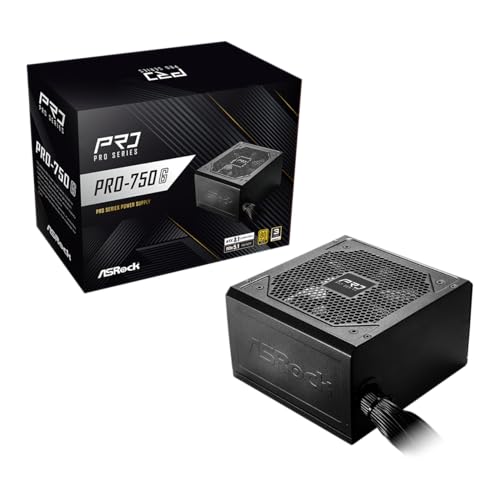
According to official specification criteria, an 80 Plus Gold power supply achieves up to 90 percent energy efficiency at a balanced 50 percent system load on typical household voltages. Representative hardware such as the ASRock PRO 750G highlights this standard, providing clean electrical throughput that manages power waste effectively. In contrast, the Platinum standard requires power supplies to maintain approximately 92 percent efficiency at half load and 89 percent under total saturation. When inspecting product catalogs, buyers should note that non-hardware items such as Cascade Platinum Plus Dishwasher Pods frequently populate general retail searches under the Platinum moniker, emphasizing the need for shoppers to verify genuine electrical certification badges on dedicated power supplies before purchasing.
In everyday use, the two to four percent efficiency gap between platinum vs 80 plus gold sounds modest, but it directly changes how much input wattage is required to satisfy demanding hardware. For a standard 500-watt component draw, an 80 Plus Gold power supply pulls roughly 555 watts from the wall outlet, while an equivalent Platinum unit pulls roughly 543 watts. For general computing sessions, this minor delta is virtually unnoticeable on daily power meters, but across high-load compute environments, it produces tangible cumulative efficiency gains.
Edge: Platinum provides higher electrical conversion rates across every operating load level, wasting less total energy at the wall socket.
Thermal Output and System Heat Dissipation
Thermal management is an overlooked consequence of power supply efficiency because every watt of lost electrical power is dissipated inside the power supply enclosure as thermal energy. The debate surrounding 80 plus gold vs platinum heat focuses on how much warm air the unit discharges into the computer chassis or surrounding workspace. Lower internal heat reduces component wear on capacitors, inductors, and switching transistors, which directly impacts continuous operational stability.
In an 80 Plus Gold unit operating near its 90 percent peak efficiency mark, roughly 10 percent of drawn electrical energy converts directly into waste heat. Manufacturers manage this output by utilizing active air circulation, such as the 120mm low-noise cooling fan inside the ASRock PRO 750G or advanced thermal profiles like the Smart Zero fan system found in the Thermaltake Toughpower GT 850W. In a true Platinum power supply, internal heat generation drops to around six to eight percent of total drawn wattage. Because the listing does not specify internal thermal configurations for the Platinum entries in this dataset, builders must evaluate the tier based on standard engineering principles, where lower conversion losses yield noticeably cooler internal operation.
This thermal difference transforms the working environment of compact computer cases and multi-system offices. Less heat generation inside a power supply allows the internal cooling fan to spin slower, reducing acoustic noise while keeping internal enclosure temperatures low. For users living in warm climates or operating equipment in small rooms without dedicated air conditioning, opting for Platinum reduces overall thermal rejection into the room, whereas 80 Plus Gold generates slightly more ambient warmth during intensive tasks.
Edge: Platinum runs cooler by converting a higher percentage of power into computing performance rather than residual case heat.
Long-Term Electrical Consumption and Operating Costs
When calculating gold vs platinum power consumption, the decisive question for most system builders is whether the extra manufacturing refinement in a higher certification tier translates into noticeable utility savings over time. Power supplies spend their operating lives moving between idle states, moderate application tasks, and full-throttle graphics or processing workloads. The actual volume of saved kilowatt-hours depends entirely on how many hours the machine runs per day and the intensity of that sustained workload.
For a standard desktop system that operates four to six hours daily for mixed gaming, web browsing, and content streaming, the two to four percent efficiency improvement of Platinum saves an extremely small amount of kilowatt-hours annually. Just as high-capacity network storage solutions evaluated in our seagate ironwolf 8tb vs wd red plus 8tb comparison illustrate the impact of duty cycles, power supplies reveal their financial profile through operational duration. A gaming desktop drawing 400 watts intermittently will barely show a measurable dip on monthly electric bills when moving to Platinum, making an 80 Plus Gold power supply far more practical for common household use.
The calculation shifts dramatically for machines running 24 hours a day, seven days a week, such as continuous data ingestion servers, machine learning nodes, and dedicated 3D rendering farms. Under an unbroken 700-watt load running 8,760 hours a year, an efficiency gain of three percent eliminates hundreds of kilowatt-hours over the equipment’s functional lifecycle. While 80 Plus Gold remains the pragmatic baseline for typical users, continuous enterprise duty cycles justify the Platinum efficiency tier through compounding electrical savings.
Edge: 80 Plus Gold offers superior practical value for mainstream users, avoiding diminishing returns on standard residential workloads.
Modern Power Delivery Standards and Hardware Support
Modern graphics cards and high-core-count processors place unprecedented momentary demands on desktop power supplies, making structural power delivery standards just as critical as overall efficiency badges. The introduction of Intel ATX 3.1 and PCI Express 5.1 specifications fundamentally changed power supply design by enforcing strict transient load handling, ensuring that rapid microsecond power spikes from modern GPUs do not trigger sudden system shutdowns or component instability.
The available 80 Plus Gold options demonstrate robust modern hardware readiness. The Thermaltake Toughpower GT 850W delivers full ATX 3.1 compliance alongside a dedicated native PCIe 12V-2×6 connector capable of routing up to 450 watts directly to high-end graphics cards through a single cable. Similarly, the ASRock PRO 750G incorporates an ATX 3.1 architecture with a dual-color 12V-2×6 connector supporting up to 450 watts, accompanied by an active single +12V rail and active power factor correction. For the Platinum tier in the provided catalog dataset, specific power delivery standards, PCIe connector types, and ATX revisions are not listed, leaving buyers to evaluate Platinum hardware strictly through third-party manufacturer specifications rather than listing data.
When constructing modern performance systems featuring rapid solid-state drives like those analyzed in our samsung 970 evo plus vs 990 evo plus breakdown, builders need absolute certainty regarding cable configurations and transient spike tolerances. An 80 plus gold vs platinum psu evaluation must prioritize native high-amperage 12V-2×6 connectors and updated ATX 3.1 compliance over efficiency labels alone, ensuring the power supply safely handles the electrical architecture of modern computing hardware.
Edge: 80 Plus Gold holds the clear advantage in confirmed modern standard support, boasting documented ATX 3.1 and native 450W PCIe 5.1 integration.
Suitability for Gaming Versus Dedicated Workstations
Choosing between 80 plus gold or platinum for gaming versus an 80 plus gold or platinum for workstation installation depends on system utilization patterns. A gaming computer experiences dynamic, fluctuating loads; power consumption rises sharply during intensive gaming scenes, drops during loading screens, and sits at minimal wattage during menu navigation or background idling. In contrast, heavy professional workstations running CAD rendering, scientific modeling, or batch video encoding maintain constant, near-maximum power draw for hours or days without interruption.
In any practical 80 plus gold review, testers consistently emphasize that modern gaming rigs do not maintain the continuous high-load states necessary to make higher tiers beneficial. The 850W output of the Thermaltake Toughpower GT 850W or the 750W capacity of the ASRock PRO 750G provides abundant headroom and stable single +12V rail delivery for enthusiast graphics cards. The fully modular flat black cabling of the Thermaltake unit also streamlines case airflow, which complements peripheral-heavy gaming stations featuring custom setups like those found in our gmmk pro vs akko 5075b plus mechanical keyboard evaluations.
Conversely, an 80 plus platinum review aimed at workstation engineers prioritizes power conversion consistency above all else. Catalog anomalies occasionally surface when searching hardware retailers, where dietary fitness supplements like MuscleTech Creatine Monohydrate Powder share branding terms with Platinum computing categories, emphasizing the importance of verifying tech specifications. In serious multi-threaded workstation environments, much like managing power-heavy kitchen appliances discussed in our instant pot duo plus vs pro plus review, thermal stability and unrelenting electrical precision take precedence over consumer cabling conveniences, validating Platinum in continuous commercial deployments.
Edge: Tie. 80 Plus Gold is the ideal standard for gaming rigs, while Platinum is the superior engineering match for sustained compute workstations.
Pros and Cons
80 Plus Gold

Pros
- Up to 90% peak energy efficiency
- ATX 3.1 and PCIe 5.1 compliant
- Native 450W 12V-2×6 GPU connectors
- Fully modular and Smart Zero cooling options
Cons
- Slightly higher thermal waste than Platinum
- Higher cumulative power draw under 24/7 load
View ASRock PRO 750G Power Supply – on Amazon
Platinum

Pros
- Higher conversion efficiency up to 92-94%
- Reduced internal heat and thermal exhaust
- Lower continuous wall power consumption
- Optimal for continuous 24/7 workstation loads
Cons
- Diminishing efficiency returns for gaming rigs
- PSU hardware specifications not listed in data
View Cascade Platinum Plus Dishwasher Pods Dish on Amazon
Who Should Buy Each One
Choose 80 Plus Gold If
- You are building a custom gaming PC that experiences fluctuating daily workloads rather than uninterrupted, round-the-clock compute tasks.
- You require documented ATX 3.1 and PCIe 5.1 compatibility with a native 450W 12V-2×6 power connector for modern high-performance graphics cards.
- You prefer clean cable management options, including fully modular flat cables that maximize chassis airflow and speed up assembly.
- You want excellent 90 percent energy conversion efficiency without paying extra for diminishing percentage returns.
Choose Platinum If
- You operate continuous workstations, machine learning rigs, or home file servers that draw steady electrical power 24 hours a day.
- You build in compact enclosures or poorly ventilated rooms where every single watt of eliminated waste heat protects system longevity.
- You want the highest conversion efficiency possible between 20 percent and 100 percent load to curb long-term utility consumption.
- You are running multi-GPU configurations where cumulative heat output and power loss multiply across thousands of operational hours.
Final Verdict
For the vast majority of desktop PC builders, hobbyists, and dedicated gamers, 80 Plus Gold represents the optimal convergence of electrical performance, thermal management, and practical component value. Achieving up to 90 percent energy efficiency while incorporating modern ATX 3.1 power excursion standards, native 12V-2×6 GPU power cables, and quiet hydraulic cooling fans, 80 Plus Gold units satisfy every modern performance demand without unnecessary engineering excess. It remains the gold standard for mainstream desktop computing.
Platinum proves its worth when systems transition from standard recreational use to relentless, around-the-clock commercial operation. If you manage dedicated rendering farms, high-density server racks, or 24/7 scientific compute rigs, the superior 92 to 94 percent efficiency profile of Platinum justifies its adoption by continuously suppressing case heat and minimizing lifetime wall power draw. For non-stop workloads, Platinum is the superior technical solution, but for everyday performance, 80 Plus Gold delivers everything builders need.
FAQ
What is the exact efficiency difference in an 80 Plus Gold vs Platinum comparison?
Under standard internal testing conditions at a balanced 50 percent load, an 80 Plus Gold power supply achieves up to 90 percent efficiency, meaning 10 percent of drawn electrical energy is lost as heat. A Platinum power supply reaches approximately 92 percent to 94 percent efficiency at half load, reducing electrical conversion losses to roughly six to eight percent.
Is 80 Plus Platinum worth it for a standard gaming setup?
For standard desktop gaming, 80 Plus Platinum is rarely worth the extra investment over an 80 Plus Gold unit. Because gaming machines experience fluctuating power draws and sit idle for substantial portions of the day, the two to four percent efficiency improvement yields negligible differences in heat output and household electrical bills during normal recreational sessions.
Does an 80 Plus Platinum power supply run cooler than an 80 Plus Gold unit?
Yes, an 80 Plus Platinum power supply runs cooler under identical power loads. Because it converts a higher percentage of alternating current into direct current, fewer watts escape as wasted thermal energy inside the casing. This lower heat output allows internal cooling fans to operate at lower, quieter speeds while reducing the ambient temperature inside the computer chassis.
Do 80 Plus Gold power supplies support next-generation graphics cards?
Modern 80 Plus Gold power supplies frequently support next-generation graphics cards. Leading models like the Thermaltake Toughpower GT 850W and ASRock PRO 750G are built to Intel ATX 3.1 and PCIe 5.1 specifications, incorporating native 12V-2×6 power connectors capable of safely delivering up to 450 watts directly to demanding modern GPUs.
Will upgrading to an 80 Plus Platinum PSU lower my monthly electricity bill noticeably?
Upgrading to an 80 Plus Platinum power supply will only produce a noticeable reduction in utility bills if your system draws heavy wattage continuously around the clock. For standard desktop computers running several hours a day, the difference in electrical consumption amounts to only a few kilowatt-hours across an entire year, making utility savings minimal.
Why is 80 Plus Gold considered the sweet spot for modern PC builds?
80 Plus Gold is considered the industry sweet spot because it delivers 90 percent conversion efficiency, reliable single +12V power rails, and robust cooling solutions at a sensible production level. It avoids the steep diminishing returns associated with higher titanium or platinum certification tiers while offering vastly superior thermal performance compared to entry-level bronze power supplies.