The choice between the DeWalt DCF850 and the DeWalt DCF888 comes down to a fundamental trade-off between physical maneuverability in restricted spaces and smart digital inventory tracking. Both drivers generate identical maximum torque figures, yet the DCF850 prioritizes a lightweight build engineered to clear tight structural framing, whereas the DCF888 incorporates integrated Tool Connect technology designed to monitor, customize, and secure the driver across commercial jobsites.
Carpenters, cabinetmakers, and general remodelers needing maximum clearance for framing and mechanical rough-ins should pick the DCF850. Commercial contractors, fleet managers, and site supervisors managing multiple crews and valuable tool trailers should pick the DCF888.


DeWalt DCF850 vs DCF888 at a Glance
| Attribute | DeWalt DCF850 | DeWalt DCF888 |
|---|---|---|
| Maximum Torque | 1825 in-lb | 1825 in-lb |
| Maximum Speed | 3250 rpm | 3250 rpm |
| Maximum Power Output | 336 watts | 300 watts |
| Bare Tool Weight | 2.2 pounds | 2.8 pounds |
| Length Front to Back | 6.5 inches | 5.3 inches |
| Speed and Mode Controls | Variable 3 speed trigger | Home mode and 3 programmable modes |
| Bluetooth Connectivity | Not listed | Tool Connect with Last Seen tracking |
| Included Components | Belt Clip, Impact Driver | Impact Driver, (2) 2Ah Batteries, Charger, Kit Box |
| Best For | Tight-clearance framing and general trade work | Commercial site tracking and custom digital setups |
Tool Connect Bluetooth and Fleet Asset Tracking
Jobsite loss, tool theft, and asset confusion represent massive operational drains on busy commercial sites. The DCF888 directly targets this friction through built-in Tool Connect connectivity that pairs with mobile software after holding down the tool foot button for three to five seconds. Once paired, the driver reports its Last Seen position by logging the physical street address of the last connected mobile device. Facility managers and general contractors can assign the driver to specific workers and jobsites via the Tool Connect Inventory Manager software, establishing digital accountability across sprawling locations. The listing also highlights internal diagnostic monitoring that tracks coin cell battery life, tool temperature, internal operating time, and total trigger pulls. When monitoring larger tool rosters, you can read our dewalt dcf845 vs dcf888 comparison to see how standard XR platforms stack up against connected models.
Beyond asset logging, the DCF888 includes security measures such as disable-when-out-of-range alerts. If an unassigned user carries the driver beyond the designated wireless perimeter, the tool can shut down, creating a direct theft deterrent on active commercial jobs. By contrast, any standard DeWalt DCF850 review confirms that this ultra-compact model contains zero wireless components, diagnostic sensors, or pairing modules. It operates purely as an analog power tool without the ability to broadcast its location, report heat build-up, or prevent unauthorized use outside a job trailer.
For an individual tradesperson working on residential remodels, the absence of smart electronics is often a non-issue. However, for team leaders trying to determine if the smart ecosystem is helpful, considering whether is DCF888 worth it depends entirely on how much lost inventory costs the business annually. The smart diagnostic array provides preventative data that helps supervisors catch overheating or maintenance issues before a tool breaks down entirely during an active installation phase.
Edge: DeWalt DCF888 because it incorporates native Tool Connect tracking, street-address mapping, theft disablement, and comprehensive diagnostic telemetry.
Dimensions and Handling in Confined Quarters
Clearance dictates productivity whenever fasteners sit between dense joists, under vanities, or within narrow mechanical chases. When weighing DCF850 or DCF888 for tight spaces, physical body geometry shapes which driver fits without requiring bulky right-angle adapters. The DCF850 listing shows a compact design measuring 8 inches tall with a package length of 6.5 inches, an overall width of 3 inches, and an ultra-light bare weight of 2.2 pounds (with the description noting an agile 2.1-pound weight). Crucially, the DCF850 listing specifies that it can accept 1-inch bit tips directly into its 1/4-inch hex collet, allowing bits to sit flush against the nosecone and drastically minimizing the combined tool-and-bit length.
The DCF888 listing highlights a compact front-to-back length of 5.3 inches and a bare tool weight of 2.8 pounds without a battery pack installed. While 5.3 inches front-to-back remains respectably compact for an XR-tier driver, the tool foot houses the Tool Connect antenna, internal coin cell battery compartment, and pairing switches, which add bulk across the base. The 0.6-pound weight increase over the DCF850 becomes immediately noticeable during overhead dry-wall fastening, electrical conduit hanging, or extended structural framing sessions. Those evaluating compact ergonomics can also examine our dewalt dcf809 vs dcf850 evaluation to assess alternative compact profiles.
Examining the concrete DCF850 vs DCF888 size difference reveals distinct operational philosophies. The DCF850 minimizes mass above the hand to maneuver seamlessly into stud bays, plumbing penetrations, and custom cabinetry. The DCF888 maintains a short front-to-back head length, but its added base electronics and heavier 2.8-pound bare weight place greater strain on the forearm over an eight-hour shift. If driving screws into cramped, awkward crevices represents daily workflow, the lighter footprint of the DCF850 provides superior dexterity.
Edge: DeWalt DCF850 because its lighter 2.2-pound body and 1-inch bit tip compatibility make it far more agile in awkward, restricted positions.
Torque, Speed, and Motor Output
Driving structural fasteners, lag bolts, and extensive deck screws requires sustained rotational power and consistent rotational velocity. Comparing DeWalt DCF850 vs DCF888 specs shows that both drivers achieve an identical top-end speed of 3,250 RPM and deliver a matching maximum rating of 1,825 in-lb. When checking pure DCF850 vs DCF888 torque numbers, neither tool outpulls the other under maximum load. Both drivers easily seat timber screws and drive heavy fasteners across residential decking and commercial framing assemblies.
A notable distinction appears in maximum electrical power output. The listing specifications assign a maximum power rating of 336 watts to the DCF850, compared to 300 watts for the DCF888. This 36-watt advantage indicates that the brushless motor inside the DCF850 draws higher sustained electrical wattage under intense driving applications, supported by its listed 16-amp operating draw versus the 2-amp rating recorded on the DCF888 data sheet. For drilling tasks, the DCF850 notes a 1-inch drilling capacity in both wood and metal, while the DCF888 listing notes a 20 mm (approximately 0.78-inch) drilling capacity in wood. Readers interested in how standard XR power plants compare with newer brushless units can see our dewalt dcf850 vs dcf887 breakdown.
In routine driving tasks involving standard framing fasteners or drywall screws, users will experience virtually indistinguishable driving speeds due to the identical 3,250 RPM ceiling. However, when sinking larger structural wood screws that push the motor toward its limits, the higher 336-watt capacity of the DCF850 provides slightly more motor headroom. The DCF888 matches torque pound-for-pound, but its brushless motor tuning is optimized to pair with runtime diagnostics rather than higher peak wattage.
Edge: DeWalt DCF850 due to a higher maximum motor power rating of 336 watts compared to 300 watts on the DCF888.
Trigger Control, Speed Settings, and App Customization
Controlling power delivery prevents stripped fasteners, snapped screw heads, and damaged workpieces, especially when assembling delicate cabinetry or driving self-tapping sheet metal screws. The DCF850 uses a physical variable 3-speed trigger mechanism. This layout gives the operator three hardware-defined speed brackets selectable on the tool itself, allowing quick manual changes on the fly. It also incorporates an integrated 3 LED work light to illuminate dark work enclosures. For trades needing immediate, unencumbered speed changes without consulting a mobile device, this mechanical arrangement remains intuitive and reliable. You can read more about standard control profiles in our dewalt dcf845 vs dcf850 guide.
The DCF888 takes drive control into fully programmable software territory. The tool features a default Home mode alongside three programmable mode slots directly accessible on the tool base. Using the Tool Connect application, users can precisely calibrate both speed and torque outputs for each individual mode. The app also allows fine-tuning of the Precision Drive control feature, which operates in speed 1 to pause briefly before impacting, preventing over-driving flush fasteners in sensitive materials. Users can even customize the brightness of the LED work lights and define how many seconds the light delay stays illuminated after releasing the trigger.
This level of digital tuning makes a comprehensive DeWalt DCF888 review stand out. While the DCF850 relies on manual trigger modulation within its three fixed gear stages, the DCF888 lets an operator dial in exact operational boundaries. If an apprentice needs to fasten delicate trim without risking workpiece gouging, a supervisor can program Mode 1 with low torque and reduced RPM, locking in consistency across every joint.
Edge: DeWalt DCF888 because of its three programmable digital modes, customizable Precision Drive parameters, and adjustable LED light delay.
Kit Packaging, Battery Inclusions, and Accessories
The configuration of packaging and included accessories significantly influences jobsite readiness right out of the shipping carton. The DCF850 model analyzed here (listing code DCF850B-NBX) ships strictly as a tool-only configuration. The listing confirms it includes the impact driver and a belt clip, listing a 5 amp_hour battery specification on its reference sheet but providing no physical battery pack or wall charger in the actual box. Buyers investing in the DCF850 must already own DeWalt 20V MAX battery packs and compatible chargers, or purchase them separately to begin working.
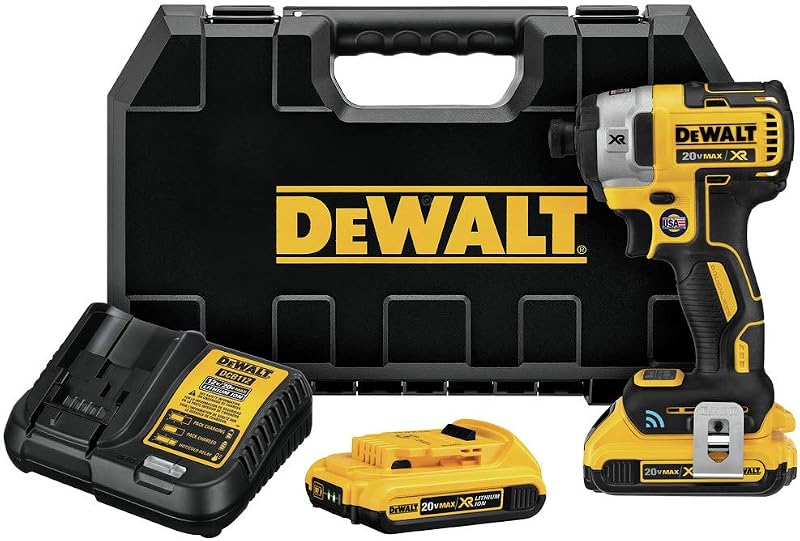
In contrast, the DCF888 configuration evaluated (model number DCF888D2) arrives as a full contractor-ready kit. The listing confirms the package includes the DCF888 Tool Connect impact driver, two DCB203 2Ah XR brushless lithium-ion battery packs, a dedicated charger, and a protective kit box. The included 2Ah compact battery packs complement the 5.3-inch front-to-back chassis, maintaining a balanced center of gravity while keeping the complete tool setup relatively lightweight. Buyers evaluating other bare tools versus kit offerings can cross-reference our dewalt dcf809 vs dcf888 summary.
For operations expanding their fleet or replacing older systems, the DCF888D2 kit provides immediate deployment capability without needing to reallocate batteries from other crews. The inclusion of two batteries ensures one pack can remain on the charger while the other drives fasteners. The DCF850 bare tool avoids redundant chargers for trades who already possess large stacks of 20V MAX batteries, but the DCF888 package delivers superior out-of-the-box readiness.
Edge: DeWalt DCF888 because it ships as a complete kit with two 2Ah batteries, a charger, and a kit box.
Pros and Cons
DeWalt DCF850

Pros
- Lightweight 2.2-pound bare tool chassis
- Higher 336-watt maximum motor output
- Can accept 1-inch bit tips directly
- Shorter 8-inch total profile height
Cons
- Lacks integrated Bluetooth tool tracking
- No mobile app diagnostics or controls
DeWalt DCF888
Pros
- Tool Connect Bluetooth tracking and inventory assignment
- Last Seen street address tracking feature
- Fully customizable modes via mobile app
- Complete kit with two 2Ah batteries
Cons
- Heavier bare tool weight at 2.8 pounds
- Lower 300-watt maximum motor output
Who Should Buy Each One
Choose the DeWalt DCF850 If
- You regularly install cabinetry, framing, plumbing, or electrical work inside cramped wall cavities where an ultra-compact 2.2-pound bare tool is vital.
- You prefer direct mechanical control via a 3-speed trigger selector without needing to configure mobile software.
- You require a driver that accepts 1-inch bit tips directly in the collet to shorten overall working reach.
- You already own DeWalt 20V batteries and want higher 336-watt maximum motor power output.
Choose the DeWalt DCF888 If
- You supervise commercial crews and need Tool Connect Bluetooth tracking to monitor tool locations and assign inventory across jobsites.
- You want theft deterrents, including the ability to disable the impact driver when it moves out of wireless range.
- You require tailored speed, torque, and Precision Drive settings stored across three customized memory modes.
- You need an all-in-one package that includes the driver, two 2Ah batteries, a charger, and a storage kit box.
Final Verdict
For the vast majority of solo tradespeople, general carpenters, and remodelers, the DCF850 is the superior everyday impact driver. Fastening work consistently encounters restricted physical clearances, where shaving more than half a pound of bare-tool weight and using 1-inch bit tips directly in the anvil drastically improves productivity. Delivering a stout 1,825 in-lb of torque with 336 watts of peak output and an intuitive 3-speed variable trigger, the DCF850 provides raw performance and ergonomic agility without requiring digital setup overhead.
The DCF888 emerges as the winner for fleet supervisors, commercial contractors, and multi-user jobsites. When considering DCF850 or DCF888 for contractors managing capital assets across commercial projects, the Tool Connect software ecosystem provides unmatched value. With Last Seen location logging, remote tool disablement, diagnostic telemetry, and deep mode customization, the DCF888 eliminates tool loss and protects company investments across demanding multi-trade environments.
FAQ
Can the DeWalt DCF850 connect to the Tool Connect mobile application?
No. The DCF850 does not feature internal Bluetooth hardware or Tool Connect tracking sensors. All speed and lighting adjustments on the DCF850 are handled directly on the tool body through its 3-speed selector switch and variable trigger.
What is the Last Seen feature on the DeWalt DCF888?
The Last Seen feature on the DCF888 identifies the street address where the driver was last within range of a mobile device running the Tool Connect application. This data helps contractors track missing tools and determine which jobsite or vehicle held the tool last.
Do both impact drivers deliver the same maximum torque?
Yes. According to the manufacturer listings, both the DCF850 and the DCF888 deliver an identical maximum torque output of 1,825 in-lb and share a top rotational speed of 3,250 RPM.
Can the DeWalt DCF850 use standard 1-inch bit tips?
Yes. The DCF850 is specifically listed to accept 1-inch bit tips directly into its 1/4-inch hex chuck, allowing fasteners to sit closer to the motor housing for enhanced clearance in confined areas.
What diagnostic information does the DeWalt DCF888 record?
The DCF888 tracks internal tool temperature, the charge level of its internal coin cell battery, the total run time of the motor, and the cumulative count of trigger pulls, all viewable inside the Tool Connect mobile app.
Does the DeWalt DCF888 come with batteries included?
Yes. The DCF888D2 configuration includes two 2Ah XR brushless batteries, a standard system charger, and a kit box, making it ready for field deployment immediately.
What does Precision Drive do on the DeWalt DCF888?
Precision Drive is an operational feature active in speed 1 that introduces added control during delicate fastening tasks. The user can further customize Precision Drive parameters using the Tool Connect mobile application to avoid stripping fasteners.