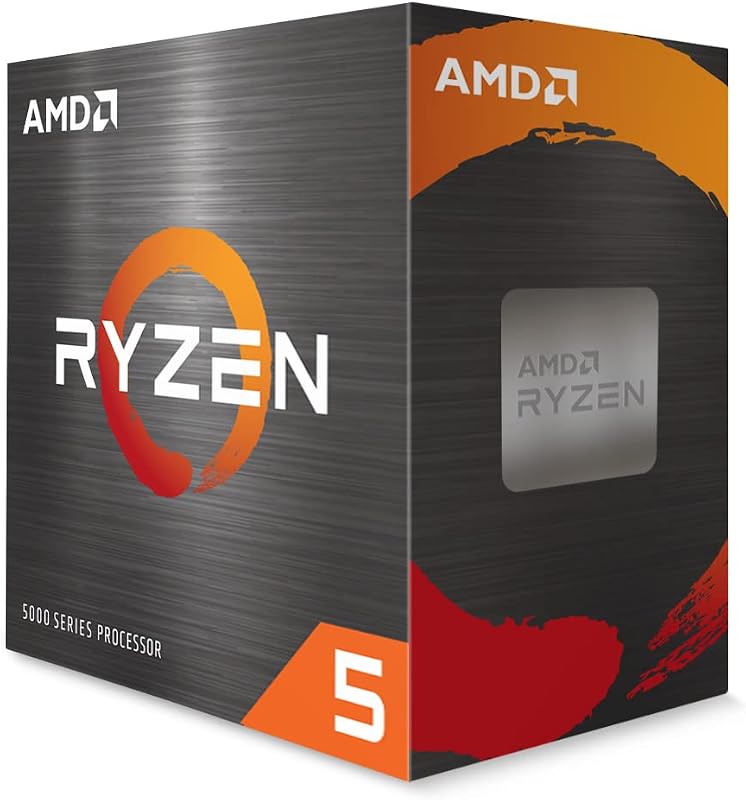
The deciding difference when evaluating the AMD Ryzen 5 7600 vs AMD Ryzen 5 7600X is thermal power management and out-of-the-box cooling. While both desktop processors share identical 6-core, 12-thread Zen 4 silicon, 5 nm manufacturing, and 38 MB of total cache memory, AMD tunes them to two completely different power profiles: a frugal 65-watt envelope paired with a bundled heatsink and fan, versus a high-draw 105-watt configuration tuned for higher factory clock speeds without an included cooler.
Choose the AMD Ryzen 5 7600 if you want an energy-efficient desktop processor with a capable stock cooler ready to run immediately on Socket AM5. Choose the AMD Ryzen 5 7600X if you plan to install a dedicated aftermarket cooling solution and want the highest possible factory base and boost clock rates straight out of the box.
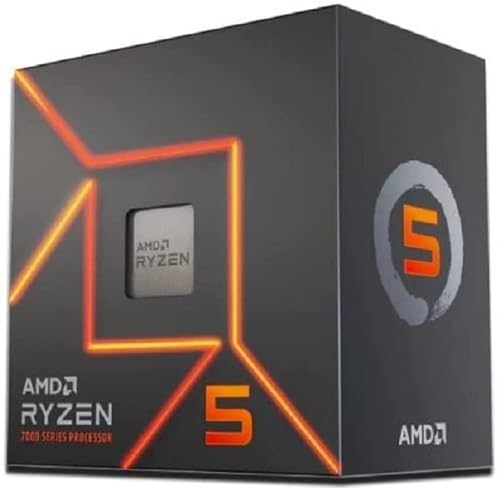

AMD Ryzen 5 7600 vs AMD Ryzen 5 7600X at a Glance
| Feature | AMD Ryzen 5 7600 | AMD Ryzen 5 7600X |
|---|---|---|
| Cores and Threads | 6 Cores, 12 Threads | 6 Cores, 12 Threads |
| Processor Base Speed | 3.80 GHz | 4.70 GHz |
| Boost / Overclocking Speed | 5.10 GHz Overclocking / 5.2 GHz Max Boost | 5.30 GHz Overclocking / 5.3 GHz Max Boost |
| Thermal Design Power (Wattage) | 65 Watts | 105 Watts |
| L2 Cache | 6 MB | 6 MB |
| L3 Cache | 32 MB | 32 MB |
| Total Cache Size | 38 MB | 38 MB |
| Included Cooling Solution | AMD Wraith Stealth cooler included | Not listed |
| Integrated Graphics | AMD Radeon Graphics | AMD Radeon Graphics |
| Platform & Socket | Socket AM5, DDR5, PCIe 5.0 support | Socket AM5, DDR5 |
| Best For | Power-conscious builders wanting an included cooler | Builders prioritizing maximum factory clock speeds with aftermarket cooling |
Power Consumption and Thermal Profiles
Thermal design power defines how much heat a CPU produces under normal operating parameters, which dictates the cooling requirements and electrical demands of your desktop build. The fundamental distinction between these two processors centers on the Ryzen 7600 vs 7600X TDP difference: the Ryzen 5 7600 operates at a default 65-watt rating, while the Ryzen 5 7600X operates at an elevated 105-watt rating. This 40-watt gap changes how the silicon behaves under sustained multi-threaded execution and determines the ambient heat output inside your chassis.
When analyzing Ryzen 5 7600 vs 7600X power consumption, the 65W rating of the non-X variant keeps electrical draw modest without throttling performance excessively. The 7600 draws less electricity from the power supply, placing lighter thermal demands on motherboard voltage regulator modules (VRMs). Conversely, the 105-watt envelope of the 7600X allows the silicon to aggressively pull more current to sustain higher operating clocks over long processing periods. Builders examining similar thermal jumps across the AM5 stack often compare this behavior to the data seen in an amd ryzen 5 7600 vs ryzen 7 7700x matchup.
The practical result is that the 65W chip operates in smaller, more restricted computer enclosures without thermal buildup, while the 105W chip requires consistent, high-volume airflow. For users who value a quiet workstation, lower room heating during long productivity tasks, and smaller power supply overhead, the 65W limit of the 7600 represents an exceptionally balanced engineering profile.
Edge: AMD Ryzen 5 7600. Its 65-watt power specification delivers outstanding operating efficiency and reduces case thermals substantially compared to the 105-watt configuration.
Clock Speeds and Processing Performance
Processor frequency dictates how rapidly CPU cores process compute instructions, making clock speed a primary consideration for single-threaded tasks, file compression, compile times, and competitive gaming framerates. In raw specifications, the AMD Ryzen 5 7600 lists a base operating speed of 3.80 GHz with an overclocking rating up to 5.10 GHz and a 5.2 GHz maximum boost. In comparison, the AMD Ryzen 5 7600X lists a base frequency of 4.70 GHz and reaches up to 5.30 GHz for its maximum clock speed.
This 900 MHz base clock difference represents the most notable factory divergence between the two chips. In continuous computational tasks where power ceilings force clock throttling, the higher 105W ceiling of the 7600X keeps baseline frequencies noticeably higher. Anyone researching an AMD Ryzen 5 7600X review will note that its 5.3 GHz top boost frequency provides a marginal edge over the 5.2 GHz ceiling of the standard 7600 in bursty desktop workloads. Cross-platform shoppers evaluating high clock speeds often cross-reference these frequencies against an intel core i5-14600k vs amd ryzen 5 7600x analysis to see how clock hierarchies align.
Despite the large difference on paper regarding base clock speeds, the practical throughput gap narrows when observing single-core burst workloads. A standard Ryzen 7600 vs 7600X benchmark scenario reveals that a 100 MHz difference at peak boost produces only a negligible single-digit percentage variance in real-world application speeds. Both processors use unlocked multipliers, allowing system tuners to adjust clock frequencies manually regardless of the model chosen.
Edge: AMD Ryzen 5 7600X. Its 4.70 GHz base clock and 5.30 GHz peak boost deliver higher factory frequencies right out of the packaging.
Bundled Cooling and Out-of-the-Box Value
Purchasing a desktop processor involves not only the silicon itself, but also the hardware required to cool it safely during intensive computing sessions. A critical factor in this comparison is the Ryzen 5 7600 included cooler: the retail box of the 7600 includes an AMD Wraith Stealth heatsink with an integrated fan. In contrast, the AMD Ryzen 5 7600X retail package lists no bundled thermal solution whatsoever.
The presence of the AMD Wraith Stealth cooler means that builders purchasing the 7600 can complete an operational Socket AM5 system immediately without sourcing external components. The low-profile heatsink with fan matches the thermal requirements of the 65-watt processor, making it a reliable plug-and-play solution for general computing, office workloads, and standard gaming setups. Because both chips share identical physical dimensions of 1.57 inches long by 1.57 inches wide, the Wraith Stealth drops directly onto the socket mounting bracket without modification.
Choosing the Ryzen 5 7600X forces an immediate secondary purchase. Because the 105-watt processor generates substantially more heat under load, users must research and source a compatible AM5 third-party air tower or liquid cooler. For users already planning an elaborate custom cooling loop or high-end aftermarket dual-tower cooler, the missing stock cooler is irrelevant, but for general builders, the bundled cooler on the 7600 eliminates complexity and extra hardware requirements.
Edge: AMD Ryzen 5 7600. The inclusion of the AMD Wraith Stealth heatsink and fan provides full system usability right out of the box without needing extra cooling gear.
Gaming Performance and Cache Architecture
For PC builders deciding on a Ryzen 5 7600 or 7600X for gaming, both processors offer a nearly identical foundational architecture. Each chip features 6 physical cores and 12 processing threads built on AMD “Zen 4” 5 nm architecture, alongside an identical memory cache configuration: 6 MB of secondary L2 cache and 32 MB of L3 cache, totaling 38 MB of installed cache memory. This large cache pool provides fast access times and high hit rates, preventing data bottlenecks during rapid asset streaming in games.
The gaming performance distinction between the two chips rests entirely on their boost clock margins. The 7600X hits 5.3 GHz, giving it a 100 MHz advantage over the 5.2 GHz maximum boost of the standard 7600. In practical gaming scenarios at common resolutions like 1440p or 4K, games are almost exclusively bound by the graphics card, rendering the 100 MHz difference functionally imperceptible. Gamers considering whether to step beyond the 6-core tier often weigh this performance ceiling against dedicated gaming silicon, as outlined in an amd ryzen 5 7600 vs ryzen 7 7800x3d comparison.
Furthermore, both processors feature integrated AMD Radeon Graphics. While not designed for intensive 3D gaming, this built-in GPU enables display output for everyday productivity, troubleshooting hardware faults, or setting up operating systems like Windows and Linux without a dedicated graphics card installed. Because cache size and graphical display hardware are identical, gaming performance across both units remains remarkably uniform.
Edge: AMD Ryzen 5 7600X. The 5.3 GHz maximum boost frequency gives it an extremely slight theoretical lead in CPU-limited gaming situations.
Platform Features and Overclocking Potential
Looking closely at the Ryzen 5 7600 vs 7600X specs reveals an identical platform framework. Both processors plug into the modern Socket AM5 interface, eliminating legacy pin arrays by using a land grid array design that seats onto the motherboard PCB without soldering. Both chips support high-bandwidth DDR5 system memory and integrate support for PCIe 5.0 expansion lanes on select 600 Series motherboards.
Overclocking flexibility is fully supported on both units. Each processor is unlocked for multiplier adjustments, meaning users with capable motherboards and adequate cooling can tweak clocks beyond factory defaults. An AMD Ryzen 5 7600 review will frequently emphasize that this 65W chip can be configured via motherboard settings to run at power limits matching the 7600X, essentially closing the performance gap. Those investigating higher core-count upgrade paths on the same platform frequently review an amd ryzen 5 7600x vs ryzen 7 7700 breakdown to gauge platform versatility.
The primary platform distinction remains the baseline power delivery demanded from the motherboard. The 105W TDP of the 7600X requires motherboards with sturdier VRM heatsinks to sustain maximum frequencies without power thermal throttling over extended durations. The 65W 7600 provides broader flexibility across entry-level and mid-range Socket AM5 motherboards, ensuring reliable operation without demanding premium power delivery components.
Edge: Tie. Both CPUs share identical Socket AM5 architecture, PCIe 5.0 capabilities, DDR5 support, and unlocked overclocking multipliers.
Pros and Cons
AMD Ryzen 5 7600

Pros
- Includes AMD Wraith Stealth cooler
- Efficient 65-watt power consumption
- Full 38 MB Zen 4 cache
- Unlocked for manual overclocking
Cons
- Lower 3.80 GHz base clock
- Slightly lower 5.2 GHz max boost
View AMD Ryzen 5 7600 on Amazon
AMD Ryzen 5 7600X

Pros
- Higher 4.70 GHz base clock
- Faster 5.3 GHz maximum boost
- Higher 105-watt power threshold
- Full 38 MB Zen 4 cache
Cons
- No cooler included in the box
- Higher 105-watt heat output
View AMD Ryzen 5 7600X on Amazon
Who Should Buy Each One
Choose the AMD Ryzen 5 7600 If
- You want a complete setup with the AMD Wraith Stealth cooler included in the retail packaging without buying extra parts.
- You are building an energy-efficient desktop or compact small-form-factor PC where a 65-watt TDP keeps temperatures low.
- You prefer a cooler, quieter PC build that places minimal thermal load on your chassis fans and motherboard VRMs.
- You plan to use manual BIOS tuning or software overclocking to easily match the boost clocks of higher-tier chips.
Choose the AMD Ryzen 5 7600X If
- You already have a high-performance aftermarket air or liquid cooling solution ready to mount to Socket AM5.
- You want top factory performance out of the box with an aggressive 4.70 GHz base clock and 5.3 GHz boost speed.
- You regularly execute heavy multi-threaded productivity tasks that benefit from the expanded 105-watt power ceiling.
- You prefer avoiding manual overclocking and want guaranteed factory-rated maximum single-core frequencies.
Final Verdict
For most desktop builders, gamers, and workstation users, the AMD Ryzen 5 7600 is the superior overall purchase. It delivers the same 6 cores, 12 processing threads, 38 MB total cache, and 5 nm Zen 4 architecture as its sibling, but confines that performance within a highly efficient 65-watt power envelope. The inclusion of the AMD Wraith Stealth heatsink and fan makes it ready to deploy out of the box, saving you the complexity of sourcing dedicated third-party cooling while generating noticeably less case heat.
When asking is Ryzen 5 7600X worth it, the answer depends entirely on your cooling plans and clock speed demands. The 7600X remains the optimal choice for builders who already own a dedicated high-capacity cooling setup and want an out-of-the-box 4.70 GHz base frequency with 5.3 GHz peak boost capability. For those weighing whether to step up within this performance tier or look toward higher multi-core variants like an amd ryzen 5 7600x vs ryzen 7 7700x, the 7600X serves as a factory-pushed, high-clock option for enthusiasts who prefer maximum factory tuning over 65W efficiency.
FAQ
Does the AMD Ryzen 5 7600 include a CPU cooler?
Yes, the AMD Ryzen 5 7600 includes an AMD Wraith Stealth heatsink with fan in the retail box, allowing you to install and cool the processor immediately without purchasing an aftermarket unit.
Does the AMD Ryzen 5 7600X come with a cooler in the box?
The product listing for the AMD Ryzen 5 7600X does not include a cooler, meaning builders must purchase a compatible Socket AM5 third-party thermal solution separately.
What is the TDP difference between the Ryzen 7600 and 7600X?
The AMD Ryzen 5 7600 has a thermal design power of 65 watts, whereas the AMD Ryzen 5 7600X operates at 105 watts. This 40-watt difference gives the 7600X more electrical headroom for sustained clock speeds while producing more heat.
Do both processors have integrated graphics?
Yes, both the Ryzen 5 7600 and Ryzen 5 7600X feature integrated AMD Radeon Graphics, providing video output for basic display use, software setup, and hardware diagnostics without a discrete GPU.
How do the clock speeds compare between the two chips?
The Ryzen 5 7600 features a 3.80 GHz base clock and reaches up to a 5.2 GHz maximum boost speed (with a 5.10 GHz overclocking rating listed). The Ryzen 5 7600X features a 4.70 GHz base clock and reaches a 5.30 GHz boost speed.
Can both processors be installed in the same motherboard socket?
Yes, both models utilize Socket AM5, support DDR5 memory, fit motherboards across the 600 Series lineup, and feature the same 1.57-inch by 1.57-inch form factor.
Are both processors unlocked for overclocking?
Yes, both the Ryzen 5 7600 and Ryzen 5 7600X have unlocked multipliers, allowing builders with compatible motherboards and sufficient cooling to adjust processor frequencies manually.