The single difference that decides the choice between these two processors comes down to compute density: the AMD Ryzen 9 7950X delivers four additional physical cores, eight extra processing threads, and four extra megabytes of secondary L2 cache over the AMD Ryzen 9 7900X within the exact same 170-watt thermal envelope.
Choose the Ryzen 9 7900X if your daily computing centers on high-refresh gaming and mixed productivity where a higher 4.70 GHz base clock provides outstanding responsiveness. Choose the Ryzen 9 7950X if your primary objective is running dense multithreaded jobs like 3D rendering, video encoding, and heavy code compilation where every additional thread cuts down total execution time.
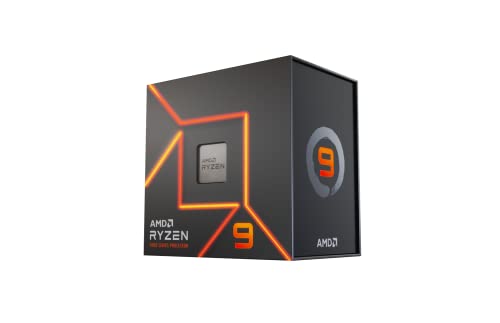

AMD Ryzen 9 7900X vs AMD Ryzen 9 7950X at a Glance
| Attribute | AMD Ryzen 9 7900X | AMD Ryzen 9 7950X |
|---|---|---|
| Physical Cores | 12 Cores (Dodeca-core) | 16 Cores (Hexadeca-core) |
| Concurrent Threads | 24 Threads | 32 Threads |
| Base Clock Speed | 4.70 GHz | 4.50 GHz |
| Maximum Boost Clock Speed | 5.60 GHz | 5.70 GHz |
| L2 Cache | 12 MB | 16 MB |
| L3 Cache | 64 MB | 64 MB |
| Total Installed Cache | 76 MB | 80 MB |
| Manufacturing Process | 5 nm | 5 nm |
| Thermal Design Power (Wattage) | 170 W | 170 W |
| Best For | Enthusiast Gaming and General Productivity | Heavy Workstation Tasks and Multithreaded Renders |
Core and Thread Count for Heavy Multitasking
When comparing the raw architectural muscle of these two desktop flagships, the primary dividing line is the physical configuration of the silicon. The Ryzen 9 7900X features a dodeca-core arrangement housing 12 physical cores and 24 concurrent threads. In contrast, the Ryzen 9 7950X steps up to a hexadeca-core layout that packs 16 physical cores and 32 concurrent threads. In modern computing, core count dictates how effectively a processor can execute parallel calculations simultaneously without stalling background operations or bottlenecking critical compute threads.
In practical workflows, this architectural distinction alters system throughput under sustained multi-core loading. A 12-core design is already well beyond the saturation point for standard consumer applications and contemporary video games, which rarely distribute compute instructions efficiently across more than eight cores. However, for digital content creators, software engineers running virtual machines, and professionals managing continuous background tasks, the 33 percent increase in cores on the 16-core chip provides immediate headroom. If you are weighing multi-core productivity against lower-tier alternatives, exploring the amd ryzen 7 7700x vs ryzen 9 7950x comparison demonstrates just how dramatically stepping up to 16 cores accelerates processing queues compared to traditional eight-core configurations.
The operational cost of having fewer cores on the 7900X is extended wait times when batch-processing computational workloads that scale directly with thread availability. Conversely, the gain delivered by the 7950X is sheer time savings: export queues finish faster, particle simulations calculate in less time, and multi-threaded compilation tasks execute without saturating every execution pipeline. When assessing the Ryzen 7900X vs 7950X core count, the 16-core chip remains the undisputed leader in parallel capacity.
Edge: AMD Ryzen 9 7950X because its 16 cores and 32 threads provide a massive 33 percent increase in parallel execution hardware over the 12-core model.
Clock Speeds and Single-Core Execution
Operating clock frequencies determine how rapidly individual processor cores complete execution cycles. In the head-to-head comparison between 7950X vs 7900X, the two chips present an interesting inverse relationship between their base and peak speeds. The Ryzen 9 7900X features a higher baseline operating speed of 4.70 GHz, giving its cores a higher out-of-the-box minimum floor when running unboosted routines. The Ryzen 9 7950X sets its baseline slightly lower at 4.50 GHz, a design choice engineered to balance heat and energy distribution across its wider 16-core layout.
When elevated workloads demand maximum burst performance, the dynamic reverses. The 7950X pushes its maximum overclocking boost speed up to 5.70 GHz, whereas the 7900X reaches a maximum boost ceiling of 5.60 GHz. This 100 MHz variance at the top end means that in lightly threaded environments, the 16-core flagship can execute single-threaded instructions with slightly higher peak throughput. For users evaluating the AMD Ryzen 9 7900X or 7950X for gaming, single-core burst speeds and memory access matter significantly, though in most titles both chips operate so close to one another that distinguishing between 5.60 GHz and 5.70 GHz during real-time gameplay is visually imperceptible. Buyers curious about pure gaming focus may also want to research the amd ryzen 7 7800x3d vs ryzen 9 7900x matchup to understand how clock rate compares to specialized gaming cache.
In day-to-day operation, the higher 4.70 GHz base clock of the 7900X ensures exceptional snap and fluidity during general desktop navigation and bursts of moderate productivity. However, the higher 5.70 GHz peak boost ceiling of the 7950X gives the top-tier processor a subtle advantage in single-threaded responsiveness and short-duration computing peaks, compensating completely for its slightly lower base operating floor.
Edge: AMD Ryzen 9 7950X due to its higher 5.70 GHz peak boost clock speed, which edges out the 7900X on single-thread ceiling.
Cache Memory Hierarchy and Data Access
Processor cache functions as ultra-high-speed memory placed directly adjacent to the execution cores, minimizing the latency required to fetch frequently used instructions from system RAM. An analysis of the Ryzen 9 7950X vs 7900X specs reveals key structural differences in secondary cache allocations. The Ryzen 9 7950X provides a total secondary cache capacity of 80 MB, broken down into 16 MB of L2 cache and 64 MB of shared L3 cache. The Ryzen 9 7900X provides 76 MB of total cache, combining 12 MB of L2 cache with the same 64 MB of shared L3 cache.
The distinction between the two models rests entirely within the Level 2 tier. Both processors dedicate exactly 1 MB of L2 cache per physical core. Because the 7950X contains 16 cores, it provides 16 MB of total L2 cache, whereas the 12-core 7900X features 12 MB. Both processors maintain an identical 64 MB allocation of Level 3 cache memory. In active computing environments, Level 2 cache provides faster hit rates and shorter access latency than Level 3 cache, ensuring that each individual core retains immediate access to local register operations without traversing the shared pool. Those interested in alternative cache designs might examine the amd ryzen 9 7900x vs 7950x3d to see how extended stacked cache impacts application speed.
For data-intensive workflows like complex spreadsheets, high-resolution rendering, and real-time audio processing, higher total cache reduces the probability of pipeline stalls. While both units achieve excellent hit rates thanks to their 64 MB L3 pools, the extra 4 MB of L2 cache on the 7950X directly benefits thread isolation when all 32 threads are engaged in heavy computing.
Edge: AMD Ryzen 9 7950X because its 80 MB total cache includes four additional megabytes of dedicated high-speed L2 cache.
Rendering and Heavy Workstation Throughput
When selecting a processor for creative workflows, examining AMD 7900X vs 7950X rendering throughput is critical. Workstation applications like 3D asset rendering, CAD modeling, offline raytracing, and heavy software compilation are natively coded to saturate every accessible core and thread. In these sustained, heavily parallel environments, processor performance scales almost linearly with physical compute units.
In creative suites, evaluating AMD Ryzen 9 7900X vs 7950X video editing performance demonstrates the clear advantage of the 16-core configuration. When exporting multiple video streams, generating real-time effects previews, or transcoding high-bitrate media files, the 7950X utilizes its 32 concurrent threads to crunch through encoding frames significantly faster than the 24 threads of the 7900X. This difference transforms production timelines: an intensive rendering job that takes an hour on a 12-core machine finishes notably sooner on a 16-core system, directly improving creative turnaround. Readers interested in high-end workstation performance can also study the amd ryzen 7 7800x3d vs ryzen 9 7950x guide to evaluate productivity benchmarks against dedicated gaming hardware.
Choosing the 7900X for an intensive workstation setup means trading export speed for lower core density. While 12 cores and 24 threads are more than capable of completing any modern creative task, production studios and dedicated creators will find that the 7950X delivers the dedicated processing power required to prevent workstation slowdowns during peak project deadlines. When answering whether you need the Ryzen 9 7900X or 7950X for workstation duties, the 16-core chip is built specifically for heavy computational heavy lifting.
Edge: AMD Ryzen 9 7950X because its 32 execution threads handle sustained rendering and media encoding queues with superior speed.
Thermal Design and Platform Efficiency
Both the Ryzen 9 7900X and the Ryzen 9 7950X are built on the cutting-edge 5 nm process technology and fit into the modern Socket AM5 motherboard platform. Crucially, both desktop processors share an identical manufacturer thermal design power rating of 170 watts. This shared wattage rating presents a fascinating engineering dynamic: the 7900X distributes 170 watts of power headroom across 12 cores, while the 7950X distributes that exact same 170-watt power ceiling across 16 cores.
Because the 7900X divides its 170-watt thermal allowance among fewer physical cores, each individual core can sustain higher clock frequencies under heavy multi-threaded loads before hitting overall package power boundaries. This accounts for the 7900X having a higher 4.70 GHz base clock speed compared to the 4.50 GHz base clock of the 7950X. Conversely, the 7950X achieves greater overall processing efficiency per watt because it completes more calculations across 16 cores within that identical 170 W package envelope. To understand how mid-tier thermal packages contrast with high-wattage flagships, our amd ryzen 7 7700x vs ryzen 9 7900x breakdown offers valuable context on AM5 power characteristics.
From an installation and platform maintenance standpoint, both processors impose identical demands on your system. Both require high-performance cooling solutions capable of managing a continuous 170-watt heat load, and both feature integrated AMD Radeon Graphics to simplify troubleshooting and initial system setup without requiring a discrete graphics card right away. Because power consumption, socket compatibility, and thermal requirements are identical, this category represents an architectural draw.
Edge: Tie because both processors feature the exact same 170-watt TDP, 5 nm manufacturing process, AM5 socket requirement, and integrated AMD Radeon Graphics.
Pros and Cons
AMD Ryzen 9 7900X

Pros
- Higher 4.70 GHz base clock speed
- 12 high-speed physical processing cores
- 24 concurrent processing threads
- Integrated AMD Radeon Graphics controller
- Efficient 5 nm process node
Cons
- Four fewer cores than the 7950X
- Slightly lower 5.60 GHz maximum boost
- Smaller 76 MB total cache pool
View AMD Ryzen 9 7900X on Amazon
AMD Ryzen 9 7950X

Pros
- Massive 16-core and 32-thread count
- Higher 5.70 GHz maximum boost clock
- Larger 80 MB combined cache pool
- Dedicated 16 MB L2 cache capacity
- Integrated AMD Radeon Graphics controller
Cons
- Lower 4.50 GHz base clock speed
- Same 170 W TDP spread across 16 cores
View AMD Ryzen 9 7950X on Amazon
Who Should Buy Each One
Choose the AMD Ryzen 9 7900X If
- Your computing time is primarily split between high-refresh competitive gaming and general desktop multitasking.
- You want a higher out-of-the-box base clock frequency of 4.70 GHz for responsive everyday computing.
- Your multithreaded workloads consist of occasional video clipping and light rendering that easily thrive on 12 cores and 24 threads.
- You want high-tier Socket AM5 performance without generating the dense core heat management demands of a 16-core package.
Choose the AMD Ryzen 9 7950X If
- You run professional workstation software that scales directly with thread count, such as 3D rendering engines and code compilers.
- You require the absolute maximum multi-threaded bandwidth available on AMD’s standard consumer AM5 desktop platform.
- You want the highest possible single-core burst frequency of 5.70 GHz alongside a massive 80 MB combined cache pool.
- Your daily creative workflow involves exporting 4K or 8K media files where shaving minutes off rendering queues increases productivity.
Final Verdict
For the majority of PC enthusiasts and high-performance gamers, the AMD Ryzen 9 7900X represents the practical sweet spot in AMD’s enthusiast lineup. With 12 physical cores, 24 threads, a higher 4.70 GHz base clock speed, and a capable 5.60 GHz boost frequency, it effortlessly handles modern AAA titles, high-resolution streaming, and substantial productivity tasks without leaving processing potential sitting idle. It provides all the benefits of the 5 nm AM5 platform, integrated Radeon Graphics, and a robust 76 MB cache memory system.
On the other hand, the AMD Ryzen 9 7950X is the superior choice whenever multi-threaded computational speed directly governs your productivity. With its 16 cores, 32 threads, 80 MB total cache, and a peak 5.70 GHz boost clock, it stands as an elite rendering and workstation powerhouse within the exact same 170 W power limit. If your computer is a tool for earning a living through video production, 3D modeling, or continuous software compilation, the 7950X easily justifies its flagship status by delivering unmatched multi-core speed.
FAQ
Can the AMD Ryzen 9 7900X and 7950X use the same motherboard?
Yes, both processors utilize the AMD Socket AM5 interface and are supported across compatible AM5 motherboards on Linux and Windows platforms.
Do both processors include integrated graphics controllers?
Yes, both the Ryzen 9 7900X and the Ryzen 9 7950X include an integrated AMD Radeon Graphics controller, allowing you to output display signals without installing a dedicated graphics card.
Is the AMD Ryzen 9 7950X worth it for gaming alone?
For gaming alone, the extra four cores and eight threads of the 7950X offer minimal practical advantage over the 7900X because contemporary game engines rarely leverage more than 8 to 12 cores effectively.
Why does the Ryzen 9 7900X have a higher base clock than the 7950X?
The 7900X features a 4.70 GHz base clock compared to 4.50 GHz on the 7950X because its 170-watt power ceiling is distributed across only 12 cores rather than 16 cores, allowing higher baseline frequencies per core.
How much more cache memory does the 7950X have compared to the 7900X?
The 7950X features 80 MB of total installed cache (16 MB L2 plus 64 MB L3), which is 4 MB more than the 76 MB total cache (12 MB L2 plus 64 MB L3) found on the 7900X.
Do these processors have different power requirements?
No, both the Ryzen 9 7900X and Ryzen 9 7950X share the identical thermal design power rating of 170 watts.


