The core difference deciding the choice between these two processors comes down to specialized gaming cache versus raw multi-threaded throughput. The AMD Ryzen 7 9800X3D integrates AMD’s Next Gen 3D V-Cache to minimize memory latency in compute-heavy game loops, whereas the AMD Ryzen 9 9900X provides a heavier 12-core, 24-thread configuration designed to power through sustained multi-core production workflows.
Pure gamers prioritizing ultra-high frame rates should select the Ryzen 7 9800X3D, while content creators and digital professionals who rely on intensive CPU rendering should choose the Ryzen 9 9900X.
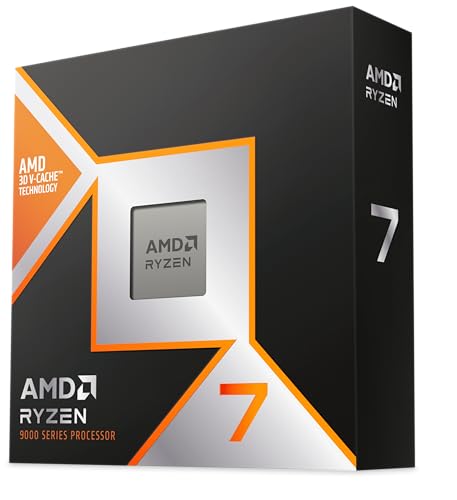

AMD Ryzen 7 9800X3D vs Ryzen 9 9900X at a Glance
| Feature | AMD Ryzen 7 9800X3D | AMD Ryzen 9 9900X |
|---|---|---|
| Processor Architecture | AMD Zen 5 (Next Gen 3D V-Cache) | AMD Zen 5 |
| Core / Thread Count | 8 Cores / 16 Threads | 12 Cores / 24 Threads |
| Base Clock Speed | 4.7 GHz | 4.4 GHz |
| Max Boost Clock Speed | Up to 5.2 GHz | Up to 5.6 GHz |
| Total / L3 Cache | 96 MB L3 Cache | 76 MB Installed Cache |
| Secondary Cache | 8 MB | 12 MB |
| Rated Power Consumption | 140 Watts | 120 Watts |
| Socket Compatibility | Socket AM5 | Socket AM5 |
| Memory & Bus Support | DDR5 Platform Ready | DDR5-5600, PCIe 5.0 Support |
| Bundled Thermal Solution | External Cooler Required | External Cooler Required |
| Best For | Maximum Gaming Frame Rates | Heavy Multi-Threaded Production |
Cache Architecture and Memory Latency
Processor cache sits closest to the execution engines, functioning as a high-speed memory buffer that feeds instructions directly into compute registers. When comparing 9800X3D vs 9900X cache specs, the architectural differences illustrate AMD’s distinct design paths. The Ryzen 7 9800X3D features 96MB of specialized L3 cache enabled by AMD’s Next Gen 3D V-Cache packaging, alongside 8MB of secondary cache. This physical stacking allows game engines to pull massive datasets without querying standard system memory, virtually eliminating micro-stutters during volatile scene transitions.
Conversely, the Ryzen 9 9900X is equipped with 76MB of total installed cache and 12MB of secondary cache. Because the 9900X splits its resources across two distinct core complexes to accommodate its 12 physical cores, its cache configuration functions differently than the unified single-complex structure found on the 8-core design. When evaluating 9800X3D 3D V-Cache vs 9900X cores, the sheer volume of low-latency L3 cache on the 9800X3D gives it an architectural advantage in applications that are sensitive to instruction turnaround times. Those interested in how high-density cache behaves against other Zen 5 options can review our guide on the amd ryzen 5 9600x vs ryzen 7 9800x3d.
In day-to-day operation, the massive 96MB cache on the 9800X3D provides structural insurance against memory-bound execution slowdowns. The 9900X balances its 76MB pool with larger per-core secondary cache allotments, ensuring balanced throughput across general computing tasks rather than targeting hyper-specialized latency gains.
Edge: AMD Ryzen 7 9800X3D, driven by its 96MB Next Gen 3D V-Cache buffer that minimizes latency penalties during demanding operations.
Gaming Performance and High-FPS Fluidity
Modern gaming engines require rapid frame draw sequencing, rendering them dependent on quick memory responses and high instructions-per-clock (IPC) execution. The AMD Ryzen 7 9800X3D review data highlights an approximate 16 percent IPC uplift through Zen 5 enhancements, paired with clock speeds reaching up to 5.2 GHz. By stacking its Next Gen 3D V-Cache underneath or alongside refined thermal layers, the processor sustains high clock ceilings while serving real-time asset streams directly from its 96MB L3 cache pool.
The Ryzen 9 9900X targets ultra-fast 100+ FPS performance across major titles by pushing clock speeds up to a blistering 5.6 GHz boost ceiling. For titles that rely on pure frequency and standard memory pipelines, this 400 MHz boost lead keeps responsiveness exceptionally sharp. However, when deciding between the Ryzen 7 9800X3D or Ryzen 9 9900X for gaming, real-world instruction pipelines reveal that games overwhelmingly favor local cache capacity over higher theoretical clock spikes. Similar dynamics show up when comparing the flagship tier in our look at the amd ryzen 7 9800x3d vs ryzen 9 9950x.
When studying general AMD Ryzen 9800X3D vs 9900X benchmarks across modern game engines, the 9800X3D consistently maintains tighter one-percent low frame rates. The 9900X delivers dependable performance for high-refresh gaming, but the 9800X3D delivers smoother overall pacing in unoptimized, simulation-heavy, or open-world PC titles.
Edge: AMD Ryzen 7 9800X3D, which leverages 3D V-Cache to optimize frame consistency and single-thread game loop execution.
Multi-Threaded Workloads and Content Creation
Raw multi-threaded throughput is governed by the total number of physical processing units and their simultaneous execution capabilities. The Ryzen 9 9900X leads this category decisively with 12 cores and 24 processing threads, compared to the 8 cores and 16 threads available on the Ryzen 7 9800X3D. In multi-stage workstation environments involving video compression, 3D model compiling, code building, and complex file packaging, having a 50 percent core count advantage fundamentally alters workflow velocity.
The Ryzen 7 9800X3D handles intermediate workloads with agility thanks to its Zen 5 IPC advances and base clock of 4.7 GHz. However, its 16 concurrent threads inevitably hit execution capacity when tasked with heavy rendering tasks. In contrast, the 9900X divides sustained computational loads across 24 concurrent threads, reducing total render completion times across multi-core software suites. Users weighing high-core Zen 5 processors should also consider our breakdown of the amd ryzen 7 9700x vs ryzen 9 9900x.
For creators asking is Ryzen 9 9900X worth it, the answer is apparent the moment daily tasks shift from simple playback to heavy background compilation. The 9900X operates as an authentic productivity engine, handling multi-app stress without bogging down real-time system navigation.
Edge: AMD Ryzen 9 9900X, providing 12 cores and 24 concurrent threads that outpace the 8-core layout in professional multi-threaded applications.
Clock Speeds and Processing Frequency
Frequency determines how rapidly individual instructions cycle through an execution pipeline, making clock speed an essential consideration for non-cache-dependent applications. The Ryzen 9 9900X achieves a 5.6 GHz max boost frequency alongside an unlocked multiplier for overclocking enthusiasts. This upper ceiling allows it to power through bursty, single-threaded productivity routines and arithmetic operations that derive little benefit from large L3 cache structures.
On the other side of the matchup, the Ryzen 7 9800X3D features a higher base speed of 4.7 GHz, outpacing the 4.4 GHz base speed of the 9900X. However, its peak boost ceiling stops at 5.2 GHz. While previous iterations of V-Cache chips operated under rigid thermal and voltage limitations, the 9800X3D listing points to improved thermal performance over earlier generations, enabling higher operational frequencies than older stacked-silicon designs could reach.
When running software unoptimized for deep cache reserves, the 5.6 GHz frequency of the 9900X provides measurable advantages over the 5.2 GHz ceiling of the 9800X3D. Shoppers comparing across different brands may also want to read our analysis on the intel core ultra 7 265k vs amd ryzen 7 9800x3d to evaluate frequency scaling across modern desktop architectures.
Edge: AMD Ryzen 9 9900X, thanks to its 5.6 GHz max boost ceiling and unlocked design.
Power Demands, Thermals, and AM5 Integration
Thermal packaging and electrical design define long-term chassis stability, power draw, and cooling hardware selection. According to product specifications, the Ryzen 7 9800X3D carries a rated wattage of 140 watts, while the Ryzen 9 9900X is rated at 120 watts. Neither processor includes a factory thermal solution in the packaging, requiring users to install an external aftermarket cooling solution such as a robust liquid cooler or a dense dual-tower air cooler.
Both models share complete platform compatibility with the Socket AM5 ecosystem and are validated for Windows 11. The 9900X listing explicitly identifies support for high-speed DDR5-5600 system memory along with PCIe 5.0 lanes on compatible motherboard platforms, ensuring broad support for modern ultra-fast solid-state storage and future add-in graphics hardware. Users building on tighter hardware profiles can also compare options via our amd ryzen 5 9600x vs ryzen 9 9900x guide.
While the 9800X3D claims better thermal dissipation characteristics versus prior generation 3D V-Cache designs, its 140W profile demands reliable cooling headroom. The 9900X achieves its lower 120W baseline through disciplined power allocation across its twin core complexes, granting it an advantage in thermal management under standard continuous operating conditions.
Edge: AMD Ryzen 9 9900X, featuring a lower 120W factory wattage rating alongside explicit PCIe 5.0 and DDR5-5600 support.
Streaming and Multitasking Workflows
Simultaneous live-streaming introduces distinct computing demands: the system must process real-time game loops while encoding a broadcast stream and managing auxiliary chat or capture software. When deciding on the Ryzen 7 9800X3D or Ryzen 9 9900X for streaming, buyers must weigh whether their encoder relies primarily on graphics hardware or on available CPU cores. If software x264 encoding is assigned directly to the central processor, the extra processing threads on the 9900X provide essential overhead.
The Ryzen 7 9800X3D ensures that the active game engine never stutters, since the 96MB L3 cache shields the rendering pipeline from frame drops. However, its 16 concurrent threads leave narrower headroom if multiple CPU-intensive tasks run in the background. Broadcasters running secondary rendering pipelines, local recording suites, and automated production overlays will find that the 12-core, 24-thread configuration of the 9900X provides more dedicated headroom.
Those considering high-end multi-tasking setups that balance cache and heavy thread counts can also explore our comparison of the amd ryzen 7 9800x3d vs ryzen 9 9950x3d. Between the two models evaluated here, the 9900X offers a superior foundation for multi-application broadcasting setups.
Edge: AMD Ryzen 9 9900X, whose 24 concurrent threads allow for smoother allocation across broadcasting software and auxiliary desktop tasks.
Pros and Cons
AMD Ryzen 7 9800X3D

Pros
- Massive 96MB L3 cache
- Next Gen 3D V-Cache architecture
- Higher 4.7 GHz base clock
- Drop-in Socket AM5 compatibility
Cons
- Limited to 8 cores and 16 threads
- Higher 140W power consumption rating
- External cooler required
View AMD Ryzen 7 9800X3D on Amazon
Who Should Buy Each One
Choose the AMD Ryzen 7 9800X3D If:
- Your primary desktop priority is achieving the highest and most stable frame rates in demanding PC games.
- You play open-world, simulation, or competitive esports titles that leverage massive cache pools to eliminate micro-stutters.
- You want high base clock performance with a 4.7 GHz foundation on an advanced Zen 5 architecture.
- You already have a capable AM5 motherboard paired with an external aftermarket cooler.
Choose the AMD Ryzen 9 9900X If:

- You routinely handle heavy productivity tasks like 3D modeling, video rendering, compiling code, or file compression.
- You need 12 physical cores and 24 execution threads to multitask during live streaming and video creation.
- You want higher burst clock frequencies reaching up to 5.6 GHz for single-threaded throughput and standard desktop operations.
- You prefer a lower 120W rated wattage profile with explicit DDR5-5600 and PCIe 5.0 platform support.
Final Verdict
For dedicated PC gamers and esports competitors, the AMD Ryzen 7 9800X3D stands as the premier recommendation. Its 96MB of Next Gen 3D V-Cache directly targets real-time game engine bottlenecks, sustaining fluid frame rates and consistent frame pacing that standard cache layouts cannot replicate. Paired with Zen 5 efficiency and an upgraded 4.7 GHz base clock, it provides high-tier gaming responsiveness that makes the most of the Socket AM5 ecosystem.
However, when computing requirements shift toward production, rendering, and heavy multitasking, the AMD Ryzen 9 9900X wins the comparison. Its 12 cores, 24 processing threads, and 5.6 GHz boost ceiling provide massive computing throughput for heavy workloads, outclassing the 8-core design across multi-threaded applications while operating within a disciplined 120W envelope.
FAQ
Can you use the AMD Ryzen 7 9800X3D on older AM4 motherboards?
No, the Ryzen 7 9800X3D is built exclusively for Socket AM5 motherboards. It requires an AM5 board along with DDR5 memory, making it incompatible with older AM4 platforms.
Does the AMD Ryzen 9 9900X include a cooling fan in the box?
No, the product listing explicitly indicates that a cooler is not included with the Ryzen 9 9900X. Buyers must acquire a separate external cooler to handle thermal dissipation.
Which processor has higher power consumption between the two?
Based on official listing specifications, the Ryzen 7 9800X3D has a rated wattage of 140 watts, while the Ryzen 9 9900X is rated at 120 watts.
Is the AMD Ryzen 9 9900X unlocked for overclocking?
Yes, the listing states that the Ryzen 9 9900X is unlocked for overclocking, allowing users to tune performance up to its 5.6 GHz boost limit on supported motherboards.
What operating system is recommended for these processors?
Both product listings identify Windows 11 as the supported platform to take full advantage of modern scheduling and architecture improvements.
How much secondary cache does each processor possess?
The Ryzen 7 9800X3D includes 8MB of secondary cache, whereas the Ryzen 9 9900X is equipped with 12MB of secondary cache to support its 12-core layout.


