The single mechanical factor that separates these two tools is output power packaged into snout length: the Makita XPH14Z delivers 1,250 in-lbs of maximum torque within a compact 7-inch tool body, whereas the older Makita XPH07Z produces 1,090 in-lbs across a noticeably longer profile.
Choose the Makita XPH14Z if you demand peak rotational power for wide-diameter boring bits and need to squeeze between narrow framing studs. Choose the Makita XPH07Z if your daily workload centers on standard anchors and structural fasteners where existing 1,090 in-lb output provides more than enough turning force.


Makita XPH14Z vs Makita XPH07Z at a Glance
| Feature | Makita XPH14Z | Makita XPH07Z |
|---|---|---|
| Peak Torque | 1,250 in-lbs | 1,090 in-lbs |
| Maximum Speed | 2,100 RPM | 2,100 RPM |
| Blows Per Minute | 0-31,500 BPM | 0-31,500 BPM |
| Overall Head Length | 7.0 inches | Not listed (14% longer) |
| Bare Tool Weight | 4.0 lbs (6.0 lbs with battery) | Not listed |
| Chuck Style | 1/2-inch all-metal self-ratcheting | 1/2-inch |
| Wood Drilling Capacity | 3.0 inches | Not listed |
| Metal Drilling Capacity | 0.5 inches | Not listed |
| Maximum Power Output | 350 watts | Not listed |
| Best For | Demanding hole drilling and tight workspaces | Standard jobsite drilling and masonry boring |
Peak Torque and Heavy-Load Boring Capacity
Torque is the rotational muscle that keeps a drill spindle turning when massive wood-boring augers, hole saws, or self-feed bits encounter dense structural lumber. In a high-demand hammer drill, higher torque ratings prevent the motor from stalling under heavy friction and reduce thermal stress during repetitive boring cycles. When boring through stacked framing members or running plumbing penetrations, reserve turning power directly dictates how fast you can push the cutter without tripping electronic overload protection.
Examining the Makita XPH14Z torque rating reveals a full 1,250 in-lbs of turning force generated by its brushless motor. In direct comparison, the legacy XPH07Z delivers 1,090 in-lbs of maximum torque. While 1,090 in-lbs has long served as a benchmark for high-output 18V tools, the extra 160 in-lbs on the newer drill provides a decisive advantage when clearing heavy knots or twisting large structural screws into engineered lumber. If you have ever examined mid-tier tools in our makita xph12z vs xph14z evaluation, you already know how upper-tier torque changes the drilling experience.
On the jobsite, this gap in twisting power means the XPH14Z maintains rotational momentum with less lugging under extreme strain. The XPH14Z is rated to push up to 3-inch cutters through dimensional wood and 0.5-inch bits through steel plate, delivering a 350-watt output ceiling that outperforms the older generation. The XPH07Z remains remarkably capable, but it works closer to its operational threshold when spinning wide accessories through tough timber.
Edge: Makita XPH14Z due to its higher 1,250 in-lb torque output that powers through dense framing lumber with less motor strain.
Tool Dimensions, Head Length, and Ergonomic Balance
Tool length dictates where a hammer drill can physically fit. In residential and commercial construction, trades regularly face narrow joist bays, pre-installed HVAC ducting, and tight stud cavities where a long drill nose simply cannot line up straight. A compact front-to-back dimension eliminates the need for awkward angle attachments or off-axis driving, which often strips screw heads or ruins hole alignment.
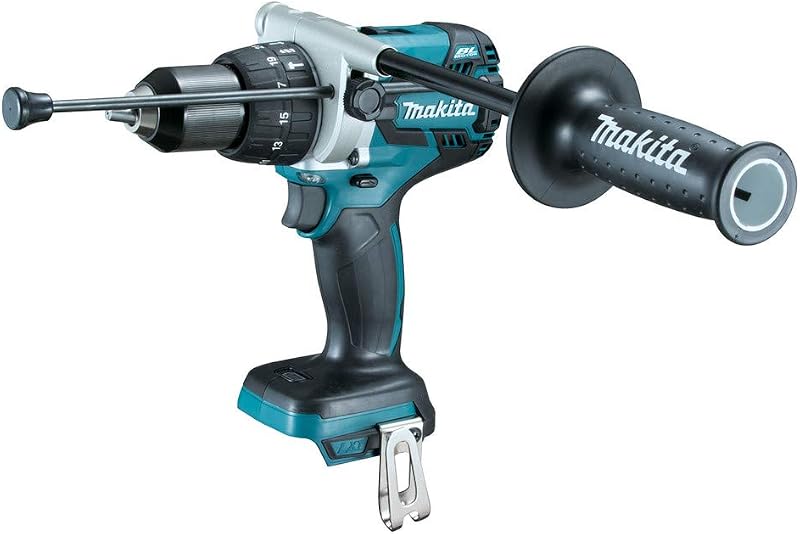
When analyzing the Makita XPH14Z length vs XPH07Z, the difference is visually immediate. The XPH14Z measures exactly 7 inches from chuck face to back cap, making it 14 percent shorter than its predecessor. While the XPH07Z listing does not specify an exact inch dimension, the factory documentation confirms the previous chassis was noticeably elongated to house its earlier-generation motor assembly. Compressing the motor and geartrain into a 7-inch footprint changes how the tool balances in hand, shifting weight closer to the operator grip.
The XPH14Z weighs in at 4 pounds as a bare tool and reaches 6 pounds when paired with a standard 5.0 Ah battery pack. Though it remains a substantial, heavy-duty driver, the shorter nose prevents excessive front-heaviness during overhead tasks or horizontal drilling. Readers exploring our makita xfd131 vs xph14z breakdown will recognize that while compact drills exist for light tasks, the XPH14Z manages to compress true high-torque mechanics into a remarkably stubby frame.
Edge: Makita XPH14Z because its 7-inch overall length is 14 percent shorter, fitting substantially better into tight stud bays.
Masonry Hammer Drilling and Impact Performance
Hammer drilling relies on high-frequency percussive impacts that shatter brittle aggregate while the rotating carbide flutes pull dust away from the hole. The speed of penetration through poured concrete, cinder block, or brick depends on two mechanical elements working in harmony: blows per minute and sustained rotational speed under friction. A drill with low impact energy or sluggish rotational velocity will glaze stone surfaces rather than pulverize them.
When deciding between the Makita XPH14Z or XPH07Z for masonry, the core impact specifications appear identical on paper. Both drills incorporate hammer mechanisms that strike at an aggressive rate of up to 31,500 BPM. Both models also feature high-speed gear settings that top out at 2,100 RPM, backed by variable-speed trigger controls that allow users to feather the throttle when starting precise pilot holes without walking off the mark.
In actual masonry drilling, the two tools deliver virtually indistinguishable penetration rates when installing 1/4-inch to 1/2-inch concrete screw anchors or conduit clips. The higher torque of the XPH14Z provides a modest advantage if you drive large-diameter core bits or masonry hole saws through soft brick, but for everyday tapcon installation, both motors easily sustain the necessary velocity. In a broader Makita 18V brushless hammer drill comparison, both units sit at the very top tier of the brand percussion performance.
Edge: Tie because both tools deliver identical 31,500 BPM percussion mechanisms and matching 2,100 RPM maximum rotational speeds.
Motor Technology, Power Output, and Heat Dissipation
Brushless motors represent a massive operational leap over legacy brushed platforms by replacing mechanical carbon brushes with electronic commutators. Without brushes generating friction against a spinning rotor, the motor produces less internal heat, suffers no brush wear, and draws energy strictly according to mechanical resistance. This electronic feedback loop maximizes battery run time while protecting internal copper windings from premature breakdown.
Both models utilize Makita brushless motor engineering, but they highlight different generations of electronic tuning. The XPH07Z utilizes an electronically controlled brushless motor designed to optimize energy usage, providing up to 50 percent longer run time per charge compared to brushed alternatives by matching torque and RPM to application resistance. It draws from the 18V line via a 5.6-amp operational rating that keeps internal components operating smoothly during continuous cycles.
The XPH14Z takes that electronic foundation and raises electrical efficiency, achieving an official 350-watt power output rating. Its brushless motor integrates seamlessly with Star Protection computer controls, exchanging real-time thermal and load data with connected 18V LXT battery packs. For those reviewing older setups like our makita xfd131 vs xph07z comparison, the motor architecture in both the XPH07Z and XPH14Z represents professional-grade engineering that runs cool through hundreds of continuous cycles.
Edge: Tie because both platforms integrate high-efficiency, electronically controlled brushless motors with intelligent load sensing.
Chuck Construction and Bit Retention Mechanics
A hammer drill chuck undergoes immense torsional stress and axial vibrations that constantly work to loosen drill shanks. Cheap plastic-sleeved chucks or loose jaw mechanisms lead to slipping bits, marred shanks, and wasted jobsite hours spent re-tightening hardware. For heavy-duty timber drilling and continuous masonry pounding, an all-metal, ratcheting chuck is an absolute necessity.
The XPH14Z listing specifies a premium 1/2-inch all-metal self-ratcheting chuck. The internal ratcheting teeth lock down against round and hex shanks, providing high gripping strength that prevents high-torque bits from spinning inside the jaws when breaking through tough surfaces. The knurled metal sleeve also withstands scraping against concrete walls, floor plates, and structural steel without cracking.
The XPH07Z also features a heavy-duty 1/2-inch chuck, though its listing details do not explicitly highlight the advanced internal self-ratcheting mechanism found on the newer revision. In any comprehensive Makita XPH14Z review, the updated chuck stands out as a durability improvement that gives operators confidence when running long augers in reverse or clearing deep plug cutters. Comparing this heavy hardware against tools discussed in our makita xph12z vs xph07z piece shows why Makita reserves full-metal chuck builds for its flagship hammer drills.
Edge: Makita XPH14Z due to its all-metal 1/2-inch self-ratcheting chuck that delivers superior bit gripping power under heavy rotational load.
Pros and Cons
Makita XPH14Z

Pros
- 1,250 in-lbs maximum torque output
- Compact 7-inch tool head length
- All-metal 1/2-inch self-ratcheting chuck
- 0-31,500 BPM for fast masonry drilling
Cons
- Heavy 6-pound working weight with battery
- Bare tool excludes battery and charger
Makita XPH07Z
Pros
- 1,090 in-lbs brushless motor torque
- 0-31,500 BPM hammer drilling mechanism
- Energy-optimizing brushless electronics
- Fast 2,100 RPM high-speed transmission
Cons
- 14% longer body than replacement model
- Lower maximum torque than the XPH14Z
Who Should Buy Each One
Choose the Makita XPH14Z If
- You regularly drill with large hole saws, self-feed bits, or augers that require 1,250 in-lbs of turning force.
- You work between tight framing studs or ceiling joists where a 7-inch head profile prevents interference.
- You need an all-metal self-ratcheting chuck to prevent bit slippage during continuous high-load boring.
- You want the current top-tier 18V LXT hammer drill with integrated dual LED lighting and 350 watts of motor power.
Choose the Makita XPH07Z If
- Your drilling needs top out at standard structural fasteners, tapcons, and mid-sized wood boring.
- You already own or have access to the XPH07Z chassis and do not encounter spatial constraints in tight corners.
- You want 31,500 BPM hammer drilling capability identical to newer generation models.
- You prioritize a proven, electronically governed brushless motor platform for standard commercial maintenance tasks.
Final Verdict
When placing the Makita XPH07Z vs XPH14Z side by side, the newer Makita XPH14Z emerges as the clear winner for modern jobsites. By packing 1,250 in-lbs of peak torque into a shortened 7-inch chassis, Makita solved the primary complaint associated with earlier high-torque drills: excessive length and front-heavy balance. The added turning power, reduced physical footprint, and heavy-duty self-ratcheting chuck make the XPH14Z the superior choice for rough carpentry, mechanical installations, and demanding contractor workloads.
That said, any honest Makita XPH07Z review will acknowledge that the older workhorse remains a capable performer. If your daily tasks do not involve running 3-inch cutters through laminated beams or squeezing between narrow 12-inch framing centers, the 1,090 in-lbs of torque and 31,500 BPM impact rate of the XPH07Z will comfortably finish the job. However, if you are purchasing a bare tool today to handle the toughest jobs on the 18V LXT platform, the XPH14Z is the definitive recommendation.
FAQ
Is Makita XPH07Z worth it compared to the newer model?
The XPH07Z remains a powerful drill, but it is rarely worth choosing over the newer XPH14Z unless you specifically require an exact replacement for an existing fleet. The XPH14Z delivers 160 more inch-pounds of torque inside a body that is 14 percent shorter, offering superior ergonomics and higher peak performance across virtually every category.
What is the Makita XPH14Z torque rating?
The Makita XPH14Z has a maximum torque rating of 1,250 in-lbs. This output is driven by a two-speed transmission delivering 0-550 RPM in low gear and 0-2,100 RPM in high gear, supported by an internal 350-watt brushless motor.
How does the Makita XPH14Z length vs XPH07Z compare in tight spaces?
The Makita XPH14Z measures 7.0 inches from the chuck tip to the back casing, which is 14 percent shorter than the previous XPH07Z model. This shortened head profile allows users to drill straight into standard stud bays without angling the tool or using flexible shaft extensions.
Can both drills use the same 18V LXT lithium-ion batteries?
Yes. Both the XPH14Z and the XPH07Z belong to the Makita 18V LXT system. They run on standard 18V LXT lithium-ion battery packs equipped with Star Protection computer controls, including 2.0 Ah, 3.0 Ah, 4.0 Ah, 5.0 Ah, and 6.0 Ah packs.
Which tool is better when choosing Makita XPH14Z or XPH07Z for masonry?
Both drills feature identical impact speeds of up to 31,500 BPM and matching 2,100 RPM high gears, making their penetration rates through concrete and mortar practically identical for standard anchor holes. The XPH14Z holds a minor advantage only when spinning wider core bits that demand its higher 1,250 in-lb torque capacity.
Does the Makita XPH14Z include an all-metal chuck?
Yes. The Makita XPH14Z features a heavy-duty 1/2-inch all-metal self-ratcheting chuck. This design uses internal ratcheting teeth to lock bits tightly in place, preventing rotational slip during heavy wood boring or masonry impact drilling.