Choosing between the Sapphire AMD RX 6650 XT and the XFX AMD RX 6800 XT comes down to the divide between dedicated 1080p rasterization efficiency and high-bandwidth 1440p or 4K visual fidelity driven by double the onboard frame buffer. While both graphics cards share AMD RDNA 2 architecture, the physical compute resources, memory bus widths, and memory allocations place them in entirely different performance brackets.
Builders putting together a compact desktop setup focused primarily on competitive esports titles should select the Sapphire RX 6650 XT for its straightforward power delivery and manageable chassis footprint. Enthusiasts pursuing modern visually intensive titles at higher resolutions with maximum texture packs should select the XFX RX 6800 XT to leverage its expansive 16GB memory ceiling and dedicated Ray Accelerators.

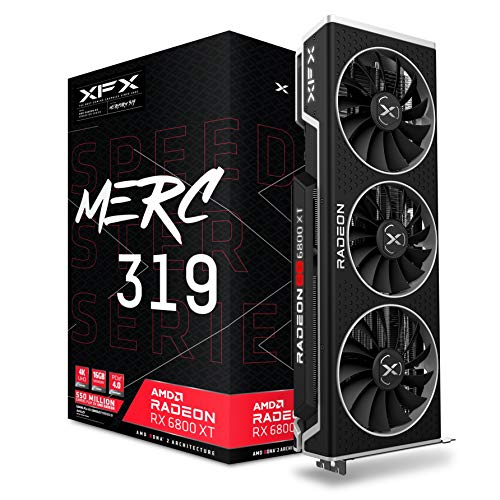
AMD RX 6650 XT vs AMD RX 6800 XT at a Glance
| Feature | Sapphire AMD RX 6650 XT | XFX AMD RX 6800 XT |
|---|---|---|
| GPU Model | AMD Radeon RX 6650 XT | AMD Radeon RX 6800 XT |
| Memory Capacity | 8 GB GDDR6 | 16 GB GDDR6 |
| Memory Clock / Speed | 17.5 GHz | 16 Gbps |
| PCIe Bus Interface | PCI-Express x8 | PCI-Express x16 |
| Core Engine Clock | Game: 2410 MHz | Boost: 2635 MHz | Not listed |
| Maximum Display Resolution | 3840 x 2160 | 7680 x 4320 |
| Card Dimensions | 11.25″L x 6.5″W | 13.39″L x 5.43″W |
| Cooling Setup | 2 Axial Fans (Two-Ball Bearing) | MERC319 Aerodynamic Airflow Design |
| External Power Connectors | 1 x 8-pin | Not listed |
| Best For | High-FPS 1080p Desktop Gaming | Demanding 1440p and 4K Gaming |
VRAM Capacity and Memory Bandwidth
Modern gaming engines require substantial onboard video memory to load high-resolution texture packs, volumetric fog, complex geometry, and post-processing assets without hitching. The direct comparison of RX 6650 XT vs 6800 XT VRAM highlights the primary operational split between these two GPUs. The Sapphire RX 6650 XT is equipped with 8GB of GDDR6 memory clocked at 17.5 GHz. This 8GB ceiling is well-suited for standard texture layers and mainstream rendering pipelines, preventing stutter in current competitive multiplayer releases. However, contemporary AAA titles with ultra-preset textures can rapidly saturate an 8GB buffer, leading to memory spillover into system RAM that introduces frame pacing irregularities.
In contrast, the XFX RX 6800 XT integrates 16GB of GDDR6 memory operating at 16 Gbps. Doubling the video memory pool alters how the card processes complex graphical environments. A 16GB allocation provides an ample buffer against heavy background resource caching, complex asset streaming, and compute-heavy draw calls. For users researching an amd rx 6700 xt vs 6800 xt upgrade path, the jump to a full 16GB buffer remains one of the safest methods to safeguard against visual degradation in newer releases.
While the memory clock speed on the Sapphire card shows a slightly higher frequency rating at 17.5 GHz versus the 16 Gbps listed for the XFX model, the total available capacity determines sustained fidelity. The XFX unit avoids the hard memory ceilings that cause asset-swapping bottlenecks during long play sessions. Gamers debating whether an RX 6650 XT or 6800 XT for 1440p gaming is appropriate will find that the 16GB buffer ensures consistent performance stability when graphics settings are pushed to their maximum limits.
Edge: XFX AMD RX 6800 XT due to its double memory capacity of 16GB GDDR6 that eliminates texture-streaming bottlenecks at elevated settings.
Target Resolution and Maximum Display Output
Rendering resolution dictates how many pixels a graphics processor must calculate per frame, with 1440p requiring roughly 77 percent more pixels than 1080p, and 4K quadrupling the workload. The Sapphire RX 6650 XT is engineered primarily as a high-refresh solution for RX 6650 XT vs 6800 XT 1080p gaming environments. Its maximum display output is rated at 3840 x 2160 (4K). While it can drive a 4K display for media playback or standard productivity tasks, rendering complex three-dimensional scenes at that resolution pushes the hardware past its optimal operational window. Users balancing mid-range options often compare this footprint against the amd rx 6650 xt vs 6700 xt to evaluate resolution longevity.
The XFX RX 6800 XT targets an entirely different display tier, boasting a maximum resolution output of 7680 x 4320 (8K). This high display ceiling reflects a rendering engine built from the ground up for high-fidelity 1440p and native 4K gaming. The listing emphasizes a revolutionary memory architecture engineered specifically to deliver higher levels of efficiency and throughput for 4K gaming. When driving ultra-wide monitors or multi-panel battlestations, the card maintains smooth pixel throughput where lower-tier units begin to drop frames.
Selecting an RX 6650 XT or RX 6800 XT for gaming fundamentally hinges on your physical monitor hardware. The Sapphire card maximizes standard 1080p esports panels where frame rates take precedence over raw pixel counts. Conversely, the XFX card thrives on 1440p high-refresh panels and 4K displays, ensuring that high-polygon character models and intricate draw distances maintain frame fluidity without requiring aggressive resolution downscaling.
Edge: XFX AMD RX 6800 XT thanks to its 7680 x 4320 maximum resolution support and architectural tuning for native 4K gaming workloads.
Architecture, Ray Accelerators, and Core Frequencies
Both graphics processors are built on AMD RDNA 2 architecture, which introduced unified compute enhancements, improved power efficiency, and hardware-based ray tracing features. However, their implementation details diverge significantly. The Sapphire Pulse RX 6650 XT relies on high core clock frequencies to achieve rapid rendering passes. Its listing specifies an aggressive Game Clock of up to 2410 MHz and a Boost Clock reaching 2635 MHz. These high factory frequencies allow the compact silicon to process geometry and shaders rapidly, which readers often note in a detailed RX 6650 XT review focusing on lightweight game engines.
The XFX Speedster MERC319 RX 6800 XT leverages a broader physical compute array equipped with dedicated Ray Accelerators. The listing confirms new Ray Accelerators engineered specifically to handle ray intersection calculations, providing hardware-accelerated ray tracing capability. While the listing does not publish the precise core and boost clock megahertz numbers for the XFX card, the sheer volume of parallel compute units inherent to the RX 6800 XT processor allows it to outpace higher-clocked smaller chips. Those monitoring an amd rx 6750 xt vs 6800 xt matchup will observe similar scaling across compute-heavy workloads.
When running an RX 6650 XT vs RX 6800 XT benchmark scenario involving dynamic reflections, ambient occlusion, or heavy compute shaders, the physical presence of dedicated Ray Accelerators and wider execution pipelines gives the 6800 XT a substantial throughput advantage. The high clock speed of the Sapphire card keeps it competitive in simple rasterized esports titles, but the architectural muscle of the XFX processor dominates complex computational tasks.
Edge: XFX AMD RX 6800 XT due to its dedicated Ray Accelerators and broader parallel compute array designed for demanding rendering pipelines.
Physical Dimensions and Desktop Case Clearance
Chassis compatibility is often the deciding factor in practical PC assembly, as modern enthusiast graphics cards require considerable physical clearance. The Sapphire Pulse RX 6650 XT features an ATX form factor measuring 11.25 inches in length and 6.5 inches in width, fitting cleanly across two expansion slots. This card utilizes two axial cooling fans built with durable two-ball bearings to maintain stable thermal profiles. Because it stays within standard dual-slot spacing, it integrates smoothly into compact mid-tower enclosures and small-form-factor builds without obstructing neighboring PCIe peripherals or front radiator fans.
The XFX Speedster MERC319 RX 6800 XT is a substantially larger piece of hardware, measuring 13.39 inches in length and 5.43 inches in width. Its aerodynamic Speedster design focuses on maximizing airflow through the heatsink assembly to manage the thermal dissipation generated by high-end gaming sessions. While the product specifications sheet lists a single fan, the MERC319 shroud represents an elongated design that demands significant longitudinal chassis space. Anyone evaluating an amd rx 6800 xt vs 6950 xt comparison will recognize the massive clearance requirements standard across high-tier AMD cards.
If you are upgrading an existing desktop tower without changing your case, the Sapphire RX 6650 XT offers an effortless installation process. The XFX card, spanning over 13.3 inches, can run into clearance conflicts with front-mounted liquid cooling radiators, drive cages, or cable management grommets. The Sapphire card’s two-ball bearing axial fans and compact dual-slot footprint give it an undeniable advantage for space-constrained builds.
Edge: Sapphire AMD RX 6650 XT because its 11.25-inch dual-slot footprint fits easily into standard mid-tower and compact cases.
PCIe Bus Interface and System Power Delivery
Motherboard communication and external power delivery establish how cleanly a graphics card integrates into your broader PC build. The Sapphire RX 6650 XT operates across a PCI-Express x8 connection. While this interface provides ample bandwidth on modern PCIe 4.0 motherboards, operating the card on an older PCIe 3.0 motherboard cuts the available interface bandwidth in half. On the power front, the Sapphire listing specifies a single 8-pin external power connector, making it exceptionally friendly for builds using lower-wattage power supplies without requiring extra modular PCIe cables. Those reviewing the amd rx 6600 vs 6650 xt will find this same power efficiency maintained across the product line.
The XFX RX 6800 XT features a full-bandwidth PCI-Express x16 interface. Utilizing all 16 physical PCIe lanes ensures maximum data throughput between the system CPU and the GPU frame buffer, eliminating motherboard interface bottlenecks even when running on older platform revisions. Although the listing does not specify the exact external power connector count for the XFX model, high-performance RDNA 2 cards in this class require robust power delivery configurations to sustain continuous high-resolution gaming loads.
Deciding if is the RX 6800 XT worth it often involves assessing whether your current power supply and motherboard support the card properly. The Sapphire RX 6650 XT wins on ease of installation and low power connector demands, requiring only a single 8-pin cable. However, the XFX RX 6800 XT guarantees uncompromised communication integrity by utilizing the full PCIe x16 lane allocation.
Edge: Tie; the Sapphire offers low-friction installation with a single 8-pin power plug, while the XFX delivers a full-width PCIe x16 interface.
Pros and Cons
AMD RX 6650 XT

Pros
- Fast 2635 MHz boost clock speed
- Compact 11.25-inch dual-slot ATX footprint
- High 17.5 GHz memory frequency
- Simple single 8-pin power connection
- Durable two-ball bearing axial fans
Cons
- Limited 8GB VRAM capacity
- Restricted to PCIe x8 interface
- 3840×2160 maximum display resolution
AMD RX 6800 XT

Pros
- Massive 16GB GDDR6 memory buffer
- Full PCIe x16 bus interface
- Extreme 7680×4320 maximum resolution output
- Dedicated hardware Ray Accelerators
- Aerodynamic Speedster airflow design
Cons
- Long 13.39-inch chassis clearance requirement
- Listing leaves clock frequencies unspecified
Who Should Buy Each One
Choose the Sapphire RX 6650 XT If
- You play predominantly on a 1080p monitor and prioritize high frame rates in competitive multiplayer shooters.
- Your desktop case has strict clearance limitations that cannot accommodate cards exceeding 12 inches in length.
- Your power supply only has a single 8-pin PCIe power cable available for GPU connection.
- You want a card with high factory clock speeds reaching a 2635 MHz boost clock out of the box.
Choose the XFX RX 6800 XT If
- You game on a 1440p high-refresh-rate display or native 4K monitor and demand ultra graphical presets.
- You want 16GB of GDDR6 video memory to eliminate texture pop-in and memory limitations in modern titles.
- Your system motherboard and case can accommodate a full PCIe x16 lane card measuring 13.39 inches in length.
- You play modern visual titles that take advantage of dedicated hardware-based Ray Accelerators.
Final Verdict
For the majority of PC gamers playing on standard 1080p displays or building inside space-constrained mid-tower cases, the Sapphire Pulse RX 6650 XT represents the practical choice. It delivers strong core clock speeds exceeding 2600 MHz, a reliable dual-fan cooling system with two-ball bearings, and simple power integration requiring only a single 8-pin connector. It executes 1080p rendering duties smoothly without requiring major hardware overhauls or extensive power supply reconfigurations.
However, when looking at the overall AMD RX 6800 XT vs 6650 XT matchup through the lens of performance longevity and resolution scaling, the XFX Speedster MERC319 RX 6800 XT operates in a superior tier. With double the VRAM at 16GB, full PCI-Express x16 bandwidth, dedicated Ray Accelerators, and an 8K-capable display output engine, it is built to handle graphically demanding titles at 1440p and 4K for years to come. If your desktop case can clear its 13.39-inch frame, the XFX card stands as the definitive performance upgrade.
FAQ
Can the Sapphire RX 6650 XT run games at 1440p resolution?
The Sapphire RX 6650 XT can output up to 3840 x 2160 and handle moderate 1440p rendering in less demanding or competitive games. However, its 8GB GDDR6 memory buffer and PCIe x8 interface are optimized primarily for 1080p gaming, meaning intense modern titles at 1440p may require lowering texture quality to maintain stable frame rates.
What makes the XFX RX 6800 XT better suited for 4K gaming?
The XFX RX 6800 XT features a 16GB GDDR6 frame buffer, dedicated Ray Accelerators, a maximum display output of 7680 x 4320, and an RDNA 2 memory architecture explicitly tuned for high-resolution asset streaming. This hardware combination gives it the parallel processing bandwidth required to render native 4K scenes without exhausting memory capacity.
How much clearance does the XFX Speedster MERC319 require inside a PC case?
The XFX RX 6800 XT measures 13.39 inches in length and 5.43 inches in width. Builders must ensure their PC chassis has at least 13.5 to 14 inches of horizontal clearance between the rear expansion slots and any front-mounted case fans or liquid cooling radiators.
Does the Sapphire RX 6650 XT require multiple power supply cables?
No, the Sapphire Pulse RX 6650 XT listing specifies an external power requirement of just 1 x 8-pin connector. This allows it to connect directly to standard desktop power supplies without requiring multi-cable splitters or dual dedicated PCIe power runs.
Does the PCIe x8 interface on the RX 6650 XT limit its performance?
The Sapphire RX 6650 XT operates on a PCI-Express x8 interface. On modern PCIe 4.0 motherboards, eight lanes provide abundant bandwidth for the GPU. On older PCIe 3.0 platforms, the reduced lane count can slightly restrict data transfer rates compared to cards utilizing a full PCIe x16 connection like the XFX RX 6800 XT.
What type of cooling fan design does the Sapphire Pulse card use?
The Sapphire RX 6650 XT features two axial cooling fans equipped with two-ball bearings. This dual-fan design is engineered for smooth operation, long lifespan, and effective heat dissipation within a standard two-slot ATX form factor.
Do both cards feature hardware ray tracing support?
Both graphics cards belong to the AMD RDNA 2 family, but the XFX RX 6800 XT listing specifically details hardware-based Ray Accelerators engineered to handle ray intersection workloads directly on the silicon. This provides superior real-time ray tracing performance compared to the smaller silicon found in the 6650 XT.


