The core difference between the Milwaukee 2730-20 and the Milwaukee 2830-20 comes down to ergonomics and cutting capacity: the 2730-20 is a compact 6-1/2-inch top-handle circular saw designed for one-handed agility and overhead maneuvering, whereas the 2830-20 is a heavy-duty 7-1/4-inch rear-handle circular saw engineered to rip through dense lumber with the force of a 15-amp corded tool. Comparing the Milwaukee 2730-20 vs 2830-20 reveals how blade geometry, motor tuning, and physical balance dictate which saw handles specific jobsite demands.
Woodworkers, remodelers, and punch-list carpenters should select the Milwaukee 2730-20 for its lightweight, nimble footprint that reduces fatigue on ladders and scaffold runs. Production framers and deck builders tackling dimensional framing and gang cutting should choose the Milwaukee 2830-20 for its extended reach, superior cutting speed, and heavy-duty torque.
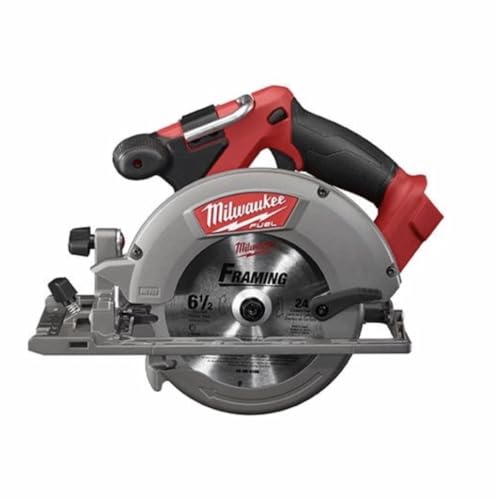

Milwaukee 2730-20 vs 2830-20 at a Glance
| Attribute | Milwaukee 2730-20 | Milwaukee 2830-20 |
|---|---|---|
| Blade Diameter | 6-1/2 In. | 7-1/4 In. |
| Handle Orientation | Top Handle | Rear Handle |
| Motor Type | Brushless Motor | POWERSTATE Brushless Motor |
| No-Load Speed | 5000 RPM | 5800 RPM |
| Item Weight | 6.8 pounds | 10 pounds |
| Cutting Depth at 90 Degrees | 2-3/16 In. | Not listed |
| Cutting Depth at 45 Degrees | 1-5/8 In. | Not listed |
| Bevel Adjustment | 0 Degrees to 50 Degrees | Not listed |
| Shoe Material | Magnesium | Magnesium |
| Electric Blade Brake | Not listed | Yes |
| Rafter Hook | Not listed | Multi-size rafter hook |
| Best For | Lightweight trim work and overhead cuts | Production framing and heavy lumber rips |
Motor Power and Cutting Speed
Motor engineering directly controls how quickly a circular saw chews through dense wood fiber without bogging down. The 2730-20 relies on a capable brushless motor spinning at 5000 RPM with an 18-amp rating. This motor delivers smooth, dependable power across standard dimensional softwood, plywood sheathing, and exterior trim boards. For punch-list tasks and standard crosscuts, its rotational velocity yields clean edges with minimal tear-out, preventing motor stalls when paired with a sharp 24-tooth carbide blade.
In contrast, the 2830-20 incorporates a high-output POWERSTATE brushless motor delivering up to 5800 RPM and generating power that matches a traditional 15-amp corded circular saw. The extra 800 RPM gives the larger saw higher blade surface feet per minute, clearing sawdust aggressively and maintaining high cutting speed even when plowing through wet pressure-treated timber, subflooring, or stacked framing lumber. When comparing heavy-duty jobsite options such as the dewalt dcs570 vs milwaukee 2830-20, the sheer cutting acceleration of Milwaukee’s rear-handle motor stands out during demanding longitudinal rip cuts.
Choosing between these two power plants depends on how much resistance your materials generate. The 2730-20 handles everyday cut lists without hesitation, but pushing it through tough LVL or dense hardwoods requires a slower feed rate. The 2830-20 powers through stubborn knots and long rips without dropping noticeable momentum, saving critical seconds on repetitive framing tasks.
Edge: Milwaukee 2830-20 because its 5800 RPM POWERSTATE motor generates corded-equivalent power for rapid, heavy-load cutting.
Size, Weight, and Ergonomic Balance
The form factor of a circular saw dictates user comfort and control over an eight-hour shift. The Milwaukee 2730-20 weight is a modest 6.8 pounds according to product specifications, with an bare tool weight listed at 6.3 pounds and a compact length of 12.97 inches (with a 16-inch total tool length noted). This top-handle layout centers the operator’s grip directly above the blade and shoe plate. This design provides natural balance for one-handed operation, controlled scribe cuts, and low arm fatigue when holding the tool at or above shoulder height.
The 2830-20 adopts a classic worm-drive style rear-handle architecture, placing the primary grip far behind the motor assembly and blade arbor. This configuration stretches the tool’s footprint and raises its overall weight to 10 pounds. While the added mass demands both hands for stable guidance, the rear grip allows carpenters to push forward through long sheets of plywood with mechanical leverage. Carpenters who evaluate tools like the milwaukee 2730-20 vs makita xsh04z often seek the compact ergonomics found in the 2730-20 to avoid hauling a heavy framing saw up ladders.
When assessing a Milwaukee rear handle vs top handle circular saw, your primary work posture should determine your pick. The 2730-20 excels when trimming rafter tails, installing siding, or slicing soffits where tool maneuverability is paramount. The 2830-20 thrives on saw horses and deck frames where gravity and forward body weight work with the tool rather than against your forearms.
Edge: Milwaukee 2730-20 due to its lightweight 6.8-pound chassis and compact top-handle design that minimizes fatigue during awkward or overhead cuts.
Blade Diameter and Cutting Capacity
Blade size controls maximum depth of cut and bevel capacity. The 2730-20 carries a 6-1/2-inch blade diameter with a 5/8-inch arbor hole. It provides a cutting depth of 2-3/16 inches at 90 degrees and 1-5/8 inches at a 45-degree bevel, with bevel adjustments ranging from 0 to 50 degrees. Because standard 2x framing lumber measures 1-1/2 inches thick, the 2730-20 easily slices through nominal two-by stock on both square and 45-degree bevel cuts. Those exploring options in the dewalt dcs573 vs milwaukee 2730-20 comparison will find that a 6-1/2-inch saw handles the vast majority of residential cut lists.
The 2830-20 steps up to an industry-standard 7-1/4-inch blade format. While the official listing does not specify the exact Milwaukee 2830-20 cutting depth in numerical inches, a 7-1/4-inch circular saw universally provides deeper cut penetration than a 6-1/2-inch model, routinely clearing 2-7/16 inches or more at 90 degrees. This extra capacity is critical when beveling thick dimensional lumber, slicing through layered sheet goods, or cutting thicker posts in fewer passes.
Analyzing a Milwaukee 6 1/2 vs 7 1/4 circular saw reveals distinct jobsite trade-offs. The 6-1/2-inch blade on the 2730-20 is lighter, uses less power to spin up, and requires thinner kerfs. However, if your cut list involves thick lumber at extreme angles or frequent gang cutting, the 7-1/4-inch blade on the 2830-20 provides essential vertical headroom and broad accessory availability on every jobsite.
Edge: Milwaukee 2830-20 because its 7-1/4-inch blade diameter delivers superior cutting capacity for deep passes and bevel operations.
Framing and Jobsite Utility Features
Beyond motor power, integrated features make saws safer and more practical on busy jobsites. The 2830-20 includes a suite of framing-focused amenities: an electric blade brake that halts the spinning 7-1/4-inch blade quickly after releasing the trigger, an integrated LED work light to illuminate layout marks, and a heavy-duty magnesium shoe and guards. It also features a multi-size rafter hook, enabling framers to hang the saw directly from joists, trusses, or staging instead of setting it on wet ground. Furthermore, the drive system requires no gear oiling, eliminating the messy maintenance associated with traditional corded worm-drive saws.
The 2730-20 focuses strictly on core essentials, featuring a rugged magnesium shoe, left-side blade placement for clear line-of-sight for right-handed users, and durable nylon housing. However, the listing does not specify an electric blade brake, LED illumination, or a rafter hook for this bare tool model. For general carpentry, having a clean, durable base plate and simple bevel controls is adequate, as seen in matchups like the dewalt dcs570 vs milwaukee 2730-20.
When deciding whether to use the Milwaukee 2730-20 or 2830-20 for framing, the specialized hardware on the rear-handle model provides a noticeable productivity boost. The rafter hook keeps the tool within arm’s reach between cuts, while the electric brake enhances safety when setting the tool down rapidly on active structural decks. In an honest Milwaukee 2830-20 review, these structural conveniences clearly distinguish it as a purpose-built framing saw.
Edge: Milwaukee 2830-20 due to its electric blade brake, built-in LED work light, and integrated rafter hook.
Battery Platform and Runtime Endurance
Both saws integrate with the Milwaukee M18 cordless ecosystem, but their current draws and battery optimization differ considerably. The 2730-20 operates efficiently on standard M18 lithium-ion packs, with the product data noting compatibility with replacement 4.0Ah battery packs. Because its 6-1/2-inch blade and 5000 RPM motor demand less energy, it runs effectively on compact and mid-sized battery packs without throwing off the lightweight balance of the tool.
The 2830-20 is built to exploit heavy-current battery architecture, pairing with REDLINK PLUS intelligence to manage heat and prevent overloading during continuous deep cuts. The listing highlights compatibility with the REDLITHIUM HIGH OUTPUT HD 12.0 battery pack, which runs 50% cooler and delivers 50% more power than standard packs. With this high-capacity setup, the 2830-20 delivers up to 570 cuts per charge. Similar comparisons like the dewalt dcs573 vs milwaukee 2830-20 demonstrate that rear-handle saws demand larger battery packs to unlock their full 15-amp corded equivalent muscle.
If you already own smaller M18 battery packs, the 2730-20 will operate smoothly without feeling front-heavy. The 2830-20, while compatible with all M18 batteries via REDLINK PLUS, truly requires larger HIGH OUTPUT packs to deliver its full power potential and 570-cut stamina. In any Milwaukee 2730-20 review, the lower battery demand stands out as an operational advantage for contractors carrying basic packs.
Edge: Milwaukee 2830-20 because of its REDLINK PLUS overload intelligence and endurance rating of up to 570 cuts per charge with high-output batteries.
Pros and Cons
Milwaukee 2730-20

Pros
- Lightweight 6.8-pound total build
- Nimble top-handle maneuverability
- Durable magnesium shoe construction
- Smooth 5000 RPM brushless motor
- Full bevel up to 50 degrees
Cons
- Smaller 6-1/2-inch blade diameter
- No rafter hook listed in specs
- No electric blade brake listed
View Milwaukee 2730-20 on Amazon
Milwaukee 2830-20

Pros
- Rapid 5800 RPM POWERSTATE motor
- Generates 15-amp corded cutting power
- Integrated electric blade brake
- Multi-size rafter hook included
- Up to 570 cuts per charge
Cons
- Heavier 10-pound tool weight
- Longer rear-handle framing profile
- Cumbersome for overhead trim cuts
View Milwaukee 2830-20 on Amazon
Who Should Buy Each One
Choose the Milwaukee 2730-20 If
- You do extensive overhead cutting, soffit work, or exterior siding where a 6.8-pound saw reduces fatigue.
- You need a nimble saw that operates comfortably with one hand for quick layout adjustments and trim jobs.
- You primarily cut standard 2×4 framing and 3/4-inch sheet goods that do not exceed a 2-3/16-inch depth requirement.
- You want to use smaller, lighter M18 batteries without compromising the overall physical balance of the tool.
Choose the Milwaukee 2830-20 If
- You work as a production framer, deck builder, or concrete former doing continuous ripping and gang cutting.
- You need the extra cutting capacity and wide blade selection of a standard 7-1/4-inch blade format.
- You prefer the line-of-sight and pushing leverage of a rear-handle worm-drive style circular saw.
- You require professional framing features like an integrated rafter hook, LED work light, and electric blade brake.
Final Verdict
For the majority of general remodelers, punch-list carpenters, and serious DIYers, the Milwaukee 2730-20 is the practical, everyday winner. Its 6.8-pound footprint, left-blade visibility, and 5000 RPM brushless motor offer ample muscle to cleanly crosscut dimensional lumber and sheet goods without wearing out your arms. When working up on ladders or trimming boards on a porch railing, the compact top-handle balance makes cutting effortless and controlled.
However, when structural framing, wet timber, and continuous ripping dominate your schedule, the question of is Milwaukee 2830-20 worth it is answered with a clear yes. With a 5800 RPM POWERSTATE motor, 7-1/4-inch blade capacity, rear-handle leverage, and up to 570 cuts per charge, the 2830-20 delivers true corded-grade endurance. If your primary tasks involve framing walls, building decks, and heavy stock removal, invest in the Milwaukee 2830-20 to get maximum production muscle on the job.
FAQ
Can the Milwaukee 2730-20 cut through a 2×4 in a single pass?
Yes. The Milwaukee 2730-20 provides a cutting depth of 2-3/16 inches at 90 degrees and 1-5/8 inches at 45 degrees. Because standard 2×4 lumber measures 1-1/2 inches thick, the saw cuts cleanly through in a single pass even at a 45-degree bevel angle.
Is the Milwaukee 2830-20 a true oil-filled worm drive saw?
No, the Milwaukee 2830-20 is a cordless rear-handle saw powered by a POWERSTATE brushless motor. It mimics the balance, body length, and line-of-sight of a classic worm-drive saw, but the listing specifies that no gear oiling is required.
Which saw is better for cutting overhead or working off a ladder?
The Milwaukee 2730-20 is significantly better for overhead and ladder work. Weighing only 6.8 pounds with a compact 12.97-inch body, it allows for easy one-handed positioning and maneuverability in tight quarters, whereas the 10-pound 2830-20 is bulky and fatiguing to hold overhead.
Does the Milwaukee 2830-20 include an electric blade brake?
Yes, the Milwaukee 2830-20 includes an integrated electric blade brake that quickly stops blade rotation once the trigger is released, increasing jobsite safety and workflow speed.
What size arbor do the blades on these saws use?
The Milwaukee 2730-20 uses a 5/8-inch arbor hole for its 6-1/2-inch blade. While the listing does not specify the arbor size for the 2830-20, 7-1/4-inch circular saws standardly accommodate standard framing blades.
Can I use my existing standard M18 batteries on both saws?
Yes, both tools belong to the Milwaukee M18 system and accept M18 lithium-ion battery packs. However, while the 2730-20 runs well on compact 4.0Ah packs, the high-demand 2830-20 achieves its best output and full 15-amp corded equivalent power when paired with REDLITHIUM HIGH OUTPUT batteries.


