The core architectural difference between the Samsung 990 PRO and the Crucial T705 comes down to interface generation: the 990 PRO maxes out PCIe 4.0 with tight power efficiency and broad hardware support, while the T705 harnesses PCIe 5.0 to nearly double sequential data rates for extreme computing rigs.
Pick the Samsung 990 PRO if you want cool-running, universally compatible storage for a PlayStation 5 console, standard gaming PC, or slim laptop. Pick the Crucial T705 if you run a cutting-edge desktop workstation equipped with Gen5 M.2 slots and an active cooling solution to handle massive sequential file transfers.
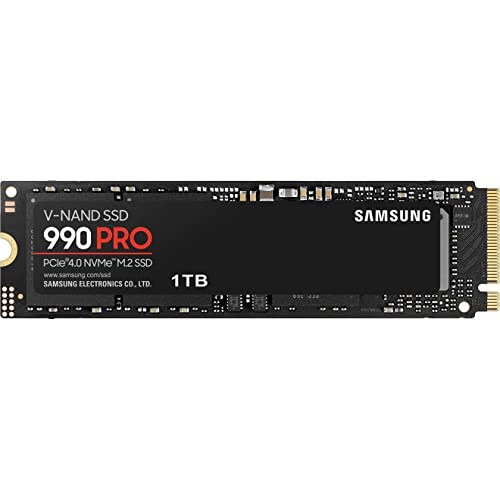

Samsung 990 PRO vs Crucial T705 at a Glance
| Feature | Samsung 990 PRO | Crucial T705 |
|---|---|---|
| Interface Standard | PCIe 4.0 x4, NVMe | PCIe 5.0 x4, NVMe |
| Form Factor | M.2 2280 (PCI-SIG D8 compliant) | M.2 2280 |
| Max Sequential Read Speed | Up to 7,450 MB/s | Up to 13,600 MB/s |
| Max Sequential Write Speed | Up to 6,900 MB/s | Up to 10,200 MB/s |
| Random Read / Write Performance | Up to 1,400K / 1,550K IOPS | Not listed |
| NAND Flash Type | Not listed | Micron TLC NAND |
| Thermal Design | Nickel-coated controller, smart thermal control | Heatsink required, proper airflow mandatory |
| Hardware Encryption | AES 256-bit Encryption | Hardware Encryption |
| Bundled Software | Samsung Magician | Acronis True Image, 1-Month Adobe Creative Cloud |
| Console Compatibility | Sony PlayStation 5 | Microsoft Xbox Series S, Xbox Series X |
| Best For | Laptops, PS5 consoles, and efficient gaming PCs | Heavy Gen5 PC workstations and 8K+ media creation |
Sequential Read and Write Speeds
Sequential throughput defines how rapidly an internal solid-state drive can read or write large contiguous blocks of data without interruption. When moving multi-gigabyte video files, archiving massive game installations, or unzipping compressed system backups, sequential metrics represent the absolute performance ceiling of your storage sub-system. Evaluating samsung 990 pro vs kingston kc3000 comparisons often reveals that high-end Gen4 drives push the edge of their bus, but stepping up to Gen5 hardware shifts the performance curve entirely.
The gap between these two models illustrates the technological leap in the PCIe 4.0 vs PCIe 5.0 SSD showdown. Samsung built the 990 PRO to saturate the Gen4 interface, posting sequential read speeds up to 7,450 MB/s and sequential write speeds up to 6,900 MB/s. Crucial engineered the T705 on full PCIe 5.0 bandwidth, achieving sequential read figures up to 13,600 MB/s and write speeds reaching 10,200 MB/s. When analyzing Samsung 990 PRO vs Crucial T705 speeds strictly by the numbers, the Crucial drive pushes 82% more read throughput and 47% more write throughput across the M.2 interface.
In practical use, these speed gains only emerge if your system platform features a native PCIe 5.0 M.2 slot routed straight to modern CPU lanes. If installed in a PCIe 4.0 slot, the Crucial T705 automatically throttles back to Gen4 interface boundaries, eliminating its sequential performance lead over the Samsung drive. When paired with supported Gen5 hardware, however, the Crucial drive handles sustained file exports and massive data ingest significantly faster than any PCIe 4.0 drive can manage.
Edge: Crucial T705, delivering nearly double the sequential read and write throughput of the Samsung drive on compatible PCIe 5.0 motherboards.
Thermal Management and Heatsink Requirements
High-speed solid-state drives generate substantial heat during sustained transfer operations, making thermal dissipation a major factor in maintaining steady performance. If a high-throughput controller exceeds its safe temperature limits, it automatically triggers aggressive thermal throttling to prevent chip degradation, significantly cutting read and write speeds. Choosing between these drives requires a close look at system cooling capacity and physical clearance within your chassis or device housing.
Samsung engineered the 990 PRO for tight physical footprints and high power efficiency. It uses an in-house, nickel-coated controller alongside smart thermal control algorithms that provide up to 50% improved performance per watt over its predecessor. With a slim single-sided profile meeting the PCI-SIG D8 standard, the 990 PRO disperses heat effectively inside compact enclosures, laptops, and consoles without requiring massive metal blocks. For users comparing alternatives like in our samsung 990 evo vs 990 pro breakdown, the 990 PRO represents top-tier thermal moderation for standard spaces.
The Crucial T705 operates under far more demanding thermal dynamics. Crucial explicitly states in its specifications that the T705 must be installed with a compatible motherboard heatsink or aftermarket cooler, and requires direct system airflow to prevent thermal throttling. The raw energy necessary to push 13,600 MB/s across Gen5 lanes generates intense thermal output. In any Samsung 990 PRO vs Crucial T705 thermals comparison, the 990 PRO runs much cooler and integrates easily into tight spaces, whereas the T705 demands serious metal heatsinks and deliberate chassis ventilation.
Edge: Samsung 990 PRO, offering superior energy efficiency, a compact PCI-SIG D8 design, and minimal cooling requirements compared to the heat-intensive Gen5 drive.
Platform Compatibility and Console Support
Compatibility determines whether your target machine can physically house an SSD and run it at rated speeds. Storage standards advance rapidly, but host platforms vary widely in their lane allotments, slot spacing, and operating system optimizations. Evaluating interface specifications avoids buying an expensive SSD only to see it run at half its rated speed or refuse to fit inside a compact bay.
Samsung built the 990 PRO with universal modern consumer computing in mind. The drive is explicitly listed as compatible with PC, Mac, Laptop, and the Sony PlayStation 5 console. Because the PS5 utilizes a PCIe 4.0 M.2 slot and enforces strict thermal and physical size restrictions, the 990 PRO drops directly into the console expansion bay without modification. Readers checking guides like the samsung 990 pro vs 9100 pro matchup know that physical clearance matters just as much as theoretical bus speeds.
The Crucial T705 is tailored specifically for desktop workstation platforms, highlighting dedicated support for Intel 13th and 14th Gen processors as well as AMD Ryzen 7000 series setups with Gen5 slots. While Crucial lists Microsoft Xbox Series S and Xbox Series X under its console hardware models in product specifications, Crucial T705 PS5 compatibility faces severe practical limitations. The PS5 does not support PCIe 5.0 speeds, and the mandatory requirement for a substantial heatsink and forced airflow on the T705 makes it an impractical fit for the console expansion bay, where the 990 PRO thrives natively.
Edge: Samsung 990 PRO, providing proven, direct compatibility across thin laptops, gaming desktops, and PlayStation 5 consoles.
Workstation and Video Editing Performance
Content creators, visual effects artists, and workstation operators demand storage that handles continuous read and write cycles without stalling. Working with multi-stream 8K footage, uncompressed video tracks, and dense 3D rendering sequences puts continuous strain on the NAND flash and internal controller. For professional workflows, the discussion over whether is Crucial T705 worth it depends largely on how many minutes it saves during daily media exports.
In a comprehensive Samsung 990 PRO review, the drive demonstrates excellent reliability for high-resolution photo and video timelines, sustaining up to 6,900 MB/s writes via its Intelligent TurboWrite architecture. It handles standard 4K workflows with complete stability and zero drops in frame access. However, for extreme multi-camera arrays and uncompressed RAW formats, Gen4 transfer ceilings can occasionally bottleneck real-time timeline scrubbing across distributed scratch disks.
A technical Crucial T705 review highlights its explicit design target: creative assets, 3D rendering, and 8K+ media workflows. Powered by Micron TLC NAND, the T705 sustained sequential write speed of up to 10,200 MB/s allows video editors to move terabytes of raw camera footage in a fraction of the time. When weighing the Samsung 990 PRO or Crucial T705 for video editing, Crucial gives editors a distinct advantage by packing enough bandwidth to scrub uncompressed 8K tracks without dropped frames, reinforced by an included one-month Adobe Creative Cloud All-Apps subscription.
Edge: Crucial T705, delivering class-leading sequential speeds and included professional creative software tailored for high-bitrate video editing and 3D rendering.
Gaming Load Times and DirectStorage
For PC and console gamers, drive performance is measured by game boot times, fast-travel loading screens, and smooth texture streaming in expansive open-world titles. Microsoft DirectStorage technology offloads asset decompression directly to the graphics card, making quick random and sequential asset delivery crucial for modern gaming pipelines. Exploring our samsung 990 pro vs teamgroup mp44 guide highlights how random throughput dictates real-world gaming responsiveness.
When deciding between the Samsung 990 PRO or Crucial T705 for gaming, real-world asset delivery reveals surprising parity. Samsung specifically positions the 990 PRO as a gaming champion, delivering up to a 65% improvement in random performance over the prior 980 PRO model. With random read and write ratings hitting up to 1,400K IOPS and 1,550K IOPS, the 990 PRO feeds small assets, shader caches, and geometry tables to game engines almost instantaneously.
The Crucial T705 counters with massive raw bus bandwidth and built-in DirectStorage optimization designed to minimize latency and CPU overhead. While the T705 delivers peak sequential asset loading slightly faster in targeted DirectStorage synthetic benchmarks, modern game engines rarely saturate a full Gen5 link during gameplay. Both drives reduce loading screens to barely perceptible blurs, meaning ordinary gaming gains from the T705 over the 990 PRO are modest in standard desktop setups.
Edge: Tie, as both drives maximize gaming performance, with Samsung leading in random IOPS optimization and Crucial dominating raw throughput.
Software Bundles and Drive Management
Drive management software protects your investment over time by delivering firmware patches, real-time health diagnostics, and seamless data migration tools. When setting up a new solid-state drive as a primary boot volume, disk-cloning utilities remove the friction of reinstalling operating systems, software licenses, and personalized settings from scratch.
Samsung equips the 990 PRO with its established Samsung Magician software suite. Magician stands as one of the most intuitive proprietary SSD utilities available, allowing users to monitor drive health indicators, track operating temperatures, run diagnostic scans, manage AES 256-bit hardware encryption, and apply critical firmware updates. Samsung regularly releases updates through Magician to maintain controller stability and protect stored assets throughout the life of the drive.
Crucial approaches the software value proposition by bundling practical third-party utilities alongside the T705 hardware. The drive includes Acronis True Image cloning software, which simplifies system migration, partition cloning, and data recovery when moving from an older storage drive. Crucial also bundles a one-month Adobe Creative Cloud All-Apps subscription, providing immediate access to applications like Premiere Pro, Photoshop, and After Effects. While Samsung offers superior daily drive monitoring through Magician, Crucial provides immediate software utility for drive migration and content creation.
Edge: Crucial T705, thanks to the combination of Acronis True Image disk cloning and the Adobe Creative Cloud software package.
Pros and Cons
Samsung 990 PRO
Pros
- Up to 7,450 MB/s sequential read speeds
- Broad compatibility across laptops and PS5
- Power-efficient design with nickel-coated heat controller
- Includes Samsung Magician management software
Cons
- Limited to PCIe 4.0 interface bandwidth
- Lower sequential throughput than Gen5 drives
View Samsung 990 PRO on Amazon
Crucial T705
Pros
- Blazing PCIe 5.0 speeds up to 13,600 MB/s
- High sequential write speeds up to 10,200 MB/s
- DirectStorage optimization for heavy creative workloads
- Includes Acronis cloning software and Adobe license
Cons
- Mandates heatsink and sufficient airflow to prevent throttling
- Requires PCIe Gen5 slot for full performance
Who Should Buy Each One
Choose the Samsung 990 PRO If

- You need internal storage expansion for a Sony PlayStation 5 console that fits factory dimensions without clearance issues.
- You are upgrading an ultra-slim laptop or compact system that relies on the PCI-SIG D8 thermal and thickness specification.
- Your desktop motherboard only supports PCIe 4.0 expansion slots and lacks heavy active M.2 cooling blocks.
- You prefer comprehensive in-house health monitoring, diagnostics, and firmware maintenance using Samsung Magician software.
Choose the Crucial T705 If

- You run an Intel 13th/14th Gen or AMD Ryzen 7000 PC with dedicated PCIe 5.0 M.2 motherboard slots.
- Your everyday workstation tasks involve moving massive individual files, such as 8K raw video, multi-layer VFX, and dense 3D scenes.
- Your desktop chassis features high-volume airflow and a heavy motherboard heatsink capable of managing Gen5 thermal loads.
- You want bundled Acronis True Image cloning software to clone an existing operating system drive easily.
Final Verdict
For the vast majority of PC gamers, laptop owners, and console players, the Samsung 990 PRO remains the most sensible and balanced solid-state drive. It pushes the PCIe 4.0 interface to its absolute physical limits with sequential reads of 7,450 MB/s, generates class-leading random speeds up to 1,550K IOPS, and operates with exceptional thermal efficiency. Because it drops seamlessly into a PlayStation 5, an ultrabook, or an existing Gen4 gaming PC without demanding custom cooling setups, it delivers reliable performance across everyday tasks.
The Crucial T705 is an uncompromising speed machine built for professionals and hardware enthusiasts who demand maximum transfer rates above all else. With sequential read speeds reaching up to 13,600 MB/s and writes hitting 10,200 MB/s, it cuts heavy video editing and large-scale rendering export times down to bare minimums. If you possess a modern PCIe 5.0 desktop motherboard with a beefy heatsink and strong chassis ventilation, the T705 rewards you with bleeding-edge storage throughput that PCIe 4.0 hardware cannot touch.
FAQ
Does the Crucial T705 work inside a PlayStation 5?
While the Crucial T705 is technically backwards compatible with PCIe 4.0 M.2 slots, it is not recommended for the Sony PlayStation 5. The PS5 slot runs at PCIe 4.0 speeds, capping the T705 far below its rated 13,600 MB/s capability. Furthermore, the T705 requires substantial heatsinks and active chassis airflow to prevent thermal throttling, which the enclosed PS5 drive bay cannot adequately supply.
Can you use the Samsung 990 PRO on a PCIe 5.0 motherboard?
Yes. PCIe interface standards are fully backward and forward compatible. Installing the Samsung 990 PRO into a PCIe 5.0 M.2 slot works seamlessly, with the drive operating at its maximum rated PCIe 4.0 speeds of up to 7,450 MB/s read and 6,900 MB/s write without generating excessive system heat.
Do you need an aftermarket heatsink for the Crucial T705?
Yes. Crucial explicitly states in the product specifications that the bare-drive T705 must be installed with either your motherboard’s integrated M.2 heatsink or a dedicated aftermarket heatsink. Operating the drive without adequate metal thermal dissipation and case airflow will quickly lead to severe thermal throttling under heavy read and write workloads.
Which drive is better for standard PC gaming load times?
Both drives deliver virtually identical gaming load times in standard PC titles. Game asset loading relies heavily on random 4K read performance and software decompression pipelines rather than continuous sequential bandwidth. The Samsung 990 PRO features exceptional random performance up to 1,400K IOPS, matching the real-world gaming responsiveness of the Crucial T705 without requiring heavy Gen5 cooling.
Does the Samsung 990 PRO fit inside slim laptops?
Yes. The Samsung 990 PRO features a slim single-sided M.2 2280 form factor that complies with the PCI-SIG D8 standard. This slim physical profile allows it to fit easily into modern high-performance laptops and ultrabooks that cannot accommodate drives with thick heatsinks or double-sided component layouts.
What software tools are included with each SSD?
The Samsung 990 PRO includes access to the Samsung Magician software suite, which focuses on drive health monitoring, diagnostic testing, performance optimization, and firmware updates. The Crucial T705 includes a license for Acronis True Image cloning software to facilitate OS migration, along with a one-month complimentary subscription to Adobe Creative Cloud All-Apps.


