Choosing between the DeWalt DWS715 and the DeWalt DCS785 comes down to whether you prioritize a stationary, continuous-power corded saw with a compact footprint or an expansive cordless sliding saw built for maximum cross-cutting capacity on active jobsites. The DWS715 relies on a standard 15-amp corded motor and a fixed chopping arm, whereas the DCS785 incorporates a sliding rail mechanism driven by DeWalt 20V MAX or FLEXVOLT battery platforms.
Woodworkers maintaining a dedicated bench in a workshop setting should choose the DeWalt DWS715 for its uninterrupted electrical supply and lighter frame. Trim carpenters and jobsite contractors needing wide board processing without hunting for wall outlets should choose the DeWalt DCS785.


DeWalt DWS715 vs DCS785 at a Glance
| Feature | DeWalt DWS715 | DeWalt DCS785 |
|---|---|---|
| Power Source | Corded Electric (120V) | Battery Powered (20V MAX / FLEXVOLT) |
| Motor Specs | 15 Amp, 1800 Watts | 20V Cordless with Bevel Gear Transmission |
| Cutting Mechanism | Non-Sliding Compound Chop | Sliding Compound |
| Bevel Capability | Single Bevel (0° to 48° L, 0° to 3° R) | Double Bevel (with 22.5° and 33.9° Pawls) |
| Max Horizontal Cut | 2×8 dimensional lumber at 90° | Up to 14 inches |
| Vertical Baseboard Cut | 5-1/2 inches vertically | 6-1/2 inches standing up |
| Tool Weight | 42.8 lbs | 51.7 lbs (tool only, 65.9 lbs item weight) |
| Included Blade | 12-inch, 80-tooth carbide | 12-inch, 60-tooth carbide |
| Dust Collection | Dust bag included | Up to 97% capture, Wireless Tool Control |
| Best For | Stationary workshops and standard dimensional cuts | Mobile jobsites and wide material cross-cutting |
Cutting Capacity and Rail Design
The fundamental physical distinction between these two 12-inch miter saws lies in the cutting assembly. The DWS715 is a non-sliding compound miter saw, meaning the motor and blade pivot downward on a fixed hinge arm. According to official specifications, the DWS715 cross cut capacity handles 2-inch by 8-inch dimensional lumber at 90 degrees and 2-inch by 6-inch lumber when set to a 45-degree miter. For woodworkers who primarily process 2x4s, standard framing studs, and modest boards, this fixed travel path provides immense rigidity without any rail deflection.
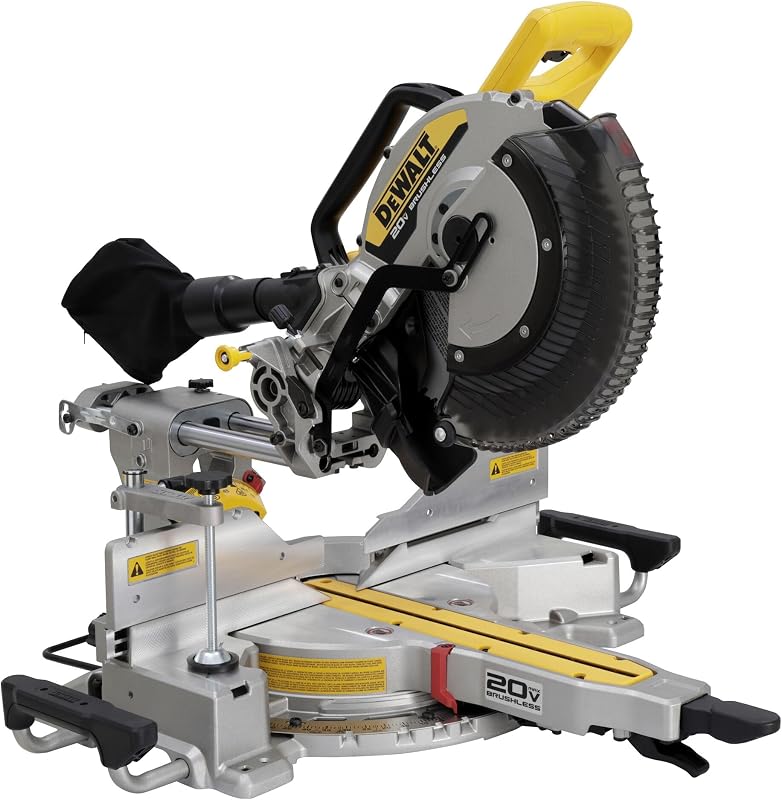
In contrast, the DCS785 is a full sliding miter saw engineered with linear rails that permit the cutting head to travel backward and forward. The DeWalt DCS785 cutting capacity expands horizontal cross-cuts up to 14 inches. This extensive reach allows contractors to cross-cut wide shelving, 1×12 trim boards, and broad stair treads in a single pass. For vertical cuts against the fence, the DCS785 accommodates baseboards up to 6-1/2 inches standing vertically and 6-1/2 inches nested crown molding, surpassing the 5-1/2-inch vertical baseboard and nested crown limits found on the DWS715 tall sliding fence. Those evaluating expansive cutting mechanisms often cross-reference the dewalt dws779 vs dcs785 to examine how different sliding designs perform across broad stock.
Gaining this substantial horizontal span fundamentally changes jobsite workflow. When using the DWS715, any board exceeding an 8-inch width requires flipping the workpiece or making a secondary cut on a table saw. The DCS785 eliminates those extra steps by clearing 14-inch stock directly on the rails. However, the sliding mechanism introduces additional mechanical components that require clearing space behind the unit.
Edge: DeWalt DCS785 provides significantly larger cutting boundaries, clearing up to 14 inches horizontally compared to the 8-inch limit on the DWS715.
Power Delivery, Runtime, and Motor Engineering
Motor configuration highlights a major divergence in how each saw sustains cutting performance over long shifts. The DWS715 features a corded 120-volt system drawing 15 amps and 1800 watts, spinning the blade at speeds listed between 4,000 and 4,500 rpm. Operating on standard utility power means you can run framing lumber through the blade indefinitely without power sag, battery management, or work interruptions. The listing notes brushless motor construction alongside a machined base fence support, creating a durable setup for heavy shop duties.
The DCS785 operates on DeWalt 20V MAX battery power and is the first 12-inch miter saw from the brand designed for compatibility across both 20V MAX and high-output FLEXVOLT battery packs. Cordless tools can suffer from battery drain under heavy load, but the DCS785 incorporates a specialized bevel gear transmission that minimizes power loss across the drive assembly. Furthermore, the tool features regenerative braking technology that redirects energy back into the system to maximize runtime. The listing notes that this system delivers up to 371 cuts in 3-1/4-inch MDF base molding and up to 153 cuts in pressure-treated 4×4 timber on a single charge.
Deciding between a corded 12-inch miter saw corded vs cordless design depends heavily on working conditions. The DWS715 offers non-stop power for all-day framing or shop processing as long as an outlet or extension cord is within reach. The DCS785 provides true jobsite freedom, allowing framing teams to set up on decks, unpowered builds, or remote locations without waiting for temporary power poles or lugging heavy generator units. Readers researching cordless alternatives frequently look at the dewalt dcs785 vs metabo hpt c10fcg2 when weighing battery freedom against compact budget corded alternatives.
Edge: DeWalt DWS715 wins for continuous workshop power, while the DCS785 takes the advantage for untethered remote operation.
Bevel Architecture and Angle Precision
Bevel versatility dictates how quickly and accurately you can handle complex trim work, rafters, and compound joinery. The DWS715 uses a single-bevel architecture. The blade tilts from 0 degrees to 48 degrees to the left, with an auxiliary adjustment of 0 degrees to 3 degrees to the right. To execute opposing compound miter cuts on moldings with a single-bevel machine, you must physically flip the workpiece end-for-end. For baseboards and crown, this requirement introduces opportunities for measuring errors on long stock.
The DCS785 solves this limitation by implementing a double-bevel layout. The saw tilts both left and right, allowing the operator to keep long, delicate molding laid flat against the bed while tilting the blade to either side. To streamline common angle configurations, the DCS785 integrates dedicated bevel pawls that stop quickly at 22.5 degrees and 33.9 degrees. This system accelerates production times for trim carpenters setting up multi-angle room corners or standard crown molding bevel profiles.
On the miter axis, both tools provide exceptional baseline precision. The DWS715 relies on a heavy-duty stainless-steel miter detent plate equipped with 14 positive stops and a cam miter lock that delivers repeatable accuracy without slipping. The DCS785 pairs intuitive touchpoint controls with its sliding travel. When assessing a dewalt dws715 or dcs785 for trim carpentry application, the dual-bevel capability and integrated pawls of the DCS785 eliminate the material handling headaches common to single-bevel designs. For wider comparative context on premium bevel architectures, builders often review the dewalt dcs785 vs bosch cm10gd.
Edge: DeWalt DCS785 wins due to its dual-bevel tilting range and pre-indexed bevel pawls that remove the need to flip workpieces.
Portability, Dimensions, and Workspace Footprint
Footprint and carry weight determine how well each tool integrates into tight workshops or moves around busy jobsites. The DWS715 features dimensions of 26.77 inches in length, 21.85 inches in width, and 18.9 inches in height, with a tool height of 15 inches. Its total weight is 42.8 pounds. Because it lacks rear sliding rails, the DWS715 can be backed almost completely against a workshop wall or set on a shallow workbench without consuming valuable walkway space. Its built-in carry handle and moderate weight make it simple for a single person to lift and store.
The DCS785 requires a much larger footprint to accommodate its 14-inch horizontal stroke. The tool measures 33.81 inches in length, 23.81 inches in width, and 19.5 inches in height. Bare tool weight is listed at 51.7 pounds, with an item weight of 65.9 pounds on the specification table. The sliding rails extend outward, requiring deeper stands and dedicated clearance behind the machine. Moving the DCS785 is facilitated by integrated carry handles, but moving a 50-plus-pound sliding assembly up ladders or through narrow residential doorways demands noticeably more physical effort.
If you are outfitting a compact residential garage shop where every inch of depth matters, the DWS715 is easier to accommodate permanently. The DCS785 sliding miter saw is built specifically for full-size work stands or spacious jobsite trailers where its footprint is offset by its massive material capacity. Those balancing footprint against performance can also examine the dewalt dws715 vs metabo hpt c10fcg2 to see how compact stationary models fit smaller benches.
Edge: DeWalt DWS715 takes the edge with a lighter 42.8-pound frame and a compact 26.8-inch footprint that fits tight spaces.
Dust Management and Cutline Alignment Technology
Keeping an indoor workspace clean and seeing your cutline clearly are critical factors for trim accuracy and health safety. The DWS715 includes a standard fabric dust bag and a vertical material clamp. It uses a traditional mechanical sightline approach to align cuts with the blade edge. While the tall sliding fences provide strong structural support for nested moldings, capturing airborne particulate relies entirely on passive flow into the attached bag or manual hookup to a shop vacuum.
The DCS785 integrates advanced electronic and airflow enhancements. DeWalt rates its internal dust collection system to capture up to 97% of dust during operation. To streamline workflow, the DCS785 features integrated Wireless Tool Control, which pairs the saw with compatible cordless dust extractors. When you squeeze the saw trigger, the paired vacuum turns on automatically, maintaining a clean workspace without reaching for secondary switches. The DCS785 package includes both a dust bag and a dedicated vacuum adaptor.
For cutline accuracy, the DCS785 incorporates the proprietary Cutline blade positioning system. Unlike standard laser markers that can drift out of calibration or become invisible in bright daylight, this system casts an adjustment-free shadow line directly on the workpiece showing the exact blade kerf. Combined with the fine-cutting capability of its carbide blade, alignment on intricate trim joints is immediate and precise. In a comprehensive dewalt dcs785 review, these smart accessories stand out as major modern usability enhancements over older chop saw designs.
Edge: DeWalt DCS785 wins decisively with up to 97% dust capture, Wireless Tool Control, and the Cutline blade positioning system.
Pros and Cons
DeWalt DWS715

Pros
- Continuous 15-amp 1800-watt corded power
- Lightweight 42.8-pound compact frame
- Stainless-steel miter plate with 14 stops
- 80-tooth carbide-tipped blade included
Cons
- Limited 2×8 horizontal cross-cut capacity
- Single-bevel tilting requires flipping long boards
- Lacks automated wireless vacuum activation
DeWalt DCS785
Pros
- 14-inch horizontal sliding cut capacity
- Cordless 20V MAX and FLEXVOLT compatibility
- Double-bevel layout with quick-set pawls
- Captures up to 97 percent of dust
- Adjustment-free Cutline blade positioning system
Cons
- Heavier 51.7-pound bare tool weight
- Deeper 33.8-inch workspace footprint required
- Batteries and charger sold separately
Who Should Buy Each One
Choose the DeWalt DWS715 If:
- You work predominantly inside a garage workshop with shallow workbenches and reliable 120-volt AC power.
- You primarily cut 2×4 framing stock, 2×6 boards, and standard 5-1/2-inch baseboards that do not require a sliding mechanism.
- You want a lighter 42.8-pound saw that is easy to lift, transport, and stow away on a shelf.
- You want continuous, uninterrupted motor run time without monitoring battery levels or charging cycles.
Choose the DeWalt DCS785 If:
- You work on active residential or commercial jobsites where wall outlets are distant, crowded, or absent.
- You regularly cross-cut wide materials such as 1×12 fascia, 12-inch shelving, stair treads, or wide 14-inch horizontal boards.
- You cut complex trim profiles and prefer a double-bevel saw that eliminates the need to flip long boards.
- You need automated dust control and rapid alignment via Wireless Tool Control and the Cutline shadow system.
Final Verdict
When comparing the dewalt dcs785 vs dws715, the DeWalt DCS785 represents the superior all-around machine for modern jobsite productivity. Its 14-inch horizontal cross-cutting span, double-bevel functionality with indexed pawls, 97% dust capture rating, and Cutline blade positioning system solve the primary bottlenecks encountered during heavy finish carpentry and dynamic site framing. The addition of regenerative braking and dual 20V MAX and FLEXVOLT battery support ensures substantial cutting runtime away from electrical infrastructure, making the investment worthwhile for professional builders who demand broad capacity and mobile independence.
Nevertheless, the DeWalt DWS715 remains an exceptional, dependable pick for stationary woodworkers and framing projects where wide sliding cuts are unnecessary. Delivering 15 amps of steady, continuous corded power with a solid 14-stop miter detent plate, 80-tooth factory blade, and an easily managed 42.8-pound body, it provides reliable chopping accuracy in a compact format. For fixed-bench hobbyists and contractors processing standard dimensional lumber, the DWS715 provides everything needed without added weight or deep rail clearance requirements.
FAQ
Can the DeWalt DCS785 use standard DeWalt 20V MAX batteries?
Yes. The DeWalt DCS785 is compatible with the entire range of DeWalt 20V MAX batteries as well as the higher-capacity DeWalt FLEXVOLT battery platform.
What is the maximum cross-cut board width for the DeWalt DWS715?
The DWS715 handles 2-inch by 8-inch dimensional lumber at a 90-degree cut and 2-inch by 6-inch dimensional lumber at a 45-degree angle. Wider boards cannot be cut in a single pass because the cutting head does not slide.
Does the DeWalt DWS715 have dual bevel or single bevel capability?
The DWS715 is a single-bevel miter saw. It bevels from 0 to 48 degrees to the left and has a limited 0 to 3-degree adjustment to the right. Opposing angle cuts on long moldings require flipping the stock over.
How does the Cutline system on the DCS785 differ from standard lasers?
The Cutline system on the DCS785 uses an LED light positioned above the blade to cast a shadow of the blade kerf onto the work surface. Unlike standard lasers, it does not require recalibration or mechanical adjustment when swapping blades.
Is the DeWalt DCS785 suitable for framing work?
Yes. When considering the dewalt dws715 or dcs785 for framing, the DCS785 delivers ample cutting depth to slice pressure-treated 4×4 timber up to 153 cuts per charge, and its 14-inch horizontal capacity makes quick work of wide engineered lumber.
What accessories are included in the box with the DeWalt DWS715?
The DWS715 comes equipped with the single-bevel compound miter saw, a 12-inch 80-tooth carbide-tipped blade, a blade wrench, a vertical material clamp, and a dust collection bag.
Can the DCS785 activate a workshop vacuum automatically?
Yes. The DCS785 features integrated Wireless Tool Control. When paired with a compatible cordless dust extractor, pulling the saw trigger automatically powers on the vacuum system.