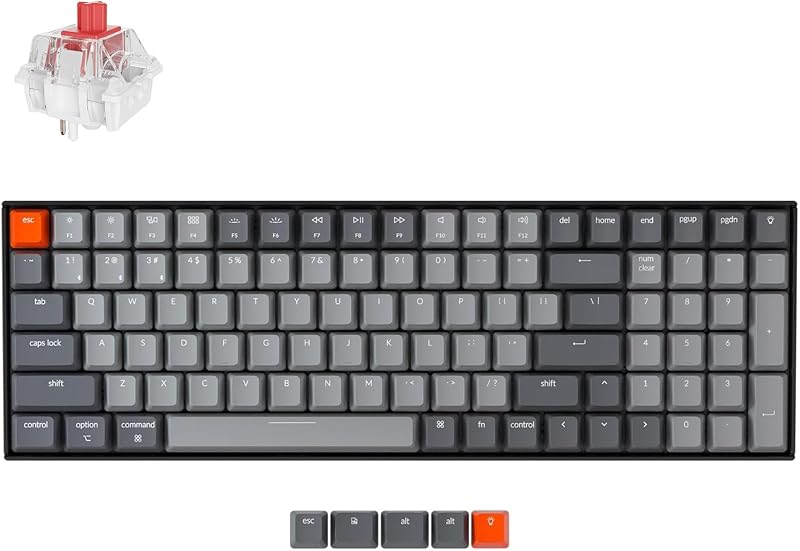
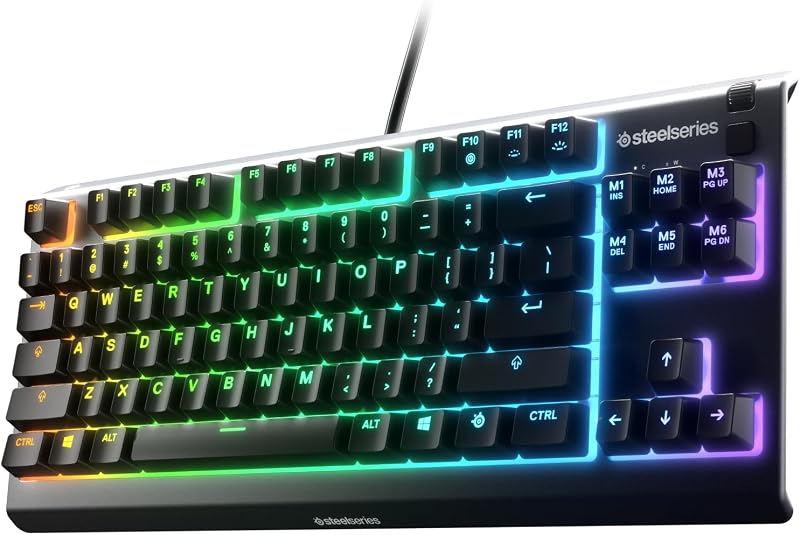
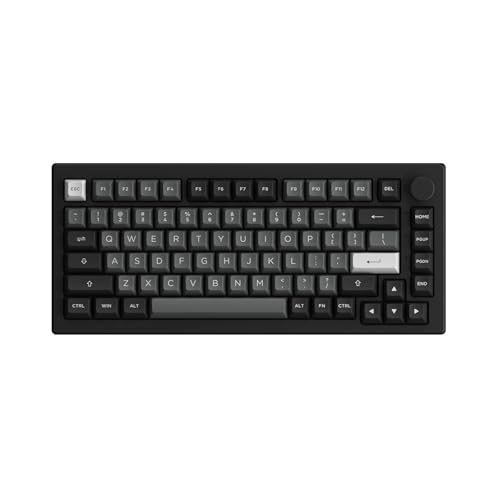
The decisive difference between the Akko 5075B Plus and the Lofree Flow comes down to typing ergonomics and chassis height: the 5075B Plus is a tall, customizable 75% mechanical keyboard fitted with an integrated rotary knob and standard-height mechanical switches, whereas the Flow is an ultra-slim, low-profile keyboard built into a unibody aluminum case with custom low-profile switches.
Typists and desktop hobbyists seeking deep acoustic foam dampening, standard switch compatibility, and 2.4GHz wireless flexibility should choose the Akko 5075B Plus. Professionals and minimalists who prioritize a low, wrist-friendly typing angle, an all-metal chassis, and a compact 100-key layout should invest in the Lofree Flow.

Akko 5075B Plus vs Lofree Flow at a Glance
| Feature | Akko 5075B Plus | Lofree Flow |
|---|---|---|
| Form Factor | 75% compact (84 keys) | Compact full-size (100 keys) |
| Chassis Material | Multi-layer case with dampening foams | All-aluminum design top to bottom |
| Profile Height | Standard profile (1.65 inches high) | Ultra-slim low profile |
| Switch Type | Akko V3 Creamy Yellow Pro (Linear) | Kailh Full POM Ghost (Linear) |
| Mounting Style | Gasket mount with silicone and IXPE pads | Low-profile gasket mount |
| Hot-Swappable Sockets | 5-pin standard mechanical sockets | Low-profile switch sockets |
| Wireless Connectivity | Bluetooth 5.0, 2.4GHz wireless, USB-C | Bluetooth, USB-C wired |
| Battery Capacity | 3000mAh rechargeable | Rechargeable (capacity not listed) |
| Keycap Construction | PBT double-shot (ASA profile) | PBT five-sided dye-sublimation |
| Hardware Controls | Multi-media rotary encoder knob | Hotkeys and media keys |
| Best For | Desktop customization and rotary control | Ultra-slim portability and sleek desk setups |
Chassis Profile and Build Construction
Chassis height dictates posture, wrist comfort, and everyday travel convenience. The 5075B Plus features a standard mechanical keyboard height measuring 1.65 inches tall, 13.19 inches long, and 5.75 inches wide. Its classic Black and Silver aesthetic relies on a multi-tiered frame engineered around noise-absorbing silicone plate foam, case foam, and an IXPE switch pad. This construction creates a substantial desktop presence that prevents shifting during intense typing sessions, though the 1.65-inch front height often requires users to hover their wrists or use an external rest to avoid strain during lengthy writing blocks.
By contrast, the Lofree Flow low profile mechanical keyboard is engineered from the ground up for minimal vertical thickness. Its all-aluminum design wraps the keyboard from top to bottom, providing structural rigidity, resistance to torsional flexing, and an executive aesthetic suitable for modern workspaces. The slim frame sits significantly lower to the desk surface, allowing users to type flat without bending their wrists upward. As explored in discussions around the akko 5075b plus vs nuphy air75 v2, low-profile designs eliminate the need for secondary wrist accessories and slip effortlessly into commuter backpacks alongside laptops and tablets.
The trade-off between these two approaches centers on material feel versus internal acoustic volume. The all-aluminum construction of the Flow feels exceptionally rigid and luxurious, giving it a noticeable advantage in premium exterior fit and finish. However, the taller body of the 5075B Plus houses extensive silicone and foam layers that absorb physical vibrations inside the case. If you prioritize an ultra-thin metal silhouette that preserves natural wrist posture, the Flow is superior. If you want a traditional, substantial desktop deck built to capture internal acoustics, the 5075B Plus delivers that traditional presence.
Edge: Lofree Flow provides a premium all-aluminum body with an ultra-slim profile that improves typing ergonomics without requiring an external wrist rest.
Switch Technology and Typing Acoustics
Switch mechanics govern keystroke feel, activation smoothness, and sound output. Akko equips the 5075B Plus with its V3 Creamy Yellow Pro switches. These linear mechanical switches operate on standard full-travel stems, delivering a deep, defined bottom-out stroke. To manage switch sound, the Akko 5075B Plus gasket mount incorporates dedicated silicone plate foam, case foam, and an IXPE switch pad beneath the switches. This specialized layering dampens pinging frequencies, producing the soft, muted, and slightly deeper sound profile commonly celebrated in an Akko 5075B Plus review.
The Flow takes an entirely different engineering path by utilizing Kailh Full POM low-profile switches, specifically the Ghost linear variant. POM (polyoxymethylene) is an inherently low-friction plastic that self-lubricates through normal friction over time, resulting in a glide-like keystroke straight out of the box. Lofree pairs these POM switches with what the brand cites as the world’s first low-profile gasket-mount structure. This design brings cushioned shock absorption to an ultra-thin form factor, distributing typing pressure evenly across the switch plate without bottoming out harshly on an unyielding metal base.
When deciding between the Akko 5075B Plus or Lofree Flow for typing, the fundamental difference lies in stroke depth and tactile acoustics. Typing on the standard Akko switches mimics the deep, resonant rhythm found in traditional desktop boards, similar to the switch travel observed in the ducky one 3 vs akko 5075b plus comparison. The Flow delivers a shorter travel distance with an effortless glide that reduces finger fatigue during all-day data entry. Typists who want deep key travel and cushioned acoustic muting will prefer the 5075B Plus, while those who want short, smooth, self-lubricating actuation will gravitate toward the Flow.
Edge: Tie. Akko offers deeper full-travel acoustics with extensive foam dampening, while Lofree delivers self-lubricating POM switches with low-profile gasket cushioning.
Connectivity and Battery Performance
Wireless versatility and battery stamina dictate how well a keyboard adapts to varying workstation environments. The 5075B Plus provides tri-mode functionality: multi-host Bluetooth 5.0, a dedicated 2.4GHz wireless connection using an included USB receiver, and a detachable USB Type-C wired mode. The 2.4GHz wireless protocol provides low-latency communication that handles fast-paced tasks without input stutter. Powering this system is an integrated 3000mAh rechargeable battery, giving users substantial runtimes when working untethered across laptops, PCs, or tablets like the AAUB P30.
The Flow approaches connectivity through Bluetooth and USB-C wired connections. The listing details support for Windows, Mac OS, PC, laptop, and tablet devices, allowing swift swapping between primary platforms. However, the product specifications do not list a dedicated 2.4GHz wireless USB receiver dongle, meaning wireless operation relies primarily on Bluetooth protocols. Additionally, while the Flow includes a rechargeable battery system, the listing does not specify the exact milliamp-hour (mAh) battery capacity.
When evaluating the Akko 5075B Plus or Lofree Flow for gaming, the presence of a dedicated 2.4GHz receiver gives the 5075B Plus an undeniable technical advantage. Bluetooth connections often introduce slight latency spikes that competitive gaming cannot tolerate. Furthermore, the verified 3000mAh battery inside the 5075B Plus provides a documented hardware baseline, whereas Flow users must manage wireless uptime without a stated battery capacity specification. For users demanding multi-channel wireless with ultra-low latency, the 5075B Plus is better equipped.
Edge: Akko 5075B Plus wins with a documented 3000mAh battery and tri-mode connectivity that includes a 2.4GHz USB wireless dongle.
Layout Efficiency and Hardware Controls
Desk space management and operational efficiency depend directly on key layout configuration. The 5075B Plus utilizes an 84-key, 75% compact arrangement. This layout preserves the dedicated function row, arrow cluster, and essential navigation keys while eliminating the numeric keypad to save lateral desk space. In the upper right corner, Akko includes a multi-media rotary encoder knob. This tactile hardware dial allows users to adjust audio volume or mute media instantly with a physical twist, a feature frequently preferred in comparisons like the akko 5075b plus vs epomaker th80 v2.
The Flow model featured here (the Flow100) utilizes a 100-key layout. Despite remaining compact thanks to tightly grouped key clusters, it retains a dedicated numeric keypad alongside standard arrow keys and media hotkeys. For accountants, data analysts, and spreadsheet managers, a numeric keypad dramatically speeds up daily numeric entry. Lofree manages to fit these 100 keys into a chassis that remains ultra-slim, giving productivity users a complete set of input keys without demanding excessive desk width.
Your choice hinges on whether you value desktop mouse clearance and tactile knob control or continuous numeric entry. The 5075B Plus frees up lateral space on your mousepad, preventing your gaming mouse from colliding with the keyboard edge during sweeping hand movements. Conversely, the Flow eliminates the need to buy an external numeric pad for financial workflows. The 5075B Plus provides immediate analog control via its rotary encoder, while the Flow delivers pure layout completeness.
Edge: Tie. The Akko 5075B Plus saves mouse desk space and adds a rotary control knob, while the Lofree Flow provides a space-efficient 100-key layout with an integrated numeric pad.
Customization, Keycaps, and Switch Compatibility
Mechanical keyboards are prized for their longevity and modularity, particularly through keycap replacement and switch swapping. The 5075B Plus features universal 5-pin hot-swappable sockets on its printed circuit board. These sockets accept virtually any standard MX-style mechanical switch from brands like Cherry, Gateron, Kailh, or Akko. Users can freely swap the included Akko 5075B Plus switches for heavier, clicky, or silent alternatives down the road. Furthermore, its PBT double-shot keycaps use an ASA profile, resisting surface shine and oil accumulation over years of daily typing.
The Flow is also hot-swappable, but Lofree Flow switch compatibility is strictly restricted to compatible low-profile switches, such as Kailh low-profile POM variants. You cannot install standard full-height 5-pin MX switches into the Flow due to physical pin spacing and chassis clearance constraints. On the keycap side, Lofree outfits the Flow with low-profile PBT keycaps manufactured via an advanced five-sided dye-sublimation process. This manufacturing method allows highly detailed printing that penetrates deep into the plastic, guaranteeing that legends will never wear away while maintaining a smooth, matte texture across the low-profile surface.
Software customization also sets these boards apart. The 5075B Plus interfaces with the Akko Cloud Driver, allowing full per-key remapping and granular control over the board’s built-in and side-LED RGB illumination. While the Flow provides ambient RGB sidelighting and backlighting (with the listing spec noting single-color backlight support), it lacks the open-ended component interchangeability of the Akko ecosystem. As seen when analyzing the gmmk pro vs akko 5075b plus, universal 5-pin hot-swap sockets provide an endless upgrade path that proprietary low-profile boards cannot match.
Edge: Akko 5075B Plus wins due to universal 5-pin switch compatibility, ASA profile keycaps, and Akko Cloud Driver programming support.
Pros and Cons
Akko 5075B Plus

Pros
- Tri-mode wireless including 2.4GHz receiver
- Universal 5-pin hot-swappable switch sockets
- Dedicated multi-media rotary encoder knob
- 3000mAh rechargeable battery capacity
- Multi-layer silicone and IXPE dampening foam
Cons
- Chassis height reaches 1.65 inches
- Lacks integrated numeric keypad
View Akko 5075B Plus on Amazon
Lofree Flow

Pros
- Ultra-slim all-aluminum unibody construction
- Self-lubricating Kailh Full POM switches
- 100-key layout includes numeric keypad
- Cushioned low-profile gasket mount system
- Five-sided dye-sublimated PBT keycaps
Cons
- Switch compatibility limited to low-profile models
- Listing does not specify 2.4GHz wireless
- Battery capacity rating not listed
Who Should Buy Each One
Choose the Akko 5075B Plus If
- You want a tactile multi-media rotary knob to control desktop audio on the fly.
- You need 2.4GHz low-latency wireless alongside Bluetooth for gaming and desktop tasks.
- You plan to swap in different standard 3-pin or 5-pin mechanical switches in the future.
- You prefer deep keystroke travel supported by multi-layer silicone and IXPE dampening foams.
Choose the Lofree Flow If
- You want an ultra-slim keyboard profile that allows natural, flat wrist typing without an extra rest.
- You appreciate an all-aluminum body that provides rigid structural stability and executive aesthetics.
- You need an integrated numeric keypad for numeric entry while maintaining a compact desk footprint.
- You prefer self-lubricating Kailh Full POM low-profile linear switches straight out of the box.
Final Verdict
For most desktop typists, gamers, and mechanical keyboard enthusiasts, the Akko 5075B Plus emerges as the more adaptable, feature-complete peripheral. Its tri-mode wireless architecture-backed by a verified 3000mAh battery and a lag-free 2.4GHz receiver-makes it infinitely practical across varied computing tasks. Combined with a dedicated rotary control knob, universal 5-pin hot-swap sockets, and a gasket-mounted interior packed with acoustic dampening foam, the 5075B Plus delivers the quintessential custom mechanical keyboard experience. In tests similar to comparisons like the akko 5075b plus vs 8bitdo retro mechanical, this level of versatility makes it a reliable centerpiece for long-term desk setups.
Yet, when asking is Lofree Flow worth it, the answer is an enthusiastic yes for users who value mobility, sleek materials, and ergonomic typing posture above all else. The Flow100 packs a complete 100-key layout into an ultra-thin unibody aluminum case that rivals premium modern laptop design. Its self-lubricating Kailh Full POM switches and low-profile gasket cushioning generate an exceptionally smooth, effortless keystroke that relieves wrist extension. If your priority is an ultra-slim, all-metal workstation keyboard that slips easily into a bag and eliminates wrist fatigue, the Lofree Flow is an outstanding choice.
FAQ
Can standard mechanical switches be installed in the Lofree Flow?
No. The Lofree Flow features hot-swappable sockets engineered specifically for low-profile switches, such as the included Kailh Full POM switches. Standard full-height 3-pin or 5-pin MX switches will not fit into the low-profile chassis or circuit board.
Does the Akko 5075B Plus require a wrist rest?
Because the 5075B Plus has a standard mechanical height of 1.65 inches, users who prefer a flat typing angle may benefit from a wrist rest to reduce wrist extension during marathon typing sessions. Those accustomed to traditional mechanical keyboards can type comfortably without one.
Which keyboard offers better wireless connectivity for fast-paced gaming?
The Akko 5075B Plus provides superior gaming connectivity because it includes a 2.4GHz wireless USB receiver in addition to Bluetooth 5.0. The Lofree Flow listing highlights Bluetooth and wired USB-C connections, but does not list a high-speed 2.4GHz wireless dongle.
Do both keyboards have hot-swappable switches?
Yes, both models feature hot-swappable circuit boards that allow users to change switches without soldering. However, the Akko 5075B Plus uses standard 5-pin sockets compatible with hundreds of switch varieties, while the Lofree Flow accommodates low-profile switches.
Does the Lofree Flow include backlighting?
Yes. The Lofree Flow features ambient RGB sidelighting alongside keyboard backlighting. While the product specifications cite single-color backlight support, the listing highlights vibrant ambient lighting effects built directly into the aluminum frame.
Can all keys be remapped on the Akko 5075B Plus?
Yes. The Akko 5075B Plus supports full key remapping and RGB lighting animation configuration through the downloadable Akko Cloud Driver application.