The single factor that decides the choice between the Wooting TenZ Takeover and the Keychron K8 HE is whether you need an uncompromising wired esports device with an 8000 Hz polling rate or a versatile multi-device keyboard featuring wireless hall effect functionality. While both boards use contactless magnetic sensors to eliminate physical debounce delay, their underlying engineering serves two distinct types of desk setups.
Choose the TenZ Takeover if your main goal is achieving the lowest possible input delay alongside fine-tuned analog movement features for high-tier competitive gaming on PC. Choose the K8 HE if you split your time between productivity and casual play, requiring flexible tri-mode connectivity, Mac and Windows compatibility, and an upscale wood-accented aluminum frame.


Wooting TenZ Takeover vs Keychron K8 HE at a Glance
| Feature | Wooting TenZ Takeover | Keychron K8 HE |
|---|---|---|
| Switch Type | Lekker TenZ TikkenZ Magnetic Hall Effect | Gateron Double-Rail Hall Effect Magnetic Switches |
| Actuation Range | 0.1 mm to 4.0 mm | 0.2 mm to 3.8 mm |
| Rapid Trigger Behavior | Continuous dynamic reset by distance | Continuous dynamic reset by distance |
| Polling Rate and Latency | 8000 Hz (8K) with 0.125ms latency | 1000 Hz in 2.4 GHz and wired modes |
| Connectivity Options | Wired USB-C | 2.4 GHz wireless, Bluetooth 5.2, USB-C wired |
| Chassis and Plate Materials | Solid black case, FR4 plate, gasket mount | Aluminum and natural wood frame, aluminum plate |
| Keycap Profile and Material | Not listed | OSA profile double-shot non-shine-through PBT |
| Software Interface | Wootility web and desktop app | Keychron Launcher web app and QMK |
| Platform Compatibility | PC | PC, Mac, Linux, iOS, Android, Consoles |
| Best For | Esports enthusiasts and FPS specialists | Hybrid desk setups and multi-device productivity |
Input Latency and Polling Performance
Input responsiveness forms the baseline of any competitive gaming peripheral, dictating how quickly an electronic signal registers on your display after a key reaches its actuation threshold. In standard mechanical switches, physical metal leaves create contact chatter that requires algorithmic debounce delays, usually adding several milliseconds to each keystroke. Magnetic switches eliminate this mechanical contact completely, but the underlying controller processing and USB polling cycle determine how fast the board reports that instantaneous measurement to your system.
When analyzing wooting tenz takeover vs steelseries apex pro tkl and other high-end peripherals, the Wooting TenZ Takeover latency numbers stand at the absolute pinnacle of current hardware design. The TenZ Takeover features an 8000 Hz polling rate that delivers data packets to the host PC every 0.125 milliseconds. This massive data pipeline minimizes the delay between continuous switch position sampling and OS recognition, producing an immediate tracking sensation that is noticeable on high-refresh-rate monitors during frantic in-game exchanges.
By comparison, the Keychron K8 HE polling rate tops out at 1000 Hz when connected over its 2.4 GHz wireless link or via a direct USB-C connection, providing a 1.0 millisecond reporting interval. While a 1000 Hz rate remains standard for most high-grade mechanical keyboards, it delivers one-eighth the transmission frequency of Wooting’s 8K architecture. For general typing and casual matches, 1000 Hz is plenty fast, but pure competitive shooters reveal a distinct edge for higher polling frequencies.
Edge: Wooting TenZ Takeover due to its native 8000 Hz polling capability and ultra-low 0.125ms internal processing delay.
Magnetic Switch Feel and Rapid Trigger Customization
Rapid trigger technology has reshaped the mechanical keyboard market by divorcing key actuation and reset from fixed physical locations. Instead of waiting for a switch to travel back up past a predefined leaf mechanism before registering another command, rapid trigger sensors detect reverse travel dynamically. The moment a switch begins an upward movement, the keystroke resets instantly, allowing immediate re-actuation from any point along the stem’s travel path.
The Wooting TenZ Takeover rapid trigger system operates across a deep 0.1 mm to 4.0 mm adjustment range, powered by Lekker TenZ TikkenZ magnetic switches. This gives users the option to set hyper-sensitive 0.1 mm registration thresholds for instant inputs or deeper travels to avoid accidental mispresses. Additionally, the TenZ Takeover incorporates Rappy Snappy, a specialized firmware mode that monitors two opposite directional keys simultaneously and activates whichever switch is pressed further down, completely redefining counter-strafing precision.
The K8 HE incorporates a capable Hall Effect magnetic sensor setup that provides adjustable actuation spanning from 0.2 mm to 3.8 mm. This travel window allows precise customization via the Keychron Launcher interface, letting you shorten the press required for movement keys while leaving communication or utility keys deeper. However, the K8 HE lacks advanced algorithmic features like Rappy Snappy, and its actuation window is slightly narrower at both boundaries compared to the Wooting switch architecture.
Edge: Wooting TenZ Takeover for its broader 0.1 mm to 4.0 mm tuning range and exclusive Rappy Snappy directional handling.
Connectivity and Multi-Device Flexibility
A keyboard’s connectivity determines how cleanly it integrates into complex workstation environments. Modern workspaces frequently feature a combination of personal gaming rigs, corporate work laptops, and portable tablets, making seamless switching between multiple host machines a major practical advantage.
This category represents the greatest strength of the K8 HE. Designed as a versatile Keychron K8 HE wireless hall effect solution, the board incorporates tri-mode connectivity: low-latency 2.4 GHz wireless, Bluetooth 5.2, and detachable USB-C wired mode. It can maintain Bluetooth connections with up to three distinct devices simultaneously, letting you jump from a desktop rig to an office laptop or mobile tablet with a simple keystroke combination. Its internal battery powers the sensor array without tethering your workspace to a permanent cable run.
In contrast, the TenZ Takeover functions exclusively as a wired peripheral. Its official listing specifies compatibility strictly with PC hardware via a direct USB cable. Powering an 8000 Hz polling controller alongside high-frequency magnetic sensor scanning draws significant electrical current, explaining why Wooting opted for a dedicated wired configuration. If you intend to take your keyboard between rooms or swap between work machines without rerouting cables, the TenZ Takeover presents unavoidable physical limits.
Edge: Keychron K8 HE thanks to its flexible tri-mode wireless architecture and multi-device Bluetooth memory.
Build Quality, Materials, and Keycaps
The acoustic output and tactile bottom-out feel of a mechanical deck stem directly from its internal mounting scheme, frame materials, and keycap construction. While gaming boards once relied on stiff, hollow plastic assemblies, premium modern designs utilize refined plates, acoustic dampening foams, and dense plastics to produce satisfying keystroke resonance.
Wooting built the TenZ Takeover around a gasket mount structure paired with an internal black FR4 composite plate. Gasket mounting introduces compliant dampening tabs between the plate and housing, absorbing vibration when keys are pressed aggressively during heated gaming sessions. The case features a solid black top and bottom complemented by dark translucent side accents, and the stabilizers are screw-in PCB mount units that reduce wire rattle on wider modifier keys.
Keychron took a distinctly different design approach with the K8 HE, blending desk aesthetics with industrial rigidity. The chassis pairs a durable aluminum frame with natural wood side accents, producing an organic aesthetic that fits seamlessly into professional office environments. Keychron also includes double-shot PBT keycaps molded in their proprietary OSA profile, which resist surface shine and finger grease over prolonged use. While it relies on an aluminum plate rather than an acoustic FR4 gasket arrangement, its structural weight ensures the board remains firmly planted on your desk mat.
Edge: Tie. The TenZ Takeover offers a superior gasket-mounted typing feel with screw-in stabilizers, while the K8 HE delivers a more luxurious exterior with natural wood accents and premium double-shot PBT keycaps.
Software Ecosystem and Platform Compatibility
Configuring dynamic magnetic sensors requires an intuitive software backend that can adjust actuation depths, assign continuous rapid trigger sensitivity, and remap layer assignments without crashing or hogging computer memory. Modern peripheral software has moved away from bloated background programs toward streamlined browser-accessible configurations.
The TenZ Takeover configures through Wootility, an interface widely praised across the enthusiast community. Wootility can run as a lightweight desktop application or directly inside any Chromium-based web browser without installing permanent background drivers. Within Wootility, users can assign rapid trigger sensitivity per key, calibrate analog movement zones, manage the board’s north-facing per-key RGB backlighting, and configure the dedicated LED indicator bar. However, the listing limits official compatibility strictly to PC systems.
Keychron counters this with its open-source philosophy, making the K8 HE fully compatible with the Keychron Launcher web interface as well as QMK firmware. You can remap key codes, build multi-step macros, and calibrate magnetic travel depths without downloading standalone programs onto your machine. More importantly, the K8 HE offers native compatibility across Windows, macOS, Linux, Android, iOS, and gaming consoles, supported by a physical OS toggle switch on the chassis.
Edge: Keychron K8 HE due to its native multi-OS compatibility and open-source QMK firmware flexibility.
In-Game Responsiveness and Movement Mechanics
When considering the Wooting TenZ Takeover or Keychron K8 HE for gaming, real-world match performance depends heavily on how rapidly the keyboard translates physical intent into digital action. In tactical first-person shooters like Counter-Strike 2 or Valorant, counter-strafing requires stopping player momentum completely before firing an accurate shot. Any delay in releasing a directional key results in bullet spread and lost duels.
Examining dynamic strafe response across competitive boards like the wooting tenz takeover vs drunkdeer a75 demonstrates why Wooting’s firmware tuning leads the market. The Lekker TikkenZ switches inside the TenZ Takeover register reverse travel instantly, cutting movement dead zones to near zero. When combined with the 8000 Hz polling engine, your character stops the microsecond your finger begins releasing pressure on the keycap. The Rappy Snappy feature further eliminates input crossover by prioritizing the deepest keystroke, giving you clean directional snaps during rapid peek battles.
The K8 HE handles competitive movement admirably compared to traditional mechanical keyboards. Its magnetic switches allow rapid trigger resets, eliminating physical reset leaves and accelerating strafe recovery significantly over conventional linear switches. However, because its polling rate is locked at 1000 Hz and its actuation floor begins at 0.2 mm, it cannot match the razor-sharp input processing speed of the TenZ Takeover in high-stakes esports matches.
Edge: Wooting TenZ Takeover for its lower input latency, 0.1 mm actuation floor, and Rappy Snappy counter-strafing utility.
Pros and Cons
Wooting TenZ Takeover
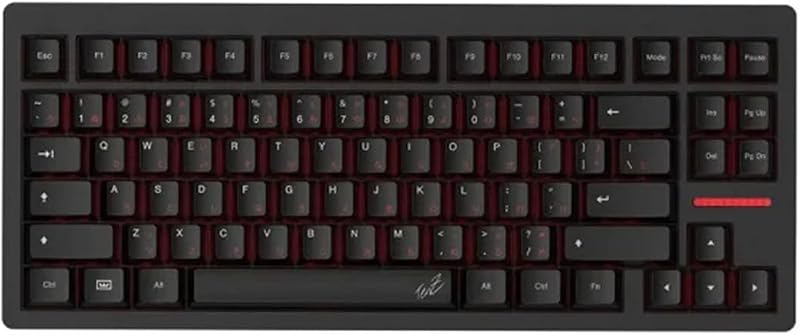
Pros
- 8000 Hz polling with 0.125ms latency
- Fine 0.1mm to 4.0mm actuation adjustment
- Rappy Snappy directional movement priority
- Gasket mount with FR4 plate dampening
- Screw-in PCB mount stabilizers
Cons
- Wired USB connection only
- Compatible officially only with PC
View Wooting TenZ Takeover on Amazon
Keychron K8 HE
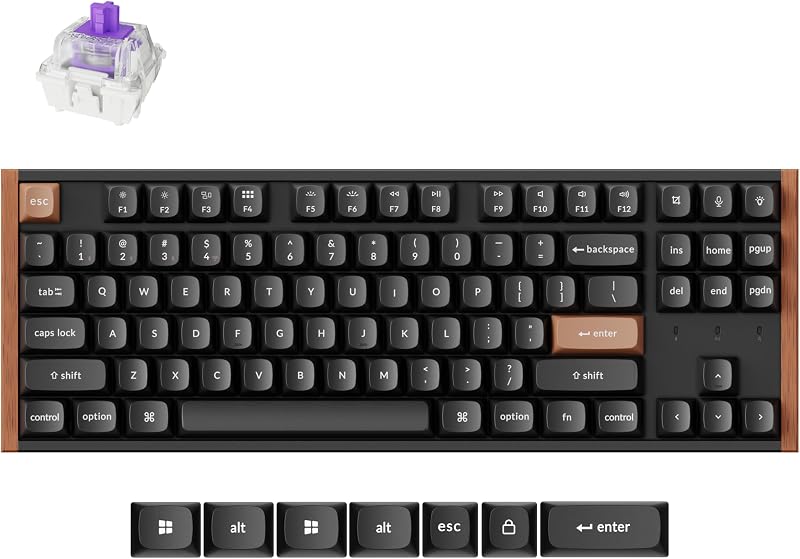
Pros
- Tri-mode wireless with Bluetooth and 2.4 GHz
- Natural wood sidings and aluminum frame
- Hot-swappable magnetic switch sockets
- Multi-device pairing across Mac, Windows, Linux
- Double-shot OSA PBT keycaps included
Cons
- Polling rate limited to 1000 Hz
- Slightly shallower 0.2mm to 3.8mm range
Who Should Buy Each One
Choose the Wooting TenZ Takeover If
- You play high-intensity tactical shooters where instantaneous counter-strafing and microsecond timing determine match outcomes.
- You want absolute peak hardware performance powered by an 8000 Hz polling rate and a 0.125ms transmission cycle.
- You prefer a gasket-mounted typing assembly with an FR4 plate and PCB-mount screw-in stabilizers for a cushioned, rattle-free bottom out.
- You exclusively game on a Windows PC and have no requirement for wireless desk aesthetics or multi-device Bluetooth pairing.
Choose the Keychron K8 HE If
- You maintain a hybrid desk setup and need to switch effortlessly between a gaming PC, a Mac work laptop, and mobile devices.
- You demand the clean aesthetics of a wireless desk surface without sacrificing the core advantages of rapid trigger magnetic switches.
- You appreciate natural wood sidings, an aluminum housing, and durable double-shot PBT keycaps straight out of the box.
- You prefer open-source QMK firmware support alongside a no-install web configuration tool that requires zero resident software.
Final Verdict
In this Keychron K8 HE vs Wooting TenZ Takeover matchup, the winner comes down to your primary desk priority: uncompromising esports speed or refined daily versatility. The TenZ Takeover captures the performance crown by delivering class-leading 8K polling, ultra-responsive 0.125ms latency, a broader 0.1 mm to 4.0 mm actuation range, and the movement-enhancing Rappy Snappy engine. It is engineered from top to bottom as a focused competitive instrument, sacrificing wireless freedom to maximize raw data throughput.
On the other hand, the K8 HE represents the superior all-around computing tool for users outside the hardcore competitive bubble. It pairs rapid trigger magnetic sensing with tri-mode wireless convenience, native macOS layout switching, and a stunning wood-accented frame. If your routine blends daily spreadsheet work, creative tasks, and multi-device switching with evening gaming sessions, the K8 HE delivers unmatched functional balance.
FAQ
Can the Keychron K8 HE match the gaming latency of the Wooting TenZ Takeover?
No, the K8 HE operates at a 1000 Hz polling rate in wired and 2.4 GHz wireless modes, corresponding to a 1.0ms response interval. The TenZ Takeover runs at 8000 Hz with an ultra-fast 0.125ms latency, transmitting position data eight times faster to minimize input lag in competitive esports titles.
Does the Wooting TenZ Takeover support wireless operation?
No, the TenZ Takeover is strictly a wired keyboard. Maintaining high-frequency magnetic switch scanning alongside an 8000 Hz USB polling rate consumes substantial power, making a dedicated wired USB connection necessary to guarantee consistent performance.
Is Keychron K8 HE worth it for competitive first-person shooters?
Yes, the K8 HE provides genuine magnetic hall effect switches with dynamic rapid trigger functionality and a 0.2 mm to 3.8 mm actuation range. While it lacks the 8K polling of dedicated esports decks, its rapid trigger implementation provides a substantial competitive upgrade over traditional mechanical keyboards.
What makes the Lekker TenZ TikkenZ switches different on the Wooting board?
The Lekker TenZ TikkenZ switches utilize magnetic sensors rather than physical electrical contacts, eliminating contact bounce and metal degradation. This contactless design enables Wooting’s granular 0.1 mm to 4.0 mm adjustable actuation range and continuous rapid trigger resetting across the entire key travel.
Can I use the Keychron K8 HE with Mac computers?
Yes, the K8 HE features full native support for macOS alongside Windows and Linux. It includes an operating system toggle switch, supports Mac layout key configurations via the Keychron Launcher web interface, and pairs over Bluetooth with Apple laptops and tablets.
What is the Rappy Snappy feature on the Wooting TenZ Takeover?
Rappy Snappy is an exclusive firmware feature on Wooting keyboards that monitors two assigned keys simultaneously, such as the directional inputs A and D. Instead of canceling movement or requiring full release, the firmware automatically prioritizes whichever key is currently pressed deeper into its travel path, optimizing counter-strafe timing.
Related reading: wooting tenz takeover 75% vs keychron q1 he, wooting tenz takeover 75% vs steelseries apex pro tkl.


