The single deciding factor between these two machines comes down to whether you prioritize portable day-to-day utility or maximum graphical horsepower. The Lenovo Legion 5i packs dedicated next-generation graphics into a slim, 4.4-pound chassis built for movement between dorms and lecture halls, whereas the Lenovo Legion Pro 7i is an uncompromising desktop-replacement powerhouse engineered for maximum frame rates with double the video memory and a blistering 240Hz refresh rate.
Choose the Legion 5i if you require a balanced, travel-friendly gaming rig that charges rapidly and slips effortlessly into a backpack for university coursework and content creation. Choose the Legion Pro 7i if you demand top-tier esports frame rates, elite thermal cooling via a vapor chamber, and massive hardware headroom for cutting-edge AAA titles.


Lenovo Legion 5i vs Legion Pro 7i at a Glance
| Feature | Lenovo Legion 5i | Lenovo Legion Pro 7i |
|---|---|---|
| Processor | Intel Core i7-14700HX | Intel Core Ultra 9-275HX Tetracosa-core |
| Graphics Coprocessor | NVIDIA GeForce RTX 5070 | NVIDIA GeForce RTX 5080 |
| Graphics Memory | 8 GB GDDR7 | 16 GB GDDR7 |
| Display | 15″ 2.5K WQXGA PureSight OLED (165Hz) | 16″ WQXGA Glossy PureSight OLED (240Hz) |
| System Memory | 16 GB | 32 GB DDR5 |
| Solid State Storage | 1 TB SSD | 2 TB SSD (2x 1 TB M.2 TLC) |
| Cooling Solution | Legion Coldfront: Hyper (Fans, Copper Pipes, Aluminum Sinks) | Legion Coldfront: Vapor (250W Vapor Chamber & Hyper Chamber) |
| Audio Hardware | Nahimic by SteelSeries 3D Audio (4 Speakers) | HD Audio (listing does not specify speaker count) |
| Weight & Thickness | 4.4 lbs | 0.85″ thick | 10.7 lbs | 3.25″ listed thickness |
| Best For | Mobile university students and creators | Elite esports competitors and power gamers |
Graphics Processing and Gaming Performance
Graphical output is the centerpiece of any high-end gaming laptop, and comparing these specifications reveals two entirely distinct tiers of visual execution. In any direct RTX 5070 vs RTX 5080 laptop comparison, the core graphics coprocessor and onboard video memory define the limits of high-resolution gaming. The Legion 5i features an NVIDIA GeForce RTX 5070 backed by 8 GB of high-speed GDDR7 VRAM. Driven by NVIDIA’s Blackwell architecture, this setup provides high frame rates for contemporary AAA releases and fast rendering acceleration in creative software, coordinated by the onboard Lenovo AI Engine+ to dynamically balance performance.
By comparison, the Legion Pro 7i steps into true desktop-grade territory with the flagship NVIDIA GeForce RTX 5080 graphics processor, equipped with a massive 16 GB of GDDR7 memory. Double the VRAM capacity allows the Pro 7i to load high-resolution texture packs, execute complex ray tracing, and tackle demanding geometry without saturating frame buffer memory. When running a rigorous Legion Pro 7i gaming benchmark, the extra graphical overhead translates to sustained frame pacing in modern titles where 8 GB allocations might face memory constraints at native resolutions. If your focus is purely on high frame rate dominance, reading our lenovo legion pro 7i vs legion slim 5 evaluation shows just how far Lenovo pushes its top-tier graphics hardware.
While the RTX 5070 in the Legion 5i handles modern titles smoothly at 2.5K, the RTX 5080 inside the Pro 7i provides the headroom necessary for future-proof graphical fidelity. Players running competitive esports titles or resource-intensive simulations will appreciate the sheer throughput delivered by the Pro 7i’s 16 GB GDDR7 configuration.
Edge: Lenovo Legion Pro 7i, thanks to its top-tier GeForce RTX 5080 graphics coprocessor and double the dedicated GDDR7 video memory.
Display Quality and Visual Experience
Both laptops leverage Lenovo PureSight OLED technology to achieve exceptional contrast, rich black levels, and vivid colors, but their refresh rates and screen geometries cater to different priorities. Evaluating the screen via a simulated Lenovo Legion 5i OLED test reveals a 15-inch 2.5K WQXGA panel operating at a 165Hz refresh rate. This configuration provides sharp pixel density, fast pixel response times, and AI-driven adjustments that keep visual assets crisp whether you are rendering digital artwork or running through fast-paced action games between classes.
The Legion Pro 7i expands the visual canvas with a 16-inch WQXGA glossy OLED display that pushes the refresh rate to a staggering 240Hz. Glossy panel treatments enhance visual punch and perceived contrast, making highlights pop and shadows appear deeper during dark gaming sequences. For competitive esports where millisecond advantages matter, the leap from 165Hz to 240Hz ensures smoother motion tracking and minimal input latency during intense firefights.
The Legion 5i provides a screen that strikes an ideal balance between battery preservation and fluid gameplay for general gaming and coursework. However, the Legion Pro 7i screen is an esports-grade showpiece, pairing expansive 16-inch real estate with a 240Hz refresh rate that satisfies elite competitive standards.
Edge: Lenovo Legion Pro 7i, offering a larger 16-inch display, a glossy surface finish, and a faster 240Hz refresh rate.
Processing Architecture, Memory, and Storage
Under the hood, these laptops feature disparate processing architectures and system resources that significantly impact multitasking and sustained computation. The Legion 5i is driven by the Intel Core i7-14700HX processor, a proven hybrid-architecture chip capable of managing demanding games, video editing projects, and heavy university workloads. Lenovo equips this model with 16 GB of system memory and a 1 TB solid-state drive, presenting an efficient out-of-the-box configuration for mainstream enthusiasts who balance coursework with evening gaming sessions.
The Legion Pro 7i elevates computational capacity with the Intel Core Ultra 9-275HX tetracosa-core (24-core) processor, engineered to crunch complex multi-threaded workloads, live streaming encoding, and physics simulations simultaneously. It doubles the system memory to 32 GB of high-speed DDR5 RAM and incorporates 2 TB of total storage across dual 1 TB M.2 TLC SSDs. Users considering productivity crossovers might also study our lenovo thinkpad x1 carbon gen 12 vs legion pro 7i breakdown to contrast business-class portability against high-core-count execution.
The 16 GB memory configuration on the Legion 5i is adequate for current gaming, but 32 GB of DDR5 on the Pro 7i provides the breathing room needed for heavy background multitasking, asset streaming, and simulation workloads without memory swapping. Combined with the dual-SSD storage array totaling 2 TB, the Pro 7i eliminates immediate storage anxiety for massive modern game installations.
Edge: Lenovo Legion Pro 7i, delivering an Intel Core Ultra 9 24-core processor, 32 GB of DDR5 memory, and double the SSD capacity.
Thermal Engineering and Cooling Solutions
Sustained performance in high-powered gaming laptops is governed entirely by thermal dissipation capabilities. The Legion 5i employs Lenovo’s Legion Coldfront: Hyper architecture. This cooling design combines turbo-charged stealth fans, robust copper heat pipes, and aluminum heat sinks to guide cool air across critical heat zones while expelling hot air quietly. It maintains manageable temperatures during extended play sessions while avoiding disruptive fan noise in shared spaces like campus libraries or dorm rooms.
The Legion Pro 7i tackles far higher component heat loads by deploying the advanced Legion Coldfront: Vapor thermal system with an integrated Hyper Chamber. Central to this system is a 250W vapor chamber that spreads thermal energy rapidly across a broad dissipation surface, preventing thermal throttling on both the Core Ultra 9 CPU and the RTX 5080 GPU. Users exploring high-performance hardware often compare extreme cooling packages in our lenovo yoga 9i vs legion pro 7i analysis to understand thermal design limits.
The Coldfront: Hyper setup on the Legion 5i is remarkably efficient for a thinner gaming laptop, ensuring dependable operation without excessive bulk. Nevertheless, the 250W vapor chamber on the Pro 7i represents an elite cooling milestone, unlocking sustained clock speeds on power-hungry silicon that lesser cooling systems cannot support.
Edge: Lenovo Legion Pro 7i, featuring a robust 250W vapor chamber engineered for maximum continuous thermal dissipation.
Form Factor, Weight, and Real-World Portability
Physical mobility is where the design paths of these two machines sharply diverge. The Legion 5i is explicitly designed with travel in mind, measuring 13.58 inches long, 10.05 inches wide, and just 0.85 inches thick. Weighing in at a portable 4.4 pounds, it is 13% thinner and lighter than previous iterations. Furthermore, the Legion 5i features rapid-charging technology that recharges the battery from 0 to 70% in under 30 minutes via USB Type-C, making it an ideal companion for mobile users who frequent study halls and classrooms.
The Legion Pro 7i prioritizes structural mass and thermal capacity over portability, carrying an official listed weight of 10.7 pounds and dimensions measuring 21.75 inches long, 14 inches wide, and 3.25 inches thick. Built with aerospace-grade aluminum, bold RGB front and tailgate accents, and heavy internal copper chambers, this machine functions as a semi-permanent desktop replacement. Those weighing transportable designs should examine our lenovo thinkpad t14s vs legion 5i comparison to see how the 5i bridges productivity and play.
For daily commuting, the Legion 5i is in a completely different class. Carrying a 4.4-pound laptop with convenient USB-C fast charging is an easy daily routine, whereas carrying a 10.7-pound chassis requires a heavy-duty carrying case and proximity to a wall outlet.
Edge: Lenovo Legion 5i, offering a 4.4-pound chassis, slim 0.85-inch profile, and sub-30-minute USB-C fast charging.
Input, Lighting, and Audio Hardware
Both models showcase Lenovo’s gaming hardware craftsmanship, but they express lighting and audio through different feature sets. The Legion 5i incorporates the responsive Legion TrueStrike keyboard augmented by Lenovo Spectrum 24-zone RGB backlighting. For auditory immersion, the 5i features a four-speaker sound system tuned with Nahimic by SteelSeries, using AI-enhanced 3D spatial processing to give gamers directional sound cues without requiring an external headset.
The Legion Pro 7i steps up cosmetic visual flair with per-key Legion TrueStrike input hardware, complemented by ambient RGB front lighting and an illuminated rear tailgate. Its software suite integrates Legion Space for granular component overclocking and AI-driven game coaching, allowing competitive enthusiasts to extract every ounce of performance from their setup. Gamers evaluating various form factors can review our lenovo legion pro 7i vs ideapad slim 5 write-up for context on keyboard ergonomics.
The Legion 5i holds a tangible advantage in standalone audio hardware with its four-speaker Nahimic array, whereas the Pro 7i appeals to esports purists with its expansive exterior RGB lightbar effects and fine-grained Legion Space overclocking utilities. Because both keyboards offer excellent tactile keystrokes and distinct strengths in lighting versus acoustic hardware, this category results in parity.
Edge: Tie, as the superior quad-speaker system on the Legion 5i balances the advanced exterior RGB and tuning controls on the Legion Pro 7i.
Pros and Cons
Lenovo Legion 5i
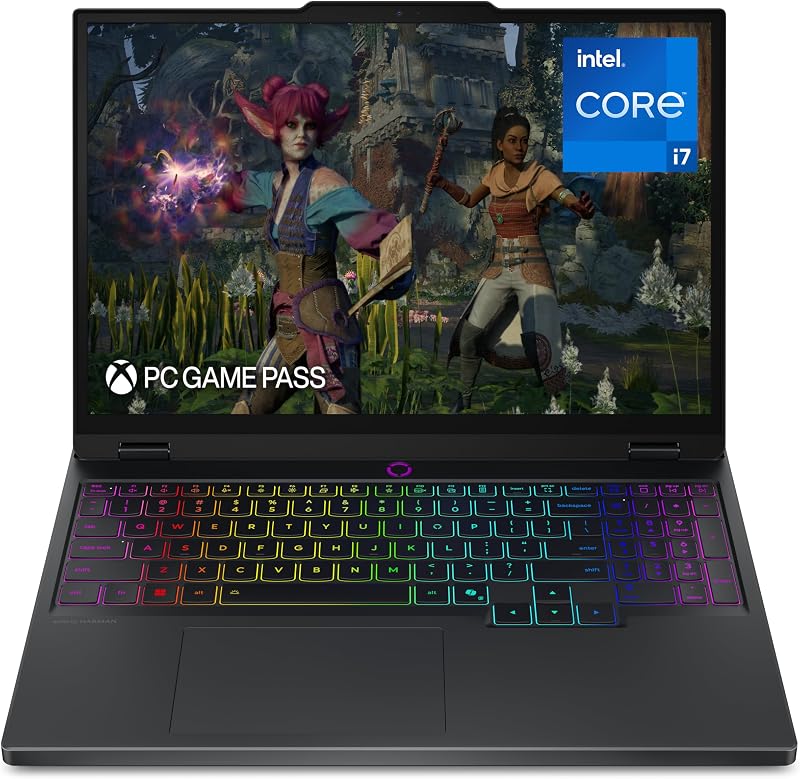
Pros
- Lightweight 4.4-pound portable chassis
- Fast USB-C charging to 70% under 30 minutes
- 165Hz PureSight OLED display
- Four-speaker Nahimic 3D sound system
- NVIDIA GeForce RTX 5070 GDDR7 graphics
Cons
- Only 8 GB VRAM buffer
- Limited to 16 GB system memory
- Single 1 TB solid-state drive
View Lenovo Legion 5i on Amazon
Lenovo Legion Pro 7i

Pros
- Flagship NVIDIA GeForce RTX 5080 GPU
- Generous 16 GB GDDR7 dedicated VRAM
- Fluid 240Hz 16-inch glossy OLED panel
- Massive 250W Coldfront vapor chamber cooling
- 32 GB DDR5 RAM and 2 TB dual SSD storage
Cons
- Heavy 10.7-pound chassis limits mobility
- Bulky 3.25-inch listed profile
View Lenovo Legion Pro 7i on Amazon
Who Should Buy Each One
Choose the Lenovo Legion 5i If
- You need a lightweight 4.4-pound laptop that easily fits into a backpack for daily commuting between work, home, or university classes.
- You want rapid USB Type-C charging that replenishes battery capacity from empty to 70% in under 30 minutes.
- You value built-in four-speaker Nahimic 3D audio for immersive media playback without relying constantly on gaming headphones.
- You prefer a balanced 15-inch 165Hz PureSight OLED screen capable of handling fast gaming and accurate creative visual workflows.
Choose the Lenovo Legion Pro 7i If
- You demand the graphical muscle of an NVIDIA GeForce RTX 5080 with 16 GB of GDDR7 VRAM for intensive AAA titles and ray tracing.
- You compete in high-stakes esports titles where a 240Hz OLED panel provides essential motion clarity and competitive responsiveness.
- You require heavy computational multitasking powered by an Intel Core Ultra 9 24-core processor, 32 GB of DDR5 memory, and 2 TB of dual SSD storage.
- You want a heavy-duty cooling architecture backed by a 250W vapor chamber designed for marathon gaming sessions without throttling.
Final Verdict
When conducting a comprehensive Lenovo Legion 5i vs Pro 7i comparison, your choice rests on where you plan to game. The Lenovo Legion 5i represents a triumph of modern engineering for users who refuse to be tethered to a single desk. Offering a capable Intel Core i7 processor, dedicated RTX 5070 graphics, an accurate 165Hz PureSight OLED panel, and rapid USB-C charging in a sleek 4.4-pound package, it delivers everything mobile gamers and students require without weighing down a shoulder bag.
Conversely, for enthusiasts asking is Legion Pro 7i worth it, the answer is an emphatic yes if raw performance and maximum fidelity are non-negotiable. With its 24-core Intel Core Ultra 9 CPU, RTX 5080 graphics coprocessor, 32 GB of memory, and blistering 240Hz glossy OLED screen cooled by a 250W vapor chamber, the Legion Pro 7i is an elite esports battle station. For pure gaming dominance, the Pro 7i stands as the undisputed performance champion.
FAQ
Can the Lenovo Legion 5i charge over USB Type-C?
Yes. The Lenovo Legion 5i listing highlights fast-charging capabilities over USB Type-C that can take the battery from zero to 70% in under 30 minutes, providing outstanding mobility for users on the move.
What are the major differences between the displays on these two laptops?
The Legion 5i features a 15-inch 2.5K WQXGA PureSight OLED display running at 165Hz, whereas the Legion Pro 7i features an expanded 16-inch glossy PureSight OLED panel running at an ultra-fast 240Hz refresh rate.
How much video memory is included on each graphics card?
The NVIDIA GeForce RTX 5070 inside the Legion 5i provides 8 GB of GDDR7 VRAM, while the NVIDIA GeForce RTX 5080 in the Legion Pro 7i features 16 GB of GDDR7 VRAM.
What cooling systems do these laptops use to manage heat?
The Legion 5i utilizes the Legion Coldfront: Hyper thermal design featuring stealth fans, copper heat pipes, and aluminum heat sinks. The Legion Pro 7i employs Legion Coldfront: Vapor, which integrates a 250W vapor chamber and a Hyper Chamber system for maximum thermal dissipation.
Does the Legion Pro 7i come with extra storage out of the box?
Yes. The Legion Pro 7i includes 2 TB of solid-state storage configured as two 1 TB M.2 TLC SSDs, whereas the Legion 5i comes equipped with a single 1 TB SSD.
What audio hardware is built into the Lenovo Legion 5i?
The Legion 5i features an integrated four-speaker sound system powered by Nahimic by SteelSeries, using AI audio processing to deliver 3D spatial sound immersion.
Which operating system comes pre-installed on these machines?
Both the Lenovo Legion 5i and the Lenovo Legion Pro 7i come with Windows 11 Home pre-installed.


