The decisive difference between these two portable solid state drives comes down to sustained interface bandwidth: the Crucial X10 Pro utilizes a 20Gbps data channel to deliver read speeds up to 2100MB/s and write speeds up to 2000MB/s, effectively doubling the 10Gbps, 1050MB/s ceiling of the Crucial X9 Pro.
Choose the Crucial X9 Pro if you need a dependable, lightweight drive for standard system backups, photo archiving, and everyday document transfers. Choose the Crucial X10 Pro if you are a content creator or video editor demanding accelerated throughput for multi-stream 4K timelines, massive file exports, and integrated drive security.

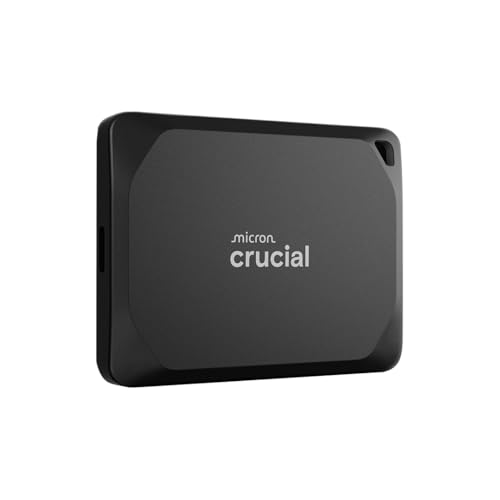
Crucial X9 Pro vs Crucial X10 Pro at a Glance
| Feature | Crucial X9 Pro | Crucial X10 Pro |
|---|---|---|
| Maximum Read Speed | Up to 1050MB/s | Up to 2100MB/s |
| Maximum Write Speed | Up to 1050MB/s (media speed) | Up to 2000MB/s |
| Interface Transfer Rate | 10 gigabits per second | 20 gigabits per second |
| Connector Type | USB-C (USB-A compatible) | USB-C (USB-A compatible) |
| Enclosure Material | Polycarbonate | Anodized aluminum |
| Ingress Protection | IP55 water and dust resistance | IP55 water and dust resistance |
| Drop Protection | Up to 7.5 feet (2 meters) | Up to 7.5 feet (2 meters) |
| Hardware Security & Indicators | Not listed | SSD password protection, activity light, lanyard loop |
| Bundled Software | Mylio Photos+, Acronis True Image (3 months) | Mylio Photos+, Acronis True Image (3 months) |
| Best For | Everyday backups, casual gaming, general storage | Professional 4K/8K video editing, rapid large-file production |
Data Transfer Speeds and Sequential Performance
Sequential throughput defines how quickly an external solid state drive moves continuous data streams, such as high-resolution video reels, raw photo libraries, and system image archives. The Crucial X9 Pro transfer speed tops out at 1050MB/s for read tasks, operating over a 10Gbps USB connection. This rate offers a dramatic leap beyond mechanical platters, allowing everyday users to clear out desktop folders or move extensive personal media collections without painful waiting periods.
The Crucial X10 Pro read write speed doubles that ceiling, utilizing a 20Gbps pipeline to hit 2100MB/s read and 2000MB/s write performance. In demanding studio environments where hundreds of gigabytes must move between cameras, scratch drives, and secondary archives every day, cutting transfer windows in half preserves billable production time. When examining a crucial x10 pro vs wd my passport ssd matchup, raw sequential velocity stands out as the primary metric separating professional drives from consumer-oriented hardware.
The practical Crucial X9 Pro vs X10 Pro speed difference is most apparent during sustained write operations. While the X9 Pro handles single large transfers smoothly at its rated media speed, the X10 Pro sustains higher data ingestion when writing sustained multi-gigabyte project folders. For day-to-day document management and moderate file batches, 1050MB/s remains fast enough that differences feel negligible, but for heavy payloads, the extra throughput of the X10 Pro changes workflow efficiency.
Edge: Crucial X10 Pro, delivering double the maximum read rate and an established 2000MB/s write ceiling for high-bandwidth data transfers.
Interface Bandwidth and System Compatibility
An external drive can only perform as quickly as the host computer port permits. The Crucial X9 Pro relies on a 10Gbps USB 3.2 connection, which aligns with standard USB-C and USB 3.2 Gen 2 ports present on almost every modern PC, Mac, tablet, and gaming console. Because 10Gbps ports are ubiquitous across laptops and desktop motherboards, the X9 Pro reaches its maximum 1050MB/s potential across virtually any machine you plug it into.
The Crucial X10 Pro steps up to a 20Gbps data transfer rate, which requires a USB 3.2 Gen 2×2 host port to reach its peak 2100MB/s speed. When evaluating the Crucial X9 Pro vs X10 Pro for Mac systems, host interface limitations become an essential technical consideration. Modern Apple silicon computers support Thunderbolt and 10Gbps USB connections, but they do not natively negotiate the dual-lane USB 3.2 Gen 2×2 protocol, causing 20Gbps drives to operate at 10Gbps speeds on those systems. Those comparing drive standards often study the samsung t9 vs crucial x10 pro to understand how 20Gbps drives behave across varying host ports.
If you connect the X10 Pro to a machine equipped with standard 10Gbps USB-C ports, the drive operates reliably while falling back to speeds around 1050MB/s, matching the X9 Pro. However, on compatible Windows PCs and custom desktop rigs that feature native 20Gbps ports, the X10 Pro takes full advantage of its doubled pipeline. Both drives provide broad compatibility across Windows, Mac, iPad Pro, Chromebooks, Android, Linux, PlayStation, and Xbox platforms.
Edge: Tie, because while the Crucial X10 Pro features a higher 20Gbps ceiling, the Crucial X9 Pro reaches its full potential across a broader range of native host ports without protocol bottlenecks.
Video Editing and Creative Workflow
Deciding between the Crucial X9 Pro or X10 Pro for video editing depends directly on timeline complexity, codec bitrates, and project scale. Video creators working with compressed formats, 1080p footage, or standard YouTube deliverables will find the Crucial X9 Pro fully competent. At 1050MB/s, it delivers sufficient throughput for smooth timeline playback and multi-track audio scrubbing without skipping frames or stalling the system buffer.
For professionals cutting uncompressed 4K or 8K multi-camera sequences, the Crucial X10 Pro review data confirms that higher bandwidth eliminates playback dropped frames and speeds up rendering cache generation. The 2000MB/s write capability allows editors to capture footage, ingest raw video directories, and export finalized renders directly to the external drive without internal storage intermediation. This makes the unit competitive against high-speed options examined in our sandisk extreme pro portable vs crucial x10 pro comparison.
So, is Crucial X10 Pro worth it for media creators? If your daily workload includes batch-processing thousands of high-resolution RAW stills or scrubbing multi-gigabyte video sequences across multiple project drives, the reduced export latency and direct-from-drive editing capability justify the upgrade. Creators handling moderate batch photography or occasional light video tasks will find the X9 Pro capable of handling standard timelines without bottlenecking the editing suite.
Edge: Crucial X10 Pro, providing the sustained 2000MB/s write performance necessary for editing high-bitrate 4K and 8K footage directly on the drive.
Gaming Console and Drive Loading Performance
When selecting the Crucial X9 Pro or X10 Pro for gaming, system interface limits play a defining role. Modern consoles like the Sony PlayStation 5, PlayStation 4, and Microsoft Xbox family feature external USB ports capped at 10Gbps transfer rates. The Crucial X9 Pro listing specifies compatibility across PS4 and PS5 systems, making it well-suited to store backward-compatible titles, archive larger console games, and expand personal storage libraries.
The Crucial X10 Pro also lists broad console compatibility, including PS4, PS5, Xbox, and the Sony PlayStation Vita. However, because current console USB-A and USB-C ports do not support 20Gbps dual-lane transmission, the X10 Pro operates at 10Gbps when connected to these devices. Console boot times, installation processes, and level load speeds on the X10 Pro will mirror the performance delivered by the X9 Pro, yielding no measurable gameplay benefit from the 2100MB/s hardware rating.
For PC gamers, the situation changes if their motherboard includes a 20Gbps USB port. In that scenario, moving games between drives or installing high-capacity modern titles proceeds noticeably faster on the X10 Pro. For dedicated console players looking to expand external libraries, comparisons like our samsung t7 shield vs crucial x9 pro show that 1050MB/s represents the optimal performance target for console architecture.
Edge: Crucial X9 Pro, delivering the exact 10Gbps bandwidth maximum that current gaming consoles can utilize without surplus hardware overhead.
Build Materials, Durability, and Hardware Features
Both external solid state drives share a compact 2.5-inch portable form factor engineered to withstand travel, outdoor fieldwork, and accidental desktop mishaps. Crucial rates both drives for IP55 water and dust resistance, protecting internal circuits from sudden rain, wet weather, and dusty job sites. Furthermore, both models feature drop resistance up to 7.5 feet (2 meters), ensuring data integrity if the drive slips out of a backpack or falls from a workstation.
The structural difference lies in their housing materials and hardware refinements. The Crucial X9 Pro utilizes a lightweight, durable polycarbonate enclosure in black. In contrast, the Crucial X10 Pro upgrades to an anodized aluminum enclosure. Aluminum provides superior rigidity and improved passive heat dissipation, an essential factor when sustaining heavy 2000MB/s data writes over extended operational sessions. Readers comparing durable drives in our samsung t9 vs crucial x9 pro breakdown will recognize the impact enclosure materials have on thermal regulation.
The X10 Pro incorporates hardware amenities absent from the X9 Pro data sheet. It features an integrated lanyard loop for tethering to camera bags, an activity light that confirms ongoing read and write cycles, and SSD password protection for enhanced physical and digital security in transit. Both drives include three-month trial subscriptions to Mylio Photos+ and Acronis True Image upon registration, but the X10 Pro provides better hardware safeguards for on-the-go professionals.
Edge: Crucial X10 Pro, offering an anodized aluminum shell, integrated lanyard loop, activity light, and SSD password protection.
Pros and Cons
Crucial X9 Pro

Pros
- Up to 1050MB/s read performance
- Universal 10Gbps USB-C compatibility
- IP55 water and dust resistance
- Drop protection up to 7.5 feet
- Lightweight polycarbonate construction
Cons
- Lacks hardware password protection
- No activity light or lanyard loop
Crucial X10 Pro

Pros
- Blazing 2100MB/s read and 2000MB/s write speeds
- 20Gbps high-bandwidth transfer rate
- Rugged anodized aluminum enclosure
- Built-in SSD password protection
- Integrated activity light and lanyard loop
Cons
- Requires 20Gbps port for peak speed
- Runs at 10Gbps on standard Mac ports
View Crucial X10 Pro on Amazon
Who Should Buy Each One
Choose the Crucial X9 Pro If
- You primarily use Mac computers, standard laptops, or gaming consoles limited to 10Gbps USB ports.
- Your primary storage tasks involve local system backups, office document management, and photo storage.
- You want a lightweight polycarbonate drive with reliable IP55 water, dust, and drop resistance.
- You need fast external performance without paying for interface speeds your host hardware cannot access.
Choose the Crucial X10 Pro If
- You work with a PC or motherboard equipped with native 20Gbps USB 3.2 Gen 2×2 ports.
- You edit 4K or 8K multi-track video projects directly from external media and require 2000MB/s write speeds.
- You require hardware security features such as built-in SSD password protection and an activity indicator light.
- You prefer the thermal dissipation and premium feel of an anodized aluminum exterior for rugged field production.
Final Verdict
The Crucial X10 Pro vs X9 Pro matchup illustrates the difference between balanced consumer convenience and focused professional utility. For the vast majority of everyday users, students, and console gamers, the Crucial X9 Pro is the logical recommendation. It matches standard 10Gbps USB infrastructure, provides robust IP55 durability against water, dust, and drops, and operates at 1050MB/s speeds that easily handle typical daily workflows, media viewing, and system backups.
The Crucial X10 Pro wins decisively for creative professionals with compatible high-speed hardware. Delivering up to 2100MB/s read and 2000MB/s write speeds over a 20Gbps interface, it eliminates performance bottlenecks when processing massive media folders or editing high-bitrate video projects directly from the drive. Combined with an anodized aluminum body, drive password protection, and an integrated activity light, the X10 Pro serves as an enterprise-grade portable solution for users whose workflows demand maximum throughput.
FAQ
What is the main Crucial X9 Pro vs X10 Pro speed difference?
The Crucial X9 Pro provides read speeds up to 1050MB/s over a 10Gbps interface, while the Crucial X10 Pro reaches up to 2100MB/s read and 2000MB/s write speeds over a 20Gbps interface, effectively doubling data transfer potential.
Is the Crucial X10 Pro worth it for Mac users?
Because Mac computers generally do not support the USB 3.2 Gen 2×2 protocol required for 20Gbps throughput, the Crucial X10 Pro will fall back to standard 10Gbps operation on macOS devices, delivering transfer speeds similar to the Crucial X9 Pro.
Can I use the Crucial X9 Pro and X10 Pro with gaming consoles?
Yes, both drives are compatible with gaming consoles including the PlayStation 5, PlayStation 4, and Xbox systems via USB-C or USB-A connections. Because console USB ports max out at 10Gbps, both drives offer identical loading speeds on console hardware.
Are both Crucial portable drives water and dust resistant?
Yes, both the Crucial X9 Pro and Crucial X10 Pro feature IP55 water and dust resistance, along with drop protection rated for falls up to 7.5 feet (2 meters).
What enclosure materials are used on each drive?
The Crucial X9 Pro features a durable polycarbonate enclosure, while the Crucial X10 Pro uses an anodized aluminum enclosure designed for enhanced durability and improved thermal dissipation.
Does the Crucial X9 Pro have password protection?
The product listing specifies SSD password protection for the Crucial X10 Pro, whereas password protection is not listed among the features for the Crucial X9 Pro.
What software comes bundled with these SSDs?
Both drives include three-month trial subscriptions to Mylio Photos+ and Acronis True Image when you purchase and register the product.