The single deciding factor between standard Cat6 cable and augmented Cat6a cable comes down to continuous transmission distance at 10-Gigabit speeds. While standard Cat6 hardware can process a 10Gbps data stream over limited patch lengths, Cat6a is explicitly engineered with heavier conductors and internal isolation to carry full 10-Gigabit Ethernet up to the maximum 328-foot standard network run without packet loss or signal decay.
Choose a Cat6 cable if you need a flexible, easily routed patch cord to link a desktop gaming rig, streaming device, or switch within a single room or short distance. Choose a Cat6a cable if you are pulling backbone wiring through walls, between floors, or outdoors where permanent 10Gbps performance, strict crosstalk suppression, and high-wattage device power are mandatory.



Cat6 vs Cat6a at a Glance
| Feature | Cat6 Cable | Cat6a Cable |
|---|---|---|
| Conductor Gauge | 24 AWG to 30 AWG | 23 AWG Solid Bare Copper |
| Rated Bandwidth | 250 MHz to 550 MHz | Up to 750 MHz |
| 10Gbps Max Distance | Short patch lengths (listing does not specify max run) | 328 feet (100 meters) |
| Shielding Architecture | UTP (Unshielded Twisted Pair) | U/UTP or F/UTP (Foil Shielded) |
| PoE Standards | PoE, PoE+, PoE++ (up to 24 AWG) | PoE, PoE+, PoE++ (IEEE 802.3af/at/bt 100W) |
| Cable Structure | Round or Flat profiles | Heavy-duty Round (CMR Riser or OSP Burial) |
| Industry Standards Met | TIA/EIA-568-B.2, TIA/EIA 568-C.2, RoHS | ANSI/TIA 568.2-E, RoHS-3, cETLus Listed |
| Best For | Workstation patches and short desk runs | In-wall, riser, and direct-burial structured wiring |
10Gbps Transmission Speed and Distance Limits
Bandwidth and line attenuation define how effectively copper wiring preserves high-frequency square waves over physical space. When data rates step up to 10GBASE-T, high-frequency electrical pulses experience accelerated signal degradation. In a comprehensive wired ethernet vs wifi comparison, wired lines deliver superior reliability, but the physical makeup of that copper line dictates whether high-speed data packets arrive intact or suffer retransmissions.
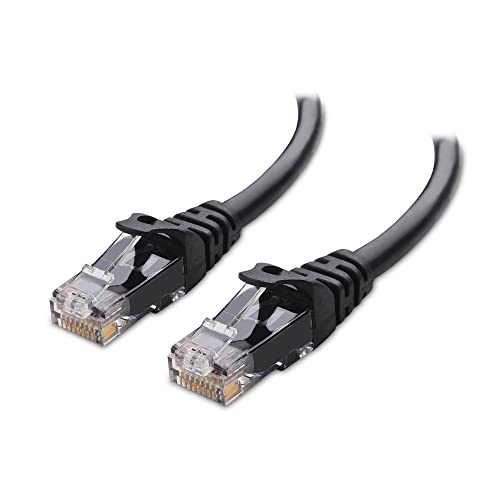
For standard copper patch runs, products like the Jadaol Cat6/Cat6A Ethernet Cable 50FT Flat with Clips 10Gbps Network, White demonstrate that Cat6 cables can negotiate 10Gbps connections, functioning seamlessly across 10BASE-T, 100BASE-TX, 1000BASE-T, and 10GBASE-T deployments. Similarly, the Cable Matters 10Gbps Snagless Cat 6 Ethernet Cable, 25ft, Black verifies 10Gbps transfer capability across a 25-foot run. However, the manufacturer data sheets for Cat6 assemblies do not guarantee high-frequency 10Gbps delivery across the full 100-meter structural limit. In contrast, bulk lines like the TRUE CABLE Cat6A Riser (CMR), Bulk Ethernet Cable, 1000ft, Blue, 23AWG Solid Bare Copper, Unshielded Twisted Pair (U/UTP), 750MHz, PoE++ 100W, ETL Listed explicitly support 1 Gigabit and 10 Gigabit Ethernet up to 328 feet, certified via Fluke DSX-8000 Versiv CableAnalyzer testing.
The difference in range changes how you plan permanent architecture. Running standard Cat6 across long structural drops risks speed negotiation stepping down to 1 Gbps due to insertion loss and packet dropouts. Cat6a maintains the internal electrical integrity required to sustain 10GBASE-T over the complete span of a residential or commercial building layout.
Edge: Cat6a cable, because its certified construction guarantees 10Gbps speeds over full 328-foot transmission runs.
Operating Frequency and Bandwidth Overhead
Frequency capacity represents the available spectrum through which data signals travel without catastrophic cross-frequency interference. A higher megahertz rating does not translate directly to faster basic ping times, but it prevents signal corruption under dense, continuous network traffic. When streaming 4K feeds, running local backups, or routing multiple concurrent virtual local area networks, higher bandwidth overhead provides greater signal headroom.
The Cat6 category traditionally operates at a baseline of 250 MHz, as confirmed by the Jadaol flat cable specifications, though advanced round versions like the Cable Matters Cat6 push tested frequencies to 550 MHz. This expanded 550 MHz envelope provides ample space for gigabit and short-range high-bandwidth pipelines. However, Cat6a establishes a much higher benchmark. Both the trueCABLE CMR Riser and the outdoor TRUE CABLE Cat6A Direct Burial Bulk Ethernet Cable, Shielded F/UTP, 500ft, Black, Waterproof, Outdoor OSP Jacket, 23AWG Solid Bare Copper, 750MHz, PoE++ 100W test up to 750 MHz, far exceeding baseline category requirements and outstripping even enhanced Cat6 lines.
That extra frequency cushion makes a measurable difference when configuring multi-gigabit hardware or linking switch uplinks. When balancing bandwidth alongside complex gaming hardware, such as choosing between the fractal torrent vs lian li lancool 216 for high-airflow PC systems, having a stable, wide-band network conduit ensures local server ingestion and uncompressed streaming never stall at the physical layer.
Edge: Cat6a cable, providing up to 750 MHz of tested operational headroom compared to the 250 MHz to 550 MHz envelope of Cat6.
Wire Gauge and Power over Ethernet (PoE) Support
Power over Ethernet consolidates high-speed data transmission and direct electrical current over a single eight-pin RJ45 assembly. Cable gauge, expressed in American Wire Gauge (AWG), determines the thickness of the copper conductors inside the jacket. As conductor diameter increases, the AWG number drops, lowering resistance and significantly improving heat dispersion when delivering direct electrical current.
Standard Cat6 solutions display wide variance in conductor thickness. The ultra-slim Jadaol flat Cat6 cable employs 30 AWG wire, prioritizing maneuverability over thermal dissipation. The Cable Matters Cat6 utilizes a standard 24 AWG copper wire core that safely supports PoE, PoE+, and PoE++ protocols for surveillance cameras and VoIP installations. In comparison, both trueCABLE Cat6a variants incorporate heavy 23 AWG solid bare copper conductors. These thick conductors are tested to handle IEEE 802.3af/at/bt 4PPoE standards up to 100W, accommodating continuous currents up to 8.33 A on the CMR riser cable and 4.17 A on the direct burial model.
Delivering high wattage through thin 30 AWG patch lines can create internal resistance and thermal accumulation, particularly within enclosed spaces or tightly bundled runs. The thicker 23 AWG solid bare copper found in Cat6a safely distributes high-draw electricity to motorized pan-tilt-zoom cameras, high-output wireless access points, and remote hardware without signal loss or thermal failure.
Edge: Cat6a cable, due to its heavier 23 AWG solid bare copper conductors certified for 100W PoE++ 4PPoE delivery.
Physical Construction, Shielding, and Crosstalk Prevention
As transmission frequencies increase, electrical emissions radiating from adjacent conductor pairs-known as alien crosstalk (ANEXT)-threaten signal purity. The physical build of the cable determines how effectively these stray fields are suppressed. When planning clean, quiet desk environments with studio-grade hardware, much like balancing the acoustic separation between the audio-technica ath-m50x vs ath-m20x, isolating electromagnetic interference is critical for maintaining pristine signal transmission.
Standard Cat6 models rely primarily on unshielded twisted pair (UTP) designs. The Jadaol Cat6 features a flat, unshielded profile that simplifies clean aesthetics by sliding under baseboards or carpet tracks. Cable Matters utilizes a traditional round UTP layout fitted with strain-relief boots and gold-plated pins. While adequate for isolated patch links, unshielded cables lack isolation barriers when bundled alongside high-voltage electrical lines or dense server switch racks. Cat6a remedies this vulnerability through specialized cable geometry and metal shielding. The trueCABLE outdoor Cat6a features F/UTP construction-incorporating an overall foil shield that wraps all four twisted pairs to completely eliminate external electromagnetic interference and alien crosstalk.
The internal engineering changes the handling of each cable. Cat6a bulk wire is noticeably thicker, heavier, and less pliable, requiring structured termination practices. Cat6 remains lightweight, supple, and forgiving during setup, but it leaves data transfers susceptible to environmental interference when deployed in dense, parallel trunking runs.
Edge: Cat6a cable, which incorporates dedicated foil shielding options and denser structural isolation against electromagnetic noise.
In-Wall Routing and Installation Flexibility
The mechanical flexibility of a networking cable determines how easily an installer can snake it through wall cavities, floor joists, or tight desk channels. Cable diameter, outer jacket rating, and conductor stiffness dictate whether an installation is effortless or physically demanding.
Standard Cat6 cables excel in tight living spaces and localized device setups. The Jadaol flat 50-foot cord weighs only 200 grams and can bend sharply along baseboard edges, slide beneath carpeting, or pin flush against door moldings using included clips. The Cable Matters 25-foot round patch cord utilizes snagless connectors that slide past furniture legs without catching. Conversely, pulling Cat6a is a heavy structural project. A 1000-foot spool of trueCABLE Cat6a CMR riser cable weighs 39 pounds, featuring a thick PVC jacket designed to resist vertical flame propagation between floors. The direct-burial Cat6a spool weighs 19.4 pounds per 500 feet, wrapped in an outdoor OSP jacket engineered to withstand standing water, sunlight, and underground conduit friction.
If you are routing network access along baseboards or building a clean desk setup featuring modern compact hardware like the fractal meshify 2 vs pop air, manipulating stiff 23 AWG Cat6a lines is cumbersome. Cat6 curves effortlessly through cramped channels, while Cat6a requires wide turning radiuses, heavy-duty punch-down blocks, and significant physical effort to maneuver through tight spaces.
Edge: Cat6 cable, offering vastly superior flexibility, lighter weight, and simpler routing around tight corners.
Pros and Cons
Cat6 Cable

Pros
- Thinner 24 to 30 AWG conductors
- Flexible flat or slim round profiles
- Easy routing around tight baseboards
- Bandwidth ratings up to 550 MHz
- Supports 10Gbps across shorter patch runs
Cons
- Unshielded designs allow higher alien crosstalk
- Lacks guaranteed 328-foot 10Gbps transmission
- Higher gauge wires limit heat dissipation
View Jadaol Cat6 Cat6A Ethernet Cable 50FT on Amazon
Cat6a Cable

Pros
- Full 10Gbps transmission up to 328 feet
- Heavy-duty 23 AWG solid bare copper
- Tested frequency bandwidth up to 750 MHz
- Certified 100W PoE++ 4PPoE handling
- Foil-shielded and riser-rated jacket options
Cons
- Stiff, heavy cable structure
- Requires wider bend radius in conduits
- Demands bulk termination skills and tools
View TRUE CABLE Cat6A Riser (CMR) Bulk on Amazon
Who Should Buy Each One
Choose the Cat6 Cable If
- You need to route clean network lines along baseboards, under carpets, or around door frames using flat, low-profile wire.
- Your network connections span short patch runs between a wall jack, desktop computer, gaming console, or smart TV.
- You want pre-terminated RJ45 patch cables with snagless boots that plug straight into network switches without field crimping.
- Your deployment environment does not produce heavy electromagnetic interference from industrial machinery or dense bundles of power lines.
Choose the Cat6a Cable If
- You are running permanent, structured in-wall network lines between building floors that require flame-retardant CMR riser certification.
- You demand guaranteed 10Gbps data transmission across long structural runs reaching up to 328 feet.
- You are powering 100W PoE++ 802.3bt equipment like PTZ surveillance cameras, access points, and remote PoE switches over 23 AWG solid bare copper.
- You need rugged direct-burial or conduit-pulled outdoor lines with foil shielding to eliminate external noise and moisture.
Final Verdict
For standard home applications, workstation connections, and casual patch routing, Cat6 cable remains the practical choice for most users. Products like the Cable Matters snagless patch cable and Jadaol flat lines deliver ample speeds up to 10Gbps over short distances, backed by tested frequencies up to 550 MHz. Their slim profiles, pliable jackets, and factory-terminated RJ45 ends make them easy to install without dedicated crimping tools, cable pullers, or complex grounding hardware.
However, when the objective shifts to whole-home structured cabling, commercial networking, or exterior installations, Cat6a cable is well worth the physical effort. With its solid 23 AWG conductors, 750 MHz frequency ceiling, verified 100W PoE++ capacity, and certified 328-foot 10Gbps performance, trueCABLE Cat6a infrastructure builds an enduring network foundation that eliminates packet degradation across full-distance runs.
FAQ
Is Cat6 or Cat6a better for gaming?
For desktop and console gaming, Cat6 provides all the speed and low latency needed to match any modern broadband connection. Over standard patch distances of 25 to 50 feet, a quality Cat6 cable easily handles high data throughput without latency penalty. Cat6a offers identical latency performance for gaming, meaning its heavier shielding and extended distance ratings will not lower in-game ping times on typical desk setups.
Can standard Cat6 handle 10Gbps speeds?
Yes, standard Cat6 cable can handle 10Gbps speeds across short runs. The Cable Matters and Jadaol Cat6 specifications confirm 10GBASE-T compatibility. However, standard Cat6 does not guarantee 10Gbps performance over full 328-foot structural runs, which requires the heavier conductors and tighter crosstalk mitigation found in Cat6a.
Can I plug Cat6a cables into standard RJ45 ports?
Yes, Cat6a uses the universal 8-pin RJ45 connector interface. It is fully backwards compatible with Gigabit Ethernet, Fast Ethernet, standard switches, routers, and network interface cards. Keep in mind that bulk Cat6a wire features thick 23 AWG conductors that require matching modular plugs or keystone jacks designed specifically for larger wire gauges.
What does a CMR riser rating mean on Cat6a cable?
A CMR (Communications Multipurpose Cable, Riser) rating indicates that the cable jacket possesses flame-retardant characteristics engineered to prevent fires from spreading vertically between floors. As noted in the trueCABLE riser specifications, CMR cables are rated for vertical paths, in-wall installations, and non-plenum structural spaces.
Is Cat6a required for Power over Ethernet?
Cat6a is not universally mandatory for all PoE devices, but it is recommended for high-wattage deployments. While 24 AWG Cat6 lines support standard PoE and PoE+, trueCABLE Cat6a features 23 AWG solid bare copper tested for PoE++ 4PPoE up to 100 watts and up to 8.33 amps. The thicker wire minimizes resistance and thermal buildup in dense cable bundles.
Does flat Cat6 perform the same as round Cat6?
Flat Cat6 cables, like the Jadaol 30 AWG cord, offer significant installation advantages by running invisibly under rugs or cleanly along wall corners. However, flat cables use thinner gauge wire and bring twisted pairs closer together, which limits operational bandwidth to 250 MHz compared to the 550 MHz supported by round 24 AWG Cat6 cords.
When is shielded Cat6a necessary instead of unshielded?
Shielded Cat6a, such as F/UTP direct-burial cable, is necessary when running cables outdoors, underground in conduit, or through commercial pathways packed with high-voltage electrical lines. The continuous foil layer drains external electromagnetic noise, preventing line interference that could degrade 10Gbps network stability.