Choosing between the UGREEN DXP2800 GT and the Terramaster F4-425 comes down to whether your daily workflow demands high-bandwidth network throughput with rapid NVMe expansion, or large-volume multi-drive mechanical storage for archiving bulk media files. The DXP2800 GT delivers extreme throughput via built-in 10GbE networking and enterprise U.2 SSD support in a two-bay footprint, whereas the F4-425 prioritizes raw capacity across four SATA drive bays backed by 2.5GbE networking.
Creative professionals and power users running heavy virtualization should opt for the DXP2800 GT to enable direct-from-NAS editing and responsive container hosting. Home media enthusiasts and collectors needing expansive room for 4K video libraries should choose the F4-425 for its four-bay volume headroom and flexible storage arrays.


UGREEN DXP2800 GT vs Terramaster F4-425 at a Glance
| Feature | UGREEN DXP2800 GT | Terramaster F4-425 |
|---|---|---|
| Drive Bays | 2 SATA bays (U.2 NVMe SSD compatible) | 4 SATA bays |
| Maximum Total Capacity | 80TB (32TB per SATA bay + 16TB M.2 SSDs) | 120TB (30TB per bay) |
| Processor | AMD Ryzen Embedded R2514 (4 cores, 8 threads, up to 3.70GHz) | Intel x86 quad-core processor |
| Base System Memory | 8GB DDR4 (Expandable to 64GB, ECC supported) | 4GB RAM (listing does not specify expandability) |
| Network Interface | 10GbE LAN port | 2.5GbE LAN port |
| M.2 / NVMe SSD Slots | 2 M.2 slots + 2 U.2 NVMe compatible bays | Not listed |
| Operating System / Ecosystem | UGOS Pro (Docker, VMs, SAN Manager) | TNAS OS / TNAS Mobile (TRAID/TRAID+, SPC) |
| Operating Noise Level | Not listed | 21dB(A) |
| Chassis Material & Weight | Grey chassis, 4.41 kg | Black plastic enclosure, 1.9 kg |
| Warranty | 2 Year Manufacturer | 2 Years |
| Best For | 10GbE video editing, Docker containers, and high-speed I/O | Massive 4-bay home multimedia collections and quiet backups |
Network Throughput and Transfer Speeds
Network interface speed dictates how quickly data moves across your local area network, establishing whether a network storage server functions as an active working volume or merely an archive destination. When evaluating UGREEN DXP2800 GT vs Terramaster F4-425 transfer speed, the hardware bandwidth gap is immediate. The DXP2800 GT arrives with a 10GbE port capable of reaching theoretical theoretical transfer ceilings near 1,250 MB/s, allowing video editors and photographers to scrub high-bitrate video footage directly from the unit without copying project directories to local computer drives.
By comparison, the F4-425 provides a single 2.5GbE LAN port, delivering a theoretical throughput ceiling around 312.5 MB/s. While 2.5GbE represents a marked upgrade over legacy gigabit networking and fully saturates the sequential transfer speeds of a single mechanical hard drive, it cannot match the intense demands of concurrent multi-user environments or multi-stream 4K editing pipelines. If your work relies heavily on UGREEN DXP2800 GT 10GbE performance, the bandwidth difference changes how your local storage behaves during day-to-day file movement. Shoppers exploring balanced alternatives often assess network tradeoffs in the ugreen dxp4800 plus vs terramaster f4-425 breakdown.
For single-client backups, standard photo archiving, and home streaming, the 2.5GbE port on the F4-425 easily clears the baseline bandwidth needed for smooth transfers. However, power users moving multi-gigabyte files daily will experience far shorter wait times on the 10GbE link provided by the UGREEN enclosure, especially when paired with solid-state drives.
Edge: UGREEN DXP2800 GT delivers four times the theoretical network bandwidth with its integrated 10GbE connection.
Drive Capacity and Storage Flexibility
Drive bay capacity and disk configuration determine how long a storage chassis can grow alongside your digital media before requiring an enclosure upgrade. The Terramaster F4-425 4-bay capacity leads in raw mechanical headroom, housing four hot-swappable 3.5-inch or 2.5-inch drive bays that accept drives up to 30TB each, creating a total storage volume of up to 120TB. TerraMaster supplements this physical space with flexible TRAID and TRAID+ arrays, which optimize drive utilization across mixed capacities and provide up to 30% more usable storage space than traditional RAID setups while maintaining parity redundancy.
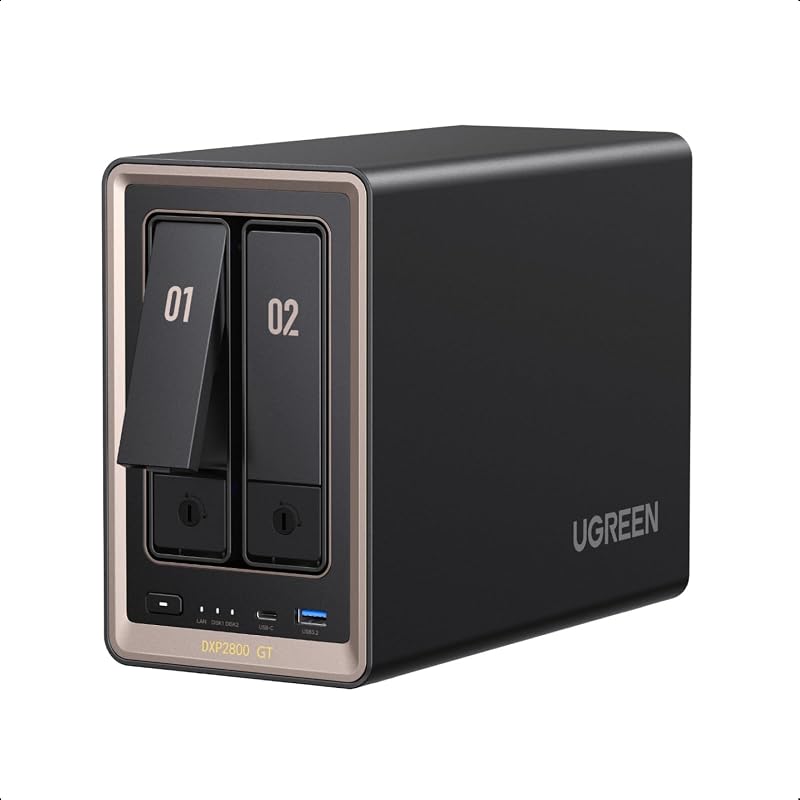
Conversely, the DXP2800 GT is a compact 2-bay enclosure supporting two 3.5-inch SATA hard drives up to 32TB each, achieving 64TB across its primary mechanical bays. Where UGREEN differentiates itself is SSD flexibility: both primary drive bays can alternatively accept high-performance U.2 NVMe SSDs, and the unit includes two internal M.2 SSD slots supporting an additional 16TB of solid-state storage. This yields an overall maximum capacity of 80TB. Buyers balancing drive count against raw processing frequently review how dual-bay hardware compares against larger enclosures in our qnap ts-464 vs ugreen dxp2800 gt comparison.
If your ultimate priority is hoarding vast media collections across multiple hard drives with single-disk redundancy, four bays make drive pooling safer and more economical. If your focus is flash-accelerated performance via U.2 and M.2 SSD tiers, UGREEN provides specialized storage configurations that mechanical bays cannot match.
Edge: Terramaster F4-425 offers higher total mechanical capacity at 120TB across four drive bays with flexible TRAID redundancy.
Processing Power and Memory Expandability
The processing architecture and system memory inside a server dictate its ability to multitask, run background indexers, host virtual machines, and manage file operations without lag. The DXP2800 GT is powered by an AMD Ryzen Embedded R2514 processor featuring 4 cores and 8 threads with clock speeds scaling up to 3.70GHz. It comes equipped with 8GB of DDR4 system memory right out of the box and features an expandable memory architecture that scales up to 64GB. Furthermore, the motherboard supports an ECC RAM upgrade, allowing users to install error-correcting memory modules to safeguard mission-critical data integrity during non-stop operation.
The F4-425 incorporates an Intel x86 quad-core processor paired with 4GB of pre-installed system RAM. The product listing does not specify thread count, boost clocks, memory upgrade ceilings, or ECC support for this model. While this Intel platform delivers sufficient compute power for standard file serving, routine backups, and basic multitasking, the 4GB memory allocation creates a strict boundary when attempting to spin up memory-hungry services. Users interested in expandability often compare similar AMD implementations against mid-range alternatives, as seen in the synology ds923+ vs ugreen dxp2800 gt overview.
Having 8 threads and an expansion pathway to 64GB of memory gives the UGREEN hardware substantial compute longevity. Heavy tasks like photo facial recognition indexing, continuous surveillance recording, and virtual machine operation can run simultaneously without throttling basic file management tasks.
Edge: UGREEN DXP2800 GT provides a superior 8-thread Ryzen CPU, double the baseline RAM, and expansion up to 64GB with optional ECC support.
Virtualization, Docker, and Application Ecosystem
Server operating systems must balance usability for home owners with software depth for advanced IT enthusiasts. When comparing UGREEN DXP2800 GT vs Terramaster F4-425 docker capabilities, both vendors provide containerization platforms, but the hardware foundation dictates overall stability. Running on UGOS Pro, the DXP2800 GT natively supports Docker containers, complete virtual machines, and SAN Manager. Its 8GB base memory and 8-thread CPU ensure that running multiple containerized stacks, such as Home Assistant, automation scripts, and self-hosted databases, will not exhaust hardware reserves.
The F4-425 runs TerraMaster’s TOS operating environment, supported by the TNAS Mobile app that allows users to initialize and manage server storage without a PC. The software suite includes an SPC security module, multi-cloud synchronization via CloudSync (supporting Google Drive and other services), and management for over 50 independent user accounts. However, because the system includes 4GB of pre-installed RAM and the listing does not specify memory expansion paths, running intensive virtualization workloads alongside primary system tasks may present memory constraints.
UGREEN also incorporates a built-in Surveillance Center supporting ONVIF and RTSP IP camera connections for 24/7 video security recording, backed by comprehensive TLS/SSL, RSA, AES, and SHA-512 cryptographic protocols via its Security Manager. Users vetting two-bay alternatives frequently consult the qnap ts-233 vs ugreen dxp2800 gt article to see how entry-level units handle software packages compared to premium offerings.
Edge: UGREEN DXP2800 GT wins due to its comprehensive virtual machine hosting, native SAN Manager, and superior memory capacity for container deployment.
Media Streaming and Home Server Features
Network storage servers commonly serve as the central media entertainment hub for modern households. Shoppers deciding between the UGREEN DXP2800 GT or Terramaster F4-425 for plex, Emby, and Jellyfin will find that both devices support these popular media server platforms. The F4-425 focuses heavily on multimedia consumption, featuring hardware-level 4K H.265 decoding that offloads video processing tasks directly to the Intel silicon, facilitating smooth HD video streaming to smart televisions, tablets, and phones via integrated DLNA support.
TerraMaster also includes a dedicated Photos app enhanced with an AI smart album feature, designed to organize millions of personal images efficiently. Backups are simplified through the TNAS Mobile client, which handles automated mobile photo and video synchronization directly over local or remote connections. The DXP2800 GT matches this streaming flexibility by supporting Plex, Emby, and Jellyfin installations across UGOS Pro, while handling media libraries via its own photo management and global search functions.
Where the systems diverge is the storage profile behind the stream. The F4-425 allows media collectors to pool four large mechanical drives into a unified RAID array, creating an expansive media repository without spending on high-cost solid-state storage. The DXP2800 GT can store high-bitrate media files, but its primary media strength lies in flash caching and direct video editing rather than sheer physical drive counts. For readers tracking multi-bay platforms within the UGREEN portfolio, our ugreen dxp2800 gt vs dxp4800 plus writeup illustrates how the platform handles expanded bay layouts.
Edge: Terramaster F4-425 takes the advantage for home entertainment due to dedicated 4K H.265 hardware decoding and four bays for extensive media hoarding.
Physical Build, Noise Levels, and Thermal Design
Physical construction and acoustic output determine where a storage appliance can live within a home or workspace. The Terramaster F4-425 is engineered for low-noise environments such as home offices and bedrooms. Built with a black plastic tabletop enclosure, it weighs an exceptionally light 1.9 kilograms and operates at an acoustic profile of just 21dB(A). Its tool-free Push-Lock drive trays allow users to slide 3.5-inch mechanical drives into the chassis in roughly 10 seconds without searching for screwdrivers.
The UGREEN DXP2800 GT features a substantial grey tabletop enclosure weighing 4.41 kilograms, reflecting a heavy-duty chassis constructed to house dual mechanical drives alongside specialized internal M.2 slots and U.2 NVMe drive bays. The listing does not specify the exact acoustic decibel rating for the DXP2800 GT. Its additional mass helps keep the unit planted firmly on desks during heavy multi-drive read and write operations, which is critical when editing video files directly from the storage pool.
If you need an unobtrusive storage box that blends silently into living spaces without generating acoustic distraction, the lightweight F4-425 is designed specifically for that purpose. If you prioritize industrial heft, high-speed thermal resilience, and support for enterprise-style U.2 hardware, the DXP2800 GT presents a more robust, workstation-adjacent chassis.
Edge: Terramaster F4-425 wins on acoustic comfort with its verified 21dB(A) quiet operation and fast tool-free drive trays.
Pros and Cons
UGREEN DXP2800 GT
Pros
- High-speed 10GbE network connectivity
- AMD Ryzen 4-core 8-thread processor
- RAM expandable to 64GB with ECC support
- Dual U.2 and dual M.2 SSD expansion
- Integrated Surveillance Center with ONVIF and RTSP
Cons
- Only two main 3.5-inch SATA drive bays
- Heavier chassis at 4.41 kilograms
- Pre-installed 8GB memory lacks ECC functionality
View UGREEN DXP2800 GT on Amazon
Terramaster F4-425

Pros
- Four drive bays supporting up to 120TB
- Ultra-quiet operation at 21 decibels
- Tool-free Push-Lock drive tray installation
- TRAID and TRAID+ flexible storage array options
- Hardware-level 4K H.265 video decoding
Cons
- Network speed capped at 2.5GbE
- Fixed 4GB memory with unlisted expansion
- Enclosure constructed from lightweight plastic
View Terramaster F4-425 on Amazon
Who Should Buy Each One
Choose the UGREEN DXP2800 GT If
- You need 10GbE network speeds to edit high-resolution video and photo projects directly across the local network.
- You plan to run multiple Docker containers, virtual machines, or local development stacks requiring up to 64GB of expandable RAM.
- You require enterprise solid-state storage flexibility through built-in M.2 NVMe slots and dual U.2 SSD bay support.
- You want an integrated Surveillance Center with ONVIF/RTSP camera recording and multi-layer TLS/RSA/AES cryptographic protection.
Choose the Terramaster F4-425 If
- You need maximum raw mechanical capacity with four drive bays supporting up to 120TB of bulk storage.
- You want an ultra-quiet 21dB(A) home media server suitable for placement in a bedroom or quiet living space.
- You prioritize flexible, space-efficient drive management through TRAID and TRAID+ disk array technology.
- You want a fast setup experience using tool-free 10-second Push-Lock trays and PC-free mobile initialization via TNAS Mobile.
Final Verdict
Deciding between these two systems depends entirely on whether your priority is raw input/output velocity or aggregate storage volume. The DXP2800 GT is our primary recommendation for power users, freelancers, and creative studios. Its AMD Ryzen Embedded R2514 processor, 8GB base memory with expansion up to 64GB, dual U.2/M.2 solid-state flexibility, and standard 10GbE networking provide an enterprise-grade computing foundation that outclasses typical two-bay home enclosures.
The F4-425 emerges as the clear winner for media collectors, home archivists, and everyday backup duties where storage capacity per dollar matters most. Offering four drive bays supporting up to 120TB, dedicated hardware-level 4K H.265 decoding, flexible TRAID storage pools, and whisper-quiet 21dB(A) operation, it serves as an exceptional centralized media server for the whole household without complicated setup requirements.
FAQ
Can the UGREEN DXP2800 GT use ECC RAM?
Yes, the DXP2800 GT supports an ECC RAM upgrade to detect and correct memory errors during long-term continuous operation. However, the pre-installed 8GB memory module is non-ECC, meaning you must install compatible ECC RAM modules to activate error-correcting functionality.
How does Terramaster TRAID help save drive space?
TRAID and TRAID+ are flexible disk array management tools developed by TerraMaster that allow users to combine hard drives of different capacities. Unlike traditional RAID configurations that base storage limits on the smallest installed disk, TRAID optimizes disk space allocation, delivering up to 30% more usable capacity while maintaining data redundancy.
Can I initialize the Terramaster F4-425 without a desktop computer?
Yes, the F4-425 supports PC-free setup through the TNAS Mobile application. You can initialize the operating environment, configure storage pools, set up user permissions, and schedule automatic photo and video backups directly from a mobile device.
Does the UGREEN DXP2800 GT support high-speed U.2 NVMe SSDs?
Yes, the two primary drive bays on the DXP2800 GT are engineered to accept either standard SATA drives or high-speed U.2 NVMe solid-state drives. In addition to these dual bays, the unit includes two internal M.2 SSD slots supporting up to 16TB of additional flash storage.
What IP cameras are compatible with the UGREEN Surveillance Center?
The built-in Surveillance Center in UGOS Pro supports IP cameras compatible with standard ONVIF and RTSP protocols. It allows you to monitor live feeds, record continuous 24/7 security footage, and manage security archives locally without relying on cloud subscriptions.
Is Terramaster F4-425 worth it for 4K video playback?
Yes, the F4-425 is well suited for home video playback because its Intel x86 quad-core architecture incorporates hardware-level 4K H.265 decoding. It integrates smoothly with Plex, Emby, and Jellyfin media servers, alongside standard DLNA streaming protocols.
What is the total drive capacity of each NAS enclosure?
The F4-425 supports up to 120TB across its four SATA bays using drives up to 30TB each. The DXP2800 GT supports up to 80TB total, consisting of up to 64TB across its two SATA/U.2 bays (32TB each) combined with up to 16TB across its two internal M.2 SSD slots.