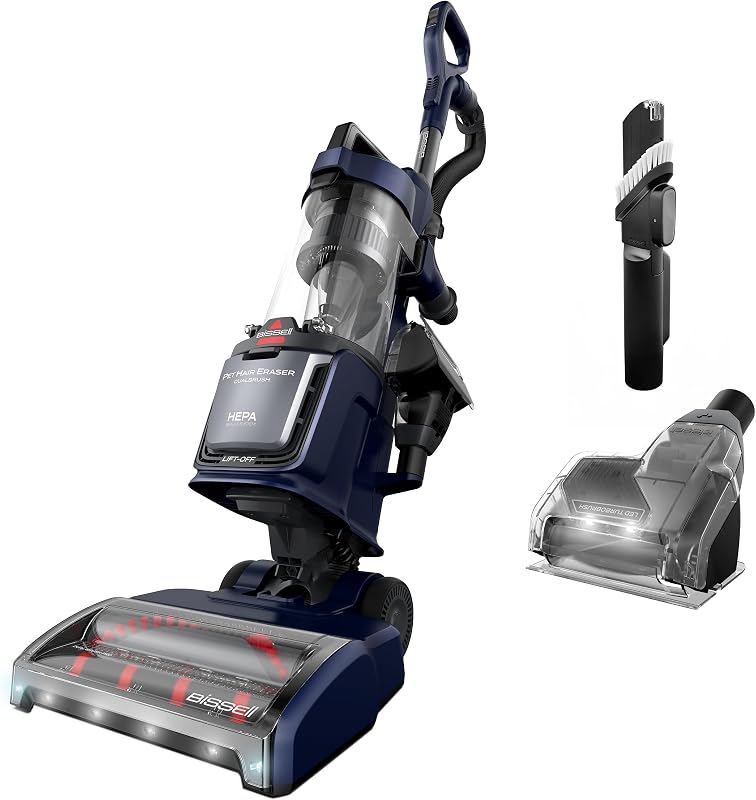
The defining difference between these two cordless stick vacuums comes down to cleaning stamina and suction performance: the Dyson V11 delivers 185 air watts of suction alongside an intelligent LCD screen that tracks run time to the second, whereas the Dyson V8 operates on a simpler two-stage motor producing 115 air watts. Choosing between the Dyson V8 and the Dyson V11 centers on whether your living space requires heavy-duty pulling power for dense carpeting and extensive floor plans, or an agile, lightweight machine for fast everyday cleanups.
Choose the Dyson V8 if you prefer an easy-handling, nimble stick vacuum for quick maintenance in smaller homes and apartments. Choose the Dyson V11 if you need long battery life, large bin volume, and maximum extraction power across a spacious, pet-friendly household.

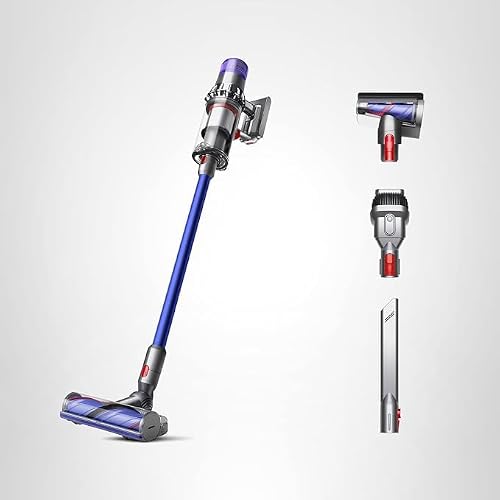
Dyson V8 vs Dyson V11 at a Glance
| Feature | Dyson V8 | Dyson V11 |
|---|---|---|
| Maximum Suction Power | 115 AW | 185 AW |
| Cleaning Modes | 2 power levels | 3 power modes (Eco, Auto, Boost) |
| Maximum Runtime | Up to 40 minutes | Up to 60 minutes |
| Intensive Mode Runtime | 5 minutes (Max mode) | 5 minutes (Boost mode) |
| Dustbin Capacity | 0.14 gallons | 0.2 gallons |
| Filtration System | Advanced whole-machine HEPA | Advanced whole-machine HEPA (99.99% down to 0.3 microns) |
| Operating Noise Level | 80 dB | 70 dB |
| Display Interface | Not listed | LCD screen with real-time countdown |
| Weight | Not listed | 6.6 pounds |
| Best For | Apartments and agile everyday cleaning | Large homes, thick carpets, and heavy shedding |
Suction Power and Carpet Performance
Suction measurement reveals how effectively a cordless vacuum pulls dust, grit, and dander out of floor surfaces rather than merely skimming the top layer. When analyzing Dyson V8 vs V11 suction power, the difference in engineering is immediately noticeable. The V8 generates 115 air watts from its 500-watt, 21.6-volt motor system. In contrast, the V11 produces 185 air watts from its 25.2-volt architecture, representing a 60 percent increase in overall suction. On hard flooring such as sealed wood, laminate, and tile, both vacuums clear loose crumbs and light dust with ease. However, when moving onto dense area rugs and medium-to-high-pile carpets, raw air watts dictate how deeply the vacuum can reach into the backing.
For shoppers deciding between the Dyson V8 or V11 for carpet, that extra 70 air watts changes how thoroughly the vacuum cleans. While the V8 relies primarily on its mechanical Motorbar bristles to agitate carpet fibers and lift surface dirt, the V11 combines aggressive mechanical agitation with superior airflow to dislodge heavy sand and compacted dirt. Readers exploring our dyson v10 vs v11 comparison know that the V11 platform is built specifically to address stubborn debris in carpets without requiring multiple passes over the exact same spot.
Both models feature a dedicated maximum power mode for tough messes: the V8 offers Max mode while the V11 features Boost mode. In both cases, the battery limits cleaning time to five minutes on this peak setting. The critical trade-off is the cleaning yield you achieve in that five-minute burst. Because the V11 pulls with 185 air watts, it extracts far more ground-in dirt from heavily trafficked entryways, car footwells, and thick rugs before the battery depletes.
Edge: Dyson V11 provides 185 air watts of suction power, generating 60 percent more pulling force to deep clean thick carpets than the 115 air watt V8.
Battery Life, Runtime, and Cleaning Modes
Battery longevity determines whether you can clean an entire house in one continuous session or whether you must stop halfway through to recharge. Evaluating the Dyson V8 vs V11 battery life shows a significant generational gap in power management. The V8 delivers up to 40 minutes of runtime on its standard setting and requires a 5-hour charging cycle to replenish its 21.6-volt battery. The V11 extends maximum cleaning time up to 60 minutes in Eco mode, giving users an extra 20 minutes of working capacity to tackle larger multi-room layouts.
The flexibility of power modes also directly impacts runtime management. The V8 provides two straightforward power levels: a low-suction standard mode for everyday upkeep and a high-draw Max mode that depletes the cell in five minutes. The V11 offers three distinct power settings: Eco mode for prolonged operation on bare surfaces, Boost mode for five minutes of extreme suction, and an intelligent Auto mode. Auto mode balances power and runtime automatically, protecting battery longevity while applying extra pull only when cleaning resistance requires it. To see how modern power monitoring has evolved in newer models, see our analysis in the dyson v11 vs v12 detect slim breakdown.
In day-to-day use, examining Dyson V8 vs V11 runtime illustrates how uninterrupted workflow changes across different floor plans. If your cleaning routine takes 35 minutes, the V8 operates near its upper limit and risks cutting out before you finish baseboards or upholstery. The V11 provides a comfortable runtime buffer that allows homeowners to vacuum multiple rooms, swap tools for stair treads, and finish edge cleaning on a single charge.
Edge: Dyson V11 wins with up to 60 minutes of runtime and three tailored cleaning modes, easily outlasting the 40-minute, two-speed battery of the V8.
Pet Hair Removal and Specialized Attachments
Pet owners face two primary cleaning obstacles: hair wrapping around the main floor brush and stubborn fur weaving itself into couch fabrics and carpeted stairs. When considering the Dyson V8 or V11 for pet hair, both vacuums are equipped with Dyson’s specialized de-tangling Motorbar cleaner head. This floor tool incorporates built-in polycarbonate hair removal vanes that actively comb the brush bar as you clean, lifting long human strands and pet fur directly off the bristles and sending them straight into the suction stream.
Both packages also feature the Hair screw tool, a motorized handheld attachment engineered specifically for animal owners. Built with an anti-tangle conical brush bar, this accessory shifts pet hair off fabric surfaces, car seats, and pet beds toward the narrow end of the cone, where it spirals into the bin without wrapping around the axle. For pet households evaluating larger formats, our guide on the dyson v11 vs outsize explores alternative configurations for extreme pet hair management.
While both vacuums share the same anti-tangle tool design, the V11 handles high-shedding environments more efficiently due to air volume and bin dynamics. When clearing heavy coats during shedding season, the 185 air watts of the V11 lifts embedded hair from fabric weaves faster, preventing the need for multiple scrub-like passes with the handheld attachment.
Edge: Dyson V11 holds the advantage by combining the shared anti-tangle Motorbar and Hair screw tool with higher air wattage to pull stubborn fur out of upholstery fibers.
Dustbin Capacity and Whole-Home Cleaning Efficiency
Dustbin capacity defines how many interruptions you will experience during a cleaning routine. Frequent trips to the trash can break cleaning momentum and increase airborne dust exposure. Choosing between the Dyson V8 or V11 for large homes highlights a noticeable difference in canister engineering: the V8 features a 0.14-gallon dustbin, while the V11 expands capacity to 0.2 gallons. While a fraction of a gallon sounds modest, it gives the V11 roughly 40 percent more usable volume for dust, pet fur, and large debris.
The increased dust volume on the V11 allows users to complete extensive floor plans without repeatedly pausing to empty the canister. This pairs effectively with the V11 advanced whole-machine filtration system, which captures 99.99 percent of microscopic particles as small as 0.3 microns and expels cleaner air back into your living space. The V8 also uses advanced whole-machine HEPA filtration, but its smaller capacity means the filter surface and canister become packed faster in dusty environments. For shoppers exploring maximum filtration and bin capabilities, our review of the dyson v11 vs v15 detect provides further perspective on high-capacity stick models.
For small apartments and quick spill pickups, the 0.14-gallon canister of the V8 is perfectly manageable and keeps the vacuum compact. But for larger households with high foot traffic, tracked-in dirt, and shedding pets, the smaller volume of the V8 requires multiple disposal stops during a single session, making the 0.2-gallon bin of the V11 far more practical.
Edge: Dyson V11 offers a 0.2-gallon dustbin that holds 40 percent more debris than the 0.14-gallon canister on the V8.
Controls, Display Interface, and Operating Noise
Ergonomics and user feedback significantly shape how effortless a vacuum feels during routine chores. In this category of the Dyson V11 vs V8 comparison, the technological divide between the two generations is clearest. The V11 features an integrated LCD screen positioned at the rear of the handle. Controlled through touch and push buttons, this display presents real-time power mode selections, maintenance alerts, and an exact countdown of remaining battery life down to the second.
The V8 operates without a digital display screen, leaving users to estimate remaining battery runtime based on simple visual cues. Running out of power abruptly mid-room is a frequent nuisance on screenless cordless vacuums. Acoustic performance also favors the newer platform according to manufacturer specifications: the V8 is rated at an operating noise level of 80 dB, whereas the V11 operates at a quieter 70 dB despite housing a stronger motor. To see how Dyson acoustic dampening compares to competing stick cleaners, look at our dyson vs tineco comparison.
On physical weight, however, the simpler engineering of the V8 offers an ergonomic benefit. The V11 weighs 6.6 pounds, measuring 10.28 inches long, 9.84 inches wide, and 49.64 inches high. While the product listing does not specify the exact weight of the V8, its smaller 21.6-volt battery, smaller canister, and lack of an LCD screen make it noticeably lighter in the hand. For reaching ceiling fans, dusting high curtains, and maneuvering into tight car corners, the lighter body of the V8 demands less wrist and shoulder effort.
Edge: Dyson V11 provides an intelligent LCD screen with a second-by-second countdown and runs at a quieter 70 dB, though the V8 provides a lighter hand feel.
Pros and Cons
Dyson V8

Pros
- Advanced whole-machine HEPA filtration
- De-tangling Motorbar cleaner head
- Anti-tangle Hair screw tool included
- Converts to handheld with one click
Cons
- Lower 115 AW suction power
- Shorter 40-minute maximum runtime
- Smaller 0.14-gallon dustbin capacity
Dyson V11

Pros
- Strong 185 AW suction power
- Up to 60 minutes of runtime
- LCD screen with second-by-second countdown
- Larger 0.2-gallon dustbin capacity
- Quieter 70 dB operating noise
Cons
- Heavier 6.6-pound total machine weight
- Bulkier dimensions for tight storage spaces
Who Should Buy Each One
Choose the Dyson V8 If
- You live in an apartment, condo, or single-story layout where up to 40 minutes of runtime easily covers all floor space.
- You prioritize a lighter stick vacuum that causes less arm fatigue when cleaning overhead vents, blinds, and high shelving.
- You have mostly hard floors, tile, or delicate low-pile area rugs that do not demand 185 air watts of deep suction.
- You prefer simple mechanical operation and do not require digital screens, live countdowns, or automated mode switching.
Choose the Dyson V11 If
- You manage a large home with expansive square footage requiring up to 60 minutes of uninterrupted cleaning time.
- You have wall-to-wall carpeting or thick area rugs that need 185 air watts of suction to pull up embedded grit and pet dander.
- You live with shedding pets and need a larger 0.2-gallon dustbin to avoid frequent trips to the trash can.
- You want complete battery visibility through an LCD screen that displays a real-time countdown to the second.
Final Verdict
When assessing overall cleaning power, runtime, and filtration capacity, any thorough Dyson V11 review confirms that the V11 is the superior vacuum for whole-home deep cleaning. With 185 air watts of suction, an extended 60-minute battery threshold, a 0.2-gallon dustbin, and an LCD screen that eliminates runtime guesswork, it is engineered to handle demanding floor plans and persistent messes. For pet owners and households with carpeted rooms, asking is Dyson V11 worth it comes down to cleaning efficiency: its higher suction and adaptive modes clean deeper in fewer passes, while operating at a quieter 70 dB rating.
Nevertheless, a balanced Dyson V8 review shows that the V8 remains an outstanding, reliable choice for smaller homes and lighter cleaning regimens. It features the exact same de-tangling Motorbar cleaner head and anti-tangle Hair screw tool found on the V11, delivers whole-machine HEPA filtration, and offers up to 40 minutes of runtime. If your home has primarily hard flooring, minimal high-pile carpet, and you value a lightweight, nimble frame for fast spot cleans, the Dyson V8 provides exceptional cleaning utility without unnecessary bulk.
FAQ
Can the Dyson V8 cleaner head detangle pet hair like the Dyson V11?
Yes. Both the Dyson V8 and Dyson V11 come equipped with Dyson’s Motorbar cleaner head, which features integrated de-tangling vanes that automatically clear wrapped hair from the brush bar as you clean. Both models also include the anti-tangle Hair screw tool for pet beds and upholstery.
How does the battery runtime compare between the Dyson V8 and V11?
The Dyson V8 provides up to 40 minutes of runtime in standard mode and takes 5 hours to fully charge its 21.6-volt battery. The Dyson V11 offers up to 60 minutes of runtime in Eco mode using its 25.2-volt battery system. Both vacuums deliver exactly five minutes of runtime when switched to their highest power modes (Max mode on the V8 and Boost mode on the V11).
Does the Dyson V8 or V11 perform better on thick carpets?
The Dyson V11 performs noticeably better on thick carpets due to its 185 air watts of suction power, which provides 60 percent more pulling power than the 115 air watts generated by the V8. This additional airflow pulls embedded debris out of dense carpet backings more effectively.
What tools and accessories come included with each vacuum?
The Dyson V8 listing specifies the Motorbar cleaner head, Hair screw tool, Crevice tool, and Combination tool. The Dyson V11 Origin listing specifies the Motorbar cleaner head, Hair screw tool, Crevice tool, Mini soft dusting brush, Wand, Docking station, Charger, and one Lithium Ion battery.
How do the dustbin capacities differ between these two models?
The Dyson V8 has a dustbin capacity of 0.14 gallons, making it compact and lightweight. The Dyson V11 features a larger 0.2-gallon dustbin, offering roughly 40 percent more storage space to handle larger cleanups without stopping to empty the bin.
Is the Dyson V11 significantly quieter than the Dyson V8?
According to the product specifications, the Dyson V11 has an operating noise level of 70 dB, whereas the Dyson V8 is rated at 80 dB. Despite its more powerful motor, the V11 produces less operating noise during use.