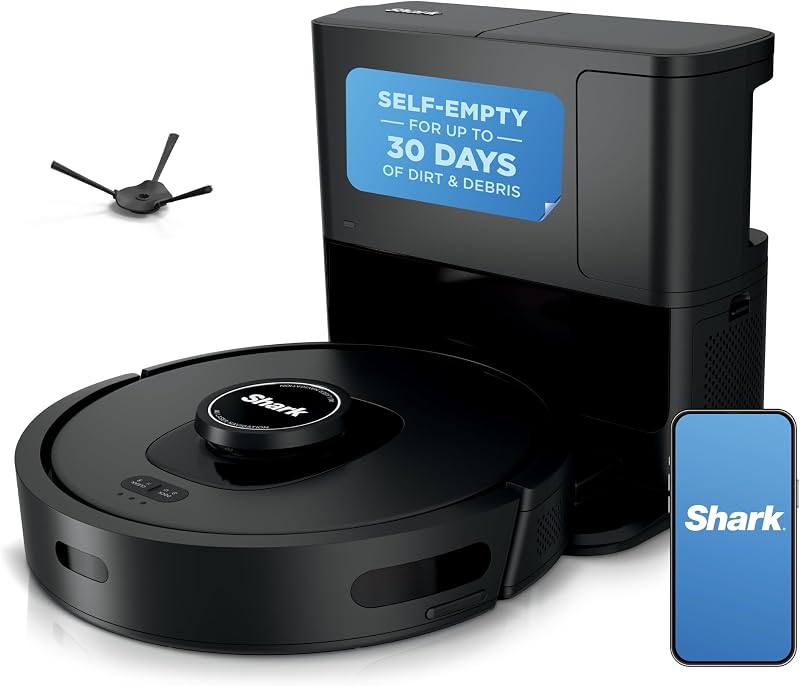
The primary division between these two automated cleaners centers on dust evacuation and navigation intelligence: the Shark AI Robot XL features a bagless self-emptying base that stores up to 60 days of debris behind a true HEPA filtration system paired with 360-degree LiDAR matrix cleaning, whereas the Shark Navigator RV2110 uses a standard charging dock, an onboard 0.52-quart dustbin with a pre-motor filter, and spot LiDAR SmartPath navigation.
Choose the Shark Navigator RV2110 if you prefer a streamlined vacuum for straightforward floor upkeep and do not mind emptying the dust container by hand after cleaning cycles. Choose the Shark AI Robot XL if you live with shedding pets or suffer from indoor allergies and want weeks of hands-free debris storage combined with multi-pass grid coverage.


Shark Navigator RV2110 vs Shark AI Robot XL at a Glance
| Feature | Shark Navigator RV2110 | Shark AI Robot XL |
|---|---|---|
| Debris Disposal System | Manual empty onboard dustbin | Bagless XL self-emptying base |
| Dust Capacity | 0.52 quarts | Up to 60 days (2 months) |
| Filtration Level | Pre-motor filter | True HEPA (captures 99.97% down to 0.3 microns) |
| Navigation Technology | SmartPath Navigation (spot LiDAR, row-by-row) | Matrix Clean Navigation (360° LiDAR vision) |
| Battery Runtime | Up to 120 minutes | Up to 120 minutes |
| Recharge and Resume | Yes | Yes |
| Cleaning Path Width | Not listed | 5.67 inches |
| Brushroll System | Self-cleaning brushroll (anti-hair wrap) | Self-cleaning brushroll (anti-hair wrap) |
| Voice Assistant Support | App and voice control | Amazon Alexa and Google Assistant |
| Body Color and Finish | Steel Grey | Black with Bronze finish |
| Best For | Budget-conscious everyday floor maintenance | Pet homes needing automated dust disposal |
Dust Containment and Self-Empty Base Functionality
Dust management represents the most noticeable functional gap when setting up the Shark AI Robot XL self empty base next to the standard dock of the Navigator RV2110. The AI Robot XL relies on a floor-standing dock equipped with an integrated evacuation motor. When the robotic unit docks, it automatically pulls collected debris from the internal container into a larger canister capable of holding up to 60 days of dust, pet hair, and dirt. This secondary bin is completely bagless, removing the need to buy disposable replacement liners while preserving a sealed pathway for dirt storage. For broader context on how Shark designs its automated docks, our breakdown of the shark ai ultra vs ai robot xl covers related multi-dock configurations across the automated product catalog.
The Navigator RV2110 functions as a self-contained unit that houses all collected floor mess inside an onboard 0.52-quart dust cup. Because it returns to a basic charging cradle without an evacuation motor, you must manually unlatch the onboard dustbin, transport it to a waste receptacle, and dump it out after every one or two cleanings. In a modest home without heavy shedding, a 0.52-quart bin can manage multiple small sessions, but homes with regular foot traffic or shedding animals will require consistent attention to keep the bin from packing solid and reducing vacuum performance.
Filtration mechanics separate these systems even further. The AI Robot XL incorporates a true HEPA filtration system inside its self-empty base that traps 99.97% of dust and allergens down to 0.3 microns. This keeps tiny particulate matter, dried dander, and microscopic pollen locked inside the base rather than venting back into your breathing space during evacuation. The Navigator RV2110 relies on a standard pre-motor filter inside the vacuum body. While effective at shielding internal mechanicals from coarse dust and larger dirt clumps, the pre-motor filter lacks the certified micron-level sealing found on the larger XL base system.
Edge: Shark AI Robot XL because its 60-day bagless self-emptying base eliminates daily dustbin dumping and secures microscopic particles with true HEPA allergen filtration.
Navigation, Mapping, and Cleaning Patterns
Systematic floor coverage determines how quickly and cleanly a robot completes a cycle without wandering aimlessly or skipping heavy-traffic lanes. The Shark Navigator RV2110 SmartPath navigation uses spot LiDAR technology to assess room boundaries and establish an organized, row-by-row path. This orderly pattern marks a massive advancement over older, bouncing robotic models, delivering up to 1.5 times more coverage than early-generation options like the Shark ION platform. By methodically moving forward, shifting over, and running parallel lines, the Navigator RV2110 avoids random drifting and ensures that open floors receive predictable attention.
The AI Robot XL advances navigation precision by combining full 360-degree LiDAR vision with Shark Matrix Clean Navigation. Instead of relying solely on spot-based optical calculations, the 360-degree laser turret maps entire floor plans instantly, measuring walls, furniture legs, and open doorways whether the environment is fully lit or completely dark. When the AI Robot XL encounters heavy debris zones or runs full room passes, its Matrix Clean system commands the robot to vacuum in a multi-directional grid. By moving in intersecting lines across the same physical space, it strikes carpet fibers and floor seams from two perpendicular angles, dislodging settled grime that single-pass sweeps often glide past.
Obstacle handling is present on both platforms, though their sensor arrays process obstacles differently during active cycles. Both vacuums detect and navigate around unexpected obstacles such as abandoned footwear, floor toys, or shifted furniture without requiring you to clear every floor surface beforehand. However, the continuous 360-degree LiDAR scanning on the AI Robot XL allows it to update its spatial awareness in real time as household members or pets move around it. Readers researching navigation variations will also find useful context in our shark navigator rv2110 vs shark ai ultra comparison, which analyzes similar laser mapping frameworks.
Edge: Shark AI Robot XL due to its 360-degree LiDAR and multi-directional Matrix Clean grid coverage that makes multiple passes over stubborn debris.
Pet Hair Management and Brushroll Engineering
When selecting the Shark Navigator RV2110 or Shark AI Robot XL for pets, the brushroll architecture and waste path dictate how much hands-on maintenance you will perform each week. Both models feature Shark’s self-cleaning brushroll, which uses an anti-hair wrap design engineered to pull stubborn human hair and long pet fur into the suction channel without wrapping tightly around the central core. This design works by agitating deep within carpet fibers while maintaining direct contact across solid hardwood and tile, keeping hair moving freely into the dust chamber rather than binding up the drive bearings.
Despite sharing this anti-hair wrap brushroll, handling pet debris in practice reveals huge differences between the models. Shedding fur takes up substantial physical volume inside any collection chamber. When running the Navigator RV2110 in a home with multiple dogs or cats, its 0.52-quart onboard container can reach maximum density mid-cycle. If fur bridges across the inlet or fills the bin, the robot continues to drive its programmed pattern without drawing in additional debris until you pause the device and manually clean out the bin. Evaluating a direct Shark RV2110 vs AV2501AE matchup highlights this physical container barrier as the single biggest factor for pet owners.
The AI Robot XL addresses the volume problem by evacuating its internal contents directly into the XL base. Furthermore, living with pets involves pet dander, dried saliva flakes, and dust mites stirred up from carpet pile. Because the AI Robot XL couples its self-cleaning brushroll with an airtight HEPA system in the dock, pet allergens are removed from the living area and trapped behind sealed gaskets. To see how other automatic docking systems compare against traditional robotic platforms, take a look at our guide on the shark navigator rv2110 vs shark iq robot.
Edge: Shark AI Robot XL because its large-capacity base handles bulky fur volume while HEPA filtration prevents pet dander from recirculating into indoor air.
Smart Controls, Scheduling, and Mapping Integration
Modern robot vacuums rely heavily on smartphone connectivity and home automation ecosystems to provide convenient control. The Shark AI Robot XL review data highlights broad integration with popular voice assistants, allowing homeowners to link the machine directly to Amazon Alexa or Google Assistant. With these integrations active, you can issue voice commands to clean specific rooms, initiate on-demand spot sessions, or send the robot back to its self-emptying base without opening a smartphone application.
A comprehensive Shark Navigator RV2110 review shows that it also includes modern hands-free options, offering app-based control alongside voice assistant command pathways. Through the Shark app, you can build customized cleaning routines, initiate whole-home sweeps, select targeted spot cleanings, or inspect the device status from any mobile device. Both models feature convenient recharge and resume logic. If the lithium-ion battery runs low halfway through a large floor plan, the vacuum pauses its cleaning routine, calculates the most efficient path back to the dock, recharges, and then travels back to the exact coordinate where it stopped to finish the run.
Where the two platforms diverge in day-to-day operation is the depth of room-level mapping delivered by their respective sensor suites. The 360-degree LiDAR on the AI Robot XL generates detailed floor plans quickly, making it easier to define specific rooms, create targeted cleaning schedules for high-spill areas like kitchens, and track cleaning progress in the app. The spot LiDAR system on the Navigator RV2110 maps the home effectively for row-by-row navigation, but the matrix mapping interface on the AI Robot XL provides deeper interactive options. Readers seeking more information on Shark app controls can examine our comparison of the shark navigator rv2110 vs shark matrix plus.
Edge: Tie as both robotic vacuums provide reliable app connectivity, voice control activation, and automated recharge and resume functionality.
Suction Performance and Floor Surface Versatility
Floor surface compatibility is essential for multi-surface homes that alternate between thick carpets, area rugs, polished hardwood, and kitchen tile. In this Shark Navigator robot vs Shark AI Robot matchup, both units demonstrate versatile surface transitions. The Navigator RV2110 is engineered for carpets and hard floors, delivering up to 50% more suction than competitor robot vacuum baselines. Its two-wheel drive system and low-profile body easily climb transition strips between different flooring materials, while the underside bristles agitate carpet pile to pull loose dirt, fine sand, and tracked-in debris from deep down.
The Shark AI Robot XL is rated for hard floors and carpets, leveraging powerful suction to tackle tough messes across wide areas. A distinctive specification for the AI Robot XL is its published 5.67-inch cleaning path width, which works in tandem with dual side brushes to sweep edge debris directly into the central airflow stream. When considering is Shark AI Robot XL worth it for multi-surface cleaning, the primary physical advantage lies in the Matrix Clean Navigation. Rather than making a single pass over high-pile carpets where suction alone might miss deeply embedded debris, the AI Robot XL sweeps across the pile in two directions to open up carpet fibers thoroughly.
The Navigator RV2110 offers balanced performance on flat hard floors where its row-by-row SmartPath pattern systematically sweeps every strip of wood or laminate. However, because it operates with a single cleaning speed and lacks the cross-hatch matrix cleaning pass of the AI Robot XL, heavily soiled entryways may require scheduling consecutive runs to match the deep extraction delivered by the AI platform. For additional insights into how Shark scales suction performance across different robot tiers, see our evaluation of the shark ai ultra vs iq robot.
Edge: Shark AI Robot XL because its multi-directional matrix grid sweeping works with high suction power to clean embedded carpet grime more deeply than single-pass passes.
Pros and Cons
Shark Navigator RV2110

Pros
- Up to 120 minutes of runtime
- SmartPath row-by-row LiDAR navigation
- Self-cleaning anti-hair wrap brushroll
- Compact charging dock footprint
Cons
- Manual dustbin emptying required
- Only basic pre-motor filtration
- Smaller 0.52-quart dust capacity
View Shark Navigator RV2110 on Amazon
Shark AI Robot XL

Pros
- 60-day bagless self-emptying base
- True HEPA filtration seals allergens
- 360-degree LiDAR Matrix Clean grid navigation
- Works with Alexa and Google Assistant
Cons
- Self-empty base requires extra floor space
- Wider footprint than standard dock
View Shark AI Robot XL on Amazon
Who Should Buy Each One
Choose the Shark Navigator RV2110 If
- You live in an apartment or smaller single-story house where a 0.52-quart onboard dustbin provides plenty of room for routine cleaning cycles.
- You want structured, row-by-row SmartPath navigation that avoids random bouncing without needing a bulky self-emptying base taking up floor space.
- You prefer a simple, streamlined setup that requires no disposal base maintenance or secondary canister cleaning.
- Your household has minimal pet shedding and you do not require specialized HEPA allergen filtration in your dock.
Choose the Shark AI Robot XL If
- You share your living space with multiple shedding pets and need an automated self-emptying base that holds up to 60 days of fur and dirt.
- You or family members have indoor allergies and require true HEPA filtration that captures 99.97% of dust and dander down to 0.3 microns.
- You want 360-degree LiDAR navigation that operates smoothly day or night alongside multi-pass Matrix Clean grid scrubbing.
- You prefer a fully automated floor care routine that runs for weeks at a time using Alexa or Google Assistant voice commands without manual intervention.
Final Verdict
For most households, the Shark AI Robot XL is the superior robotic vacuum. Its combination of a 60-day bagless self-emptying dock, true HEPA filtration, 360-degree LiDAR mapping, and multi-pass Matrix Clean Navigation resolves the most frustrating aspects of robotic floor cleaning. Instead of kneeling down to empty an onboard bin after every run, you can let the vacuum manage both debris pickup and disposal automatically for up to two months, all while keeping trapped allergens sealed away from your home’s air.
The Shark Navigator RV2110 remains a strong choice if you want capable, orderly cleaning without the large footprint of an auto-empty base station. With up to 120 minutes of lithium-ion runtime, SmartPath row-by-row navigation, a self-cleaning anti-hair wrap brushroll, and app scheduling, it reliably maintains carpets and hard floors. If you do not mind emptying its 0.52-quart dustbin manually, the Navigator RV2110 delivers genuine cleaning performance in a sleek Steel Grey package.
FAQ
Does the Shark Navigator RV2110 empty its own dustbin?
No. The Shark Navigator RV2110 docks onto a standard charging cradle and requires manual bin maintenance. You must remove the onboard 0.52-quart dust cup and empty it directly into your household trash can between cleaning cycles.
How often do you need to empty the base on the Shark AI Robot XL?
The bagless XL self-empty base holds up to 60 days of dirt and debris under standard household cleaning conditions. Depending on the size of your home and the amount of pet hair present, you will only need to open and empty the base canister roughly once every one to two months.
Do both vacuums navigate in straight lines or bounce randomly?
Both models use structured navigation rather than random bounce patterns. The Navigator RV2110 uses SmartPath Navigation with spot LiDAR to clean in systematic, row-by-row lines. The AI Robot XL uses 360-degree LiDAR and Matrix Clean Navigation to clean in straight rows as well as intersecting grid patterns for deeper coverage.
Can the Shark AI Robot XL clean effectively in the dark?
Yes. Because the Shark AI Robot XL uses 360-degree LiDAR laser vision rather than optical camera sensors, it maps rooms, detects furniture, and avoids obstacles in total darkness just as effectively as it does in broad daylight.
Are replacement bags required for the Shark AI Robot XL self-empty base?
No. The Shark AI Robot XL features a completely bagless self-empty base. When the base canister reaches capacity, you simply carry the bin to a trash can, press the release latch to drop the debris out, and snap it back onto the base station without buying disposable bags.
How does recharge and resume work on these Shark robotic vacuums?
Both the Navigator RV2110 and the AI Robot XL feature recharge and resume functionality. When the lithium-ion battery depletes during a cleaning run, the robot marks its coordinates, travels back to its charging dock, recharges its battery, and returns directly to the spot where it paused to finish the cleaning run.