The defining difference between the Shark Navigator RV2110 and the Shark AI Ultra is how they handle dust containment and floor coverage: the AI Ultra features a bagless self-emptying base holding up to 30 days of debris alongside multi-directional grid navigation, while the Navigator RV2110 relies on a compact charging base, a larger onboard dust bin, and standard row-by-row pathing.
Choose the Shark Navigator RV2110 if you want methodical floor cleaning with a minimal dock footprint and a spacious 0.52-quart onboard dust cup. Choose the Shark AI Ultra if you want a truly hands-off cleaning routine powered by automated debris evacuation, true HEPA allergen filtration, and intensive multi-pass deep cleaning.


Shark Navigator RV2110 vs Shark AI Ultra at a Glance
| Feature | Shark Navigator RV2110 | Shark AI Ultra |
|---|---|---|
| Navigation Technology | SmartPath Navigation (Spot LiDAR) | 360-Degree LiDAR Vision |
| Cleaning Pattern | Row-by-row methodical rows | Matrix Clean precision grid passes |
| Dust Disposal System | Manual empty onboard dust cup | Bagless self-emptying base |
| Dust Capacity | 0.52 quarts (onboard) | 0.09 liters (robot) / 30-day base capacity |
| Filtration Type | Pre-motor filter | Foam filter with True HEPA base filtration |
| Brushroll Style | Self-cleaning anti-hair wrap | Self-cleaning anti-hair wrap |
| Battery Runtime | Up to 120 minutes | Up to 120 minutes |
| Object Avoidance | Detects and avoids obstacles | Detects and avoids obstacles day or night |
| Voice Assistants | Voice control enabled | Amazon Alexa and Google Assistant |
| Color Finish | Steel Grey | Dark Grey |
| Best For | Homes wanting compact docks and simple manual emptying | Busy pet owners wanting 30 days of hands-free allergen containment |
Dust Disposal and Base Design
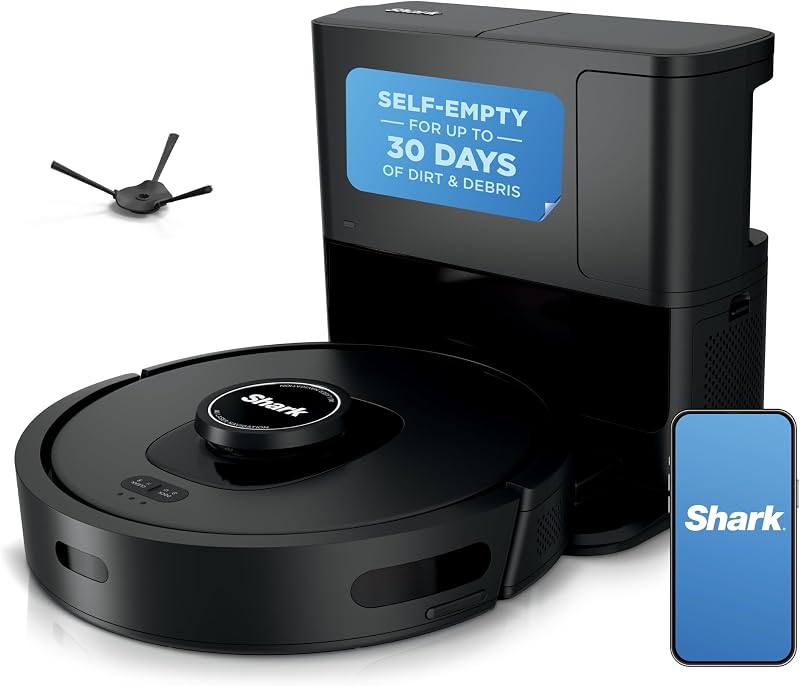
The base station defines everyday ownership when evaluating the Shark AI Ultra vs Shark Navigator RV2110. The AI Ultra includes an automated self-emptying dock with a 30-day capacity. Every time the robot docks, a motorized suction motor transfers debris from the robot’s internal dust cup into the base chamber. This eliminates the need to bend down and clear dirt after every cycle, making the Shark AI Ultra self emptying base the central mechanical advantage for hands-free maintenance.
In contrast, the Navigator RV2110 docks on a low-profile charging station that serves purely to recharge the lithium-ion battery. Dirt collected during a run stays inside the robot’s onboard dust cup. However, the Navigator gives you a much larger onboard bin capacity at 0.52 quarts compared to the tiny 0.09-liter bin inside the AI Ultra chassis. If you do not mind ejecting the dust cup over your trash can after each cleaning cycle, the Navigator RV2110 keeps floor space completely uncluttered because its charging dock lacks the tall vertical footprint of an auto-empty station.
The structural trade-off comes down to mechanical automation versus floor footprint. The AI Ultra base requires dedicated vertical and horizontal clearance along an open wall outlet, operating at 120 volts to pull dirt out of the chassis. The Navigator dock requires minimal wall real estate and uses a 19-volt charging feed, but shifts 100 percent of disposal labor onto you. For shoppers debating whether to invest in larger automated cleaning hubs, exploring a comparison like the shark navigator rv2110 vs shark matrix plus reveals how common this dock footprint trade-off is across Shark automated lineups.
Edge: Shark AI Ultra due to its hands-free 30-day bagless self-emptying base that removes daily dust disposal tasks.
Navigation Technology and Cleaning Coverage
Navigation determines how thoroughly a robotic vacuum covers floor plans without missing patches or repeating areas unnecessarily. The Navigator RV2110 utilizes SmartPath Navigation, which integrates spot LiDAR technology to map the home environment. Instead of randomly bouncing off baseboards, it executes a calculated, row-by-row path across bare floors and low rugs, generating up to 1.5 times more coverage than traditional random-bounce units like the older Shark ION platform.
The AI Ultra steps up navigation capability through 360-degree LiDAR vision paired with Matrix Clean navigation. Rather than making a single pass through a room, the Shark AI Ultra matrix clean mode commands the robot to vacuum across a dense grid pattern. It takes multiple overlapping passes over dirt and debris, attacking high-traffic zones from multiple angles. Furthermore, the 360-degree LiDAR dome operates day or night, mapping interior spaces accurately without requiring ambient room lighting.
For large layouts with multiple distinct rooms, the precision of 360-degree LiDAR gives the AI Ultra a clear operational advantage. While the Navigator RV2110 handles straightforward row cleaning effectively, it only runs a single-direction pass during standard cleaning tasks. The multi-directional matrix grid of the AI Ultra provides deeper agitation on carpet fibers and captures debris that a single linear sweep often leaves behind along floor transitions.
Edge: Shark AI Ultra because its 360-degree LiDAR system and matrix grid navigation deliver superior multi-pass floor coverage.
Filtration and Allergen Containment
Filtration systems dictate whether fine debris, pet dander, and microscopic irritants stay trapped or blow back into your living areas. The Navigator RV2110 utilizes a standard pre-motor filter system inside its chassis. This washable filter protects the internal suction fan from coarse debris and day-to-day grit, but it does not offer sealed, fine-particle allergen certification. When you slide the 0.52-quart bin out to dump it, fine dust plumes can escape back into the room.
Filtration is where the AI Ultra separates itself significantly. The vacuum unit itself utilizes a foam filter, while the self-emptying base incorporates a fully sealed true HEPA filtration system. According to manufacturer specifications, this HEPA system captures and traps 99.97% of dust and allergens down to 0.3 microns. Because the robot evacuates into the sealed dock automatically, you interact with loose pet dander and fine particulate far less frequently.
Homeowners sensitive to airborne particles must weigh these filtration designs carefully. If you or family members suffer from seasonal dust sensitivities, the sealed dock HEPA barrier on the AI Ultra offers substantial peace of mind. The Navigator RV2110 performs well for general cleaning, but its basic pre-motor filter requires regular manual tapping and washing, exposing you to concentrated dust during maintenance.
Edge: Shark AI Ultra thanks to its true HEPA base filtration that traps 99.97% of fine particles down to 0.3 microns.
Pet Hair Management and Brushroll Mechanics
Hair management on hard floors and rugs represents a major purchase factor when deciding between the Shark Navigator RV2110 or Shark AI Ultra for pet hair. Both models share Shark’s self-cleaning brushroll technology, which uses engineered bristles and integrated anti-hair wrap ribs to actively shed long hair and fur into the suction airstream rather than allowing it to wrap tightly around the cylinder.
Where the experience differs is how each machine manages the volume of hair picked up. The Navigator RV2110 relies solely on its 0.52-quart internal bin. In households with multiple shedding pets, pet fur quickly fills this onboard capacity. If the bin fills midway through a cycle, suction diminishes until you manually empty the compartment, though the anti-hair wrap roll itself keeps rotating freely.
The AI Ultra mitigates the hair volume problem through automated docking. Even though its internal bin measures only 0.09 liters, the robot can return to base, purge fur into the 30-day base chamber, and continue working via Recharge and Resume. For high-shedding dogs and cats, the combination of anti-hair wrap mechanics and continuous dock evacuation gives the AI Ultra a clear operational advantage. For readers interested in how earlier Shark self-emptying designs handled pet fur, checking the shark navigator rv2110 vs shark iq robot provides helpful context on brushroll evolution.
Edge: Shark AI Ultra due to the combined utility of its self-cleaning brushroll and automated base emptying for high-volume pet shedding.
Suction Power and Floor Performance
Suction performance directly impacts how effectively a robotic vacuum pulls embedded grit from carpets and dislodges fine debris from hard surface crevices. In any Shark Navigator RV2110 review, the Shark RV2110 suction power stands out as a headline specification: Shark rates it for up to 50% more suction than competing robot vacuums, designed specifically to tackle carpet piles and hard floors alike through a single-speed power system.
The AI Ultra also operates on a single-speed motor platform engineered for deep-cleaning suction across all floor types. While Shark does not provide an identical percentage claim for the AI Ultra in its specification sheet, it classifies the machine as delivering incredible suction designed to tackle tough messes, pet dander, and fine dust. Both machines automatically adjust to surface transitions between low-pile carpets and bare hardwood via dual drive wheels.
Because both robots utilize Lithium-ion battery packs that deliver up to 120 minutes of runtime, their overall floor cleaning capability over identical square footage is very similar on a single pass. Both models support Recharge and Resume: if the battery drops low before the job finishes, the robot returns to dock, charges, and picks up cleaning right where it stopped. Those researching standard upright suction benchmarks might reference the shark nv360 vs az2002 comparison, but in the robotic category, both of these Sharks deliver robust, comparable raw pickup.
Edge: Tie as both units deliver comparable single-speed deep suction and 120-minute runtimes with Recharge and Resume.
Mapping Features, Obstacle Avoidance, and Smart Controls
Smart home integration and obstacle management determine whether you have to tidy your floors before sending the robot out. In this Shark Navigator robot vacuum vs AI Ultra matchup, both machines feature proactive object detection. The Navigator RV2110 utilizes its spot LiDAR hardware to sense objects in its forward path, navigating around stray shoes, chair legs, and dropped items without getting snagged.
The AI Ultra expands on obstacle management with 360-degree LiDAR mapping that detects and avoids obstacles day or night. It builds a detailed floor map of your home within the companion app, allowing you to schedule specific rooms, initiate on-demand cleanings, or command the vacuum via Amazon Alexa or Google Assistant. The Navigator RV2110 also supports app mapping and voice commands to clean rooms, specific spots, or the entire home, but its spot LiDAR system does not possess the full 360-degree continuous scanning range of the AI Ultra turret.
When running in dim or dark rooms, the 360-degree LiDAR on the AI Ultra operates completely independent of ambient lighting. Shoppers curious about how older Shark AI models compare in navigation intelligence can view the shark navigator rv2110 vs shark ai robot xl guide. For overall smart mapping, room customization, and voice assistant versatility, the AI Ultra offers a more flexible feature set.
Edge: Shark AI Ultra because of its 360-degree day-or-night LiDAR mapping and broader smart home assistant integration.
Pros and Cons
Shark Navigator RV2110

Pros
- Spacious 0.52-quart onboard dust cup
- Compact charging dock saves space
- SmartPath row-by-row LiDAR navigation
- Self-cleaning anti-hair wrap brushroll
- Up to 120 minutes of runtime
Cons
- No self-emptying base included
- Lacks true HEPA filtration
View Shark Navigator RV2110 on Amazon
Shark AI Ultra
Pros
- Bagless 30-day self-emptying base
- True HEPA base allergen filtration
- Matrix Clean multi-pass grid coverage
- 360-degree LiDAR day or night mapping
- Works with Alexa and Google Assistant
Cons
- Very small 0.09-liter onboard bin
- Self-empty base requires extra wall space
Who Should Buy Each One
Choose the Shark Navigator RV2110 If
- You prefer a compact charging dock that takes up minimal wall space.
- You want a spacious 0.52-quart onboard dust cup for quick, direct trash bin emptying.
- You need disciplined, row-by-row pathing without complicated multi-pass grid routines.
- You want powerful suction and an anti-hair wrap brushroll without managing dock exhaust filters.
Choose the Shark AI Ultra If
- You want up to 30 days of automated, hands-free debris disposal.
- You require certified true HEPA filtration to trap pet dander and fine allergens down to 0.3 microns.
- You want Matrix Clean grid navigation to scrub high-traffic areas from multiple directions.
- You run cleaning schedules in dark rooms where 360-degree LiDAR vision excels.
Final Verdict
For most households, the Shark AI Ultra is the superior automated vacuum. By pairing a 30-day bagless self-emptying base with true HEPA filtration and Matrix Clean multi-pass navigation, it eliminates the two biggest drawbacks of traditional robot vacuums: frequent dust bin emptying and missed patches of dirt. It operates autonomously for weeks at a time while actively trapping fine pet allergens, making it an exceptional upgrade for pet owners and busy families.
The Shark Navigator RV2110 remains a strong choice if you want reliable row-by-row cleaning without a massive dock dominating your living area. With its generous 0.52-quart onboard capacity, anti-hair wrap brushroll, and 120-minute battery life, it delivers thorough daily floor maintenance for anyone who prefers manual dust cup disposal over a bulky base station.
FAQ
Does the Shark Navigator RV2110 come with a self-emptying base?
No, the Navigator RV2110 comes with a standard compact charging dock. Dust and debris are collected inside its 0.52-quart onboard dust bin, which you must slide out and manually empty into your trash can.
How does Matrix Clean work on the Shark AI Ultra?
Matrix Clean navigation directs the vacuum to clean across a precise grid pattern rather than a single straight pass. The robot takes multiple overlapping passes over the floor from different angles to lift deep dirt and debris from carpets and hard surfaces.
Which vacuum is better for pet hair, the Shark Navigator RV2110 or Shark AI Ultra?
Both vacuums feature a self-cleaning, anti-hair wrap brushroll that prevents fur from tangling around the cylinder. However, the AI Ultra is superior for heavy pet shedding because it automatically evacuates hair into its 30-day self-emptying base, preventing pet fur from quickly clogging the robot’s onboard dust cup.
What is the battery life on both Shark robot vacuums?
Both the Shark Navigator RV2110 and the Shark AI Ultra provide up to 120 minutes of runtime on a single charge using their lithium-ion batteries. Both models also feature Recharge and Resume, returning to their respective docks to charge before finishing incomplete cleaning runs.
Can the Shark AI Ultra navigate in completely dark rooms?
Yes, the Shark AI Ultra uses 360-degree LiDAR vision to map your floor plan and detect obstacles day or night. Because LiDAR relies on light detection and ranging lasers rather than optical camera lenses, ambient room light is not required for navigation.
Is Shark AI Ultra worth it compared to the Navigator RV2110?
The AI Ultra is well worth considering if you want hands-free maintenance and true HEPA allergen control. The convenience of a 30-day self-emptying base combined with matrix grid cleaning provides a significantly more automated experience than the manual emptying required by the Navigator RV2110.


