The primary decision between the Shark Navigator RV2110 and the Shark IQ Robot comes down to hands-free docking maintenance versus intelligent obstacle avoidance. The Shark IQ Robot features an automated bagless base station that holds up to 45 days of dirt and debris, whereas the Shark Navigator RV2110 incorporates spot LiDAR technology designed specifically to detect and avoid floor obstacles without requiring manual pre-cleaning.
Buyers living in busy homes where cables, shoes, and toys frequently litter the floor should select the Shark Navigator RV2110 to prevent navigation snags, while households with shedding pets and busy schedules should choose the Shark IQ Robot to eliminate the chore of daily dustbin emptying.

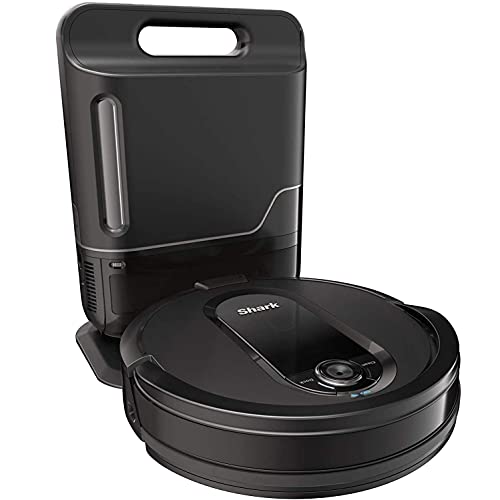
Shark Navigator RV2110 vs Shark IQ Robot at a Glance
| Feature | Shark Navigator RV2110 | Shark IQ Robot |
|---|---|---|
| Base Station Type | Standard charging dock | Bagless self-emptying base (up to 45-day capacity) |
| Navigation Technology | SmartPath Navigation (spot LiDAR) | IQ Navigation with total home mapping |
| Obstacle Avoidance | Active object detection and avoidance | Physical BotBoundary strips |
| Onboard Dustbin Capacity | 0.52 quarts | 0.19 liters |
| Battery Life | 120 minutes | Not listed (listing states 30 days) |
| Brushroll System | Self-cleaning, anti-hair wrap | Self-cleaning, anti-hair wrap |
| Filtration System | Pre-motor filter | High-efficiency allergen filter (non-washable) |
| Cleaning Pattern | Row-by-row | Row-by-row with room select |
| App and Voice Control | App control and voice control | SharkClean app, Amazon Alexa, Google Assistant |
| Included Accessories | Charging dock | Self-empty base, 2 side brushes, 1 filter, BotBoundary strips |
| Best For | Cluttered floors and obstacle avoidance | Hands-free dust disposal and pet homes |
Base Station Convenience and Debris Disposal
The method a robotic vacuum uses to dispose of dirt determines how much human intervention is required between runs. A robot vacuum with an automated base extracts collected dirt every time it docks, allowing the unit to run for weeks without user involvement. In contrast, a standard docking robot stores everything inside its internal dust container, requiring the user to open, empty, and reseat the compartment after one or two cleaning cycles to maintain airflow and suction.
The Shark IQ Robot self emptying base changes daily upkeep completely by utilizing an onboard vacuum motor in the dock to evacuate the internal compartment into a large bagless holding chamber. According to manufacturer specifications, this dock holds up to 45 days of dust, pet hair, and debris. Because the base is bagless, there is no recurring expense or maintenance routine involving disposable replacement bags. In contrast, the Shark Navigator RV2110 docks strictly to recharge its battery. Its larger 0.52-quart internal bin holds more material than the IQ Robot’s onboard compartment during a single run, but every ounce of dust must be dumped manually into a trash can.
When weighing the mechanical upkeep of the two machines, the hands-off reliability of the auto-empty system offers a major advantage for households with heavy shedding or active dust buildup. Readers reviewing alternate automated systems in our shark navigator rv2110 vs shark ai ultra comparison will find that self-emptying docks significantly reduce daily chores, giving the IQ Robot a clear mechanical edge in maintenance convenience.
Edge: Shark IQ Robot, thanks to its 45-day bagless self-emptying dock that removes the need for daily manual dustbin emptying.
Navigation and Floor Obstacle Avoidance
Navigation determines not just how efficiently a robot travels through rooms, but whether it can finish a scheduled cleaning run without getting trapped. Older or entry-level navigation setups depend on contact bumpers, causing machines to bounce randomly until the battery runs out. Advanced platforms deploy optical sensors or laser-based LiDAR scanning to plot structured rows and recognize physical items sitting across the cleaning path.
This is where the Shark Navigator RV2110 lidar navigation stands out. Built with SmartPath Navigation, the RV2110 utilizes spot LiDAR technology to map the home and calculate structured, row-by-row lines. More importantly, its hardware actively detects and avoids objects resting on the floor. Shark notes that users do not need to tidy up cables, clothes, or toys before the robot cleans because the system identifies these hazards and maneuvers around them. The Shark IQ Robot also cleans in orderly, methodical rows and navigates from room to room, but its listing makes no mention of active object avoidance sensors. Instead, the IQ Robot relies on physical BotBoundary strips laid across doorways or around floor hazards to keep the robot out of sensitive areas.
In homes where everyday clutter is common, physical boundary tape is cumbersome to place and visually intrusive compared to automated object detection. For homes with fluctuating floor conditions, the obstacle detection on the Navigator RV2110 prevents stalled cycles and errors. Similar navigation differences are explored in our analysis of the shark navigator rv2110 vs shark matrix plus, proving that integrated floor sensing consistently reduces operational friction.
Edge: Shark Navigator RV2110, because its spot LiDAR sensor actively detects and avoids low-lying floor obstacles without physical boundary tape.
Pet Hair Management and Brushroll Design
Cleaning homes with cats or dogs requires both relentless agitation and tangle-free roller mechanisms. Pet hair wraps tightly around traditional bristle brushes, choking the motor and forcing users to regularly cut away tangled strands with scissors. High-performing pet vacuums counter this by combining anti-hair wrap brushrolls with advanced filtration systems capable of locking away fine fur and microscopic dander.
Both models come equipped with Shark’s self-cleaning brushroll technology. This engineered roller digs into carpet pile and makes direct contact with hardwood floors, lifting trapped fur, dust, and particulate debris while using integrated comb guides to strip tangled hair into the airstream. However, the systems diverge sharply in filtration and collection capacity. The Shark IQ Robot listing emphasizes that it is specifically designed for pet homes, pairing its self-cleaning brushroll with a high-efficiency filter engineered to trap dander, dust, and pet allergens. Furthermore, because long hair can quickly overwhelm small internal bins, the IQ Robot’s base station continuously empties the robot so hair does not compact inside the roller housing.
The Shark Navigator RV2110 includes the same anti-tangle brushroll mechanism and delivers up to 50 percent more suction than competitor robot vacuums, making it highly effective on carpets and hard floors alike. However, its filtration relies on a standard pre-motor filter rather than a sealed allergen-rated setup, and without an auto-empty base, heavy shedding can fill its 0.52-quart bin mid-cycle. As detailed in our breakdown of the shark navigator rv2110 vs shark ai robot xl, pairing an anti-tangle roller with allergen filtration creates a vastly superior environment for pet owners.
Edge: Shark IQ Robot, which combines the anti-hair wrap roller with an allergen-rated filter and an automated emptying dock that handles large volumes of pet fur.
Mapping Precision and Room Selection
Digital mapping capabilities govern how much control a user has over the robot’s cleaning itinerary. While standard cleaning routines treat the home as one undivided floorplan, interactive mapping allows users to label distinct zones, target heavy-traffic spaces, and dispatch the machine to single rooms on demand via mobile applications or connected voice assistants.
The Shark IQ Robot home mapping software offers Total Home Mapping with Room Select. After conducting exploratory passes, the robot builds a comprehensive floor plan inside the SharkClean mobile app. Users can name individual rooms, establish priority areas, and command the robot to vacuum specific locations such as the kitchen or living room immediately. Control can be executed through the app or through voice commands via Amazon Alexa, Google Assistant, or compatible Vera controllers. To block off restricted areas, the package includes physical BotBoundary strips that the robot will not cross.
The Shark Navigator RV2110 also builds structured maps using its SmartPath spot LiDAR system, delivering up to 1.5 times more coverage than traditional bounce-based vacuums like the Shark ION. Its application allows homeowners to clean the whole home, select an individual room, or target a specific spot using app controls or voice commands. However, the Navigator’s primary structural control is driven by its real-time object avoidance rather than dedicated boundary tape accessories. While both units provide room-targeting capabilities, the IQ Robot’s mature room-select suite paired with explicit boundary accessories makes it particularly straightforward for multi-room floor plan management, a dynamic mirrored in our shark ai ultra vs iq robot guide.
Edge: Tie, as both models support row-by-row mapping, room targeting, and voice assistant integration through Shark’s software ecosystem.
Battery Runtime and Multi-Room Coverage
Battery endurance determines the square footage a robot can cover in a single pass before requiring a charging dock visit. In spacious floor plans, a vacuum with limited endurance will spend more time charging than working. When cleanups span broad layouts, the presence of recharge-and-resume logic ensures the robot finishes the entire floor rather than abandoning uncleaned zones.
According to manufacturer specifications, the Shark Navigator RV2110 runtime reaches up to 120 minutes on its lithium-ion battery. This sustained two-hour operational window allows the spot LiDAR system to clean large multi-room layouts methodically in structured rows. If the battery drains during an intensive cleaning run, the RV2110 automatically returns to its charging dock, replenishes its cell, and resumes cleaning right where it stopped, ensuring no zone is overlooked.
The Shark IQ Robot listing does not state a minute-by-minute runtime per charge (listing a 30-day battery specification attributed to its docking maintenance intervals). However, it does feature the same recharge-and-resume capability. When its lithium-ion power supply runs low, the IQ Robot navigates back to its self-emptying base, evacuates its debris, charges up, and returns to the exact coordinates where cleaning was paused to complete the run. Nevertheless, the documented 120-minute operational envelope of the Navigator RV2110 gives buyers verified performance metrics, a critical factor also examined in the shark matrix plus vs iq robot analysis.
Edge: Shark Navigator RV2110, due to its documented 120-minute continuous cleaning runtime on a single charge.
Dustbin Capacity and Daily Maintenance Demands
Internal dustbin capacity directly dictates how frequently a homeowner must manage a robot vacuum that lacks an auto-empty base. If an internal bin fills up midway through a cycle, airflow drops, cleaning efficiency declines, and dirt begins recirculating back across the floor. Understanding the volumetric capacity of each unit clarifies the level of daily oversight required.
The Navigator RV2110 carries a large 0.52-quart internal dust container. Because it relies entirely on this onboard receptacle, the generous capacity is essential for capturing multiple rooms of dirt, pet dander, and floor grit without spilling over during a single run. Removing the bin requires pulling the latch from the robot chassis and dumping the compartment manually over a wastebasket. The pre-motor filter inside the bin catches coarser particulate before air exits the system.
Conversely, the Shark IQ Robot features an internal dust container with an onboard capacity of only 0.19 liters. Under standalone conditions, this small internal volume would require constant emptying. However, because the unit docks and purges its contents directly into the bagless 45-day capacity dock, the small internal reservoir does not hinder its practical operation. While the Navigator provides nearly three times the onboard internal capacity, the IQ Robot’s docking system renders onboard volume largely irrelevant by automating the disposal process entirely.
Edge: Shark IQ Robot, because the automated base bypasses internal volume constraints by regularly purging debris.
Pros and Cons
Shark Navigator RV2110

Pros
- Spot LiDAR object detection and avoidance
- Generous 0.52-quart onboard dust capacity
- Documented 120-minute cleaning runtime
- Anti-hair wrap self-cleaning brushroll
- Row-by-row SmartPath navigation
Cons
- Lacks an automated self-emptying dock
- Uses a basic pre-motor filter
View Shark Navigator RV2110 on Amazon
Shark IQ Robot

Pros
- Bagless base holds 45 days of debris
- High-efficiency allergen and pet dander filter
- Includes physical BotBoundary strips
- Total home mapping with Room Select
- Recharges and resumes cleaning automatically
Cons
- Relies on physical strips for no-go zones
- Very small 0.19-liter onboard dustbin
Who Should Buy Each One
Choose the Shark Navigator RV2110 If
- Your living spaces often have floor-level clutter such as phone chargers, pet toys, or scattered shoes.
- You prefer laser-guided spot LiDAR navigation that actively steers around unexpected obstacles.
- You want a documented 120-minute continuous cleaning runtime for expansive single-session vacuuming.
- You are comfortable manually emptying a 0.52-quart dustbin after cleaning cycles to keep your dock compact.
Choose the Shark IQ Robot If
- You want hands-off debris disposal for up to 45 days without buying replacement bags.
- You share your home with shedding pets and require an allergen-rated high-efficiency filter.
- You want dedicated boundary strips included in the box to block off delicate pet feeding areas or low furniture.
- You want Room Select features paired with an automated self-emptying routine for high-traffic zones.
Final Verdict
Choosing between the Shark Navigator RV2110 and the Shark IQ Robot depends entirely on whether you prioritize floor navigation intelligence or base station automation. For the vast majority of homeowners, the Shark IQ Robot represents the superior overall ownership experience. Its bagless self-emptying base eliminates up to a month and a half of manual dustbin maintenance, and its high-efficiency allergen filtration makes it outstanding for controlling pet hair and fine dander. When assessing everyday convenience, the ability to let a vacuum run for weeks without manual emptying makes the IQ Robot exceptionally practical.
However, the Shark Navigator RV2110 remains the winning choice for homes with dynamic floor environments. If your rooms frequently have obstacles scattered across rugs and hard floors, the IQ Robot’s lack of active obstacle avoidance means it may get stuck on socks or cables unless you pre-clean beforehand. The Navigator RV2110’s spot LiDAR system actively maneuvers around floor clutter and provides a solid 120 minutes of runtime, making it the smarter choice for chaotic, lived-in spaces where hands-free navigation matters more than hands-free dust disposal.
FAQ
Does the Shark Navigator RV2110 require floor boundary tape?
No, the Shark Navigator RV2110 relies on spot LiDAR navigation and active object detection to recognize items in its path and steer around them automatically. While the Shark IQ Robot comes with physical BotBoundary strips to block off sections of the room, the RV2110 manages obstacle avoidance through onboard optical scanning without needing tape on the floor.
How often do you have to empty the Shark IQ Robot base?
The bagless self-emptying base of the Shark IQ Robot is designed to hold up to 45 days of dirt, dust, and debris under normal operating conditions. Because the base holds multiple weeks of waste, you only need to pull the exterior canister and dump it into a trash bin roughly once a month, depending on home size and pet shedding levels.
Do both robot vacuums prevent pet hair from wrapping around the roller?
Yes, both the Shark Navigator RV2110 and the Shark IQ Robot feature Shark’s proprietary self-cleaning brushroll technology. This mechanism engages carpets and hard surfaces while continuously clearing long hair, short pet fur, and string away from the brush core, directing it into the dust compartment to prevent tangling.
Can the Shark Navigator RV2110 clean multiple rooms in one session?
Yes, the Shark Navigator RV2110 uses SmartPath Navigation to clean row by row across multiple rooms. Backed by up to 120 minutes of battery life and a recharge-and-resume feature, the vacuum will return to its standard dock when battery power drops, charge up, and resume vacuuming where it stopped until the entire mapped area is complete.
Does the Shark IQ Robot require disposable vacuum bags for its base?
No, the Shark IQ Robot base station features a bagless design. Unlike many competing auto-empty robot docks that require proprietary paper dust bags, the Shark IQ base collects debris inside an integrated plastic bin that releases over a garbage can with the press of a button, eliminating recurring bag costs.
Can you control both vacuums with Amazon Alexa?
Yes, both units support voice-activated controls. The Shark IQ Robot explicitly interfaces with Amazon Alexa and Google Assistant through the SharkClean ecosystem, allowing you to begin cleaning or target rooms with voice prompts. The Shark Navigator RV2110 also supports hands-free voice commands via app integration to initiate whole-home, room, or spot cleaning.


