Deciding between the Ryobi ONE+ 18V and the Echo SRM-2620T comes down to whether you prioritize lightweight cordless convenience for routine residential upkeep or heavy-duty two-stroke gas power for dense overgrowth and demanding acreage. While one model eliminates fuel mixing in favor of push-button electric operation, the other provides commercial-grade torque designed to run continuously across large properties without stopping to recharge.
Homeowners maintaining standard suburban turf should choose the Ryobi ONE+ 18V for its 7-pound frame and integrated edging capability. Landscaping contractors and rural property managers should opt for the Echo SRM-2620T for its high-torque 25.4cc commercial gas engine that tears through tall grass and woody brush.

Ryobi ONE+ 18V vs Echo SRM-2620T at a Glance
| Feature | Ryobi ONE+ 18V | Echo SRM-2620T |
|---|---|---|
| Power Source | 18-Volt Battery (Cordless) | Gasoline (25.4cc 2-stroke engine) |
| Operating Speed | 5000 rpm | 6000 rpm |
| Tool Weight | 7 pounds | 5.9 kg |
| Cutting Width | Adjustable 11 in. to 13 in. | Not listed |
| Line Head Style | Auto-feed line head | Speed Feed / quick feed head |
| Supported Line Sizes | .065 in. and .080 in. | Not listed |
| Edging Function | Pivoting head with step-to-edge | Not listed |
| Speed Control | Variable speed trigger | Not listed |
| Included Equipment | 4.0 Ah battery and charger | Trimmer unit and cutting head |
| Manufacturer Warranty | 3-year warranty | Not listed |
| Best For | Suburban yards and detailed edging | Commercial clearing and heavy brush |
Power Output and Cutting Performance
Rotational speed and motor torque dictate how cleanly a string trimmer slices through grass and whether it stalls when pushed into thick vegetation. The Echo SRM-2620T operates with a 25.4cc commercial-grade gasoline engine capable of spinning up to 6000 rpm. Designated as a high-torque model, the SRM-2620T is engineered specifically to maintain head velocity when encountering dense weed patches, tangled reeds, and thick orchard grass. That persistent rotational momentum prevents line wrap and stalls, ensuring operators can clear heavy brush without backing off the throttle. For buyers researching an Echo SRM-2620T review, this commercial cutting capability stands as the machine’s central mechanical advantage.
The Ryobi ONE+ 18V operates on Ryobi’s 18-volt battery platform, turning its cutting head at a maximum of 5000 rpm. While 5000 rpm provides plenty of tip speed for slicing tender fescue, Kentucky bluegrass, and routine perimeter growth along fence lines, the 18V battery motor does not match the heavy low-end grunt of a commercial two-stroke engine. When faced with woody weed stalks or soaking wet thatch, the Ryobi motor slows down sooner than a commercial gas unit. Homeowners assessing a Ryobi ONE+ 18V review will find that its power delivery is balanced toward energy efficiency and extended battery runtime rather than extreme brush-clearing muscle. Readers comparing high-voltage cordless alternatives can also review our comparison of the ego st1623t vs ryobi one+ 18v to see how higher voltages bridge this performance gap.
When looking at Ryobi 18V vs Echo 25.4cc output, the two machines serve entirely different performance tiers. The Echo high-torque drive excels in unmaintained fields where dense weeds choke smaller trimmers, while the Ryobi provides smooth, controlled trimming designed strictly for residential lawn manicuring. Choosing between them on power requires being realistic about your landscape: standard turf upkeep favors the manageable output of the Ryobi, but heavy field clearing demands the raw torque of the Echo.
Edge: Echo SRM-2620T provides 1000 higher operating rpm and dedicated 25.4cc gas torque that powers through thick overgrowth without stalling.
Weight, Ergonomics, and Handling
Handling and physical fatigue determine how long you can comfortably operate a string trimmer before back and shoulder strain set in. The Ryobi ONE+ 18V is engineered specifically around portability and ease of handling, weighing in at a mere 7 pounds. With product dimensions of 28 inches in length and 10 inches in width, the compact frame allows operators of any physical build to maneuver effortlessly around landscape obstacles. The lightweight chassis minimizes arm fatigue during overhead trimming, making it exceptionally comfortable for quick touch-ups around flower beds, patios, and mailboxes.
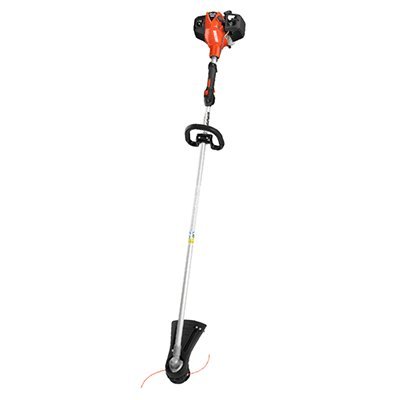
The Echo SRM-2620T carries a listed weight of 5.9 kg, which translates to roughly 13 pounds, and measures 48.00 by 48.00 by 48.00 inches in listed product dimensions. This added mass reflects commercial construction, including a robust straight shaft, metal gear housing, and a dedicated 25.4cc internal combustion engine. While commercial landscapers are accustomed to managing heavy equipment with shoulder harnesses, the weight difference is immediately noticeable when compared to a 7-pound cordless unit. For buyers comparing mid-weight outdoor tools, our analysis of the ryobi one+ 18v vs husqvarna 330lk highlights how weight shifts across different trimmer styles.
Precision handling also benefits from throttle control. The Ryobi P20180 features a variable speed trigger that allows the user to feather the motor speed when working near delicate siding, newly planted annuals, or fragile masonry. The Echo listing does not specify specialized trigger sensitivity beyond commercial throttle operation. For detailed work in tight residential yards, the featherweight Ryobi provides effortless control, while the Echo requires greater physical effort to maneuver through narrow spaces.
Edge: Ryobi ONE+ 18V wins easily for everyday handling thanks to its nimble 7-pound weight and variable speed trigger.
Cutting Swath and Line Feeding Systems
Line capacity, cutting swath, and feeding mechanisms determine how fast a trimmer clears ground and how frequently you must stop to deal with broken monofilament. The Ryobi ONE+ 18V gives operators dual-swath versatility with an adjustable cutting width of 11 inches to 13 inches. By adjusting the cutting swath to 11 inches, the motor experiences less drag, optimizing the 4.0 Ah battery for increased runtime. Expanding the swath to 13 inches widens the cut path to trim open spaces more rapidly. Furthermore, the Ryobi utilizes an auto-feed line head that automatically advances line whenever the user releases the trigger, completely eliminating the need to bump the tool against the lawn.
The Echo SRM-2620T features an Echo Speed Feed cutting head, also described in the listing as a quick-feed head. Although the Amazon listing does not specify the exact cutting swath width or line diameter compatibility for this model, commercial Speed Feed heads are renowned in the landscaping industry for lightning-fast reloading without disassembling the head assembly. This system allows commercial operators to feed replacement line straight through the eyelets and wind it using an external cap. Readers evaluating professional head designs will also appreciate our breakdown of the ego st1521s vs echo srm-2620t.
Regarding trimmer line sizes, the Ryobi listing explicitly confirms compatibility with .065-inch and .080-inch trimmer line. These gauges are ideal for slicing grass blades and common weeds without putting excessive strain on the 18V motor. However, lighter .065 line can snap when contacting concrete curbs or chain-link fences. While the auto-feed system advances line effortlessly, heavy clearing tasks benefit from heavier commercial line types typically found on gas equipment. For residential lawns, the Ryobi auto-feed system and adjustable 11 to 13-inch width deliver seamless convenience.
Edge: Ryobi ONE+ 18V provides an adjustable 11 to 13-inch cutting swath and an automatic release-to-feed system that eliminates manual head bumping.
Power Source, Maintenance, and Runtime
The choice between gas vs battery string trimmer operation impacts long-term maintenance, fueling procedures, and daily readiness. The Echo SRM-2620T runs on standard gasoline mixed for a two-stroke 25.4cc engine. The primary benefit of a gasoline power plant is continuous runtime: when the fuel tank runs dry, refueling takes less than a minute at the bed of a truck, allowing operators to work all day without pause. However, gas ownership involves regular maintenance, such as mixing two-cycle oil, replacing spark plugs, cleaning air filters, and draining carburetors before winter storage to prevent ethanol fouling. For readers asking is Echo SRM-2620T worth it, the trade-off of routine maintenance is offset by non-stop commercial utility.
The Ryobi ONE+ 18V operates on battery power, running off an included RYOBI 18-Volt 4.0 Ah lithium-ion battery pack and dedicated 18-Volt charger. The ONE+ battery platform delivers instantaneous push-button starting without pull cords, zero exhaust fumes, low operational noise, and absolutely no routine engine servicing. You never have to store fuel cans in your garage or clean gummy carburetors in the spring. Those looking at a Ryobi ONE+ 18V trimmer edger review will appreciate that the battery can also power hundreds of other tools within the Ryobi ONE+ ecosystem.
The trade-off for battery operation is limited runtime per charge. While the bundled 4.0 Ah pack delivers ample endurance for a standard suburban lawn, once the battery depletes, trimming must pause until the pack recharges on the included station. For multi-acre properties, a single battery may run short, whereas the Echo SRM-2620T high torque trimmer maintains limitless field endurance as long as fuel is on hand. Additional perspective on gas runtimes versus battery capacity can be found in our comparison of the ego st1623t vs echo srm-2620t.
Edge: Ryobi ONE+ 18V takes this category for residential users due to its zero-maintenance electric motor, included 4.0 Ah battery, and clean push-button starting.
Yard Versatility and Edging Capability
Yard tools that serve multiple functions save storage space and reduce the total number of tools required for complete lawn maintenance. The Ryobi ONE+ 18V features a specialized pivoting head that transforms the tool from a horizontal string trimmer into a vertical lawn edger. Using an integrated step-to-edge mechanism, the operator simply steps on the pivot joint to rotate the cutting head into an edging orientation. This feature allows homeowners to define clean borders along concrete walkways, driveways, and garden perimeters without buying a separate dedicated edger or straining their wrists trying to hold the trimmer sideways.
The Echo SRM-2620T is built purely as a dedicated straight-shaft commercial string trimmer. The listing does not specify any pivoting head, rotating collar, or integrated edging mechanisms. While skilled commercial operators frequently flip straight-shaft trimmers upside down to edge sidewalk borders by feathering the throttle, the machine provides no mechanical assistance, guide wheel, or rotating joint to support that technique. The Echo is designed specifically for high-production clearing and traditional trimming.
Furthermore, the Ryobi listing explicitly cites recommended uses including edging, portable use, lawn and garden maintenance, and trimming around delicate areas. The Echo listing lists general outdoor gardening and lawn maintenance. For homeowners wanting a dual-purpose landscaping tool that handles perimeter trimming and crisp driveway edging in one pass, the Ryobi provides purpose-built mechanics that the commercial Echo lacks. For further details on straight-shaft utility, see our guide on the echo srm-2620t vs husqvarna 330lk.
Edge: Ryobi ONE+ 18V wins with its step-to-edge pivoting head that quickly converts the string trimmer into a vertical sidewalk edger.
Pros and Cons
Ryobi ONE+ 18V

Pros
- Lightweight 7-pound chassis
- Pivoting head for quick edging
- Adjustable 11 to 13-inch swath
- Auto-feed line advancement
- Includes 4.0 Ah battery and charger
Cons
- Lower 5000 rpm top speed
- Runtime constrained by battery charge
- Not designed for heavy overgrowth
Echo SRM-2620T

Pros
- High-torque 25.4cc commercial gas engine
- Fast 6000 rpm operating speed
- Quick-loading Speed Feed head
- Unlimited runtime with fast gas refills
- Excels in heavy overgrowth and brush
Cons
- Heavier 5.9 kg tool weight
- Requires gas mixing and engine maintenance
- Listing does not specify edging capability
Who Should Buy Each One
Choose the Ryobi ONE+ 18V If
- You maintain a standard residential lawn and want a single 7-pound tool that handles perimeter trimming and sidewalk edging.
- You prefer clean battery power with push-button starting, avoiding gas mixing, carburetor maintenance, and exhaust fumes.
- You already own or plan to expand into the Ryobi ONE+ 18-volt interchangeable battery system.
- You need precise control and variable speed trimming around delicate garden beds, masonry, and wooden fences.
Choose the Echo SRM-2620T If
- You run commercial lawn care routes or maintain multi-acre properties requiring all-day runtime and rapid gas refueling.
- You regularly cut through dense, tangled overgrowth, tall weeds, and tough brush that demand 25.4cc high-torque power.
- You want a commercial 6000 rpm operating speed paired with an easy-to-load Speed Feed head.
- You require a rugged outdoor machine built for demanding environments where electrical outlets are unavailable.
Final Verdict
For the vast majority of homeowners deciding between the Ryobi ONE+ 18V or Echo SRM-2620T for yard work, the Ryobi ONE+ 18V is the smarter, more practical purchase. It eliminates the frustration of small engine maintenance, pull cords, and exhaust smoke while offering an exceptionally light 7-pound frame that anyone can handle comfortably. With its adjustable 11 to 13-inch cutting swath, auto-feed head, and step-to-edge pivoting design, the Ryobi bundles two essential residential lawn tools into a single, quiet cordless platform backed by an included 4.0 Ah battery and a 3-year warranty.
On the other hand, the Echo SRM-2620T remains the clear champion for commercial landscapers, farm owners, and operators facing aggressive wilderness growth. Its 25.4cc high-torque engine, 6000 rpm operating velocity, and commercial Speed Feed cutting head are purpose-built to withstand grueling work conditions that would overwhelm an 18-volt consumer battery unit. If your workload involves clearing overgrown fence rows or cutting continuously for hours on end, the Echo SRM-2620T delivers the raw power and commercial endurance needed to get the job done.
FAQ
Can the Ryobi ONE+ 18V handle thick brush like the Echo SRM-2620T?
No. The Ryobi ONE+ 18V is designed for routine residential lawn and garden maintenance, delicate trimming, and edging using .065-inch or .080-inch line at 5000 rpm. The Echo SRM-2620T features a 25.4cc high-torque commercial gas engine spinning at 6000 rpm, which delivers significantly greater power for cutting heavy weeds and dense brush.
How does the line feed mechanism compare between these two trimmers?
The Ryobi ONE+ 18V uses an auto-feed line head that automatically extends line each time the trigger is released, eliminating the need to bump the tool against the lawn. The Echo SRM-2620T includes a Speed Feed quick-feed head designed for fast, seamless line reloading without taking the head assembly apart.
Does the Echo SRM-2620T feature a built-in edger?
The Echo SRM-2620T listing does not specify any pivoting head or built-in edging mechanism. In contrast, the Ryobi ONE+ 18V is equipped with a step-to-edge mechanism and a pivoting head that rotates the cutting plane 90 degrees for sidewalk and driveway edging.
What comes in the box with the Ryobi ONE+ 18V?
The Ryobi ONE+ 18V string trimmer comes as a complete kit under model number P20180. It includes the cordless string trimmer and edger, one RYOBI 18-Volt 4.0 Ah lithium-ion battery, an 18-Volt charger, and is backed by a 3-year manufacturer warranty.
What are the weight differences between the Echo SRM-2620T vs Ryobi ONE+ 18V?
The Ryobi ONE+ 18V weighs 7 pounds, making it exceptionally lightweight and easy to control. The Echo SRM-2620T has a listed weight of 5.9 kg, which is roughly 13 pounds, reflecting its heavy-duty commercial gas engine and rugged construction.
Can I adjust the cutting width on both trimmers?
The Ryobi ONE+ 18V features an adjustable cutting width that lets you choose between an 11-inch swath for extended battery runtime or a 13-inch swath for wider clearing. The Echo SRM-2620T product listing does not specify an adjustable cutting width feature.