The single difference that decides the choice between these two moisture extractors is how you balance manual reservoir capacity against automated wireless control: the Frigidaire 50 Pint Dehumidifier provides an expansive 2.7-gallon internal collection tank that drastically reduces the frequency of manual bucket dumps, whereas the GE 50-Pint WiFi Smart Dehumidifier incorporates connected SmartHQ app scheduling, voice commands, and automated humidity-tracking sensors into a slimmer chassis.
Homeowners seeking a heavy-duty unit for unattended basements without floor drains should pick the Frigidaire for its larger holding capacity. Tech-minded buyers looking to adjust humidity levels remotely, receive filter cleaning alerts, or integrate climate monitoring into an automated home ecosystem should choose the GE.

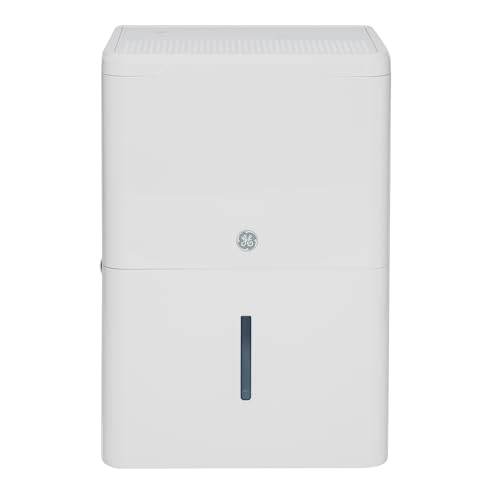
Frigidaire 50 Pint Dehumidifier vs GE 50-Pint WiFi Smart Dehumidifier at a Glance
| Feature | Frigidaire 50 Pint Dehumidifier | GE 50-Pint WiFi Smart Dehumidifier |
|---|---|---|
| Daily Moisture Removal | 50 pints per day | 50 pints per day |
| Coverage Area | 4,500 sq ft | 5,000 sq ft |
| Tank Capacity | 2.7 gallons (approx. 21.6 pints) | 15 pints (approx. 1.875 gallons) |
| Air Flow Capacity | 235 CFM | Not listed |
| Smart Controls | Programmable | SmartHQ app, Alexa, Google Assistant |
| Operating Speeds | 3 speeds | 3 speeds |
| Dimensions (D x W x H) | 12.19 x 24.25 x 24.25 inches | 11.4 x 14.4 x 24.1 inches |
| Item Weight | 44.5 pounds | 41.1 pounds |
| Wattage | 470 watts | Not listed |
| Continuous Drain Port | Yes | Yes |
| Best For | Fewer manual bucket empties | Smart home automation and tighter spaces |
Water Tank Capacity and Drainage Convenience
Water reservoir volume dictates how much manual labor a dehumidifier demands when operated away from a floor drain. The Frigidaire features a 2.7-gallon bucket, which equates to roughly 21.6 pints of water storage. By contrast, the GE model is equipped with a 15-pint collection bucket, holding approximately 1.875 gallons. In a high-humidity environment where a unit extracts close to its full 50-pint daily rating, the Frigidaire holds over 43 percent of a full day’s condensation before triggering an automatic shutoff. The GE bucket captures less than a third of its daily rating, requiring you to empty it more frequently throughout the day to prevent the machine from pausing operation.
Both models offer alternative water disposal mechanisms to bypass manual handling. Each appliance includes a continuous drain port, allowing you to attach a standard hose for gravity-assisted draining directly into a sump basin or floor drain. The GE includes specific safety mechanisms around its tank, such as a water level control switch that stops operation if the bucket is improperly seated, paired with a 10-second full bucket alert alarm. Frigidaire counters with functional bucket hardware, outfitting its front-loading bucket with an integrated carrying handle and a splash guard to minimize sloshing while walking to a sink. If your setup mirrors situations explored in our frigidaire 50 pint dehumidifier vs homelabs 4500 comparison, reservoir volume remains the deciding operational factor when continuous plumbing is not an option.
Ultimately, the Frigidaire vs GE 50 pint dehumidifier tank capacity matchup clearly favors the Frigidaire for manual drainage routines. While both machines shut down automatically when full to prevent messy overflows, the Frigidaire’s extra 6.6 pints of bucket volume translates to several hours of additional runtime between trips to the sink during peak summer humidity.
Edge: Frigidaire 50 Pint Dehumidifier, because its 2.7-gallon reservoir holds significantly more water than GE’s 15-pint bucket, cutting down manual emptying cycles.
Smart Connectivity and Automation Features
Smart capabilities separate modern climate appliances from traditional mechanical hardware. The GE 50-Pint WiFi Smart Dehumidifier includes integrated Wi-Fi that interfaces directly with the SmartHQ mobile application. Through this app, you can monitor ambient room conditions from anywhere, adjust the humidistat within a 30 to 70 percent range, set custom 24-hour schedules, and receive instant push notifications when the bucket is full or when the air filter requires washing. Furthermore, GE integrates with Amazon Alexa and Google Assistant, enabling hands-free voice commands to turn the unit on or alter operational modes.
The GE model also features Smart Dry technology, an automated system that monitors relative humidity levels and dynamically changes the fan speed. Instead of running on high continuously, Smart Dry steps down the fan speed as the room nears the target humidity threshold, which preserves energy and prevents excessive drying. Frigidaire includes programmable controls and custom humidity management on its interface, but its listing does not provide a dedicated smart ecosystem, third-party voice integration, or dynamic humidity-to-fan automated scaling.
For users asking is the GE 50-Pint WiFi Smart Dehumidifier worth it over standard programmable machines, the connected ecosystem provides substantial day-to-day convenience. The ability to verify basement moisture levels while away from home or run automated schedules during off-peak energy hours gives the GE a pronounced modern advantage.
Edge: GE 50-Pint WiFi Smart Dehumidifier, due to its comprehensive SmartHQ app integration, voice assistant compatibility, and automated Smart Dry technology.
Coverage Area and Moisture Removal Performance
Both appliances are rated by their manufacturers to extract 50 pints of water per day under standard testing conditions, making either unit a viable moisture extractor for domestic dampness. Where they diverge in their manufacturer specifications is their maximum rated coverage area. Frigidaire rates its appliance for areas up to 4,500 square feet, while GE certifies its unit for expansive residential zones up to 5,000 square feet. This 500-square-foot difference makes GE slightly more ambitious in its whole-home and open-concept claims.
Airflow handling determines how quickly a machine pulls damp air across its refrigerated coils. Frigidaire publishes an airflow capacity of 235 cubic feet per minute (CFM) across its 3-speed blower system, ensuring strong air exchange in stagnant crawlspaces or large basements. The GE listing confirms a 3-speed fan system but the listing does not specify its exact CFM rating. Frigidaire categorizes its operational mode as Standard continuous extraction, whereas GE describes its baseline operation as Intermittent, which cycles components according to target thresholds to manage run intervals.
When choosing a Frigidaire or GE 50 pint dehumidifier for basement moisture or evaluating a Frigidaire 50 pint or GE 50 pint dehumidifier for large room humidity, both machines provide the required 50-pint daily extraction muscle. Similar to points raised in our frigidaire 50 pint dehumidifier vs midea cube 50 review, coverage claims above 4,000 square feet are well-suited for sprawling open basements, though GE claims a slightly larger operational boundary.
Edge: GE 50-Pint WiFi Smart Dehumidifier, thanks to its higher manufacturer coverage rating of 5,000 square feet compared to Frigidaire’s 4,500 square feet.
Physical Footprint, Weight, and Portability
The exterior architecture of these two dehumidifiers reveals substantial differences in layout and ease of movement. The Frigidaire presents a wide, square-like cabinet measuring 12.19 inches deep, 24.25 inches wide, and 24.25 inches high, weighing in at 44.5 pounds. Its 24.25-inch width accommodates the broad 2.7-gallon front-loading tank, but it also means the unit demands considerable horizontal floor space along walls or between storage shelving.
In contrast, the GE unit uses a much narrower, tower-oriented profile measuring 11.4 inches deep, 14.4 inches wide, and 24.1 inches high, with a total weight of 41.1 pounds. At almost ten inches narrower than the Frigidaire, the GE fits far more comfortably into tight utility alcoves, compact laundry rooms, or small basement corners. Moving the GE between floors or rooms is also significantly easier, as the manufacturer equips the chassis with integrated pocket handles and 360-degree easy-roll caster wheels designed for multi-directional transport.
In our broader evaluations, including the homelabs 4500 vs ge 50-pint wifi smart dehumidifier breakdown, vertical form factors consistently prove more versatile for residential living spaces. The GE saves floor area and sheds over three pounds compared to the Frigidaire, making it the more maneuverable appliance.
Edge: GE 50-Pint WiFi Smart Dehumidifier, because its chassis is nearly ten inches narrower, three pounds lighter, and features 360-degree caster wheels.
Operating Controls, Power, and Maintenance
Day-to-day operation requires regular filter maintenance and responsive control interfaces. Frigidaire provides an easy-to-clean washable filter engineered to trap airborne dust while moisture is extracted. Keeping this filter clear maintains the unit’s 235 CFM airflow and preserves mechanical efficiency. Frigidaire specifies a power draw of 470 watts running on standard 115-volt residential circuits. For control adjustments, users rely on custom digital humidity selections directly on the unit’s physical control deck.
GE also employs a washable, reusable filter, but enhances maintenance by integrating an automated filter clean alert that notifies you when airflow is becoming restricted. GE features an adjustable digital humidistat displaying current room readings alongside target settings between 30 and 70 percent relative humidity. Additionally, GE builds in specialized operational protections, including an auto defrost mode that actively melts frost off internal coils during cool-weather basement operation, and an auto restart function that restores your previous settings immediately following a power failure. The GE listing does not specify its wattage consumption.
Shoppers frequently investigate the Frigidaire 50 pint vs GE smart dehumidifier noise level before making a purchase. However, the listing does not specify decibel ratings for either product. Both utilize 3-speed fans and refrigeration compressors, meaning sound output varies primarily by the selected fan speed rather than differing design technology. For general maintenance and utility reliability, as noted across our ge 50-pint wifi smart dehumidifier vs vremi midea 22 analysis, automated filter reminders and defrost cycles minimize guesswork for the user.
Edge: GE 50-Pint WiFi Smart Dehumidifier, owing to its automated filter notification, auto defrost feature, auto restart recovery, and precise digital humidistat.
Pros and Cons
Frigidaire 50 Pint Dehumidifier

Pros
- Large 2.7-gallon water collection tank
- High airflow rating of 235 CFM
- Built-in splash guard and carry handle
- Washable dust-capturing air filter
- Continuous draining support
Cons
- Significantly wider chassis at 24.25 inches
- Lacks mobile app remote connectivity
- Heavier cabinet design at 44.5 pounds
View Frigidaire 50 Pint Dehumidifier on Amazon
GE 50-Pint WiFi Smart Dehumidifier

Pros
- SmartHQ app and voice assistant control
- Smart Dry automated fan speed adjustment
- Covers larger spaces up to 5000 square feet
- Slimmer footprint at 14.4 inches wide
- Filter cleaning alert notification
Cons
- Smaller 15-pint water tank capacity
- Requires more frequent manual bucket emptying
- Wattage draw not listed by manufacturer
View GE 50-Pint WiFi Smart Dehumidifier on Amazon
Who Should Buy Each One
Choose the Frigidaire 50 Pint Dehumidifier If
- You rely on manual tank emptying and need the largest possible water reservoir (2.7 gallons).
- You prefer a front-loading bucket complete with an ergonomic carrying handle and splash guard.
- You want a confirmed high-volume airflow rating of 235 CFM to circulate air throughout open rooms.
- You prefer straightforward on-device programmable controls without setting up mobile apps or Wi-Fi networks.
Choose the GE 50-Pint WiFi Smart Dehumidifier If
- You want to monitor humidity levels and adjust schedules remotely via the SmartHQ smartphone app.
- You use Alexa or Google Assistant voice commands to control indoor climate appliances.
- You have limited floor space and need a slim machine measuring under 15 inches wide.
- You operate your dehumidifier in cooler basements where auto defrost protection is necessary.
Final Verdict
When weighing the Frigidaire vs GE 50 pint dehumidifier options, your decision comes down to physical capacity versus digital control. The Frigidaire 50 Pint Dehumidifier stands out primarily for its massive 2.7-gallon bucket. Holding roughly 21.6 pints of water, it significantly reduces the chore of manual bucket emptying compared to typical dehumidifiers. If you plan to place your machine in an unfinished basement or remote area without continuous drainage plumbing, Frigidaire’s spacious reservoir and splash-guarded bucket provide tangible everyday value that smart software cannot replace.
However, for most homeowners, the GE 50-Pint WiFi Smart Dehumidifier is the superior overall purchase. It delivers the same 50-pint moisture extraction capability while covering a larger 5,000-square-foot footprint from a considerably more compact cabinet. With SmartHQ mobile monitoring, smart home voice controls, Smart Dry automated fan speeds, auto defrost protection, and filter cleaning alerts, the GE model automates the entire dehumidification process. Unless you strictly require Frigidaire’s oversized water bucket, the GE provides better spatial flexibility and modern convenience.
FAQ
Which model has the larger water bucket capacity?
The Frigidaire model has the larger tank, offering a 2.7-gallon capacity (approximately 21.6 pints). The GE unit features a 15-pint capacity bucket (approximately 1.875 gallons), which means the GE requires more frequent emptying if you are not using continuous drainage.
Can both of these dehumidifiers run on continuous drainage?
Yes, both units feature continuous drain connections. You can attach a standard drainage hose to either appliance to route extracted water directly to a floor drain or sump pump, eliminating the need to empty their internal buckets manually.
Does the Frigidaire dehumidifier have smart app control?
The Frigidaire listing specifies programmable custom humidity control, but it does not detail full mobile app management or voice assistant integration. The GE dehumidifier includes built-in Wi-Fi that fully connects to the SmartHQ mobile app, Alexa, and Google Assistant.
What is the noise level of the Frigidaire 50 pint vs GE smart dehumidifier?
The manufacturer listings do not specify decibel ratings for either model. Both units feature 3-speed fans and standard compressor refrigeration systems, so operating sound will primarily depend on whether you run them on low, medium, or high fan settings.
How do the coverage areas compare between the two units?
The GE model is rated for spaces up to 5,000 square feet, while the Frigidaire model is rated for spaces up to 4,500 square feet. Both units are designed to pull up to 50 pints of moisture per day from the air.
How do the air filters work on these dehumidifiers?
Both dehumidifiers utilize washable, reusable air filters designed to trap dust and maintain internal operating efficiency. The GE model includes a digital filter alert that notifies you when it is time to remove and clean the filter, whereas the Frigidaire requires manual routine inspection.
Which unit is easier to move between rooms?
The GE dehumidifier is easier to transport because it weighs 41.1 pounds (over three pounds lighter than the Frigidaire), features a narrower 14.4-inch width, and includes built-in pocket handles alongside 360-degree easy-roll caster wheels.


