The core factor separating the DeWalt DCF787 and the DeWalt DCF845 is transmission design: the DCF845 provides a three-speed selector switch capable of reaching 3,400 RPM and 1,825 in-lbs of torque, whereas the DCF787 relies on a single-speed drivetrain topping out at 2,800 RPM and 1,500 in-lbs of torque.
Homeowners seeking an all-in-one kit with an included battery and charger should choose the DeWalt DCF787. Trade professionals and woodworkers demanding top-tier driving speeds, shadow-free lighting, and multi-speed precision should invest in the DeWalt DCF845.
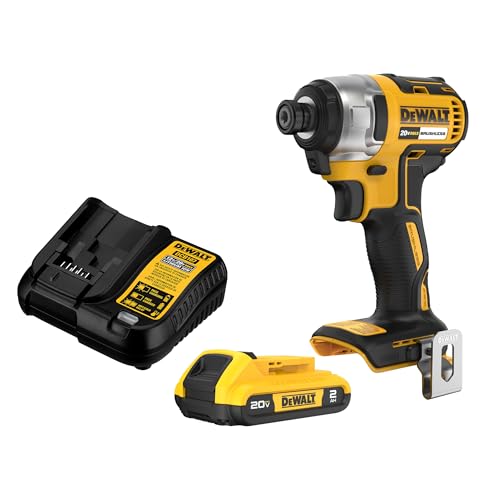

DeWalt DCF787 vs DeWalt DCF845 at a Glance
| Feature | DeWalt DCF787 | DeWalt DCF845 |
|---|---|---|
| Motor Type | Brushless | Brushless |
| Maximum Torque | 1,500 in-lbs | 1,825 in-lbs |
| Maximum Rotational Speed | 2,800 RPM | 3,400 RPM |
| Speed Modes | 1 speed (variable trigger) | 3 speeds (variable trigger) |
| Work Light | Single LED with 20-second delay | 3-LED integrated halo ring |
| Collet Size | 1/4-inch hex | 1/4-inch hex |
| Power Output | 300 Watts | 300 Watts |
| Digital Asset Tracking | Not listed | Tool Connect Chip Ready pocket |
| Included Equipment | 2.0Ah battery, charger, belt hook | Belt hook (bare tool only) |
| Best For | General household upkeep and DIY builds | Heavy-duty framing, decking, and professional trade work |
Torque and Fastening Power
Torque determines the rotational force an impact driver applies to overcome high-friction fastening resistance. In structural carpentry, timber framing, and subfloor construction, higher torque values prevent fasteners from binding halfway into dense lumber and minimize the physical strain placed on the motor. When examining the dewalt dcf787 vs dcf845 torque ratings, the specification gap reveals two distinct classes of fastening capability. The DCF787 delivers a factory rating of 1,500 in-lbs of rotational force, while the DCF845 produces 1,825 in-lbs, representing an increase of 325 in-lbs or nearly 22 percent more twisting force.
In routine fastening scenarios like driving standard drywall screws or installing interior door hinges, both tools exhibit ample power to seat fasteners flush. However, pushing into dense southern yellow pine or driving six-inch structural lag screws quickly exposes the ceiling of the DCF787. The DCF845 relies on its upgraded motor architecture to sustain consistent driving momentum without stalling, allowing long hardware to draw down tight against framing timbers. For builders who often explore comparisons like the dewalt dcf787 vs dcf887, moving up to the DCF845 provides the same industrial-grade torque profile necessary to complete demanding structural fasteners without bogging down.
While the extra 325 in-lbs on the DCF845 grants immense mechanical headroom, it also demands greater user attentiveness when dealing with softer workpieces. Over-torquing can easily strip out pilot holes in soft pine or sheer off smaller brass cabinet screws. Fortunately, the mechanical advantages of the DCF845 ensure that when tough fasteners are on the agenda, you will not find yourself switching to an impact wrench or ratchet to finish sinking the head.
Edge: DeWalt DCF845 because its 1,825 in-lbs of torque supplies the necessary muscle to drive large structural screws and dense lag bolts without stalling.
Operating Speed and Production Efficiency
Rotational speed, measured in revolutions per minute, directly governs the time required to seat each screw. On large-scale installations such as hanging dozens of drywall sheets, assembling hundreds of linear feet of privacy fencing, or securing extensive deck boards, speed differences compound rapidly. Comparing dewalt dcf845 rpm vs dcf787 performance illustrates a noticeable gulf in production capability: the DCF845 operates at a maximum rotational speed of 3,400 RPM, whereas the DCF787 reaches a ceiling of 2,800 RPM.
That 600 RPM surplus grants the DCF845 a decisive edge during prolonged, repetitive tasks. When driving hundreds of three-inch decking fasteners back to back, the DCF845 spins the fastener into the wood fiber significantly quicker per cycle. The tool impacts with higher frequency, allowing users to move fluidly from one joist bay to the next. In an intensive dewalt dcf845 review, this high-speed capacity stands out as one of its most productive workflow upgrades over earlier generation brushless models.
The DCF787 still turns faster than standard non-impact drill-drivers, and its 2,800 RPM maximum offers dependable pacing for light-to-medium residential tasks. Yet, when faced with high-volume assembly line work, the difference in pacing is tangible. The DCF845 finishes screw-driving passes faster, keeping user fatigue low by shortening the duration of downward pressure required for each individual screw.
Edge: DeWalt DCF845 due to its 3,400 RPM top speed, which saves considerable time during high-volume fastening jobs.
Speed Settings and Precision Control
Raw power requires reliable regulation, particularly when shifting between heavy structural driving and delicate assembly work. The dcf787 vs dcf845 speed settings mark the single greatest ergonomic difference in everyday operation. The DCF845 incorporates an electronic 3-speed selector switch on its base, complemented by a variable-speed trigger. In contrast, the DCF787 is a dedicated single-speed tool, relying entirely on the operator’s trigger finger to modulate RPM and torque delivery.
Having dedicated speed modes on the DCF845 changes the entire handling dynamic. Setting the tool to Mode 1 restricts both RPM and torque output, making it virtually impossible to overdrive cabinet hardware, strip small machine screws, or warp thin sheet metal. Mode 2 provides a balanced middle tier suitable for general carpentry and electrical rough-ins, while Mode 3 unleashes the full 3,400 RPM and 1,825 in-lbs for maximum driving power. This modular control answers the frequent buyer query of dewalt dcf845 vs dcf887 shoppers asking is dewalt dcf845 worth it for delicate cabinetry alongside heavy framing.
The DCF787 can technically handle smaller fasteners, but doing so requires continuous feathering of the trigger. Maintaining that delicate trigger hold while working overhead or in awkward orientations can cause hand cramps, and a brief slip of pressure can overdrive a fastener through drywall paper or crack delicate trim lumber. For fine woodworking or maintenance involving varied fastener dimensions, the mechanical speed management on the DCF845 is far superior.
Edge: DeWalt DCF845 because its 3-speed mechanical selector provides dedicated speed gates to safeguard delicate hardware and small fasteners.
Workplace Illumination and Visibility
Impact drivers frequently operate in poorly lit corners, deep inside utility cabinets, beneath floor joists, or within dark stud cavities. Effective onboard lighting prevents cam-out, reduces cross-threading, and eliminates the hassle of balancing an auxiliary flashlight while positioning a screw tip. The lighting hardware implemented on the dewalt 20v impact driver dcf787 vs dcf845 highlights another generational hardware division.
The DCF845 features an integrated 3-LED work light arranged in a triangular halo pattern directly around the 1/4-inch hex chuck. This ring configuration illuminates the workpiece from multiple angles simultaneously, virtually wiping out the triangular shadow that single-bulb setups cast over the screw bit. Whether driving deep pocket screws or fastening junction boxes in dim basements, the illumination remains crisp, bright, and centered directly on the fastener head, much like the visibility praised in comparisons like the dewalt dcf845 vs dcf850.
On the DCF787, illumination comes from a single LED mounted above the battery base, equipped with a 20-second delay after trigger release. While the 20-second delay is convenient for inspecting finished work, the single-point light source inevitably casts an elongated shadow upward across the fastener tip when an extension bit or wide socket is mounted. While adequate for broad garage tasks, it lacks the surgical clarity provided by the three-diode nosecone assembly found on the DCF845.
Edge: DeWalt DCF845 because its 3-LED halo array encircles the collet to deliver bright, shadow-free illumination right at the fastener tip.
Kit Completeness, Build Design, and Asset Management
A tool’s real-world utility also depends on what arrives inside the packaging and how the tool integrates into a broader tool collection. When conducting a dewalt dcf787 review, the primary selling point is that the DCF787D1 comes as a complete, functional kit. It includes the DCF787 impact driver, a DCB203 20V MAX 2.0Ah lithium-ion battery, a DCB107 charger, and a belt hook. You can unpack the carton, plug in the charger, and immediately start driving screws without sourcing supplementary power equipment.
Conversely, the DCF845 model covered here (DCF845B) is sold as a bare tool, supplying only the driver and a belt clip. To utilize the tool, you must already own DeWalt 20V MAX batteries and a compatible charger, or buy them as separate line items. For seasoned contractors already running DeWalt tools, bare-tool acquisitions represent an efficient way to expand capability without accumulating redundant chargers. However, for a beginner or DIY homeowner starting from scratch, purchasing a bare driver can be an unwelcome surprise.
Looking at commercial features, the DCF845 incorporates a dedicated Tool Connect Chip pocket directly inside the foot of the housing. This slot accommodates DeWalt’s Tool Connect Chip (sold separately), allowing commercial crews to log tool diagnostics, track tool locations across worksites, and mitigate jobsite theft. Those deciding whether to select the dewalt dcf787 vs dcf809 or step up to the DCF845 will find that the DCF787 completely lacks Tool Connect integration, sticking purely to a stripped-down, analog housing. If jobsite inventory tracking matters, the DCF845 is prepared for digital fleet management.
Edge: DeWalt DCF787 because it ships as an all-inclusive kit with an authentic 20V MAX battery and charger ready for immediate use.
Pros and Cons
DeWalt DCF787

Pros
- Includes 20V MAX battery and charger
- Compact and lightweight design
- Reliable brushless motor
- LED light with 20-second delay
Cons
- Single speed setting only
- Lower 1,500 in-lb torque output
- Single LED casts bit shadow
DeWalt DCF845

Pros
- High 1,825 in-lb torque output
- Fast 3,400 RPM driving speed
- Versatile 3-speed selector switch
- Shadow-free 3-LED halo light
- Tool Connect Chip Ready pocket
Cons
- Sold as bare tool without battery
- Requires battery purchase if starting fresh
Who Should Buy Each One
Choose the DeWalt DCF787 If
- You need a complete kit containing a 20V MAX battery and charger out of the box.
- Your primary projects involve routine household repairs, flat-pack furniture, and light DIY builds.
- You prefer a simple, single-speed tool without needing to adjust selector switches on the base.
- You rarely drive heavy structural lag bolts or wide-diameter timber screws.
Choose the DeWalt DCF845 If
- You regularly tackle structural framing, decking, or heavy-duty construction requiring 1,825 in-lbs of torque.
- You demand the fast productivity of a 3,400 RPM drivetrain for repetitive, high-volume fastening.
- You require three mechanical speed settings to safely seat delicate trim screws without stripping workpieces.
- You already own DeWalt 20V MAX batteries and want Tool Connect tracking capability on commercial job sites.
Final Verdict
When assessing overall mechanical capability, the DeWalt DCF845 stands out as the superior impact driver. Its brushless motor generates 1,825 in-lbs of torque and 3,400 RPM, giving it a measurable performance edge over the DCF787 across tough construction tasks. Furthermore, the inclusion of a 3-speed selector switch, a shadow-reducing 3-LED halo light, and a Tool Connect Chip pocket equips the DCF845 with the precision, visibility, and modern jobsite features required for diverse fastening jobs. For experienced woodworkers, builders, and tradespeople who already own 20V MAX batteries, the DCF845 is the obvious technical upgrade.
However, the DeWalt DCF787 remains an excellent, sensible choice for general homeowners and casual hobbyists. Because it is sold as a complete kit containing a 20V MAX battery and dedicated charger, it offers unmatched simplicity for anyone starting out without existing cordless gear. Delivering 1,500 in-lbs of torque and a reliable 2,800 RPM brushless drivetrain, the DCF787 provides more than enough power to assemble furniture, repair fencing, and handle routine DIY maintenance without requiring external accessories.
FAQ
What is the difference in torque between the DeWalt DCF787 and DCF845?
The DCF845 delivers 1,825 in-lbs of maximum torque, whereas the DCF787 generates 1,500 in-lbs. This gives the DCF845 an extra 325 in-lbs of twisting power, making it better suited for sinking heavy structural screws and long lag bolts into dense construction lumber.
Does the DeWalt DCF787 feature multiple speed settings?
No, the DCF787 operates on a single mechanical speed setting that tops out at 2,800 RPM. While it features a variable-speed trigger allowing you to control speed by altering finger pressure, it lacks the dedicated 3-speed electronic selector switch found on the base of the DCF845.
Can both impact drivers use any DeWalt 20V MAX battery?
Yes, both the DCF787 and DCF845 belong to the DeWalt 20V MAX system. They are fully cross-compatible with all DeWalt 20V MAX lithium-ion battery packs, ranging from compact 1.5Ah and 2.0Ah batteries up to high-capacity extended-runtime options.
How does the LED lighting differ between these two models?
The DCF845 features an integrated 3-LED halo array situated around the collet, providing balanced illumination that prevents the bit from casting shadows on the work area. The DCF787 features a single LED light mounted lower on the tool body, which includes a 20-second shutoff delay after the trigger is released.
Is the DeWalt DCF845 suitable for delicate fastening jobs?
Yes, the DCF845 is exceptionally well-suited for delicate fastening tasks because of its 3-speed transmission. When shifted into Mode 1, the driver restricts motor output to prevent over-driving, head shearing, and thread stripping on smaller wood and machine screws.
Does the DeWalt DCF845 come with a battery and charger?
The DCF845 model listed here (DCF845B) is sold as a bare tool only and includes a belt hook, but does not include a battery or charger. In contrast, the DCF787 (DCF787D1) comes as a complete kit with an included 20V MAX 2.0Ah battery and charger.
What does Tool Connect Chip Ready mean on the DCF845?
Tool Connect Chip Ready means the DCF845 has a dedicated internal housing slot designed to accept an optional DeWalt Tool Connect Chip. When installed, this chip links the driver to DeWalt’s mobile inventory app, allowing jobsite managers to track tool presence and monitor equipment across busy worksites.


