The choice between a circular saw and a miter saw comes down to handheld mobility versus stationary precision. A circular saw moves freely across workpieces to rip full plywood panels and trim framing lumber on the fly, while a miter saw sits on a fixed base to deliver rapid, dead-accurate crosscuts and angled joinery.
Choose a circular saw if you need an adaptable, portable cutting tool to break down large sheet goods, frame structures, and tackle outdoor building projects. Choose a miter saw if your work revolves around trim carpentry, crown molding, picture framing, and making dozens of identical square or angled crosscuts with zero guesswork.



Circular Saw vs Miter Saw at a Glance
| Attribute | Circular Saw | Miter Saw |
|---|---|---|
| Tool Style | Handheld linear saw | Stationary benchtop chop/compound saw |
| Primary Cut Types | Rip cuts, long crosscuts, plunge cuts, bevels | Crosscuts, miter cuts, compound bevel cuts |
| Typical Tool Weight | 7 to 8.7 lbs (Skil models) | 24.2 to 30 lbs (Metabo HPT, DEWALT models) |
| Power Configurations | 13-Amp to 15-Amp corded electric | 15-Amp corded electric or 20V Max cordless |
| Standard Blade Diameters | 7-1/4 inches | 7-1/4 inches to 10 inches |
| Bevel Capacity | Up to 51° with 45° stop | 0° to 45° left bevel |
| Miter Range | Not listed (requires manual angle guide) | 0° to 52° left and right |
| Material Support Method | Rests directly on workpiece face | Machined aluminum base table with fence and clamp |
| Best For | Ripping sheet goods, framing, and mobile construction | Trim carpentry, picture frames, and repeatable angled cuts |
Cutting Versatility and Material Capacity
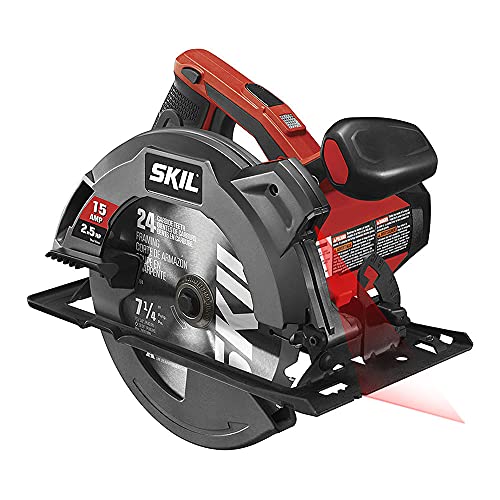
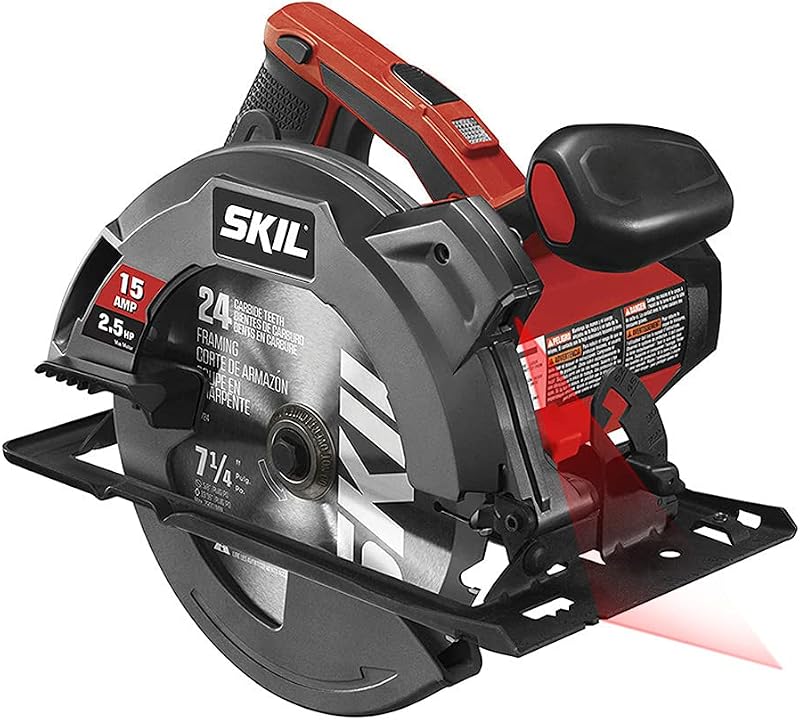
Material capacity is the single biggest operational divide when comparing a miter saw vs circular saw. A handheld circular saw has virtually unlimited length capacity because the tool travels over the material. Whether you are ripping an eight-foot sheet of plywood down the center or trimming subfloor edges, the circular saw glides smoothly along the workpiece. The SKIL 5280-01 exemplifies this versatility with a 15-Amp motor producing 5,300 RPM, designed specifically to cut lumber and broad sheet goods for home additions and decks. Similarly, the Skil 5080-01 utilizes a 13-Amp motor that easily slices through shelving boards and sheet stock that would never physically fit across a standard miter saw table.
A miter saw is inherently limited by its mechanical throat and blade diameter. A standard 10-inch stationary model like the Metabo HPT C10FCG2 relies on bringing the spinning blade down onto a fixed workpiece supported by its integrated table. While it provides exceptional stability, it cannot make rip cuts along the length of a board. A cordless model like the DEWALT DCS361B provides specialized vertical capacity, handling up to 3-5/8-inch nested crown molding and 3-1/2-inch baseboard held vertically against its fence. DEWALT notes that this tool delivers roughly 183 cuts of 2×4 pine or 275 cuts of 3-1/4-inch pine baseboard per battery charge, making it a crosscutting powerhouse, yet entirely incapable of processing a four-by-eight-foot panel.
When evaluating a circular saw vs miter saw crosscut, the miter saw is strictly faster and cleaner on narrow boards, but the circular saw handles both crosscuts and continuous rip cuts. If your work demands slicing wide panels, cutting dimensional lumber to length outdoors, or trimming sheet goods on sawhorses, a circular saw provides unmatched functional range.
Edge: Circular saw, because it handles both continuous rip cuts on wide sheet goods and crosscuts, whereas a miter saw cannot perform rip cuts.
Accuracy, Repeatability, and Bevel Range
When craftsmen evaluate circular saw vs miter saw accuracy, the miter saw is the undisputed leader. A miter saw eliminates human wobble by locking the cutting head into a rigid pivot arm mounted to a heavy machined base. The DEWALT DCS361B features an adjustable stainless steel miter detent plate with 11 positive stops, a cam lock handle, and an integrated cut line cross-cut positioning system that projects an adjustment-free cut indicator. Similarly, the Metabo HPT C10FCG2 incorporates an improved miter scale adjustable from 0 to 52 degrees left and right, an adjustable 0 to 45-degree bevel range, an Xact Cut shadow line system, and a dedicated vice clamping system that physically locks the workpiece against the fence.
Circular saws can produce clean, accurate cuts, but precision depends heavily on the operator’s steady hands and visual tracking. The SKIL 5280-01 improves cut line tracking with a single-beam laser guide and an integrated dust blower that clears sawdust ahead of the blade. It also includes an extended 51-degree bevel capacity with a positive stop at 45 degrees. The lighter Skil 5080-01 also provides a 51-degree bevel range with positive stops and an on-tool dust blower. However, neither circular saw features a fixed fence, clamping vice, or detent plate. You must measure, mark, and guide every single cut manually or clamp an auxiliary straightedge to your material.
If you are assembling cabinet face frames, baseboard corners, or intricate molding joints where a fraction of a degree creates an unsightly gap, the miter saw delivers effortless, repeatable perfection. While reading a detailed milwaukee 2730-20 vs makita xsh04z comparison shows how modern handheld saws push the limits of tracking accuracy, nothing matches the fixed fence and mechanical detents of a miter station.
Edge: Miter saw, thanks to machined fences, positive angle detents, workpiece clamping vices, and rigid mechanical blade arms that guarantee repeatable cuts.
Portability, Weight, and Jobsite Mobility
Portability represents one of the sharpest contrasts between these two tool categories. Handheld circular saws are engineered to go wherever the carpenter climbs, balances, or walks. The Skil 5080-01 weighs just 7 pounds, boasting a 15 percent weight reduction over earlier generation tools to minimize user fatigue during overhead or prolonged cutting. Even the more robust, feature-packed SKIL 5280-01 weighs only 8.7 pounds and measures a compact 8.75 inches long by 10.75 inches wide. You can carry either saw in one hand, stash it inside a standard tool bag, or take it up a ladder to trim rafter tails without hassle.
Miter saws, even those marketed as compact or lightweight, represent substantial benchtop machinery. The Metabo HPT C10FCG2 weighs 24.2 pounds and occupies a footprint of 23.6 inches long, 18.3 inches wide, and 21.8 inches tall. The cordless DEWALT DCS361B comes in at 30 pounds (13,608 grams) with overall dimensions of 25.35 inches by 21 inches by 16.1 inches. Transporting a 24 to 30-pound machine requires two hands, dedicated vehicle cargo room, and a sturdy table, stand, or level patch of ground before you can cycle the blade.
For mobile builders moving around a jobsite or hobbyists working in a cramped garage where every square foot counts, a circular saw can be stowed on a high shelf or hung from a rafter. Those comparing cordless options often weigh tools like the dewalt dcs391 vs milwaukee 2730-20 precisely because handheld mobility remains paramount when framing remote structures or working without workbench space.
Edge: Circular saw, as its 7 to 8.7-pound weight and handheld profile easily beat the 24 to 30-pound footprint of a miter saw.
Framing vs Finish Work Applications
Evaluating circular saw or miter saw for framing highlights two distinct workflows. On a residential framing site, carpenters use circular saws to cut wall studs, gang-cut floor joists, slice exterior OSB sheathing, and trim rafter angles right on the structure. The Skil models, equipped with aggressive 18-tooth and 24-tooth carbide blades, chew through framing lumber at 5,300 RPM. A miter saw set up on a mobile stand can speed up square cuts on wall studs, but it cannot cut sheathing or notch joists. For true rough construction, a circular saw is mandatory, while a miter saw is a convenient luxury.
The calculation completely flips for interior finish carpentry, trim, and cabinetry. Installing baseboards, chair rails, door jambs, and crown molding requires tight joint fits at varying miter and bevel angles. The DEWALT DCS361B comes equipped with an 80-tooth blade and dedicated bevel scales, engineered specifically to prevent grain tear-out on delicate pine and hardwood molding. The Metabo HPT C10FCG2 offers a 40-tooth tungsten carbide blade, providing clean, smooth crosscuts on trim pieces right out of the box. Attempting to cut delicate 45-degree trim angles freehand with an 18-tooth blade on a circular saw inevitably leads to splintered ends and misaligned corner joints.
Anyone wondering is a miter saw worth it must evaluate how much time they spend on visible finish joints versus hidden rough framing. Professional woodworkers often research dedicated chop saws, examining matchups like the dewalt dws715 vs dhs790 or the heavy-duty dewalt dws779 vs dhs790 to secure unmatched trim accuracy. However, across structural and finish projects as a whole, neither tool can completely replicate the specialty of the other.
Edge: Tie, because circular saws dominate rough framing and structural building, while miter saws dominate finished trim and fine joinery.
Ease of Use and Safety for Beginners
When evaluating a circular saw or miter saw for beginners, the user experience differs dramatically in stability and workpiece control. Operating a miter saw feels inherently secure because the tool remains bolted to a stationary surface. The user places the workpiece against a fixed metal fence, engages a vice clamp-such as the material clamps supplied with the Metabo HPT C10FCG2 and DEWALT DCS361B-and keeps both hands clear of the blade path while pulling a downward handle. The integrated cut-line indicator on the DEWALT or the shadow line system on the Metabo HPT shows exactly where the blade will make contact before the motor even spins.
A circular saw requires considerably more physical coordination, workpiece preparation, and situational awareness. Because the tool moves across the wood, the operator must support the cut-off piece properly to prevent blade pinching, which can trigger dangerous tool kickback. Managing a circular saw requires the user to follow a pencil line manually, balance the base plate flat on the stock, and hold a steady forward pace. Safety features help mitigate these challenges; the SKIL 5280-01 includes a guarded trigger, a safety lock, a power-on indicator light, and an integrated dust blower to ensure the cut line remains visible. The Skil 5080-01 adds a spindle lock for fast, safe blade changes with the on-board wrench.
Despite these smart safety implementations, a circular saw still demands strict attention to blade depth settings, grip pressure, and cut paths. For a complete novice building basic birdhouses or cutting small craft boards, a miter saw provides a far more controlled introduction to power tool woodworking.
Edge: Miter saw, because the workpiece clamps securely against a fixed table and fence, eliminating freehand kickback hazards and difficult workpiece balancing.
Pros and Cons
Circular Saw
Pros
- Rips broad sheet goods and panels
- Weighs under 9 pounds for extreme portability
- 51-degree bevel capacity with positive stops
- High blade speeds up to 5,300 RPM
Cons
- Requires steady manual guidance for straight lines
- Difficult to repeat precise angle cuts quickly
View SKIL 15 Amp 7-1 4 Inch on Amazon
Miter Saw

Pros
- Mechanical miter detents ensure repeatable precision
- Integrated clamp and fence secure workpieces safely
- High-tooth blades deliver clean finish cuts
- Cut-line and shadow systems indicate exact kerf
Cons
- Bulky benchtop footprint up to 30 pounds
- Cannot perform rip cuts on long boards
View Metabo HPT 10-Inch Compound Miter Saw on Amazon
Who Should Buy Each One
Choose the circular saw If
- You regularly cut large 4×8-foot sheet goods such as plywood, OSB, and MDF panels that cannot fit onto a miter saw table.
- You need an ultra-portable tool weighing under 9 pounds that you can carry up ladders, across framing, or between outdoor jobsites.
- You are managing rough construction tasks like building an outdoor deck, framing walls, or notching rafters.
- You want a single, budget-conscious cutting tool capable of executing both rip cuts along the grain and crosscuts across boards.
Choose the miter saw If
- You specialize in interior finish carpentry, including crown molding, baseboards, window casings, and door trim.
- You need to make dozens of identical, highly accurate crosscuts with positive angle detents and zero manual layout lines.
- You prioritize stationary stability, clamp-down workpiece safety, and high-tooth finish blades for tear-out-free cuts.
- You have a dedicated workshop bench or jobsite stand capable of housing a 24 to 30-pound stationary tool.
Final Verdict
If you can only purchase one cutting tool to start building, the circular saw is the practical choice for most general DIYers and outdoor builders. Its ability to rip wide sheet goods, trim dimensional lumber, make bevel cuts up to 51 degrees, and travel effortlessly in a lightweight package makes it unmatched in overall cutting utility. As seen on models like the SKIL 5280-01 and Skil 5080-01, modern circular saws supply ample power and laser or blower guides that bridge the gap between rough framing and everyday home workshop repairs.
However, the miter saw wins hands-down the moment precision, speed, and clean joinery take priority. Tools like the Metabo HPT C10FCG2 and DEWALT DCS361B turn complex miter and compound cuts into effortless, repeatable tasks that no handheld circular saw can match. If your woodworking revolves around trim carpentry, furniture building, picture framing, or extensive decking crosscuts where exact 90-degree and 45-degree angles make or break the final product, investing in a dedicated miter saw is well worth the footprint.
FAQ
Can a circular saw replace a miter saw for DIY projects?
A circular saw can handle almost any cut a miter saw makes, provided you use an auxiliary guide or speed square to direct the base plate. While it takes more time to measure, clamp a straightedge, and line up each angle manually, a circular saw can execute crosscuts, 45-degree miters, and bevels effectively for basic home projects.
Can a miter saw make rip cuts along a long board?
No, a miter saw cannot make rip cuts along the length of a board. A miter saw is strictly designed for crosscutting across the width of lumber resting against its back fence. Pushing a board lengthwise through a miter saw blade is impossible due to the tool frame and poses an extreme safety hazard.
Which tool is better for beginners building simple furniture?
A miter saw is often easier and safer for complete beginners because the workpiece is clamped against a stable metal table while the blade swings down on a fixed track. However, if the furniture project requires broad plywood tops or shelving panels, a circular saw becomes necessary to break down those wider materials.
Which saw should I choose for building an outdoor deck?
Both saws excel at deck building, but they serve different phases. A circular saw is essential for notching posts, cutting stringers, ripping rim joists, and snapping a chalk line across laid deck boards to trim them flush in one pass. A miter saw is ideal at a central cutting station to quickly square hundreds of deck board ends and railing pickets.
Is a miter saw worth having if I already own a circular saw?
A miter saw is well worth adding to your workshop if you frequently install trim, molding, picture frames, or make repetitive angled crosscuts. The mechanical detents, shadow-line cut guides, and vice clamps save massive amounts of layout time and deliver clean, gap-free joints that are very difficult to achieve consistently with a handheld saw.
What blades come standard on circular saws versus miter saws?
Circular saws typically ship with fast-cutting framing blades featuring lower tooth counts, such as the 18-tooth blade on the Skil 5080-01 or the 24-tooth carbide blade on the SKIL 5280-01. Miter saws are built for finer finish work and often ship with higher tooth counts, such as the 40-tooth blade on the Metabo HPT C10FCG2 or the 80-tooth blade listed on the DEWALT DCS361B.