Choosing the right DDR5 memory kit often comes down to matching your system platform and cooling setup with the right combination of transfer frequency, memory timings, and physical design. The fundamental distinction between these kits is their architectural target: the G.Skill Flare X5 DDR5 6000 is engineered specifically for AMD AM5 platforms with native AMD EXPO profiles and low-latency CL30 timings in a low-profile matte black format, while the Kingston Fury Renegade DDR5 focuses on raw speed for Intel rigs with Intel XMP 3.0 certification, a 6400MT/s transfer rate at CL32, and dynamic RGB illumination.
Builders putting together an AMD Ryzen system who want plug-and-play stability with optimal memory controller ratios should choose the G.Skill Flare X5 DDR5 6000. Enthusiasts building an Intel platform who want faster 6400MT/s transfer rates and customizable lighting effects should choose the Kingston Fury Renegade DDR5.


G.Skill Flare X5 DDR5 6000 vs Kingston Fury Renegade DDR5 at a Glance
| Feature | G.Skill Flare X5 DDR5 6000 | Kingston Fury Renegade DDR5 |
|---|---|---|
| Rated Transfer Speed | 6000 MT/s | 6400 MT/s |
| CAS Latency | CL30 (30-38-38-96) | CL32 |
| Operating Voltage | 1.35 Volts | 1.4 Volts |
| Overclocking Profile | AMD EXPO & JEDEC Default | Intel XMP 3.0 Certified |
| RGB Lighting | No (Matte Black) | Yes (Dynamic RGB with Infrared Sync) |
| Form Factor | 288-Pin UDIMM | 288-Pin DIMM |
| Total Capacity | 32 GB (2 x 16 GB) | 32 GB (2 x 16 GB) |
| Supported Platforms | AMD X870, X670, B850, B840, B650, A620 | Desktop (Intel XMP Certified) |
| Unit Weight | Not listed | 24 g |
| Best For | AMD AM5 Gaming Builds | Intel Gaming & RGB Setups |
Memory Speed and Data Bandwidth
Memory frequency dictates the volume of data that can travel between the system memory and the processor every second. Operating at 6000 MT/s, the Flare X5 provides a data transfer rate of 6000 megabits per second per pin, which aligns cleanly with the architectural sweet spot of modern AMD memory controllers. The memory bus maintains a synchronous 1:1 ratio between the memory clock and memory controller clock at this frequency, ensuring minimal bus latency and rock-solid system stability across modern workloads.
By contrast, the Fury Renegade pushes transfer speeds up to 6400 MT/s, offering 6400 megabits per second of raw throughput. For processors and motherboards that take advantage of elevated bandwidth without introducing divider penalties, this extra transfer speed delivers higher peak memory bandwidth. In bandwidth-constrained tasks such as massive file uncompression, code compilation, and select high-framerate esports titles, the additional 400 MT/s provided by the Kingston module offers measurable throughput gains. If you want to see how this compares with other premium high-bandwidth kits, check out our comparison between the g.skill trident z5 rgb ddr5 6000 vs kingston fury renegade ddr5.
Evaluating this Flare X5 DDR5 6000 vs Fury Renegade 6400 dynamic comes down to whether your motherboard and processor can actively capitalize on the extra 400 MT/s. Intel platforms handle 6400 MT/s effortlessly on mainstream motherboards, whereas AMD Ryzen systems often encounter stability challenges or memory divider drops past 6000 MT/s. As a result, the higher raw frequency of the Fury Renegade is an advantage primarily when paired with matching high-speed platform architecture.
Edge: Kingston Fury Renegade DDR5 delivers higher overall data throughput with its 6400 MT/s rated transfer speed.
CAS Latency and Memory Timings
CAS latency indicates the number of clock cycles that elapse between a memory controller requesting data and the RAM making that data available. The Flare X5 features an aggressive timing configuration of CL30-38-38-96. When paired with its 6000 MT/s frequency (which translates to a 3000 MHz clock cycle), the module achieves a true first-word latency of exactly 10.0 nanoseconds. This snappy access time reduces input lag and smooths out frame pacing in games sensitive to memory response times.
The Fury Renegade operates at CL32 at its rated 6400 MT/s speed. Because the clock frequency is higher (3200 MHz), running at 32 cycles results in the exact same calculated first-word latency of 10.0 nanoseconds. This Flare X5 vs Fury Renegade latency CL30 vs CL32 balance reveals an interesting reality of memory architecture: despite the numerical difference in cycle count, the actual real-time delay before data retrieval begins is identical between both memory modules. For builders weighing latency against other design factors, reviewing the g.skill flare x5 ddr5 6000 vs kingston fury beast ddr5 provides further context on low-latency memory tuning.
While absolute response times match at 10.0 nanoseconds, secondary timings play an influential role in sustained workloads. The Flare X5 explicitly publishes its tight primary sub-timings (38-38-96) optimized for quick recovery times between memory page changes. The Fury Renegade focuses its timing structure on maintaining stability under higher clock speeds. Both configurations avoid the looser CL36 or CL40 latencies common on entry-level DDR5 memory kits, ensuring exceptional responsiveness regardless of which kit you select.
Edge: Tie. Both kits deliver an identical 10.0-nanosecond first-word response time despite their different cycle ratings.
Platform Compatibility and Overclocking Profiles
Memory overclocking profiles eliminate the tedious trial-and-error process of entering voltage, primary timings, and sub-timings manually in the BIOS. The Flare X5 incorporates AMD EXPO (Extended Profiles for Overclocking) technology, built specifically for AMD AM5 platforms. G.Skill lists targeted compatibility for AMD X870, AMD X670, AMD B850, AMD B840, AMD B650, and AMD A620 motherboards. Selecting the EXPO profile loads tested voltages and sub-timings matched directly to Ryzen processors, ensuring you reach the rated 6000 MT/s speed without system instability.
The Fury Renegade is an Intel XMP 3.0 certified memory kit, engineered for desktop PC platforms built around modern Intel chipsets. Intel XMP 3.0 allows the memory kit to store multiple performance profiles and gives users the ability to tap into extreme overclocking potential through validated motherboard BIOS environments. While some modern AMD motherboards can translate XMP profiles, using an Intel-certified kit on an AM5 platform can occasionally lead to sub-optimal sub-timings or prolonged memory training on boot. Builders comparing platform-tuned kits will find our breakdown of the g.skill ripjaws s5 ddr5 vs kingston fury renegade ddr5 helpful for understanding how XMP and EXPO kits perform across different builds.
When asking whether you should pick the G.Skill Flare X5 or Kingston Fury Renegade for AMD Ryzen, the inclusion of dedicated AMD EXPO profiles on the Flare X5 makes it the clear choice for AM5. Conversely, those constructing an Intel gaming rig gain certified reliability and straightforward one-click performance tuning from the XMP 3.0 implementation of the Fury Renegade. Both kits include default JEDEC profiles to ensure the PC boots reliably at base speeds before overclocking profiles are enabled.
Edge: G.Skill Flare X5 DDR5 6000 for AMD platforms due to native EXPO support; Kingston Fury Renegade DDR5 for Intel platforms via certified XMP 3.0.
Operating Voltage and Thermal Efficiency
Voltage dictates the thermal output of memory modules and influences stability during sustained gaming sessions or heavy rendering workloads. The Flare X5 achieves its 6000 MT/s CL30 performance using 1.35 volts. Operating at 1.35V keeps electrical resistance and power consumption modest, resulting in cooler module temperatures without requiring large heatsinks or direct fan cooling. Lower operating voltage also places less thermal stress on the integrated power management circuit (PMIC) embedded on the DDR5 PCB.
The Fury Renegade increases the operating voltage to 1.4 volts to sustain its higher 6400 MT/s transfer frequency and CL32 timings. While an increase of 0.05 volts seems minor, DDR5 memory modules generate noticeably more heat as voltage scales upward. The higher voltage envelope is essential to tap into extreme overclocking stability on the Kingston module, but it also means the memory runs warmer under load. If thermal efficiency is a key consideration for your compact rig, exploring the kingston fury renegade ddr5 vs crucial pro ddr5 comparison will demonstrate how standard-voltage options behave in tight spaces.
For builders wondering is G.Skill Flare X5 DDR5 6000 worth it from an efficiency standpoint, the 1.35V requirement gives it a decisive advantage in airflow-restricted cases or small form factor builds. The lower voltage ensures that the Flare X5 maintains stable temperatures without exhausting excess heat toward neighboring components like the CPU socket or graphics card backplate. The Fury Renegade trades thermal efficiency for pure frequency, making proper case ventilation more important.
Edge: G.Skill Flare X5 DDR5 6000 requires lower operating voltage at 1.35V compared to 1.4V on the Kingston kit.
Aesthetics, Physical Clearance, and Lighting
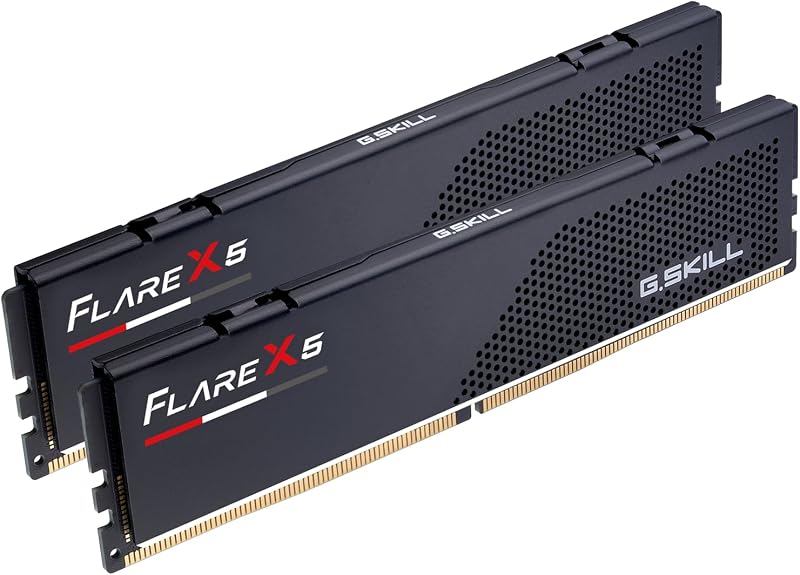
Physical clearance and aesthetic styling heavily influence component selection, especially when planning CPU cooler compatibility. The Flare X5 features a minimalist matte black design without RGB LEDs. Its low-profile heat spreader ensures broad compatibility with large dual-tower air coolers, where protruding heat spreaders frequently collide with front-mounted cooling fans. The understated finish blends naturally into stealth, industrial, or blackout computer builds where flashy lighting is undesirable.
The Fury Renegade takes an entirely different design direction, featuring dynamic customizable RGB lighting effects. It utilizes patented Kingston FURY Infrared Sync Technology to keep lighting patterns aligned across both modules without physical sync cables. Users can configure up to 18 customizable RGB lighting effects through Kingston’s FURY CTRL software or sync them with popular motherboard lighting suites. This makes the Fury Renegade a showcase piece for tempered-glass enclosures. Builders evaluating aesthetic options can read our look at the kingston fury renegade ddr5 vs teamgroup t-force delta rgb ddr5 for another perspective on illuminated memory.
Deciding between these two visual styles comes down to practical clearance versus presentation. Any Kingston Fury Renegade DDR5 RGB review will praise the seamless synchronization provided by Infrared Sync, making it a standout option for illuminated builds. However, the taller profile required to house the light diffuser can interfere with large CPU air heatsinks. The Flare X5 eliminates clearance concerns entirely, trading visual flair for guaranteed physical fitment.
Edge: Kingston Fury Renegade DDR5 for dynamic visual customization; G.Skill Flare X5 DDR5 6000 for compact cooler clearance.
Pros and Cons
G.Skill Flare X5 DDR5 6000
Pros
- Native AMD EXPO profiles
- Low latency CL30 timings
- Low-profile cooler clearance
- Efficient 1.35V operating voltage
Cons
- Lower 6000 MT/s frequency
- Lacks RGB lighting
View G.Skill Flare X5 DDR5 6000 on Amazon
Kingston Fury Renegade DDR5

Pros
- Higher 6400 MT/s bandwidth
- Dynamic RGB with Infrared Sync
- Intel XMP 3.0 certified
- FURY CTRL software support
Cons
- Higher 1.4V operating voltage
- Taller profile may block coolers
View Kingston Fury Renegade DDR5 on Amazon
Who Should Buy Each One
Choose the G.Skill Flare X5 DDR5 6000 If
- You are building an AMD Ryzen AM5 gaming desktop using an X870, X670, B850, or B650 motherboard.
- You use a large dual-tower air cooler and require compact memory modules to avoid fan clearance conflicts.
- You prefer a blackout, non-RGB aesthetic with an understated matte black heat spreader.
- You want tight CL30 timings and an optimal 1:1 memory controller ratio at a modest 1.35V operating voltage.
Choose the Kingston Fury Renegade DDR5 If
- You are assembling a high-performance Intel gaming desktop that benefits from 6400 MT/s transfer speeds.
- You want dynamic customizable RGB illumination featuring 18 lighting presets controlled via FURY CTRL.
- You want patented Infrared Sync Technology to keep lighting effects synchronized across memory modules.
- You plan to leverage Intel XMP 3.0 profiles to tap into extreme overclocking potential.
Final Verdict
When deciding between the G.Skill Flare X5 DDR5 6000 and the Kingston Fury Renegade DDR5, your processor platform is the most critical deciding factor. For AMD Ryzen AM5 PC builders, the Flare X5 is the superior choice. Its 6000 MT/s transfer speed hits the ideal frequency sweet spot for AMD memory controllers, its CL30-38-38-96 timings minimize latency to 10 nanoseconds, and its built-in AMD EXPO profiles guarantee stable one-click overclocking at an efficient 1.35 volts. Combined with a low-profile matte black heat spreader that fits under any CPU air cooler, the Flare X5 provides an optimal balance of stability and performance for AMD systems.
On the other hand, the Kingston Fury Renegade DDR5 is the better pick for Intel gaming builds and enthusiasts who want a visually striking rig. With an elevated 6400 MT/s transfer rate, Intel XMP 3.0 certification, dynamic RGB lighting with Infrared Sync, and tuning through FURY CTRL software, the Fury Renegade delivers superior raw memory bandwidth and showcase aesthetics. If your motherboard natively supports 6400 MT/s speeds and your case showcases internal components, the Fury Renegade provides the extra bandwidth and visual customization that make it worth the higher operating voltage.
FAQ
Does the G.Skill Flare X5 DDR5 6000 work with Intel processors?
The Flare X5 includes standard JEDEC default profiles that allow it to boot on any standard DDR5 desktop platform, including Intel motherboards. However, because its overclocking profile is AMD EXPO rather than Intel XMP, reaching the full 6000 MT/s speed on an Intel board depends on whether the motherboard BIOS supports EXPO profile translation. For guaranteed one-click performance on Intel platforms, an Intel XMP certified kit is recommended.
Can I run the Kingston Fury Renegade DDR5 on an AMD AM5 motherboard?
Many modern AMD AM5 motherboards feature BIOS tools that read Intel XMP 3.0 profiles and apply the appropriate frequency and timings. However, running memory at 6400 MT/s on AM5 can push the integrated memory controller past its 1:1 ratio limit, potentially causing system instability or requiring manual BIOS adjustments to maintain stability.
Is there a real-world performance difference between CL30 and CL32?
In terms of absolute response time, there is virtually no difference between 6000 MT/s at CL30 and 6400 MT/s at CL32. Both memory configurations produce an identical first-word latency of 10.0 nanoseconds. The 6400 MT/s kit delivers higher peak bandwidth, while the 6000 MT/s CL30 kit allows tighter sub-timings that benefit latency-sensitive games on AMD architectures.
How does Kingston Infrared Sync Technology work on the Fury Renegade?
Kingston FURY Infrared Sync Technology uses infrared communication channels built directly into each module’s circuit board. The modules detect each other and synchronize their RGB lighting patterns without requiring extra cables or complex background software, preventing the lighting desynchronization that can occur over extended system uptime.
Why does the Kingston Fury Renegade require 1.4 volts while the Flare X5 uses 1.35 volts?
The Kingston Fury Renegade requires 1.4 volts to maintain signal integrity and stability at its faster 6400 MT/s transfer speed with CL32 latency. The G.Skill Flare X5 runs at 6000 MT/s, which requires less electrical power, allowing it to remain completely stable at 1.35 volts while producing less heat.
Can I buy two of these 32GB kits to create a 64GB four-stick memory setup?
Both manufacturers advise against combining separate memory kits, even if they share the exact same model number. Memory kits are factory-tested and binned to operate reliably as a matched set of two. Combining two separate kits can overload the motherboard memory trace topology and CPU memory controller, leading to boot failures or failure to run at rated overclocking speeds.