When deciding between the Intel Core i5-12400F and the AMD Ryzen 5 7600, the pivotal factor comes down to DDR4 memory compatibility and budget platform accessibility versus modern Zen 4 clock speed, integrated graphics, and long-term AM5 motherboard longevity.
Choose the Core i5-12400F if you want an affordable mid-range build that preserves backward compatibility with cost-effective DDR4 memory modules while pairing with a dedicated graphics card. Choose the Ryzen 5 7600 if you want unlocked clock speeds up to 5.2 GHz, built-in Radeon Graphics, and a modern DDR5 architecture designed to stay relevant across multiple hardware upgrade cycles.

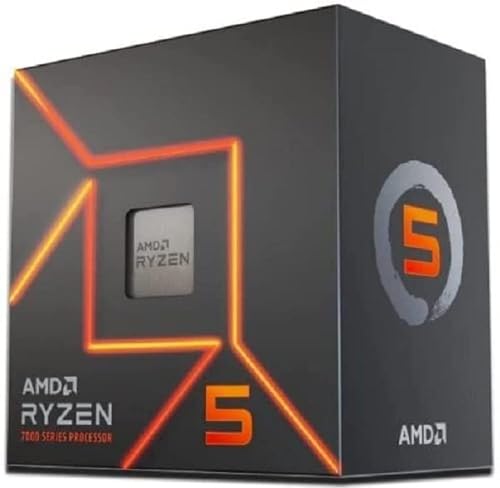
Intel Core i5-12400F vs AMD Ryzen 5 7600 at a Glance
| Feature | Intel Core i5-12400F | AMD Ryzen 5 7600 |
|---|---|---|
| Processor Architecture | Intel 12th Gen (6P + 0E Cores) | AMD Zen 4 (5 nm Hexa-Core) |
| Core and Thread Count | 6 Cores / 12 Threads | 6 Cores / 12 Threads |
| Base Frequency | 2.0 GHz / 2.5 GHz | 3.80 GHz |
| Maximum Boost Frequency | Up to 4.4 GHz Turbo | Up to 5.2 GHz Max Boost |
| Cache Capacity | 18 MB Secondary Cache | 38 MB Total (32 MB L3, 6 MB L2) |
| Memory Architecture | DDR4 and DDR5 Support | DDR5 Support |
| Processor Graphics | None (Discrete graphics required) | AMD Radeon Graphics |
| Motherboard Socket | LGA 1700 (600 Series Chipset) | Socket AM5 (600 Series Chipset) |
| Bundled CPU Cooler | Intel Laminar RM1 | AMD Wraith Stealth |
| Overclocking Capability | Locked Multiplier | Unlocked for Overclocking |
| Processor Base Power | 65 Watts | 65 Watts |
| Operating System Support | Windows 10, Windows 11 | Windows, Linux |
| Best For | Budget DDR4 gaming and office rigs | Future-ready AM5 gaming and productivity |
Clock Speed and Processor Architecture
Processor clock frequencies and microarchitecture dictate how quickly instructions are executed across core workloads. In this AMD Ryzen 5 7600 vs Intel Core i5-12400F head-to-head, AMD establishes a substantial clock speed lead right from the baseline. The AMD Ryzen 5 7600 features a base operating frequency of 3.80 GHz and can achieve up to a 5.2 GHz Max Boost across its 6-core, 12-thread design. Built on an advanced 5 nm manufacturing process, AMD’s Zen 4 compute engine handles heavy compute tasks by sustaining high operating frequencies across both light-threaded and multi-threaded applications.
By comparison, the Core i5-12400F operates on Intel’s 12th-generation architecture with 6 performance cores and 12 concurrent processing threads, leaving out the efficiency cores found in higher-tier Alder Lake dies. The chip features a base speed of 2.0 GHz to 2.5 GHz and reaches a maximum turbo frequency of up to 4.4 GHz. While this 4.4 GHz ceiling offers dependable speed for general multitasking and day-to-day office processing, the Ryzen 5 7600 clock speed vs i5-12400F comparison reveals an 800 MHz advantage at maximum boost for the Ryzen chip. Builders interested in seeing how clock scaling impacts higher-end hardware can explore our analysis of the intel core i5-14600k vs amd ryzen 5 7600x.
In real-world terms, this frequency gap affects how quickly each processor handles heavy computational passes, such as file compression, audio rendering, and physics calculations. The higher operating frequencies of the Zen 4 silicon ensure faster per-core execution times under sustained loads. While the Core i5-12400F holds steady under its 4.4 GHz turbo limit, it cannot match the raw single-core throughput produced by AMD’s 5.2 GHz ceiling.
Edge: AMD Ryzen 5 7600 because of its substantially higher 3.80 GHz base clock and 5.2 GHz maximum boost frequency built on 5 nm Zen 4 architecture.
Cache Capacity and Gaming Performance
Cache sizing plays a fundamental role in maintaining steady frame delivery when comparing the Intel Core i5-12400F or AMD Ryzen 5 7600 for gaming. When a processor cannot store immediate game instructions inside on-die cache, it must retrieve data from system RAM, which introduces latency and can produce frame drops. The Ryzen 5 7600 is equipped with 38 MB of total installed cache memory, comprising 32 MB of high-speed L3 cache and 6 MB of dedicated L2 cache. This deep memory reservoir keeps critical rendering pipelines and asset streaming routines ready for immediate execution by the processor cores.
Conversely, the Core i5-12400F carries an 18 MB secondary cache configuration according to manufacturer specifications. While 18 MB of cache provides plenty of room for general desktop software and stable mid-tier gaming, it is less than half the total cache array integrated into the Ryzen 5 7600. In demanding competitive titles and open-world environments, the larger cache pool on AMD’s processor reduces pipeline stalls and helps sustain smooth 1% low frame rates during chaotic scenes. A similar cache-focused engineering philosophy is evident in top-tier silicon such as the intel core i7-14700k vs amd ryzen 7 7800x3d, highlighting how on-die capacity directly shapes modern gaming responsiveness.
When evaluating i5-12400F vs Ryzen 5 7600 gaming metrics, the combination of a 5.2 GHz boost frequency and 32 MB of L3 cache gives the Ryzen 5 7600 a distinct performance advantage. Gamers targeting high-refresh-rate 1080p and 1440p displays will experience better frame pacing from the AMD processor, whereas the Intel chip serves as a capable baseline option for standard 60 Hz to 120 Hz gaming monitors when matched with an appropriate graphics card.
Edge: AMD Ryzen 5 7600 because of its 38 MB total cache array (including 32 MB of L3 cache) that minimizes memory latency in CPU-bound gaming.
Memory Compatibility and Platform Flexibility
Platform decisions often hinge on memory configurations and motherboard lifespans. On this front, the Core i5-12400F offers flexibility by supporting both DDR4 and DDR5 memory standards. This dual-standard capability allows PC builders to assemble a modern system using existing, highly affordable DDR4 modules or step into newer DDR5 kits on LGA 1700 motherboards equipped with Intel 600 series chipsets. Those looking for a value-driven setup can also consult our comparison of the intel core i5-13400f vs amd ryzen 5 5600 to see how previous generations balanced memory costs.
The Ryzen 5 7600 operates exclusively on AMD’s Socket AM5 platform, which requires DDR5 system memory. By dropping DDR4 backward compatibility entirely, AMD forces buyers to purchase new DDR5 memory kits and compatible AM5 600 series motherboards. While DDR5 brings higher bandwidth and improved operating efficiency, it eliminates the possibility of recycling an older memory kit from a prior computer build.
However, the trade-off swings back toward AMD when looking at platform longevity. Socket AM5 is AMD’s active platform intended for multi-year drop-in support, whereas Intel’s LGA 1700 platform is a mature, closed socket ecosystem. Even so, if your objective is to minimize immediate platform transition friction and take advantage of DDR4 memory options, the Core i5-12400F remains the more flexible silicon for mixed hardware builds.
Edge: Intel Core i5-12400F because of its native support for both DDR4 and DDR5 memory modules on LGA 1700 chipsets.
Integrated Graphics and System Troubleshooting
A major functional difference between these two processors centers on onboard display capabilities. The “F” designation on the Core i5-12400F explicitly signifies that the processor ships without integrated processor graphics. According to the manufacturer data, a discrete graphics card is strictly required to post video, install display drivers, and output visual data to a monitor. If your dedicated graphics card malfunctions or you are assembling the PC in phases, an i5-12400F build will remain completely dark until an external video card is installed.
The Ryzen 5 7600 includes integrated AMD Radeon Graphics directly on the processor substrate. While these basic Radeon Graphics are not intended to replace high-tier discrete graphics cards for heavy 3D rendering, they provide essential video output capabilities out of the box. Users can connect monitors directly to the motherboard display ports to configure system BIOS settings, install operating systems, and stream video content without needing a separate graphics card plugged into the PCIe slot.
This integrated graphics processor also transforms the Ryzen 5 7600 into an effective standalone chip for office setups and productivity workstations where dedicated GPU rendering is unnecessary. When determining whether to pick the Intel Core i5-12400F or AMD Ryzen 5 7600 for productivity, having functional integrated graphics reduces troubleshooting complexity and keeps workstation displays active during dedicated GPU maintenance.
Edge: AMD Ryzen 5 7600 because its built-in AMD Radeon Graphics provide native video output without requiring an external graphics card.
Overclocking Potential and Thermal Management
Thermal characteristics and tuning flexibility are critical factors when selecting a desktop CPU for sustained daily use. Both the Core i5-12400F and the Ryzen 5 7600 are rated at an efficient 65 watts processor base power, making them relatively easy to cool inside mid-tower and small-form-factor chassis. Furthermore, both manufacturers include a capable thermal heatsink and fan inside the retail package: Intel supplies its cylindrical Intel Laminar RM1 cooler, while AMD bundles the AMD Wraith Stealth cooler.
The operational divide appears in multiplier control and frequency tuning. The Ryzen 5 7600 is fully unlocked for overclocking, allowing users with compatible 600 series motherboards to adjust multiplier ratios, fine-tune voltage curves, and push clock frequencies up to a specified 5.10 GHz overclocking profile. This unlocks extra performance margins for enthusiasts who enjoy tuning their system hardware. For builders curious about how thermal overhead scales across higher-tier enthusiast platforms, our deep dive on the intel core i7-13700k vs amd ryzen 7 7700x highlights the thermal demands of unlocked high-wattage silicon.
In contrast, the Core i5-12400F is a locked processor. Users cannot adjust CPU core multipliers to overclock the chip beyond its factory-defined 4.4 GHz turbo limits. While this locked nature guarantees predictable 65W thermal behavior and stable operation on standard motherboards, it limits the processor’s ceiling. Both stock coolers effectively manage baseline 65W workloads, but AMD gives power users the freedom to customize clock performance.
Edge: AMD Ryzen 5 7600 because it features an unlocked multiplier that supports user overclocking up to 5.10 GHz on compatible motherboards.
PCIe Expansion and Chipset Architecture
Expansion lane capabilities define how many high-speed add-in cards and solid-state drives your desktop can manage simultaneously. The Core i5-12400F includes support for PCIe Gen 5.0 and Gen 4.0 lanes, allowing modern LGA 1700 motherboards to support modern graphics cards alongside multiple Gen 4 M.2 NVMe storage drives. This ensures high-bandwidth connectivity for fast game load times and massive data transfer pipelines without bottlenecking storage arrays.
AMD’s Ryzen 5 7600 matches this bandwidth standard by supporting PCIe 5.0 on select 600 series motherboards within the Socket AM5 ecosystem. With 64-bit processing architecture on a modern 5 nm node, the platform provides dedicated PCIe communication channels for both graphics accelerators and next-generation storage drives. Users who manage massive enterprise data pipelines can see how extreme PCIe bandwidth configurations function in high-end workstations by reading our review of the intel core i9-14900k vs amd ryzen 9 7950x3d.
Because both processors connect to modern 600 series motherboards that provide PCIe 5.0 lane capabilities and robust peripheral routing, neither chip creates an expansion bottleneck for modern hardware. Whether you mount a modern GPU on an LGA 1700 board or an AM5 motherboard, both platforms supply ample high-speed lane routing for current and upcoming add-in components.
Edge: Tie because both processors feature PCIe 5.0 interface support on their respective 600-series motherboard platforms.
Pros and Cons
Intel Core i5-12400F

Pros
- Flexible DDR4 and DDR5 memory compatibility
- PCIe 5.0 and 4.0 expansion support
- 6 cores and 12 processing threads
- Bundled Intel Laminar RM1 thermal cooler
- Efficient 65W processor base power
Cons
- No integrated graphics included
- Locked core multiplier prevents overclocking
- Lower 4.4 GHz maximum turbo clock
View Intel Core i5-12400F on Amazon
AMD Ryzen 5 7600

Pros
- High 5.2 GHz maximum boost frequency
- Generous 38 MB total on-die cache
- Integrated AMD Radeon Graphics
- Unlocked multiplier for user overclocking
- Bundled AMD Wraith Stealth cooler
Cons
- Requires DDR5 memory with no DDR4 support
- Mandates Socket AM5 motherboard upgrade
View AMD Ryzen 5 7600 on Amazon
Who Should Buy Each One
Choose the Intel Core i5-12400F If
- You want to build an economical gaming PC using an existing DDR4 memory kit to reduce overall platform expenditure.
- You already own a dedicated graphics card and do not require onboard video outputs for initial setup or troubleshooting.
- You prefer a simple, plug-and-play 65W processor that runs reliably under its factory turbo limits without needing overclocking adjustments.
- You are pairing your processor with an LGA 1700 motherboard for a dedicated Windows 10 or Windows 11 workstation.
Choose the AMD Ryzen 5 7600 If
- You want higher gaming frame rates driven by 5.2 GHz boost frequencies and 38 MB of total on-die cache.
- You are investing in the long-term Socket AM5 platform and plan to upgrade to future generations of processors without changing motherboards.
- You need integrated AMD Radeon Graphics to display video without purchasing or troubleshooting a separate graphics card.
- You want an unlocked processor multiplier that allows you to tune frequencies and overclock on compatible 600 series motherboards.
Final Verdict
For most builders assembling a brand-new desktop computer today, the AMD Ryzen 5 7600 is the superior overall processor. With its modern 5 nm Zen 4 architecture, a 5.2 GHz maximum boost clock, 38 MB of total installed cache, and unlocked multiplier tuning, it consistently outperforms the 12th-generation Intel chip in gaming responsiveness and compute throughput. Furthermore, the inclusion of integrated AMD Radeon Graphics ensures hassle-free troubleshooting and flexible workstation deployment, while the Socket AM5 motherboard platform provides a long-term foundation for future component upgrades.
On the other hand, the Intel Core i5-12400F remains a practical, cost-effective choice for budget-conscious builders who want to avoid the transition costs associated with DDR5 memory. Its native support for DDR4 RAM on LGA 1700 motherboards allows users to assemble a balanced 6-core, 12-thread system using accessible parts without compromising on PCIe 5.0 graphics compatibility. If your build budget requires reusing memory modules and you already own a dedicated graphics card, the Core i5-12400F delivers dependable mid-range power that meets everyday computing needs.
FAQ
Does the Intel Core i5-12400F include integrated graphics?
No, the Intel Core i5-12400F does not feature integrated processor graphics. The “F” model designation indicates that the integrated GPU is disabled or absent, meaning the processor strictly requires a dedicated discrete graphics card plugged into the motherboard to output video to a monitor.
Can the AMD Ryzen 5 7600 run with DDR4 memory?
No, the AMD Ryzen 5 7600 does not support DDR4 memory. Socket AM5 motherboards and Zen 4 processors are engineered exclusively for DDR5 system memory, requiring users to purchase compatible DDR5 RAM modules when assembling a Ryzen 7000-series system.
Which processor is faster for competitive gaming?
The AMD Ryzen 5 7600 is noticeably faster for gaming due to its higher maximum boost frequency of up to 5.2 GHz and its large 38 MB total cache configuration (including 32 MB of L3 cache). These attributes reduce memory latency and improve 1% low frame rates in CPU-demanding competitive titles compared to the 4.4 GHz turbo ceiling and 18 MB secondary cache on the Core i5-12400F.
Do both processors include a CPU cooler in the retail box?
Yes, both processors include a stock heatsink and fan inside the retail package. The Intel Core i5-12400F comes bundled with the Intel Laminar RM1 cooler, while the AMD Ryzen 5 7600 includes the AMD Wraith Stealth cooler. Both included thermal solutions are designed to handle each processor’s standard 65-watt base power rating.
Can you overclock the Intel Core i5-12400F?
No, the Intel Core i5-12400F has a locked core multiplier that prevents traditional CPU overclocking. In contrast, the AMD Ryzen 5 7600 is fully unlocked for overclocking, allowing builders to adjust clock multipliers up to a specified 5.10 GHz overclocking profile on compatible motherboards.
What operating systems do these processors support according to the specs?
According to manufacturer specifications, the Intel Core i5-12400F lists support for Windows 10 and Windows 11 platforms. The AMD Ryzen 5 7600 specifications list official platform support for both Windows and Linux operating systems.