The fundamental distinction between the NOCO GB40 and the NOCO Genius5 centers on immediate cranking power versus gradual battery replenishment. While both units originate from the same manufacturer, the GB40 is an UltraSafe lithium jump starter built to deliver instant power to an immobilized vehicle, whereas the Genius5 is an AC-powered 5-amp smart charger, maintainer, trickle charger, and desulfator engineered to restore and sustain battery health over multiple hours.
Drivers who require portable emergency assistance on the roadside should choose the GB40, while vehicle owners looking to charge depleted batteries and preserve seasonal equipment in a garage should select the Genius5.


NOCO GB40 vs NOCO Genius5 at a Glance
| Attribute | NOCO GB40 | NOCO Genius5 |
|---|---|---|
| Device Type | Lithium jump starter | Smart charger, maintainer, and desulfator |
| Power Source | Internal lithium battery | 120 volts AC outlet |
| Output Voltage | Not listed | 6 volts and 12 volts |
| Charging Current | Not listed | 5 amps |
| Battery Chemistries | Not listed | Lead-acid (AGM, Gel, SLA, flooded) and Lithium-ion |
| Low-Voltage Recovery | Not listed | Down to 1 volt (0 volts in Force Mode) |
| Desulfation Support | Not listed | Automatic pulse desulfation |
| Dimensions | Not listed | 3.43 x 4.61 x 7.95 inches |
| Weight | Not listed | 1.6 pounds |
| Best For | Roadside jump starting | Garage battery charging and maintenance |
Primary Function: Instant Cranking vs Sustained Recharging
Understanding the difference between an instantaneous engine start and a multi-stage battery recharge is crucial when deciding on a noco gb40 vs gb70 or evaluating jump starter vs battery maintainer capabilities. An engine jump starter works like a high-output electrical bridge, dumping heavy current into the starter motor in seconds to crank the motor over when the primary vehicle battery lacks the voltage to engage the solenoid. The GB40 functions as an UltraSafe lithium jump starter designed specifically to address sudden starting failures without waiting around.
In contrast, the Genius5 operates as a continuous 5-amp replenishment unit that feeds current into a battery gradually over an 8-hour charge time cycle. Connecting a maintainer to an engine with an entirely dead battery will not provide immediate ignition capabilities, because the 5-amp flow is far below the massive current drawn by an automotive starter motor. A NOCO Genius5 jump start is physically impossible because the unit must run through a methodical charging cycle rather than dumping burst amperage.
Purchasing the wrong hardware for your primary failure scenario leads to acute inconvenience. Relying on the Genius5 when stranded in a parking lot leaves you immobilized without a nearby wall outlet, whereas expecting the GB40 to maintain a classic car battery over a four-month winter will leave the internal chemistry neglected.
Edge: Tie. The GB40 dominates sudden roadside emergencies requiring immediate movement, while the Genius5 is built for controlled battery rejuvenation and long-term storage.
Power Source and Portability: Cordless Freedom vs AC Wall Power
The operational divide between these two units is largely dictated by how they receive electricity. The GB40 is an untethered, self-contained lithium device that stores its own reserve energy. This internal power source allows motorists to carry the hardware in a glove compartment, center console, or spare tire well, making it ready to deploy on remote roads, job sites, or boat ramps where grid electricity does not exist.
The Genius5 relies on a standard 120-volt alternating current wall supply delivered through its integrated 72-inch AC power cord. This makes the unit fundamentally stationary or bound to locations within reach of an extension cord. Comparing the portable setup against garage maintainers, such as in our analysis of the noco genius5 vs schumacher sc1281, highlights how wall-tethered chargers excel in workshop bays but remain unusable during transit.
The trade-off is clear: the GB40 provides absolute spatial independence but must eventually be monitored to ensure its internal cell retains an operational charge level. The Genius5 trades away field portability to deliver an infinite supply of wall-drawn energy that never depletes during extended maintenance sessions.
Edge: NOCO GB40. Its cordless design allows deployment anywhere without depending on a residential electrical outlet.
Dead Battery Recovery: Cranking Discharge vs Force Mode Restoration
Deciding between the NOCO GB40 or Genius5 for dead battery recovery depends on how depleted the battery is and how quickly you must resume driving. When a battery is merely low on resting voltage, an UltraSafe jump starter like the GB40 bridges the circuit to ignite the motor, immediately turning operational duties over to the vehicle alternator. However, running a deeply discharged battery straight from an alternator places intense electrical stress on the charging system and does not repair underlying chemical distress.
The Genius5 approaches deeply discharged cells with precision diagnostic circuitry. It automatically detects and charges batteries down to 1 volt. When a battery has been sitting neglected for months and drops below that threshold, the Genius5 features a specialized Force Mode that overrides automated safeguards to manually deliver charge down to zero volts. Evaluating this feature in a NOCO Genius5 review reveals why it is an exceptional diagnostic tool for rehabilitating severely discharged lead-acid plates.
Motorists comparing recovery options against traditional shop equipment, like the noco gb40 vs schumacher sc1281, will appreciate that the Genius5 methodically steps depleted cells back to life instead of shocking a damaged battery with raw starting amperage.
Edge: NOCO Genius5. Its low-voltage detection down to 1 volt and 0-volt Force Mode allow recovery of deeply discharged batteries that standard tools fail to read.
Voltage and Chemistry Versatility: Specialized 12V vs Multi-Chemistry Support
Vehicle fleets frequently consist of diverse battery chemistries and electrical system voltages, creating a distinct difference when examining NOCO GB40 vs Genius 5 differences. The Genius5 functions as a multi-voltage, multi-chemistry tool capable of managing 6-volt and 12-volt systems. It features specific charging profiles for lead-acid varieties, including wet flooded, maintenance-free, Gel, enhanced flooded, and Absorbent Glass Mat (AGM) cells, as well as modern lithium-ion (LiFePO4) batteries up to 120 amp-hours.
The GB40 listing describes an UltraSafe lithium jump starter, but does not specify compatibility with 6-volt electrical architectures or multi-chemistry charging profiles. Users looking for cross-compatibility across vintage tractors with 6-volt configurations or lightweight lithium powersport applications can explore broader cross-brand options in our look at the noco gb70 vs genius5.
This wide-ranging compatibility allows the Genius5 to service everything from small powersport machines, jet skis, and lawn tractors to heavy-duty marine, RV, and diesel truck batteries. The GB40 remains focused strictly on turning over automotive starting systems.
Edge: NOCO Genius5. It explicitly accommodates both 6V and 12V architectures across lead-acid and lithium-ion battery constructions.
Long-Term Maintenance and Desulfation Capabilities
Leaving a vehicle parked for weeks or months leads to parasitic electrical drain and lead sulfation, which degrades cranking performance and shortens battery lifespan. The Genius5 is built specifically to address this issue through automated pulse charging that detects and reverses battery sulfation and acid stratification. When shoppers ask is Genius5 worth it for seasonal storage, the automatic desulfation program answers affirmatively by actively conditioning battery plates.
Furthermore, the Genius5 integrates an ambient thermal sensor that monitors external temperatures and dynamically adjusts output. This prevents overcharging during hot summer storage and prevents undercharging in freezing winter conditions, making it safe to leave connected indefinitely. When comparing portable packs like in the noco gb40 vs dbpower 800a review, the lack of float monitoring becomes a major differentiator.
The GB40 provides no continuous battery maintenance capabilities whatsoever. Clamping an emergency booster pack to a stored car battery indefinitely is not its intended use, as it lacks floating charge profiles, desulfation pulses, and thermal compensation sensors.
Edge: NOCO Genius5. It offers fully autonomous, thermal-compensated maintenance and desulfation for indefinite connections.
Physical Build, Hardware, and Inclusions
Hardware packaging dictates how each device fits into a vehicle owner’s everyday workflow. The Genius5 weighs 1.6 pounds with dimensions of 3.43 by 4.61 by 7.95 inches, making it a compact unit that mounts cleanly to workshop walls using its included mounting bracket and screws. Its cabling consists of a 72-inch AC cord and an 80-inch DC connection equipped with heavy-duty battery clamps that unbolt to reveal integrated eyelet terminals for permanent hardwired battery leads.
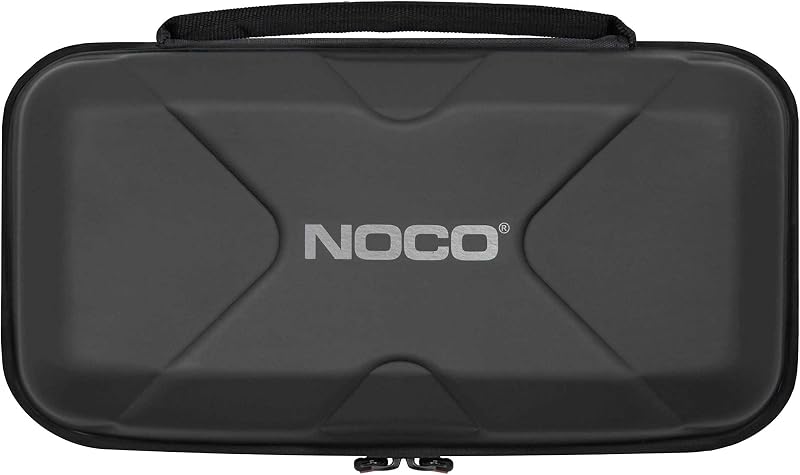
For the GB40, the product data highlights an optional or bundled GBC013 rugged EVA protection case that is lightweight, crush-resistant, anti-shock, and weather-resistant with a precision steel-rimmed zipper and velvet lining. However, the listing does not specify the exact unit dimensions, item weight, or cable lengths for the GB40 booster itself.
The Genius5 is engineered with permanent garage installations in mind, while the GB40 enclosure focuses entirely on surviving glove box friction, trunk impacts, and travel environments.
Edge: NOCO Genius5. It includes complete mounting hardware, lengthy DC/AC lines, and convertible eyelet clamps, backed by comprehensive listed specifications.
Pros and Cons
NOCO GB40
Pros
- Cordless portable emergency jump starting
- Rugged weather-resistant EVA protective case
- UltraSafe lithium construction
Cons
- Cannot trickle charge or maintain batteries
- Requires periodic manual recharging to remain ready
- Listing omits specific amperage and dimensions
NOCO Genius5

Pros
- Versatile 6V and 12V multi-chemistry charging
- Force Mode recovers batteries down to zero volts
- Automatic pulse desulfation and thermal compensation
- Safe for indefinite continuous maintenance
Cons
- Cannot jump start an engine instantly
- Requires continuous 120V AC wall power
Who Should Buy Each One
Choose the NOCO GB40 If
- You need immediate roadside starting capability without waiting for an electrical charge.
- You want a compact safety device that stores self-contained in a trunk, cabin, or glove compartment.
- You travel frequently in remote areas far away from standard 120V alternating current outlets.
- You require a rugged emergency tool built with an EVA crush-resistant and weather-resistant protective shell.
Choose the NOCO Genius5 If
- You store seasonal equipment such as motorcycles, watercraft, lawn mowers, or classic cars for months at a time.
- You have regular access to a standard 120-volt garage or driveway electrical receptacle.
- You need to bring severely discharged batteries back from zero volts using a dedicated manual Force Mode.
- You manage a mix of 6V and 12V electrical systems spanning flooded, AGM, and LiFePO4 chemistries.
Final Verdict
Evaluating this matchup reveals that the GB40 and the Genius5 are complementary tools rather than interchangeable competitors. The NOCO GB40 serves as a pure emergency intervention device. When your vehicle fails to start miles from assistance, the internal lithium cell delivers immediate cranking power to get you home. Any comprehensive NOCO GB40 review highlights its value as an essential piece of travel safety gear, but it offers zero battery maintenance, trickle charging, or desulfation benefits.
For long-term vehicle ownership, garage storage, and comprehensive battery care, the Genius5 wins the overall comparison. Its 5-amp output, multi-chemistry compatibility across 6V and 12V platforms, automated thermal compensation, and zero-volt Force Mode make it an indispensable workshop asset. If you can only buy one device today, select the GB40 if your main fear is being stranded away from home, or select the Genius5 if you want to extend the operational life of your batteries and prevent dead-battery breakdowns before they ever occur.
FAQ
Can the NOCO Genius5 jump start a vehicle with a dead battery?
No, the Genius5 cannot deliver an immediate engine jump start. It is a 5-amp battery charger and maintainer that restores power slowly over several hours. Turning over an internal combustion engine requires high bursts of cranking power that only a jump starter like the GB40 can deliver.
Can I leave the NOCO Genius5 connected to my battery indefinitely?
Yes, the Genius5 is specifically designed for indefinite connection. Its integrated smart sensor constantly monitors the battery voltage and temperature, automatically switching into maintenance mode to prevent overcharging while keeping the battery at peak performance.
Does the NOCO GB40 have a trickle charging capability?
No, the listing does not specify any NOCO GB40 charging capability for maintenance duties. The GB40 is an emergency lithium jump starter designed for short bursts of starting power and lacks the continuous low-amperage monitoring software found in trickle chargers.
How does Force Mode work on the Genius5?
Force Mode allows the Genius5 to manually deliver current to batteries that have dropped below 1 volt, where automated chargers normally cannot detect a connection. Engaging Force Mode bypasses the sensor to deliver continuous power down to zero volts to revive deeply discharged batteries.
Can the Genius5 charge 6-volt batteries?
Yes, the Genius5 natively supports both 6-volt and 12-volt battery architectures. This makes it compatible with older classic cars, vintage tractors, and specialized equipment running on 6V systems.
Can the Genius5 charge lithium batteries?
Yes, the Genius5 features dedicated charging profiles for 12-volt lithium-ion batteries, including lithium iron phosphate (LiFePO4) configurations up to 120 amp-hours.
Where should I store the NOCO GB40?
The GB40 is designed for vehicle storage, protected inside its rugged, weather-resistant EVA case. It safely stores in your trunk, center console, or glove box so that it is always accessible during roadside emergencies.
