The core difference that decides the choice between the NOCO GB70 and the NOCO Genius5 comes down to immediate standalone emergency starting versus wall-powered multi-stage charging and maintenance. One unit serves as an UltraSafe lithium jump starter designed to revive stalled vehicles in remote locations without access to mains electricity, while the other functions as a dedicated 120-volt alternating current smart charger engineered to recharge, condition, and sustain batteries over extended intervals.
Choose the GB70 if you need immediate roadside starting capability stored in your vehicle glove compartment during transit. Choose the Genius5 if you need an all-in-one bench charger, trickle maintainer, and desulfator to preserve vehicle batteries in a garage or workshop.


NOCO GB70 vs Genius5 at a Glance
| Feature | NOCO GB70 | NOCO Genius5 |
|---|---|---|
| Primary Function | UltraSafe lithium emergency jump starter | Smart battery charger, maintainer, and desulfator |
| Operating Power Source | Internal lithium-ion battery | 120V AC wall power |
| Output Current | Not listed in specification data | 5 Amps |
| Supported System Voltages | 12V vehicle systems | 6V and 12V systems |
| Supported Chemistries | 12V vehicle batteries (specific types not listed) | Lead-acid (AGM, Gel, SLA, VRLA, flooded) and LiFePO4 |
| Deep Discharge Recovery | Not listed | Down to 1V (standard) or 0V (Force Mode) |
| Pulse Desulfation | Not listed | Precision pulse repair for sulfated plates |
| Thermal Sensing | Not listed | Integrated ambient temperature dynamic sensor |
| Dimensions and Weight | 12.4″L x 8.1″W x 5.4″H; 0.64 kg (enclosure) | 3.43″D x 4.61″W x 7.95″H; 1.6 lbs |
| Included Hardware | EVA protective case with zipper and handle | Clamps, integrated eyelets, mounting bracket, screws |
| Manufacturer Warranty | 1-Year Limited | 3-Year Limited |
| Best For | Roadside jump starting and glove-box storage | Garage battery charging, maintenance, and seasonal storage |
Emergency Starting vs Scheduled Maintenance
Understanding the operational boundary between an emergency jump pack and a bench charger prevents significant frustration during an unexpected vehicle failure. The GB70 is engineered around rapid electrical transfer to crank over an engine whose battery cannot supply enough starting amperage on its own. It requires no wall outlet to operate, drawing on its internal lithium architecture to send sudden power directly to the starter motor. For readers comparing portable booster sizes, examining the noco gb40 vs gb70 breakdown illustrates how NOCO scales jump-starting platforms for varying engine demands.
In contrast, the Genius5 cannot deliver the massive burst of instantaneous cranking energy required to turn over an engine on the spot. Instead, it operates on a standard 8-hour charge cycle powered by a 120-volt AC electrical connection. It progressively feeds current into the battery pack to return resting voltage to full capacity. If you are stranded in a parking structure with a drained starter, the Genius5 cannot rescue you without a mains plug and several hours of charging time, whereas the GB70 is built precisely for that immediate rescue scenario.
The operational trade-off is equally stark when vehicles sit parked for months at a time. Leaving a jump starter connected to a dormant vehicle does nothing to prevent parasitic draw from degrading the lead plates. The Genius5 excels in sustained connection, monitoring battery integrity constantly and modulating its output indefinitely without risks of overcharging. When evaluating standalone emergency capability against steady replenishment, the core purpose of each tool dictates where it belongs.
Edge: NOCO GB70 because it delivers instant engine starts without relying on an external alternating current power supply.
Power Delivery and Output Specifications
Analyzing electrical output clarifies how these two units treat internal battery chemistry. While vehicle owners frequently research NOCO GB70 jump starter amps, the official product listing data does not specify the exact peak cranking amperage rating for this unit. Instead, the documentation designates the unit as an UltraSafe Lithium Jump Starter engineered for high-demand cranking duties, designed to be stored compactly alongside its heavy-duty leads. Readers examining high-output jump starters often compare alternatives like the noco gb70 vs dbpower 800a to gauge how portable lithium packs handle different engine displacements.
Looking at the NOCO Genius5 charging specs reveals a finely calibrated 5-amp output current operating from a 120-volt AC input. Engineered as an upgrade to older hardware, it delivers over 65 percent more power than the legacy G3500 model while reducing overall housing volume by 34 percent. Rather than dumping unregulated current into the battery, the 5-amp stream systematically recharges 12-volt and 6-volt cells over an 8-hour typical charging cycle, ensuring the electrolyte solution does not overheat or boil during absorption.
Because the GB70 relies on stored lithium energy designed for rapid discharge rather than continuous amperage metering, it cannot replicate the steady, controlled power delivery of an AC-fed maintainer. Conversely, the 5-amp ceiling on the Genius5 makes it strictly a steady-state charger; it lacks the instantaneous power dump needed to crank an automotive starter motor directly. The trade-off centers on burst amperage versus regulated continuous current.
Edge: NOCO Genius5 because its regulated 5-amp output provides multi-stage energy transfer optimized for safe, complete cell replenishment.
Dead Battery Recovery and Desulfation
Deciding between the NOCO GB70 or Genius5 for dead battery situations requires evaluating the depth of discharge and the chemical health of the lead plates. A standard battery that has merely lost its surface charge due to an illuminated cabin dome light can be bypassed by the GB70, allowing the vehicle alternator to take over once the engine runs. However, jump starters do not alter internal plate chemistry or reverse physical degradation. When evaluating garage recovery tools, reading a noco gb70 vs schumacher sc1281 comparison highlights how jump packs contrast with larger commercial charging equipment.
The Genius5 is engineered specifically for deeply drained and chemically degraded batteries. Standard smart chargers often fail to recognize batteries that drop below standard activation voltages, treating them as disconnected. The Genius5 solves this by charging depleted cells from as low as 1 volt in standard mode, while also providing a specialized Force Mode that allows users to manually deliver continuous current to batteries drained completely down to zero volts. This unlocks recovery options for neglected equipment that other systems ignore entirely.
Beyond low-voltage intervention, the Genius5 integrates precision pulse charging designed to restore battery health. As lead-acid units remain discharged, lead sulfate crystals accumulate on the plates, while acid stratification causes the electrolyte concentration to settle unevenly. The Genius5 automatically detects this condition and applies high-frequency pulse profiles to break down sulfation and mix stratified acid. The GB70 listing does not specify any desulfation circuitry, making the Genius5 the clear instrument for battery resuscitation.
Edge: NOCO Genius5 because it features zero-volt Force Mode recovery alongside automated pulse desulfation to chemically repair depleted batteries.
Battery Chemistry and Voltage Versatility
Vehicle fleets rarely share identical battery architectures, making electrical compatibility a decisive factor. The Genius5 features extensive compatibility, operating across both 6-volt and 12-volt electrical architectures. Its programming encompasses flooded lead-acid, maintenance-free, AGM, Gel, SLA, and VRLA deep-cycle marine and powersport units, handling capacities up to 120 amp-hours. It also natively supports 12-volt lithium-ion systems using Lithium Iron Phosphate (LiFePO4) chemistry, complete with dedicated charging profiles for each type.
The GB70 data focuses squarely on 12-volt engine starting applications using its internal UltraSafe lithium architecture. However, the listing does not specify support for 6-volt electrical systems commonly found in vintage tractors, older classic cars, or specialized equipment. For shoppers weighing multi-platform utility against compact jump units, examining the noco gb40 vs genius5 head-to-head demonstrates how voltage flexibility influences tool selection across varied garages.
Using the wrong profile on sensitive battery types can cause premature failure. AGM and lithium-ion batteries demand strict voltage regulation thresholds to avoid cell damage, which the Genius5 controls through specialized operational modes. The GB70 is intended to connect, deliver a cranking assist to 12-volt electrical circuits, and be removed immediately. It cannot switch down to 6-volt duty cycles or tailor an absorption charge to unique marine deep-cycle formulations.
Edge: NOCO Genius5 because it supports both 6V and 12V architectures across standard lead-acid, AGM, gel, and LiFePO4 chemistries.
Winter Storage and Long-Term Maintenance
Choosing between the NOCO GB70 or Genius5 for winter storage depends entirely on whether a vehicle is operational or laid up for the cold months. Extreme cold drastically reduces chemical efficiency in lead-acid cells while increasing oil viscosity, placing maximum strain on starting systems. Storing a vehicle over winter without an active trickle charger results in natural self-discharge, leaving the battery vulnerable to freezing and permanent plate damage.
The Genius5 excels during prolonged seasonal storage due to its integrated thermal sensor. This sensor dynamically monitors ambient room temperature and adjusts the charging profile accordingly, eliminating overcharging in hot spaces and undercharging in sub-freezing garages. Vehicle owners can secure the charger via its included 80-inch DC cable with eyelet terminals, mount the chassis with the supplied bracket, and leave the system connected indefinitely without fear of thermal runaway or water loss.
By comparison, leaving the GB70 attached to a parked vehicle over the winter is neither practical nor supported by its design. While the GB70 can sit in a cold vehicle inside its protective enclosure to provide an emergency jump start if the primary battery falters, it cannot maintain the vehicle’s state of charge during dormancy. For keeping stored motorcycles, classic cars, lawn equipment, or seasonal watercraft in peak operational condition through freezing weather, the continuous monitoring of the Genius5 is indispensable.
Edge: NOCO Genius5 because its dynamic thermal sensor and safe indefinite float charging preserve dormant batteries throughout seasonal storage.
Portability, Enclosure, and Storage Form Factor
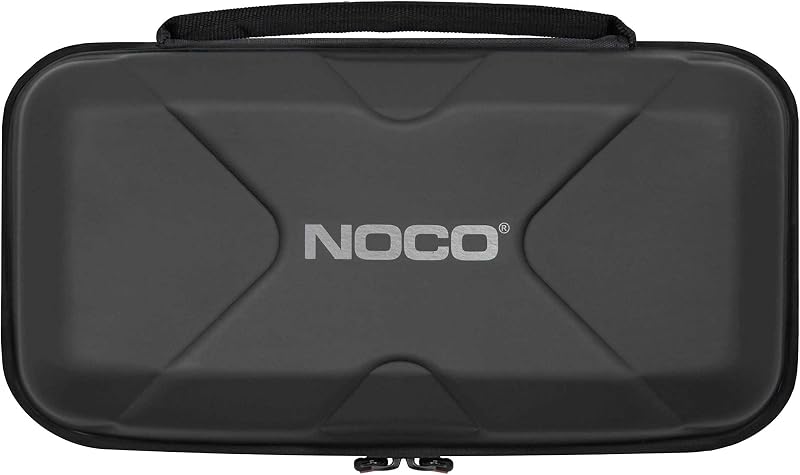
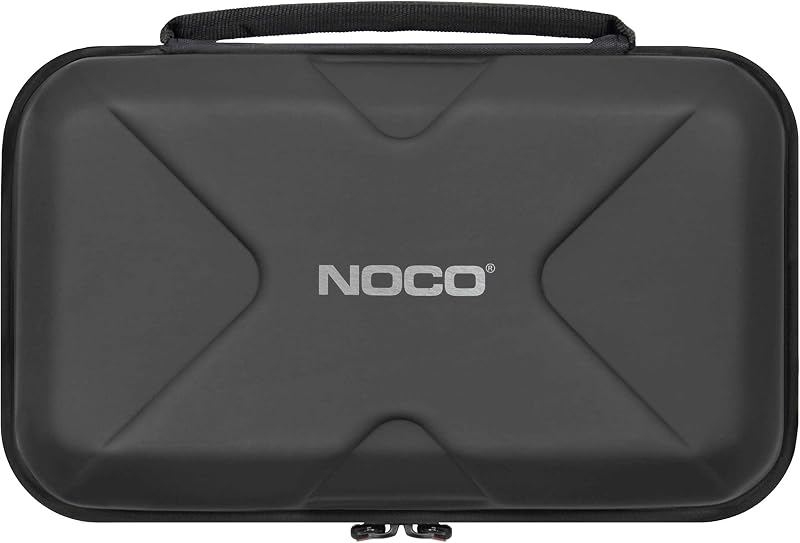
The physical packaging and mounting options of each device dictate where they can be deployed effectively. The GB70 documentation highlights the GBC014 protective enclosure, constructed from heavy-duty Ethylene Vinyl Acetate (EVA) material. Measuring 12.4 inches long, 8.1 inches wide, and 5.4 inches high with a weight of 0.64 kilograms, this case is crush-resistant, anti-shock, and weather-resistant. It includes a reinforced web handle, precision steel-rimmed zippers, custom over-molded pull tabs, and an interior soft melange velvet lining containing two dedicated compartments for the booster and its accessories.
This rugged construction allows the GB70 to live permanently inside a trunk, truck toolbox, or vehicle glove compartment without sustaining physical damage from shifting cargo or temperature swings. For drivers who evaluate mobile gear setups, reviewing how alternatives compare in the noco genius5 vs dbpower 800a analysis demonstrates how mobile form factors differ from bench equipment. The GB70 is built entirely around self-contained transit.
The Genius5 features a compact bench footprint measuring 3.43 inches deep, 4.61 inches wide, and 7.95 inches high at a weight of 1.6 pounds. Designed primarily for static workshop installations, it comes equipped with a 72-inch AC power cable, an 80-inch DC lead with battery clamps, and a specialized mounting bracket with screws for wall or workbench attachment. While lightweight, it relies on reaching a 120V wall outlet via its AC cord and lacks a protective travel enclosure, reflecting its identity as a stationary maintenance appliance.
Edge: NOCO GB70 because its rugged, weather-resistant EVA protective case and self-contained battery design make it fully mobile for vehicle storage.
Pros and Cons
NOCO GB70
Pros
- Standalone lithium emergency jump starting
- Rugged crush-resistant EVA protective case included
- Two dedicated internal storage compartments
- Compact fit for vehicle glove boxes
Cons
- Listing does not specify continuous maintenance
- Limited one-year manufacturer warranty period
NOCO Genius5

Pros
- 5A multi-voltage charging for 6V and 12V
- Dynamic thermal sensor adjusts for ambient temperatures
- Force Mode recovers batteries down to zero volts
- Automatic pulse desulfation repairs stratified plates
- Three-year manufacturer warranty included
Cons
- Requires 120V AC wall power connection
- Eight-hour charge cycle prevents instant starts
Who Should Buy Each One
Choose the NOCO GB70 If
- You need standalone emergency starting capability to revive a dead engine while traveling away from electrical outlets.
- You want a complete mobile setup with a crush-resistant, weather-resistant EVA carrying case that fits in a glove compartment or trunk.
- You drive frequently in remote areas where waiting for roadside assistance is impractical.
- Your primary goal is rapid vehicle turnaround without waiting for an eight-hour charging cycle.
Choose the NOCO Genius5 If
- You need to maintain, trickle charge, or winterize stored vehicles such as motorcycles, classic cars, boats, or lawn tractors.
- You require multi-voltage support for both 6-volt and 12-volt lead-acid, AGM, and lithium LiFePO4 batteries up to 120 amp-hours.
- You need to recover deeply discharged batteries drained down to zero volts using manual Force Mode.
- You want an automatic pulse desulfator with ambient temperature compensation that can stay connected safely and indefinitely.
Final Verdict
When conducting a comprehensive Genius5 vs NOCO GB70 evaluation, the final recommendation depends entirely on where your vehicle battery is most likely to fail. For the vast majority of vehicle owners looking to avoid roadside stranding, having emergency starting power directly inside the car is paramount. In any NOCO GB70 review, its primary value lies in its self-contained mobility, allowing drivers to overcome a dead battery anywhere without relying on another vehicle or a mains power outlet. If you spend significant time driving away from home, the security of portable boosting makes the jump starter an essential glove-box companion.
However, when evaluating a NOCO Genius5 review for workshop utility, the smart charger represents an entirely different class of tool. Those who park seasonal equipment, manage classic vehicle collections, or require deep chemical restoration will find the AC charger far more beneficial over the lifespan of their batteries. Ultimately, is NOCO Genius5 worth it? Yes, for anyone with garage access who wants to reverse sulfation, manage winter storage, and prevent battery death before it ever happens. Likewise, is NOCO GB70 worth it? Absolutely, whenever independent roadside survival and rapid engine turnover take precedence over stationary maintenance.
FAQ
Can the NOCO GB70 recharge a dead battery like the Genius5?
No, the GB70 is designed as an emergency jump starter rather than a multi-stage battery charger. It delivers a rapid burst of current to start the engine, after which the vehicle alternator must recharge the battery. The listing does not specify continuous trickle charging or multi-stage replenishing modes for the GB70.
Does the NOCO Genius5 require an AC wall outlet to work?
Yes, the Genius5 requires a 120-volt alternating current wall outlet to operate. It includes a 72-inch AC power cord and does not contain an internal battery, meaning it cannot provide portable jump starts on the side of the road away from mains power.
Can the NOCO Genius5 jump start a car immediately?
No, the Genius5 has a current rating of 5 amps, which is designed for steady replenishment over an 8-hour charge cycle rather than instantaneous cranking. It does not provide the massive instant amperage dump required to turn over a dead starter motor on demand.
What is the difference in warranty coverage between these two units?
According to the manufacturer product data, the GB70 protective case package includes a 1-year limited warranty, whereas the Genius5 smart battery charger comes backed by a 3-year limited warranty.
How does Force Mode work on the NOCO Genius5?
Standard charging modes on the Genius5 detect and charge batteries down to 1 volt automatically. Force Mode is a manual feature that bypasses standard automated detection to deliver charging current to completely dead batteries down to zero volts, allowing users to recover deeply discharged or neglected cells.
Can you leave the NOCO GB70 connected to a vehicle battery indefinitely?
No, jump starters are intended for temporary connection strictly during the starting process and must be disconnected once the vehicle runs. For indefinite, worry-free maintenance, the Genius5 is specifically designed to remain connected 24/7 without risk of overcharging.
Can the NOCO Genius5 charge 6-volt batteries?
Yes, the Genius5 features dedicated charging modes for both 6-volt and 12-volt systems, making it compatible with older vintage cars, tractors, and small powersport batteries, whereas the GB70 listing does not indicate 6-volt compatibility.