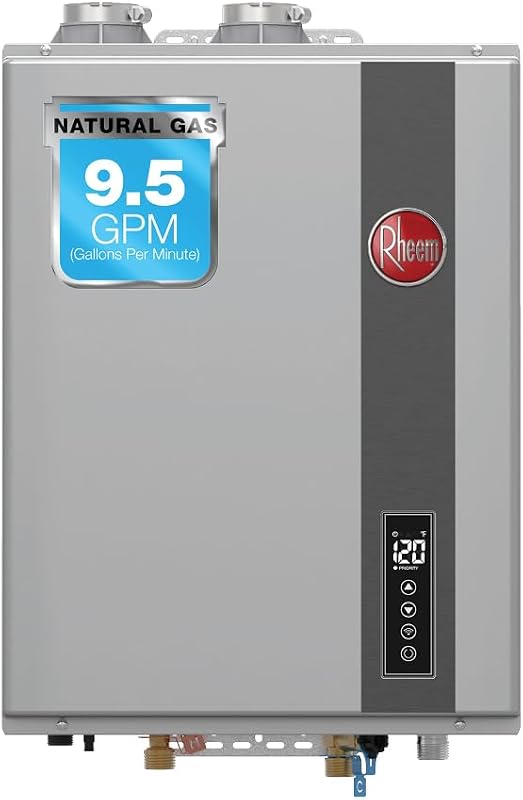
The fundamental dividing line between the Rinnai RE180iN and the EcoSmart ECOS 27 comes down to fuel infrastructure and flow capacity: the gas-fired Rinnai delivers high-output continuous flow across multiple simultaneous plumbing fixtures, whereas the electric EcoSmart offers vent-free installation and point-of-use agility constrained by residential electrical panel limits.
Choose the Rinnai RE180iN if your property has an active natural gas line and demands enough hot water to run multiple showers and appliances at the same time. Choose the EcoSmart ECOS 27 if your home is fully electric, has sufficient breaker panel headroom to support a heavy amperage draw, and needs a compact footprint for low-flow or targeted fixture delivery.


Rinnai RE180iN vs EcoSmart ECOS 27 at a Glance
| Feature | Rinnai RE180iN | EcoSmart ECOS 27 |
|---|---|---|
| Power Source | Natural Gas | Corded Electric |
| Heating Output / Input | 180,000 BTU (18 kW listed) | 27 kW |
| Maximum Flow Rate | 8.5 GPM (up to 6.9 GPM across 5 fixtures) | 2.7 to 6.6 GPM |
| Electrical Service Requirement | 120 Volts | 240 Volts, 112.5 Amps |
| Dimensions (W x H x D) | 14.05 x 27.28 x 27.28 inches | 9.25 x 19 x 4.25 inches |
| Unit Weight | 24.49 kg | 10.9 lbs |
| Cabinet Material | Stainless Steel | Plastic |
| Thermal Efficiency | Not listed | 96% |
| Maximum Operating Temperature | 140 °F | 140 °F |
| Warranty Coverage | 15-yr heat exchanger, 5-yr parts, 5-yr labor (registered) | 5-yr limited on leaks, 1-yr parts |
| Best For | Whole-home concurrent fixture usage with gas utility | Compact, vent-free electric installations with robust power service |
Hot Water Delivery and Flow Rate Capacity
Flow rate determines how many plumbing fixtures can draw hot water simultaneously without causing a sudden temperature plunge or a trickle at the faucet. In any practical hot water evaluation, flow rate is dictated by both burner or heating element power and incoming groundwater temperature. If incoming water is cold, a heater must apply far more energy to lift that water to a comfortable 120 °F to 140 °F threshold, which naturally lowers the gallons per minute (GPM) the appliance can push out in real-time operation.
The Rinnai RE180iN is engineered around high-volume domestic output. With a raw heating potential of 180,000 BTU, it lists a top-tier flow rate of 8.5 GPM, with Rinnai detailing that it reliably supplies up to 6.9 GPM across as many as five fixtures running at once. That sheer thermal throughput makes it a true whole-house anchor. In contrast, the EcoSmart ECOS 27 operates on a 27 kW electric array that delivers between 2.7 and 6.6 GPM depending strictly on inlet water temperature. While 6.6 GPM is achievable under warm Southern inlet temperatures, homeowners in northern climates drawing near-freezing inlet water will see output drop toward the lower 2.7 GPM floor. Shoppers comparing high-capacity platforms often cross-shop units like the rinnai ru199in vs ecosmart ecos 27 to measure whether electric elements can ever truly match gas combustion.
For large households where morning routines overlap, this difference is substantial. The RE180iN can handle two full showers, a washing machine, and a kitchen sink concurrently under moderate ground temperatures. The ECOS 27, even under favorable conditions, is constrained to one or two concurrent hot water draws before exhausting its instantaneous thermal capacity. In colder regions, the electric unit functions best as an office breakroom, bathroom-dedicated, or low-flow solution rather than a whole-house workhorse.
Edge: Rinnai RE180iN, because its 180,000 BTU gas output reliably supports up to five simultaneous fixtures compared to the lower, inlet-dependent flow window of the electric unit.
Utility Infrastructure and Installation Requirements
Choosing between natural gas and electric tankless water heaters requires looking closely at your home’s existing utility infrastructure. The physical water heater is only one half of the system; the utility lines supplying it dictate whether installation is a straightforward swap or a major home renovation. A gas burner requires adequate fuel volume, combustion air, and an exhaust route, whereas a high-wattage electric water heater demands severe continuous electrical capacity from your main breaker panel.
The EcoSmart ECOS 27 requires 240 volts and draws 112.5 amps at peak output across its 27 kW heating matrix. In practical terms, this requires dedicated multi-breaker space-often three 40-amp double-pole breakers-and substantial total service amperage. If your home has a standard 100-amp or older 150-amp electrical panel, installing the ECOS 27 will necessitate an electrical service upgrade before the unit can even be switched on. However, because it is an electric appliance, it requires zero venting, zero combustible clearance outside the cabinet, and produces no exhaust gases. For a look at how electric platforms match up against dedicated condensing gas designs, see our analysis of the rheem rtgh series vs ecosmart ecos 27.
Conversely, the RE180iN draws very little electrical power, running on a standard 120-volt outlet to power its internal computer, LED display, and electronic ignition. However, feeding its 180,000 BTU demand requires an active natural gas connection. While the listing notes an improved cleaner internal layout and a new sliding bracket for easier alignment, it explicitly advises professional installation through a licensed technician. Regarding the Rinnai RE180iN gas line size, the listing does not specify the exact pipe diameter required, meaning an installer must calculate line length and gas pressure to verify if a standard supply pipe suffices. Gas combustion also mandates dedicated exhaust venting to the outdoors because the RE180iN is an indoor non-condensing appliance.
Edge: Tie, as the EcoSmart eliminates exhaust venting and gas lines entirely but requires massive 112.5-amp electrical capacity, while the Rinnai needs only standard 120V power but demands professional gas line routing and flue venting.
Cabinet Footprint and Placement Flexibility
Tankless heaters are inherently space-saving compared to traditional 50-gallon storage tanks, but the physical disparity between gas and electric form factors is striking. Where the unit can be mounted alters closet utility, garage layout, or bathroom aesthetics.
The EcoSmart ECOS 27 showcases extreme miniaturization. Measuring 19 inches high, 9.25 inches wide, and just 4.25 inches deep, with a weight of only 10.9 pounds, the unit is scarcely larger than an average dictionary. Its lightweight plastic enclosure and lack of combustion air requirements allow it to be mounted inside small utility closets, under vanity cabinets, in office breakrooms, or directly at the point of use on almost any interior wall stud. You do not need to factor in exterior wall proximity or vertical roof penetrations for exhaust pipes.
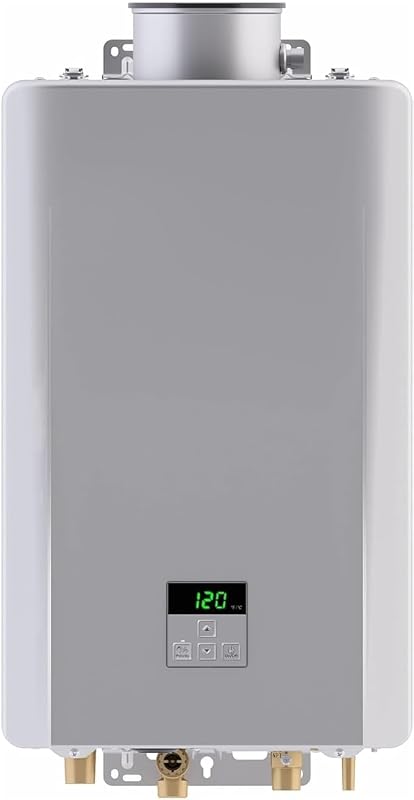
The Rinnai RE180iN occupies a much more substantial envelope. Described by Rinnai as taking up the space of a small suitcase, its dimensions measure 14.05 inches wide by 27.28 inches high, with a listed item depth of 27.28 inches. Weighing in at 24.49 kilograms (roughly 54 pounds), this stainless steel appliance demands a sturdy structural wall mount. Furthermore, because it burns natural gas indoors, it must be situated where intake and exhaust flue pipes can safely breach the home envelope. While its sliding bracket aids physical hanging, you cannot tuck the RE180iN under a sink or inside a shallow finished cabinet.
Edge: EcoSmart ECOS 27, by virtue of its ultra-slim 4.25-inch depth, 10.9-pound weight, and ability to mount in tight point-of-use spaces without venting cutouts.
Thermal Efficiency and Temperature Control
Operational efficiency measures how completely an appliance converts incoming energy into usable domestic heat. In an era of escalating utility demands, the method by which a unit modulates its heating elements directly affects stability at the tap and long-term energy waste.
The EcoSmart ECOS 27 features self-modulating technology that actively measures water flow rate and incoming temperature. By continuously adjusting the electrical draw of its 27 kW elements, the unit regulates water output to remain consistent within 1 degree of your selected temperature, up to a maximum setting of 140 °F. Furthermore, the listing rates the EcoSmart at 96% thermal energy efficiency. Because electric immersion elements transfer heat directly to the water column without exhaust gasses carrying away BTUs, almost every watt pulled from the grid enters the water stream. Those evaluating high-tier gas efficiencies often explore comparisons like the rinnai re180in vs rheem rtgh series to evaluate how non-condensing burners contrast with alternative heating systems.
The Rinnai RE180iN is a non-condensing gas platform. While the listing does not specify an exact thermal efficiency percentage, non-condensing gas systems generally lose a fraction of their thermal energy through the high-temperature exhaust flue. However, the RE180iN incorporates a smart design that fires only when hot water is called for, eliminating standby heat loss entirely. It features an integrated LED display that delivers clear error codes and automated service reminders, and it caps out at the same 140 °F maximum water temperature as the electric competitor. For homeowners seeking smart home integration, the listing confirms the RE180iN can pair with an optional Rinnai Controlr module for Wi-Fi management, though this accessory is not included in the standard box.
Edge: EcoSmart ECOS 27, due to its documented 96% thermal efficiency rating and precise self-modulating temperature control within 1 degree.
Build Construction, Materials, and Warranty Protection
Water heaters endure immense mechanical stress from water pressure, thermal cycling, and corrosive mineral deposits. A heavy-duty build and comprehensive manufacturer warranty are vital indicators of whether a system will survive years of uninterrupted service.
Rinnai builds the RE180iN with commercial-grade durability in mind. The external cabinet is fabricated from stainless steel, protecting internal components and isolating burner combustion. Rinnai backs the unit with an industry-leading residential warranty structure: 15 years on the heat exchanger, 5 years on parts, and 5 years on labor. Buyers must note an important warranty condition: the unit must be registered within 90 days of installation, or the labor coverage defaults to 1 year. The internal layout has also been refined for better serviceability, enabling easier access for maintenance technicians. Those interested in Rinnai’s product hierarchy can examine the rinnai ru199in vs re180in to see how internal heat exchangers differ across model tiers.
The EcoSmart ECOS 27, manufactured under Rheem ownership, uses a lightweight plastic exterior casing. While plastic prevents external rust or corrosion in damp basements, it does not offer the rugged physical protection of stainless steel. Its warranty coverage is considerably more modest: a 5-year limited warranty against leaks and a 1-year warranty on internal parts. When comparing brand longevity across broader lineups, such as in our rinnai vs navien overview, Rinnai’s 15-year heat exchanger protection consistently ranks near the top of the residential plumbing sector.
Edge: Rinnai RE180iN, courtesy of its rugged stainless steel construction and a 15-year heat exchanger warranty that dramatically outclasses the 5-year leak warranty of the EcoSmart.
Pros and Cons
Rinnai RE180iN
Pros
- Up to 8.5 GPM flow rate
- Supplies up to 5 simultaneous fixtures
- Durable stainless steel cabinet
- 15-year heat exchanger warranty
- Operates on standard 120-volt electrical outlet
Cons
- Requires dedicated natural gas line and venting
- Substantial 24.49 kg weight
- Professional technician installation recommended
EcoSmart ECOS 27

Pros
- 96% thermal energy efficient
- Ultra-compact 4.25-inch depth
- Weighs only 10.9 pounds
- Self-modulating within 1 degree
- Zero combustion exhaust venting required
Cons
- Heavy 112.5-amp electrical draw at 240 volts
- Flow drops to 2.7 GPM in cold climates
- Exterior housing made of plastic
View EcoSmart ECOS 27 on Amazon
Who Should Buy Each One
Choose the Rinnai RE180iN If
- Your home is already plumbed for natural gas and has a dedicated exhaust route or exterior wall access for non-condensing flue venting.
- You need to supply continuous hot water to multiple high-demand fixtures at once, such as concurrent showers and dishwashers, reaching up to 6.9 GPM across 5 points of use.
- You value long-term structural durability and want a 15-year heat exchanger warranty supported by a stainless steel housing.
- Your electrical panel is older or full, making a standard 120-volt plug-in gas unit far easier to integrate than a high-draw electrical system.
Choose the EcoSmart ECOS 27 If
- Your home has no natural gas line or propane storage, making an all-electric water heating solution mandatory.
- Your main electrical panel has ample headroom to accommodate a 240-volt, 112.5-amp continuous draw.
- You need an ultra-compact water heater that can be tucked into a shallow closet, breakroom, or point-of-use location with only 4.25 inches of depth.
- You want a system that requires zero combustion exhaust venting and achieves 96% thermal energy efficiency right out of the box.
Final Verdict
For the vast majority of medium-to-large single-family homes, the Rinnai RE180iN is the superior primary water heating solution. Its 180,000 BTU natural gas burner delivers up to 8.5 GPM of continuous flow, ensuring that family members can run multiple showers, sinks, and appliances simultaneously without experiencing cold-water interruptions. When paired with its stainless steel construction and up to 15 years of heat exchanger warranty protection, the RE180iN provides the robust output and commercial durability required for demanding whole-house applications.
The EcoSmart ECOS 27 wins decisively in scenarios where natural gas is unavailable, venting penetrations are architecturally impossible, or physical space is at an absolute premium. If your electrical infrastructure can handle the heavy 112.5-amp load, its 96% thermal efficiency, 10.9-pound featherweight frame, and precise self-modulating temperature control make it an exceptional choice for small apartments, office breakrooms, or regional warm-climate homes with lower simultaneous flow demands.
FAQ
Can the EcoSmart ECOS 27 support a whole house?
The EcoSmart ECOS 27 can serve as a whole-house heater primarily in warmer climates or smaller homes with modest hot water demands. Because its output ranges from 2.7 to 6.6 GPM depending on incoming groundwater temperature, colder northern regions will see flow rates drop toward the lower end of that range, which is generally only sufficient for a single shower running at one time.
What are the electrical requirements for the EcoSmart ECOS 27?
The EcoSmart ECOS 27 operates on 240 volts and draws up to 112.5 amps at peak capacity across its 27 kW heating matrix. Installing this unit requires an electrical service panel with substantial available amperage, typically utilizing multiple dedicated double-pole breakers.
What gas line size does the Rinnai RE180iN require?
The product listing does not specify the exact gas line diameter for the Rinnai RE180iN. Because the unit consumes 180,000 BTU of natural gas, the required pipe diameter depends on the distance from your gas meter and total household gas demand; Rinnai strongly advises consulting a licensed technician to size the gas line appropriately.
Does the Rinnai RE180iN include Wi-Fi capabilities?
The Rinnai RE180iN supports Wi-Fi connectivity, but the required module is not included in the box. Homeowners must purchase the separate Rinnai Controlr accessory to enable wireless monitoring and control features.
What is the maximum water temperature for both units?
Both the Rinnai RE180iN and the EcoSmart ECOS 27 have a specified maximum water temperature output of 140 °F, which exceeds standard residential delivery recommendations of 120 °F and provides ample heat for sanitizing needs.
Can the EcoSmart ECOS 27 be mounted outdoors?
The EcoSmart ECOS 27 is an indoor-rated electric water heater featuring a plastic cabinet and corded electrical connection. It is not designed or listed for outdoor installation and must be protected from weather elements inside a conditioned or semi-conditioned space.
Do I need professional installation for the Rinnai RE180iN?
Yes, Rinnai explicitly states in the listing that they do not recommend installing the RE180iN without a technician. A licensed professional ensures proper gas line sizing, gas pressure regulation, safe indoor combustion venting, and timely warranty registration within 90 days.