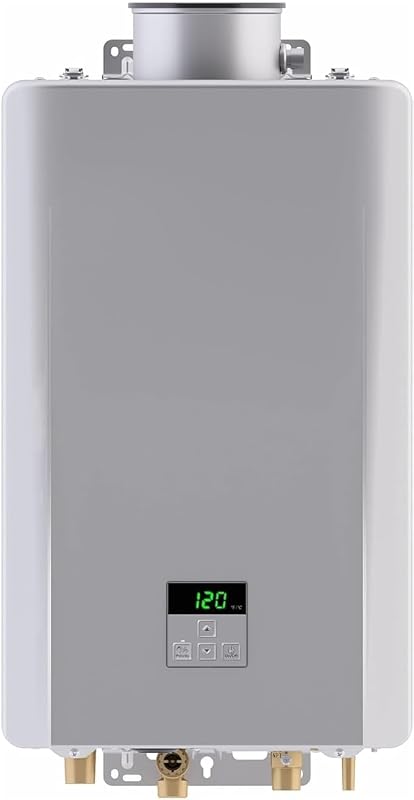
The fundamental distinction separating the Rheem RTGH Series from the EcoSmart ECOS 27 centers on fuel infrastructure and real-world hot water volume. Rheem engineered the RTGH Series as a high-capacity condensing natural gas powerhouse capable of delivering up to 9.5 gallons per minute for whole-home demand across multiple simultaneous fixtures. In contrast, the EcoSmart ECOS 27 runs purely on 240-volt electrical service, outputting between 2.7 and 6.6 gallons per minute to serve point-of-use installations, single bathrooms, or homes with moderate simultaneous hot water needs.
Homeowners with existing natural gas lines who require continuous hot water for large, multi-bathroom households should install the Rheem RTGH Series. Property owners operating an all-electric utility profile with sufficient breaker panel space who prioritize compact footprint and point-of-use simplicity should choose the EcoSmart ECOS 27.
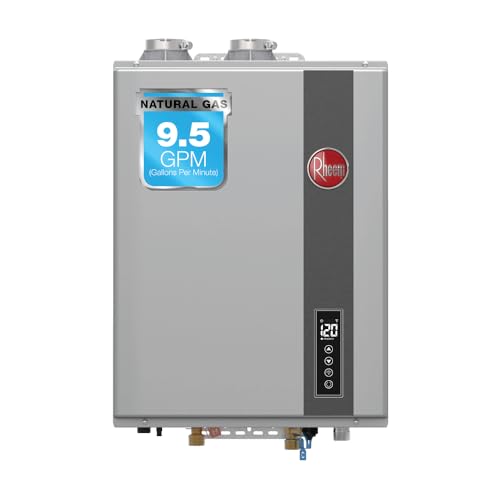

Rheem RTGH Series vs EcoSmart ECOS 27 at a Glance
| Attribute | Rheem RTGH Series | EcoSmart ECOS 27 |
|---|---|---|
| Power Source | Natural Gas (120V ignition/controls) | Corded Electric (240V) |
| Thermal / Power Rating | 199,900 BTU/hr | 27 kW (112.5 Amps) |
| Maximum Flow Rate | 9.5 GPM (at 35°F rise) | 6.6 GPM (ranges 2.7 to 6.6 GPM) |
| Energy Efficiency | 0.93 Uniform Energy Factor (UEF) | 96% Thermal Energy Efficiency |
| Item Dimensions (W x H x D) | 17.7 x 23.7 x 9.8 inches | 9.25 x 19 x 4.25 inches |
| Unit Weight | 51.3 pounds | 10.9 pounds |
| Exterior Material | Stainless Steel | Plastic |
| Smart Connectivity | Built-in Wi-Fi with EcoNet app | Not listed |
| Leak Protection | LeakGuard detection and prevention | Not listed |
| Warranty Coverage | 15-year heat exchanger, 5-year parts | 5-year limited on leaks, 1-year parts |
| Best For | Multi-bath whole-house demand | Low-flow electric and point-of-use |
Heating Power and Fuel Infrastructure
Heating output determines how quickly and effectively a tankless water heater raises incoming cold water to your chosen tap temperature. The Rheem RTGH Series utilizes a massive 199,900 BTU natural gas burner combined with condensing technology to produce immense thermal energy on demand. This heavy combustion output requires an active natural gas supply line, dedicated venting, and a standard 120-volt electrical outlet drawing just 132 watts to operate its internal exhaust blower and digital control board. When sizing residential units against high-output competitors, as seen when comparing the rinnai ru199in vs rheem rtgh series, access to an adequate gas meter and pipe diameter remains essential for reaching full BTU output.
The EcoSmart ECOS 27 takes a completely different path by using electric resistance heating elements. Consuming 27 kilowatts of power at 240 volts, the unit draws a substantial 112.5 amps at peak operation. To support this electrical appetite, your property must provide sufficient electrical service, typically requiring multiple dedicated 40-amp double-pole breakers and heavy-gauge copper wiring. While it eliminates the need for gas plumbing or combustion air supplies, homeowners considering the rinnai ru199in vs ecosmart ecos 27 must ensure their home electrical panel has at least 150 to 200 amps of total capacity before adding an electric heater of this size.
Operating a natural gas unit gives you far higher gross energy throughput without placing strain on your electrical panel. While the EcoSmart ECOS 27 avoids gas line installations, its massive 112.5-amp electrical draw can necessitate an expensive breaker box upgrade if your service panel is already near capacity. For whole-home heating tasks requiring sustained peak temperatures, the natural gas burner in the RTGH Series supplies vastly superior heating potential.
Edge: Rheem RTGH Series delivers substantially higher raw heating output through its 199,900 BTU gas system without overloading your household electrical panel.
Flow Rate and Multi-Fixture Demand
Flow rate dictates how many household fixtures can draw hot water at the exact same moment without causing cold water fluctuations. The Rheem RTGH Series model RTGH-95DVELN-3 delivers an impressive maximum flow rate of 9.5 gallons per minute at a 35°F temperature rise. According to the manufacturer specifications, this volume comfortably supports three to four simultaneous showers, making it an authentic whole-house platform for busy morning routines in large family residences. Even in cooler regions where groundwater enters the home at lower temperatures, the high BTU burner maintains strong pressure across several open taps.
The EcoSmart ECOS 27 provides between 2.7 and 6.6 gallons per minute depending heavily on incoming groundwater temperature. In warm climates where supply water requires minimal heating, the unit can reach its 6.6 GPM threshold, running two standard fixtures concurrently. However, in northern climates where groundwater is frigid, the flow rate drops toward the 2.7 GPM floor to ensure the heating elements achieve the target temperature. As detailed in the manufacturer listing, this model is tailored specifically for a bathroom, small sink, office breakroom, or localized point-of-use and low-flow applications rather than concurrent multi-bathroom demands.
The difference in output creates distinct practical use cases. If multiple family members shower while a dishwasher or washing machine runs, the ECOS 27 will throttle flow or struggle to maintain heat. Shoppers researching the rinnai re180in vs rheem rtgh series will find that whole-home continuous flow requires the high-volume throughput that only large-format gas units deliver.
Edge: Rheem RTGH Series wins decisively by supplying up to 9.5 GPM, enabling three to four simultaneous showers without loss of hot water.
Energy Efficiency and Thermal Management
Efficiency ratings highlight how effectively each unit converts incoming energy into usable hot water without waste. The EcoSmart ECOS 27 boasts a 96% thermal energy efficiency rating. Because electric immersion elements transfer heat directly to the water surrounding them inside the heat chamber, almost no energy escapes during the process. Furthermore, its self-modulating technology continuously monitors incoming water temperature and flow rates, modulating electrical power consumption in real time to maintain temperature consistency within 1 degree of your selection.
The Rheem RTGH Series features an industry-leading condensing design achieving a 0.93 Uniform Energy Factor (UEF). Condensing systems incorporate a secondary stainless steel heat exchanger that captures heat from exhaust gases before venting them outside, using up to 34% less energy than standard 50-gallon electric storage tanks. Rheem also integrates exclusive Hot Start Programming, a software safeguard that keeps the internal system in a ready state during back-to-back fixture uses to eliminate the frustrating cold-water sandwich burst typical of traditional on-demand heaters.
Both models feature precision digital temperature controls capable of maintaining warmth within 1°F up to a maximum limit of 140°F. While the EcoSmart holds a higher raw percentage of thermal efficiency at 96%, the Rheem RTGH Series balances its fuel efficiency with ultra-low NOx burner compliance and advanced thermal buffering that stops sudden water temperature drops during intermittent use.
Edge: EcoSmart ECOS 27 holds a slight theoretical advantage with 96% thermal efficiency, though Rheem matches it in practical consistency via Hot Start Programming.
Physical Dimensions and Installation Constraints
Physical space and mounting requirements influence installation complexity and placement options. The EcoSmart ECOS 27 measures a compact 9.25 inches wide, 19 inches high, and 4.25 inches deep, with a total weight of just 10.9 pounds. Constructed with a lightweight plastic exterior, the unit is roughly 90% smaller than a standard storage tank. It requires zero exhaust ductwork or intake piping, allowing it to hang directly on drywall inside a small closet, under a counter, or adjacent to a single bathroom fixture.
By comparison, the Rheem RTGH Series is a heavy-duty appliance measuring 17.7 inches wide, 23.7 inches high, and 9.8 inches deep, with an overall weight of 51.3 pounds. The durable stainless steel enclosure requires solid structural wall mounting. Because it burns natural gas, it requires dedicated direct venting through an exterior wall or roof to exhaust combustion gases, alongside proper gas line sizing and condensate drainage lines to handle the acidic runoff generated by condensing heat exchangers.
The EcoSmart ECOS 27 provides exceptional spatial flexibility for tight living spaces and retrofit installations where cutting vent penetrations through walls is impossible. Those exploring smaller alternative units like the rinnai re180in vs ecosmart ecos 27 will appreciate that electric tankless models require no roof penetrations or exterior vent terminations, dramatically simplifying physical mounting location.
Edge: EcoSmart ECOS 27 easily wins on physical footprint and placement versatility thanks to its 10.9-pound weight and ventless design.
Smart Features, Safety, and Long-Term Durability
Component materials and built-in protection mechanisms determine how long a tankless water heater operates without maintenance headaches. The Rheem RTGH Series incorporates advanced smart home connectivity through integrated Wi-Fi and the EcoNet app. Homeowners can adjust water temperatures, track energy usage, and receive real-time system alerts directly on a smartphone. For safety, Rheem includes built-in freeze protection, an Overheat Film Wrap around the heat exchanger, and the proprietary LeakGuard Leak Detection and Prevention System, which detects moisture and shuts down water flow to protect your home from costly water damage.
The EcoSmart ECOS 27 focuses on straightforward hardware operation without wireless features or mobile applications. It uses digital LED controls to let you dial in precise temperatures, operating safely up to a maximum water pressure of 150 psi. However, the listing does not specify internal Wi-Fi capabilities, freeze protection safeguards, or automatic water shut-off valves, relying instead on its self-modulating internal sensors to prevent element burnout.
Durability differences are also reflected in exterior build quality and manufacturer warranties. Rheem builds the RTGH Series with an industrial stainless steel chassis and backs it with a 15-year heat exchanger warranty and 5 years on parts. EcoSmart builds the ECOS 27 housing from plastic and provides a 5-year limited warranty against leaks, with parts covered for just 1 year. The industrial construction and comprehensive monitoring of the Rheem model deliver unmatched longevity and peace of mind.
Edge: Rheem RTGH Series dominates with stainless steel construction, integrated Wi-Fi controls, LeakGuard flood prevention, and a 15-year warranty.
Pros and Cons
Rheem RTGH Series
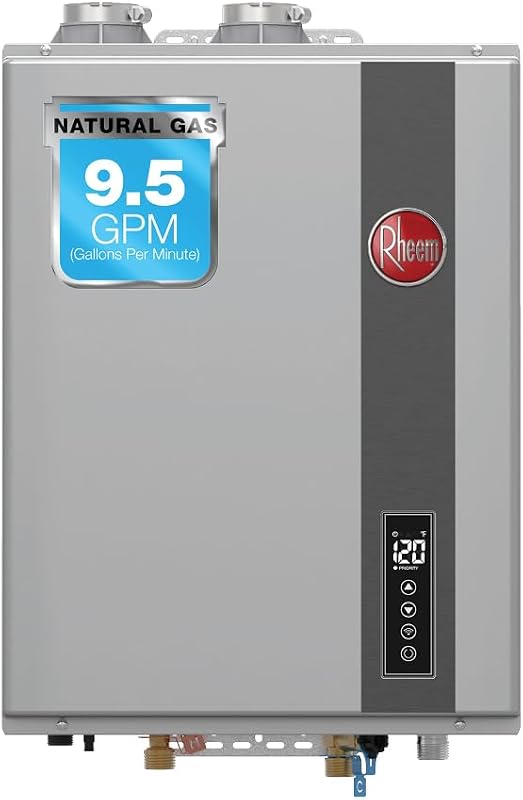
Pros
- 5 GPM continuous multi-fixture flow rate
- High-efficiency 199,900 BTU condensing gas burner
- Built-in Wi-Fi with EcoNet app controls
- Integrated LeakGuard detection and prevention system
- 15-year heat exchanger warranty coverage
Cons
- Requires dedicated direct venting and gas piping
- Heavier 51.3-pound stainless steel chassis
View Rheem RTGH Series on Amazon
EcoSmart ECOS 27

Pros
- 96 percent thermal energy efficiency
- Compact 10.9-pound space-saving wall mount
- No exterior combustion venting required
- Precise self-modulating temperature technology
Cons
- Demands 112.5-amp 240-volt electrical capacity
- Flow drops to 2.7 GPM in cold water
- Limited 1-year parts warranty
View EcoSmart ECOS 27 on Amazon
Who Should Buy Each One
Choose the Rheem RTGH Series If
- You live in a multi-bathroom household where 3 to 4 showers run simultaneously.
- Your home is equipped with a natural gas line and an exterior wall or roof path for direct venting.
- You want remote smartphone control, water tracking, and leak prevention via built-in Wi-Fi and LeakGuard.
- You value long-term equipment protection backed by a 15-year heat exchanger warranty.
Choose the EcoSmart ECOS 27 If
- Your residence runs exclusively on electricity and lacks natural gas infrastructure.
- Your electrical service panel has 150 to 200 amps with space for 112.5 amps of dedicated 240V breakers.
- You need an ultra-compact unit for an office breakroom, small sink, or single bathroom point-of-use application.
- You want a vent-free installation that can mount inside tight closets or small utility spaces.
Final Verdict
For most homeowners seeking a comprehensive whole-house replacement for a traditional water tank, the Rheem RTGH Series is the superior choice. Its 199,900 BTU condensing gas burner delivers up to 9.5 gallons per minute, effortlessly supplying multiple fixtures at once without sudden temperature drops. Combined with commercial-grade stainless steel construction, built-in Wi-Fi management through the EcoNet app, integrated LeakGuard water shut-off protection, and a 15-year heat exchanger warranty, the RTGH Series offers the durability and continuous capacity required for modern families.
The EcoSmart ECOS 27 remains a sensible option when natural gas is unavailable or venting through exterior walls is physically impractical. Its 96% thermal efficiency, 10.9-pound plastic chassis, and self-modulating 27 kW heating system make it a capable point-of-use or low-flow solution. However, because it demands 112.5 amps of dedicated electrical service and caps flow between 2.7 and 6.6 GPM depending on incoming water temperatures, it cannot match the continuous whole-home multi-bath capabilities of the Rheem RTGH Series.
FAQ
Can the EcoSmart ECOS 27 support a whole house?
The EcoSmart ECOS 27 can serve as a whole-house water heater only in small homes with warm incoming groundwater and modest simultaneous usage. Because its output ranges from 2.7 to 6.6 GPM, it is primarily intended for a single bathroom, small sink, breakroom, or point-of-use applications rather than multi-bath homes running simultaneous showers.
What venting is required for the Rheem RTGH Series?
The Rheem RTGH Series is an indoor condensing natural gas unit that requires direct venting to the outside. Because it uses condensing technology with a 0.93 UEF, exhaust gases are cool enough to allow approved venting materials, but it must have dedicated exterior intake and exhaust ducting to operate safely.
What electrical service does the EcoSmart ECOS 27 require?
The EcoSmart ECOS 27 draws 27 kW at 240 volts, which equals 112.5 amps of electrical current. Installing this unit requires adequate main panel capacity, usually demanding a 200-amp electrical service panel and multiple dedicated double-pole 40-amp circuit breakers.
Does the Rheem RTGH Series require electricity to run?
Yes, while the primary heating fuel is natural gas, the Rheem RTGH Series requires a standard 120-volt electrical connection. The electrical draw is 132 watts, which powers the digital LED control panel, internal computer, exhaust blower, freeze protection, and built-in Wi-Fi module.
How does Rheem Hot Start Programming prevent cold water bursts?
Hot Start Programming keeps the RTGH Series in a ready state between consecutive hot water demands. This eliminates the standard lag time when cycling taps on and off, preventing the common cold-water sandwich effect where a slug of unheated water enters the pipes between uses.
Can I install the EcoSmart ECOS 27 outdoors?
The listing specifies that the EcoSmart ECOS 27 is designed for indoor wall mounting or point-of-use locations. It features a lightweight plastic enclosure that is not rated for outdoor weather exposure or freezing environmental conditions.