The primary distinction between the Samsung T7 Shield and the Samsung T9 comes down to a direct tradeoff between outdoor environmental sealing and peak data throughput. While the T7 Shield caps sequential read speeds at 1,050 MB/s over a USB 3.2 Gen 2 interface and adds certified IP65 water and dust resistance, the T9 doubles that theoretical bandwidth ceiling to 2,000 MB/s utilizing a dual-lane USB 3.2 Gen 2×2 interface without advertising liquid ingress protection.
Outdoor videographers, field photographers, and mobile content creators facing dirt, rain, or wet terrain should choose the Samsung T7 Shield. Studio editors, desktop operators, and PC workstation users who have compatible 20 Gbps ports and prioritize raw data transfer speeds for multi-gigabyte files should choose the Samsung T9.
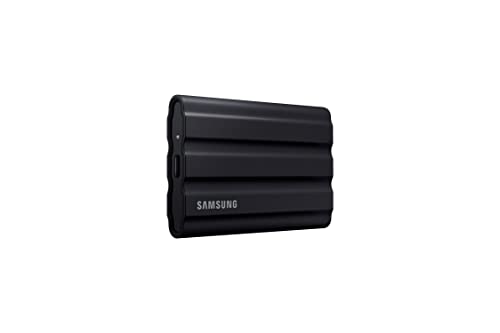
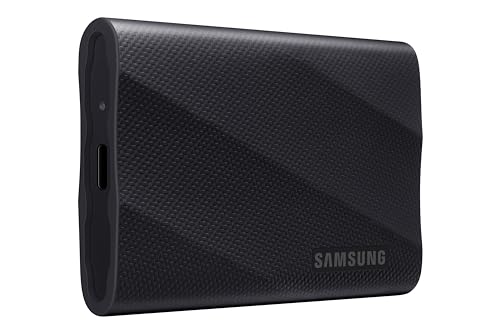
Samsung T7 Shield vs Samsung T9 at a Glance
| Feature | Samsung T7 Shield | Samsung T9 |
|---|---|---|
| Host Interface | USB 3.2 Gen 2 (10 Gbps) | USB 3.2 Gen 2×2 (20 Gbps) |
| Max Sequential Read Speed | Up to 1,050 MB/s | Up to 2,000 MB/s |
| Max Sequential Write Speed | Up to 1,000 MB/s | Up to 2,000 MB/s |
| Ingress Protection | IP65 water and dust resistance | Not listed |
| Drop Resistance | Up to 9.8 feet | Up to 9.8 feet |
| Thermal Management | Dynamic Thermal Guard | Dynamic Thermal Guard (IEC 62368-1) |
| Hardware Encryption | AES 256-bit | AES 256-bit |
| Form Factor Size | 2.5 inches | 2.4 inches |
| Direct iPhone ProRes Support | iPhone 15/16 Pro 4K at 60fps | iPhone 15/16 Pro 4K at 60fps |
| Best For | Rugged field capture and travel | High-bandwidth studio production |
Transfer Speeds and Interface Performance
Sequential throughput marks the fundamental divide between these two solid-state drives. The T7 Shield relies on a single-lane USB 3.2 Gen 2 interface paired with internal PCIe NVMe technology, delivering maximum sequential read and write speeds of up to 1,050 MB/s and 1,000 MB/s respectively. This configuration easily saturates a standard 10 Gbps USB port, which provides plenty of headroom for editing high-resolution stills, operating general file backups, or skimming compressed video files. Understanding these metrics is familiar to anyone who followed the transition in the samsung t7 vs t7 shield evolution, where internal architecture stayed constant while the outer chassis changed.
In contrast, the Samsung T9 transfer speed scales up to 2,000 MB/s for both sequential read and sequential write tasks. This leap is made possible by its USB 3.2 Gen 2×2 interface, which effectively doubles the bandwidth lane count to 20 Gbps. In sustained large-file copying, such as moving a 100GB folder of raw video assets, the T9 can cut waiting times roughly in half compared to the T7 Shield, provided the host system supports dual-lane USB 3.2 Gen 2×2. When running a direct Samsung T7 Shield vs T9 speed test on a motherboard equipped with USB 3.2 Gen 2×2, the T9 clearly separates itself from the 1,050 MB/s ceiling of the Shield.
However, that performance gain hinges entirely on host hardware support. The T9 requires both a computer port and connection cables that support USB 3.2 Gen 2×2 with UASP mode enabled to reach that 2,000 MB/s limit. If plugged into a standard USB 3.2 Gen 2 port, the T9 automatically steps down to standard 10 Gbps speeds, operating at virtually the same rates as the T7 Shield. For users whose devices support the 20 Gbps protocol, the performance upgrade is substantial, whereas users on single-lane connections will see identical throughput across both drives.
Edge: Samsung T9, because its USB 3.2 Gen 2×2 interface offers double the maximum theoretical read and write throughput of the T7 Shield on supported systems.
Durability and Environmental Protection
Physical protection is where the priorities invert in this Samsung T9 vs T7 Shield durability comparison. The T7 Shield is specifically engineered for exposure to unpredictable outdoor elements. It features a ruggedized outer elastomer cover that wraps the entire casing, providing verified drop resistance from heights up to 9.8 feet. The listing specifies that this rubberized outer layer cushions sudden shocks, protecting the internal drive components from accidental slips off desks, camera carts, or trail benches.
More importantly, the T7 Shield includes certified ingress protection under an IP65 rating. The manufacturer documentation specifies rigorous testing under controlled conditions: the drive withstood continuous water flow of 100kPa for 3 minutes and was tested against 2kg/m³ of active dust under a pressure of 2kPa for 8 hours. This makes Samsung T7 Shield water resistance and dust exclusion a decisive factor for creators who shoot in damp forests, desert environments, beaches, or rainy city streets, mirroring the weather-proofing needs discussed in the samsung t7 shield vs sandisk extreme pro portable evaluation.
The T9 provides rugged durability that also endures drops up to 9.8 feet, but its product listing does not specify an IP rating for water or dust ingress. While its curved textured chassis can handle impact and physical drops in a studio or travel bag, it lacks the certified defense against fine particle penetration or direct water spray found on the T7 Shield. Submerging or exposing the T9 to severe environmental conditions introduces risks that the T7 Shield was explicitly engineered to handle.
Edge: Samsung T7 Shield, due to its certified IP65 water and dust resistance rating paired with an impact-absorbing elastomer body.
Video Editing and Sustained Creator Workflows
When weighing the Samsung T7 Shield or T9 for video editing, the nature of your timeline and footage codecs dictates which drive delivers better everyday value. The T7 Shield provides sequential write speeds up to 1,000 MB/s, which is more than sufficient to edit 4K ProRes or compressed raw footage directly from the drive without dropping frames. For independent creators managing single-camera timelines or working with compressed media formats, the T7 Shield handles continuous playback and scrubbing smoothly.
For high-end productions, the Samsung T9 review specs demonstrate a clear advantage in sustained editing environments. The 2,000 MB/s read and write ceiling allows multi-stream 4K or 8K editing, multicam scrubbing, and rapid timeline rendering without bottlenecks. When asking is Samsung T9 worth it for media creation, the answer leans heavily toward yes for editors handling uncompressed footage or massive project caches where disk access speed directly prevents playback stuttering during complex effects processing. It matches the high-throughput requirements seen in other creative comparisons like the samsung t7 vs sandisk extreme pro portable matchup.
Both drives offer direct hardware integration for mobile video capture. Each model supports direct recording from an iPhone 15 Pro or iPhone 16 Pro capturing ProRes 4K video at 60fps. Both listings recommend using the included SSD cable to ensure steady bandwidth during direct camera recording. Because both drives maintain the continuous write throughput necessary for ProRes 4K capture, mobile videographers gain identical capture capability on either model, though the T9 provides faster offloading once the drive is connected back to a 20 Gbps editing bay.
Edge: Samsung T9, because its 2,000 MB/s throughput handles heavier multicam timelines and drastically reduces render and export times on compatible rigs.
Mac and Host Platform Compatibility
System architecture plays an unexpected role when choosing between the Samsung T7 Shield or T9 for Mac users. Apple hardware, including modern MacBook Pro and Mac Studio workstations, features Thunderbolt and USB4 ports that deliver immense bandwidth. However, Apple systems historically do not support the USB 3.2 Gen 2×2 (20 Gbps) dual-lane standard. Consequently, when the T9 is connected to a Mac Thunderbolt 3, Thunderbolt 4, or USB4 port, the connection negotiates down to standard 10 Gbps USB 3.2 Gen 2.
Because of this hardware negotiation limitation, a Mac user plugging in a T9 will typically observe read and write speeds capped near 1,000 MB/s rather than the advertised 2,000 MB/s. The T7 Shield also operates on USB 3.2 Gen 2 at up to 1,050 MB/s. On a standard Mac workstation, both drives essentially deliver matching performance in everyday use. The extra speed headroom of the T9 remains dormant unless you connect it to a PC platform with a dedicated USB 3.2 Gen 2×2 controller, such as high-end Intel or AMD desktop motherboards. Creators pairing drives with dedicated creative monitors, like those comparing the dell u2723qe vs samsung viewfinity s9 for studio real estate, must assess their host ports before expecting peak speeds.
Beyond computers, both drives demonstrate broad ecosystem compatibility across operating systems and consumer hardware. The product data lists compatibility with PC, Mac, Android devices, tablets, and gaming consoles for both units. The T9 listing explicitly names support for specific console models, including the Sony PlayStation 5, Microsoft Xbox Series X, and Microsoft Xbox Series S, confirming its ability to serve as high-capacity external gaming storage alongside professional work.
Edge: Tie, because while the T9 lists explicit gaming console models, the T7 Shield delivers its full advertised performance on standard 10 Gbps Mac and PC ports without requiring niche 2×2 controllers.
Thermal Management and Sustained Heat Control
High-speed solid-state drives generate substantial heat during sustained file transfers, and thermal throttling can quickly degrade performance if an enclosure cannot shed heat effectively. Both models incorporate Samsung Dynamic Thermal Guard, an internal thermal management system designed to monitor and regulate drive temperature during demanding tasks. In any thorough Samsung T9 review or Samsung T7 Shield review, thermal stability is critical for creators transferring hundreds of gigabytes in a single pass.
The T9 features an advanced thermal solution that adheres to international safety standards. According to its specifications, the T9 controls heat to maintain outer skin temperatures below 140 degrees Fahrenheit (60 degrees Celsius) under controlled conditions, complying with the IEC 62368-1 safety standard. This active heat dissipation ensures that the internal NVMe controller does not drop out of peak write modes during prolonged file exports, preventing sudden speed dips in studio workflows.
The T7 Shield relies on its outer elastomer coating and internal heat dissipation pads to govern thermals. While the rubber outer shell acts as an impact buffer, it also manages surface heat effectively without letting the interior throttle during typical operations. Both drives also integrate directly with Samsung Magician software, which allows users to monitor drive health, review internal temperatures, update firmware, and manage data encryption settings from a unified desktop interface.
Edge: Samsung T9, thanks to documented compliance with IEC 62368-1 standards that keep outer skin temperatures below 140 degrees Fahrenheit during sustained heavy loads.
Pros and Cons
Samsung T7 Shield

Pros
- IP65 water and dust resistance
- Up to 1,050 MB/s read speeds
- Durable rubber elastomer outer casing
- Up to 9.8-foot drop resistance
- Direct iPhone 15/16 ProRes recording
Cons
- Half the peak speed of T9
- Limited to USB 3.2 Gen 2
View Samsung T7 Shield on Amazon
Samsung T9
Pros
- Up to 2,000 MB/s transfer speeds
- Fast USB 3.2 Gen 2×2 interface
- Skin temperature kept below 140°F
- Up to 9.8-foot drop resistance
- Explicit console support including PS5 and Xbox
Cons
- No certified IP water resistance
- Requires Gen 2×2 port for top speed
Who Should Buy Each One
Choose the Samsung T7 Shield If
- You work outdoors in dusty, damp, or rainy environments that require certified IP65 ingress protection.
- You use a Mac system or standard 10 Gbps USB ports where USB 3.2 Gen 2×2 performance cannot be unlocked.
- You prefer a grippy elastomer rubber exterior that provides added drop protection and surface grip on mobile rigs.
- You need a dedicated external drive for iPhone 15 Pro or 16 Pro ProRes 4K video recording in the field.
Choose the Samsung T9 If
- Your PC workstation or motherboard includes native USB 3.2 Gen 2×2 ports capable of 20 Gbps bandwidth.
- You regularly transfer multi-gigabyte files and want sequential read and write speeds up to 2,000 MB/s.
- You edit complex multi-stream video timelines directly from an external drive inside a clean studio environment.
- You want verified compatibility with gaming consoles including the PlayStation 5 and Xbox Series X/S.
Final Verdict
For the majority of general users, field videographers, and Mac creators, the Samsung T7 Shield remains the more practical portable SSD. Its 1,050 MB/s read speed fully saturates ubiquitous USB 3.2 Gen 2 ports, providing fast, responsive performance for video editing, photo backup, and direct iPhone 15/16 Pro ProRes recording. Combined with a rugged elastomer body, 9.8-foot drop resistance, and verified IP65 water and dust protection, the T7 Shield delivers the physical resilience necessary to survive everyday accidents, travel, and demanding field environments.
The Samsung T9 wins decisively for production studios, PC power users, and digital editors with hardware built to support USB 3.2 Gen 2×2. When connected to a compatible 20 Gbps port, its 2,000 MB/s read and write capabilities cut project transfer times in half and give high-end editing timelines massive throughput headroom. While it sacrifices the certified IP65 water resistance of its sibling, the T9 is the superior choice for controlled desktop setups where pure transfer performance is the top priority.
FAQ
What is the main speed difference between the Samsung T7 Shield and Samsung T9?
The Samsung T7 Shield operates on a USB 3.2 Gen 2 interface with maximum read and write speeds of 1,050 MB/s and 1,000 MB/s. The Samsung T9 uses a USB 3.2 Gen 2×2 interface, allowing maximum read and write speeds up to 2,000 MB/s when connected to a host device that supports 20 Gbps transfer modes.
Does the Samsung T9 have water and dust resistance?
The listing for the Samsung T9 does not specify an IP rating for water or dust protection. While it features rugged construction and drop resistance up to 9.8 feet, users who need certified protection against water flow and dust accumulation should opt for the T7 Shield, which carries an IP65 rating.
Can both drives record ProRes 4K at 60fps directly from an iPhone?
Yes, both the Samsung T7 Shield and the Samsung T9 support direct recording of iPhone 15 Pro and iPhone 16 Pro ProRes 4K footage at 60fps. Both listings recommend using the included SSD cable to ensure an uninterrupted, high-speed connection during capture.
Why does the Samsung T9 run at lower speeds on some computers?
To reach its advertised 2,000 MB/s transfer rate, the Samsung T9 requires a host port that specifically supports USB 3.2 Gen 2×2 (20 Gbps) with UASP mode enabled. Many standard computers and Mac systems only support USB 3.2 Gen 2 (10 Gbps), which causes the T9 to operate at roughly 1,000 MB/s.
How does Samsung Magician software work with these drives?
Samsung Magician is an optimization suite compatible with both the T7 Shield and T9. It allows users to monitor drive health, verify operational temperatures, install firmware updates, manage AES 256-bit hardware encryption, and oversee data security from an intuitive desktop dashboard.
Are both drives protected against physical drops?
Yes, both the Samsung T7 Shield and Samsung T9 are rated to withstand falls from heights up to 9.8 feet. The T7 Shield features a rubberized elastomer outer layer for additional grip and impact absorption, while the T9 utilizes a durable, curved casing engineered for longevity.


