The single fundamental difference that decides the choice between the Shure MV7 and the Rode NT-USB+ is capsule architecture: the MV7 relies on a unidirectional dynamic capsule engineered to isolate spoken voice in imperfect acoustic environments, while the NT-USB+ uses a 1/2-inch studio condenser capsule that captures high-frequency air and intimate detail across a much broader soundstage.
Choose the Shure MV7 if your workstation faces persistent keyboard clicks, street noise, or uninsulated walls, and you want an analog XLR upgrade path alongside direct USB connectivity. Choose the Rode NT-USB+ if you record in an acoustically treated space and want broadcast condenser warmth, extensive hardware monitoring dials, and an included desktop boom arm ready out of the box.

Shure MV7 vs Rode NT-USB+ at a Glance
| Feature | Shure MV7 | Rode NT-USB+ |
|---|---|---|
| Transducer Type | Dynamic | Condenser (1/2-inch studio capsule) |
| Polar Pattern | Unidirectional | Tight Cardioid |
| Frequency Response | 50 Hz to 16 kHz | 20 Hz to 20 kHz |
| Connector Type | USB, XLR | USB Type-C |
| Internal Conversion | Not listed | 24-bit / 48 kHz |
| Preamplifier & DSP | Onboard DSP via ShurePlus MOTIV | Revolution Preamp with APHEX DSP |
| Physical Controls | Integrated touch panel (gain, mix, mute) | Dedicated rotary knobs (volume, blend mix) |
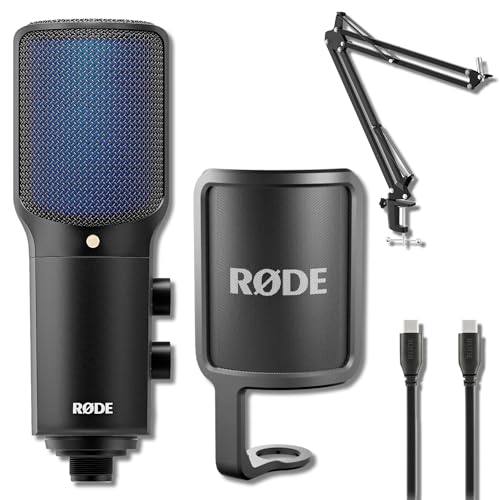
| Mounting Hardware | Adjustable yoke mount | StreamEye 27-inch boom arm & desk clamp |
| Housing Material | Metal | Metal |
| Best For | Untreated rooms and hybrid USB/XLR setups | Acoustically treated voice-over and desktop streaming |
Transducer Architecture and Acoustic Room Isolation
The choice between dynamic and condenser transducers directly shapes how much ambient room noise appears in your finished audio tracks. In a head-to-head evaluation of shure sm7b vs rode nt-usb+ inspired microphones, transducer physics dictates the baseline signal-to-noise ratio in untreated environments. The MV7 utilizes a rugged dynamic capsule derived from broadcast vocal lineage. Dynamic microphones have heavier diaphragms that require higher acoustic energy to move, creating natural passive rejection of ambient computer fan hum, HVAC air currents, and distant room reverberations. Because the MV7 employs a focused unidirectional pickup pattern, it captures vocals placed within inches of the capsule while aggressively tapering off sound originating off-axis.
By comparison, the NT-USB+ houses an externally biased 1/2-inch studio condenser capsule paired with a high-gain Revolution Preamp. Condenser diaphragms are ultra-lightweight, allowing them to react instantaneously to fast vocal transients, subtle lip movements, and room reverberation. While the NT-USB+ features a tight cardioid polar pattern designed to focus directly on the speaker in front of the mesh grill, condenser elements naturally register wider spatial acoustics. If your recording room features bare hardwood floors, glass windows, or reflective drywall, the NT-USB+ will translate those reflections into the digital capture alongside your speech.
When weighing Shure MV7 vs Rode NT-USB+ dynamic vs condenser capsules, this isolation difference alters your daily workflow. The MV7 lets content creators speak directly into the microphone without needing acoustic foam or heavy wall treatment, producing dry, broadcast-style vocal tracks. The NT-USB+ rewards creators who have dedicated studio treatment, producing an expansive, airy acoustic signature that highlights breath control and delicate inflections. Without proper room dampening, the NT-USB+ will require software gating to strip out the room noise that the MV7 blocks by design.
Edge: Shure MV7 provides noticeably superior background rejection in untreated rooms.
Connectivity and Long-Term Hardware Expandability
Connectivity options determine how long a microphone remains useful as your home production setup expands over time. The MV7 distinguishes itself from standard digital microphones by providing both a digital USB connection and a traditional analog XLR output. This dual-output configuration allows you to plug the microphone directly into a computer or compatible mobile phone via USB for quick solo sessions, while also maintaining the ability to route the balanced XLR signal into hardware mixers, outboard broadcast gear, or dedicated audio interfaces. Creators comparing the shure mv7 vs rode podmic often appreciate that the MV7 eliminates the immediate need for outboard preamplification while keeping the analog XLR upgrade path completely open.
The NT-USB+ operates exclusively via a modern USB Type-C interface. It connects directly to personal computers, laptops, and smartphones to deliver 24-bit / 48 kHz digital conversion without requiring secondary drivers or specialized external hardware. Because it lacks an analog XLR connection, the NT-USB+ cannot interface with traditional studio mixing consoles, analog channel strips, or multi-channel podcast interfaces. It is intentionally designed as an all-in-one digital endpoint, condensing the preamplification, analogue-to-digital conversion, and digital processing into the microphone body itself.
Having the Shure MV7 XLR output gives creators substantial insurance against changing workflow requirements. You can start a live stream using a single USB cord plugged into your laptop today, and later integrate the microphone into an multi-host XLR audio setup without replacing the unit. The NT-USB+ delivers a streamlined, single-cable digital installation, but users who eventually desire multi-channel analog workflows will have to replace the unit entirely.
Edge: Shure MV7 offers far greater long-term flexibility with its dual USB and XLR connections.
Audio Processing and Software DSP Capabilities
Both manufacturers include hardware-based digital signal processing (DSP) inside these microphones to lighten the load on your computer CPU and eliminate latency during recording. In any balanced Shure MV7 review, the ShurePlus MOTIV desktop application stands out as a core strength. The MOTIV platform allows users to engage real-time auto-gain, tailored equalization profiles (such as dark, natural, or bright), limiter controls, and multiple compression presets directly on the microphone hardware. Once these DSP settings are selected in the software, the parameters are saved to the MV7 onboard memory, allowing the microphone to retain its sonic profile across diverse applications without ongoing adjustments.
The NT-USB+ takes internal processing even further by integrating genuine APHEX DSP alongside its proprietary, ultra-low-noise Revolution Preamp. Accessible via companion applications like RØDE Connect, RØDE Central, and RØDE Reporter, the NT-USB+ provides granular control over broadcast-grade audio algorithms. Users can activate a high-pass filter to eliminate low-end desk rumble, apply an automatic noise gate to mute room sound during pauses, and engage studio compression for consistent vocal levels. Furthermore, the NT-USB+ includes the legendary Aural Exciter for high-end acoustic shimmer and the Big Bottom processor to introduce authoritative low-end resonance to your voice.
Creators comparing the shure mv7 vs mv7+ will find that the original MV7 processing provides robust practical tools for vocal consistency. However, in any comprehensive Rode NT-USB+ review, the included APHEX suite delivers more expressive sound-shaping modules. The combination of the high-gain Revolution Preamp and specialized harmonic processing lets you craft an immediate, polished commercial broadcast tone without touching a third-party digital audio workstation.
Edge: Rode NT-USB+ delivers richer onboard DSP processing with its integrated APHEX suite.
Frequency Response, Intelligibility, and Vocal Nuance
A microphone frequency profile determines how natural, authoritative, and intelligible your voice sounds to listeners. The MV7 features a targeted frequency range of 50 Hz to 16 kHz. This specialized bandwidth is tailored specifically for speech intelligibility. By rolling off sub-bass frequencies below 50 Hz, the MV7 prevents plosive wind blasts and low-end HVAC rumble from muddying the recording. The gentle shelf in the upper frequencies above 16 kHz reduces harsh sibilance and digital splashiness, ensuring that dialogue remains comfortable and fatigue-free for listeners during multi-hour listening sessions.
In contrast, the NT-USB+ provides a full-spectrum frequency response spanning 20 Hz to 20 kHz. Because its 1/2-inch condenser capsule reacts to the entire audible acoustic spectrum, the NT-USB+ captures deep chest resonances and extended top-end airiness that dynamic capsules typically roll off. When tracking a Rode NT-USB+ voice over, this wider bandwidth results in an intimate, present vocal capture that sounds open, detailed, and three-dimensional. Every subtle change in vocal timbre, soft whisper, and room dynamic is preserved with 24-bit / 48 kHz digital fidelity.
Evaluating shure mv7+ vs rode nt-usb+ alternatives demonstrates that frequency width represents a deliberate trade-off between controlled isolation and acoustic detail. The MV7 is engineered specifically to emphasize spoken dialogue and suppress unwanted extremes. The NT-USB+ offers the comprehensive frequency bandwidth necessary for nuanced voice-over work, acoustic instrument tracking, and multi-layered vocal productions where high-frequency air gives recordings a modern commercial feel.
Edge: Rode NT-USB+ captures broader frequency response and subtle vocal details.
Onboard Hardware Controls and Zero-Latency Monitoring
Accessing controls directly on the microphone chassis saves critical seconds during high-stakes live productions. The MV7 features an integrated capacitive touch panel directly on the top surface of its metal barrel. This panel allows you to slide your finger to adjust microphone input gain, regulate 3.5 mm headphone output volume, toggle microphone muting with a single tap, and sweep the monitor mix balance between live microphone playback and computer system audio. Because the touch panel uses capacitive sensors rather than mechanical switches, making adjustments introduces minimal mechanical clicks into the active audio stream.
The NT-USB+ utilizes traditional physical rotary knobs positioned along the side of the housing. One dial controls the output volume of the integrated zero-latency 3.5 mm headphone jack, while a second dedicated knob adjusts the monitoring blend between direct microphone input and host computer playback. Wiring the headphone output before the digital conversion path ensures immediate hardware-level monitoring without software round-trip latency. However, unlike the MV7, the NT-USB+ listing does not include an onboard hardware mute button or a direct physical mic gain knob on the microphone body itself, requiring users to set capture levels inside the software application.
Determining which control layout excels depends on your operational style. The tactile knobs on the NT-USB+ allow you to make blind monitoring adjustments by feel while keeping your eyes on your screen or camera. Conversely, the MV7 provides a centralized touch interface that includes essential microphone muting and input gain adjustment without forcing you to switch windows to access companion software during a broadcast.
Edge: Tie. The MV7 adds mic muting and gain control to its surface, while the NT-USB+ offers immediate tactile knobs for monitoring.
Form Factor, Mounting, and Desk Setup
Desktop microphones must integrate cleanly into your workspace without obstructing sightlines, causing desk clutter, or introducing mechanical vibration into the recording. The MV7 features an all-metal chassis weighing 600 grams, with dimensions measuring 4.3 x 12.3 x 5 inches. It comes built with an integrated, heavy-duty adjustable yoke that allows the microphone to tilt smoothly to match your mouth angle. The yoke threads directly onto standard desktop stands or broadcast boom arms. However, the MV7 listing does not supply a stand or boom arm in the box, requiring buyers to source their own desk base or mounting solution.
The NT-USB+ listing comes bundled with the StreamEye BOOMARM1, an aluminum alloy 27-inch desktop boom arm complete with an integrated desk clamp mount. This 27-inch reach allows you to suspend the metal NT-USB+ capsule directly in front of your mouth while keeping your desk clear of stands and cables. The external tension springs on the arm adjust silently to prevent metallic squeaks during live movements. When examining the shure mv7+ vs rode podmic usb ecosystem, out-of-the-box mounting hardware represents a substantial convenience advantage for creators building a desk setup from scratch.
Because the NT-USB+ includes a purpose-built 27-inch articulated boom arm, you can position the side-address condenser at the exact speaking distance required to minimize room acoustics. The MV7 provides a durable, professional yoke that mounts securely to third-party equipment, but it cannot be placed on a desk without purchasing an accessory stand.
Edge: Rode NT-USB+ provides a complete setup out of the box with the included 27-inch boom arm.
Pros and Cons
Shure MV7

Pros
- Dual USB and XLR outputs
- Natural dynamic noise rejection
- Touch panel with gain and mute
- ShurePlus MOTIV onboard DSP
- Durable all-metal construction
Cons
- Narrower 50 Hz to 16 kHz range
- Listing includes no desktop stand
- Requires close-mic placement
Rode NT-USB+

Pros
- Wide 20 Hz to 20 kHz response
- Built-in APHEX processing suite
- Ultra-low-noise Revolution Preamp
- Dedicated tactile monitoring knobs
- Includes 27-inch aluminum boom arm
Cons
- Lacks analog XLR connection
- Sensitive capsule picks up room echo
Who Should Buy Each One
Choose the Shure MV7 If
- You record podcasts or stream in an untreated home office with background noise from computers, fans, or nearby traffic.
- You want a future-proof audio pipeline with both digital USB and pro-grade analog XLR outputs.
- You need immediate hardware access to touch-panel mic gain, monitor mixing, and an instant mute control on the mic body.
- You prefer a focused dynamic broadcast sound tailored specifically for speech intelligibility without room echo.
Choose the Rode NT-USB+ If
- You produce audiobooks, voice-over narrations, or studio podcasts in an acoustically controlled environment.
- You want the full desktop bundle, including a 27-inch aluminum boom arm with a desk clamp mount, in a single purchase.
- You desire advanced onboard APHEX DSP processing featuring high-pass filtering, gating, Aural Exciter, and Big Bottom effects.
- You want tactile analog rotary dials to quickly adjust zero-latency headphone monitoring levels and computer playback mix.
Final Verdict
When selecting between the Rode NT-USB+ vs Shure MV7, the Shure MV7 remains the superior overall choice for the vast majority of creators working from home. Its rugged dynamic capsule naturally suppresses keyboard clatter, environmental noise, and wall reflections that plague typical bedrooms and offices. Furthermore, the inclusion of an analog XLR output alongside modern USB connectivity ensures that the MV7 will continue serving your studio workflow even if you eventually transition to multi-channel hardware mixers and professional audio interfaces.
However, the Rode NT-USB+ wins decisively when placed in a quiet, acoustically treated room where rich vocal presence, extended high-frequency response, and detailed transient capture are paramount. Between its high-gain Revolution Preamp, comprehensive APHEX audio processing suite, and the inclusion of the StreamEye 27-inch articulated boom arm, the NT-USB+ offers an extraordinary out-of-the-box studio solution. If you create audiobooks, commercial voice-overs, or delicate acoustic recordings, the NT-USB+ delivers the airy, studio-grade condenser fidelity you need.
FAQ
Which microphone is better for streaming in an untreated room?
The Shure MV7 is far better suited for an untreated room. Because it uses a dynamic capsule with a unidirectional polar pattern, it naturally ignores off-axis room reverberations, loud PC cooling fans, and mechanical keyboard clicks. Condenser microphones like the Rode NT-USB+ have highly sensitive diaphragms that readily capture room echo and ambient household noise unless the recording space is treated with sound-dampening acoustic materials.
Can I use both the USB and XLR outputs on the Shure MV7 at the same time?
Yes, the Shure MV7 supports simultaneous digital and analog output. You can connect the USB output to a computer or mobile device to capture a digital recording with onboard DSP, while concurrently routing the analog XLR output into a dedicated hardware mixer, backup recorder, or broadcast interface. This provides redundancy and flexible signal routing during mission-critical live streams.
Is Rode NT-USB+ worth it for voice-over recording?
Yes, the Rode NT-USB+ is exceptionally well-suited for voice-over work. Its 1/2-inch studio condenser capsule delivers a wide 20 Hz to 20 kHz frequency response that captures high-frequency air, vocal nuance, and chest resonance. Combined with the internal APHEX processing suite (including the Aural Exciter and Big Bottom effects) and 24-bit / 48 kHz conversion, it produces a commercial, studio-quality vocal track without requiring external preamplifiers.
Does the Rode NT-USB+ require an external audio interface to work?
No, the Rode NT-USB+ connects directly to computers, laptops, and smartphones via USB Type-C. It contains an internal Revolution Preamp and an integrated 24-bit / 48 kHz analog-to-digital converter, eliminating the need for an external audio interface, dedicated sound card, or phantom power supply.
Does the Shure MV7 come with a desktop stand or boom arm?
The Shure MV7 listing includes an integrated, adjustable all-metal yoke with standard threaded mounting, but it does not include a tabletop base or boom arm in the box. You will need to mount it to a third-party desktop microphone stand or an adjustable boom arm to place it comfortably at speaking distance on your workstation.
How do the hardware monitoring controls differ between these two microphones?
The Shure MV7 features a flush capacitive touch panel that adjusts input gain, headphone volume, monitor blend, and microphone muting. The Rode NT-USB+ features dedicated tactile rotary knobs on the side of the microphone to control headphone volume and monitor mix balance, while mic gain and muting functions are managed within compatible RØDE software applications.
Can I connect these microphones directly to a smartphone?
Both microphones support smartphone connectivity over USB. The Shure MV7 is compatible with smartphones using USB connections (though the listing notes a Lightning cable is not included for older iOS devices). The Rode NT-USB+ connects directly to smartphones using its standard USB Type-C port, allowing creators to record directly into mobile recording apps on the go.