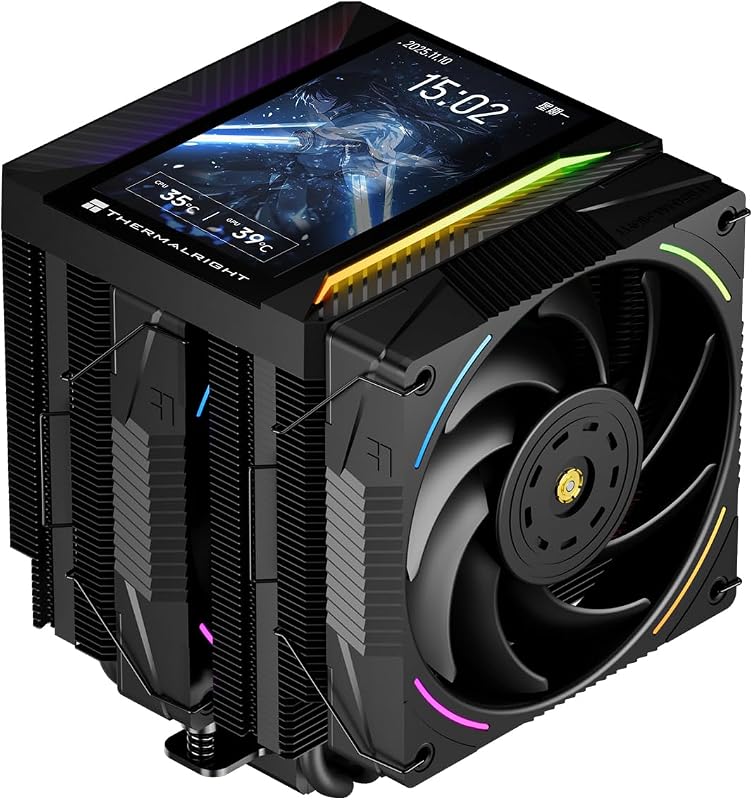
The defining difference between the Thermalright Phantom Spirit 120 and the be quiet! Dark Rock Pro 5 centers on acoustic customization: the Dark Rock Pro 5 incorporates an integrated hardware Speed Switch allowing instant toggling between Quiet and Performance profiles alongside advanced motor damping, whereas the Phantom Spirit 120 prioritizes a lower vertical profile and straightforward dual-tower airflow density.
Builders requiring broad chassis clearance and standard dual-tower cooling efficiency should choose the Thermalright Phantom Spirit 120, while enthusiasts prioritizing acoustic control, premium fan dampening, and heavy overclocking headroom should select the be quiet! Dark Rock Pro 5.


Thermalright Phantom Spirit 120 vs be quiet! Dark Rock Pro 5 at a Glance
| Feature | Thermalright Phantom Spirit 120 | be quiet! Dark Rock Pro 5 |
|---|---|---|
| Heat Pipe Configuration | 7 AGHP 4.0 heat pipes | 7 high-performance copper heat pipes |
| Exterior Coating | Not listed | Black coating with ceramic particles |
| Fan Complement | Dual 120mm TL-C12B V2 PWM fans | 2x Silent Wings PWM fans (integrated middle fan) |
| Fan Bearing Type | S-FDB Bearing | Advanced fluid-dynamic bearing (FDB) |
| Maximum Fan Speed | 1500 RPM | 2000 RPM (Performance) / 1500 RPM (Quiet) |
| Maximum Airflow | 66.17 CFM | 68.7 CFM |
| Noise Level Rating | 25.6 dB | 23.3 dB |
| Hardware Speed Controls | Standard motherboard PWM only | Integrated 2-mode hardware Speed Switch |
| Cooler Dimensions (L x W x H) | 125 x 135 x 157 mm | 5.7 x 5.35 x 6.61 inches |
| Rated Cooling Capacity | Not listed (30W electrical wattage listed) | 280 watts TDP rating |
| Best For | Compact dual-tower high-value builds | Ultra-quiet workstations and heavily overclocked rigs |
Acoustic Control and Fan Noise Levels
Operating sound profile represents the most noticeable day-to-day distinction when evaluating the be quiet! Dark Rock Pro 5 vs Thermalright Phantom Spirit 120. The Dark Rock Pro 5 targets silence through dedicated hardware integration, featuring a manufacturer sound ceiling of 23.3 dB. Its cooling apparatus is powered by two Silent Wings PWM fans driven by smooth 6-pole motors, engineered to minimize structural vibration and rotational hum. To further isolate operational noise, the heatsink frame employs decoupled fan mountings lined with vibration-dampening elements that prevent harmonic resonance from transferring through the fin stacks.
By contrast, the Phantom Spirit 120 utilizes a pair of TL-C12B V2 PWM fans rated up to 25.6 dB. While 25.6 dB remains quiet during standard desktop workflows, the cooler lacks mechanical dampening switches or specialized motor isolators. It relies solely on S-FDB bearings and your motherboard BIOS fan curves to keep sound manageable. When comparing the thermalright peerless assassin 120 vs be quiet! dark rock pro 5 in similar noise-sensitive environments, the Silent Wings platform consistently maintains a softer acoustic footprint under sustained load.
The standout mechanical feature on the Dark Rock Pro 5 is its integrated Speed Switch. Positioned under the detachable mesh top cover, this switch lets builders toggle between Quiet Mode (which enforces a 1500 RPM ceiling suitable for everyday processing) and Performance Mode (which uncaps the fans up to 2000 RPM for extreme thermal demands). This hardware-level throttle provides acoustic predictability that cannot be accidentally overridden by aggressive motherboard fan curves. If minimizing the Phantom Spirit 120 vs Dark Rock Pro 5 noise level is your primary design goal, the Dark Rock Pro 5 holds a measurable mechanical advantage.
Edge: be quiet! Dark Rock Pro 5 delivers a lower maximum decibel rating, 6-pole motor dampening, and a hardware speed switch to enforce strict noise limits.
Cooling Architecture and Overclocking Capacity
Both manufacturers utilize a 7-pipe thermal transfer array, but their implementation and thermal headroom differ significantly. The Phantom Spirit 120 implements Thermalright’s AGHP 4.0 (Anti-Gravity Heat Pipe) technology across its 7 heat pipes. This internal capillary wick design maintains efficient fluid phase changes whether the cooler is mounted in a vertical tower chassis or a horizontal test bench. Understanding how this layout competes with other flagship solutions is explored in our breakdown of the thermalright peerless assassin 120 vs phantom spirit 120, highlighting how the extra pipe augments heat transfer across dense fin clusters.
The Dark Rock Pro 5 counters with 7 high-performance copper heat pipes enveloped in a specialized black ceramic particle coating. This coating is engineered to elevate radiative heat dissipation beyond standard bare aluminum or standard painted finishes. Backing this hardware, the manufacturer explicitly rates the Dark Rock Pro 5 for a 280-watt cooling capacity, declaring low thermal thresholds even during periods of peak processor utilization on heavily overclocked rigs. It also includes dedicated thermal grease in the packaging to ensure optimal heat conduction from the processor lid.
When assessing the Phantom Spirit 120 vs Dark Rock Pro 5 cooling performance for extreme power delivery, the Dark Rock Pro 5 provides clear thermal specifications. The Thermalright listing notes a 30-watt operating power specification for electrical draw without publishing an official TDP cooling rating in its documentation. Builders asking whether to pick the Phantom Spirit 120 or Dark Rock Pro 5 for overclocking will find the engineered 280-watt capability and ceramic-infused fins of the Dark Rock Pro 5 better documented for thermal abuse.
Edge: be quiet! Dark Rock Pro 5 provides an established 280-watt cooling rating, ceramic heat-transfer coating, and bundled thermal grease designed for high thermal loads.
Airflow Dynamics and Fan Engineering
Heatsink fin density demands high static pressure and stable airflow to exchange heat rapidly. The Phantom Spirit 120 pairs its dual towers with two 120mm TL-C12B V2 PWM fans spinning to a maximum of 1500 RPM. These fans push up to 66.17 CFM of air through the heatsink assembly, utilizing S-FDB (Stabili-Fluid Dynamic Bearings) to maintain shaft stability and balance blade rotation over time. As demonstrated across compact dual-tower alternatives in our thermalright phantom spirit 120 vs scythe fuma 3 analysis, dual 120mm fans provide an even balance between linear airflow and static fin penetration.
The Dark Rock Pro 5 utilizes an asymmetric, high-pressure airflow approach driven by two Silent Wings PWM units. The front intake fan is integrated into a frame with a funnel-shaped air inlet, designed specifically to generate high static pressure and force fresh air through the initial fin stack. From there, the middle fan pulls air inward and expels it across the secondary radiator. When switched into Performance Mode, these fans spin up to 2000 RPM, achieving an airflow rating of 68.7 CFM-surpassing the 66.17 CFM threshold of the Phantom Spirit 120.
For PC builders contemplating the Thermalright PS120 vs be quiet! Dark Rock Pro 5 for continuous workloads, the higher peak CFM and directional funneling on the Dark Rock Pro 5 give it an advantage when dissipating sudden thermal spikes. However, when deciding between the Phantom Spirit 120 or Dark Rock Pro 5 for gaming, the 1500 RPM ceiling of the Phantom Spirit 120 is more than capable of handling modern gaming CPUs without introducing distracting pitch shifts during rapid gameplay transitions.
Edge: be quiet! Dark Rock Pro 5 achieves higher peak volumetric airflow at 68.7 CFM through high-pressure funnel engineering and an upper speed limit of 2000 RPM.
Chassis Clearance and Physical Dimensions
Clearance constraints frequently dictate cooler selection, making the Thermalright Phantom Spirit 120 vs Dark Rock Pro 5 dimensions a decisive point of comparison. The Phantom Spirit 120 features a compact profile measuring 125 mm in length, 135 mm in width, and 157 mm in total height (approximately 4.92 x 5.31 x 6.18 inches). Standing at 157 mm tall, it fits comfortably inside standard mid-tower enclosures and many compact ATX or micro-ATX chassis where vertical clearance is strictly limited.
The Dark Rock Pro 5 demands substantially more space within the case. Its official dimensions measure 5.7 inches long, 5.35 inches wide, and 6.61 inches high (approximately 145 x 136 x 168 mm). The 6.61-inch height translates to nearly 168 mm of vertical clearance needed from the motherboard surface to the side panel. In smaller chassis or narrower mid-towers, this height can interfere directly with tempered glass side panels. Evaluating smaller alternatives like the noctua nh-u12a vs thermalright phantom spirit 120 underscores how critical a sub-160mm height is for everyday chassis compatibility.
Memory clearance and motherboard component spacing also skew toward the Phantom Spirit 120 due to its shorter 125 mm depth compared to the 145 mm (5.7-inch) frame of the Dark Rock Pro 5. The larger overall footprint of the Dark Rock Pro 5 means its front fan is more likely to overhang memory slots, potentially requiring you to mount the front fan slightly higher on the heatsink and expanding the required case depth even further. For compact system builds, the Phantom Spirit 120 remains the easier unit to integrate.
Edge: Thermalright Phantom Spirit 120 wins with a modest 157 mm height and a shorter footprint that ensures wider chassis and component compatibility.
Mounting Architecture and Socket Compatibility
Mounting mechanism stability and motherboard socket accommodation ensure the cooler stays firmly anchored over the CPU heat spreader. The Dark Rock Pro 5 provides an elegant top-down installation process. It features a detachable mesh top cover that houses the integrated middle fan; removing this top section allows access to a pre-installed mounting bridge and fixing screws matching the cooler’s black aesthetic. The listing explicitly supports Intel LGA 1851, 1700, 1200, 1151, 1150, and 1155, alongside AMD AM5 and AM4 sockets.
The Phantom Spirit 120 features equally robust retention hardware and broad socket support. Compatible out of the box with AMD AM4 and AM5, as well as Intel LGA 1851, 1700, 1200, and 115X, it adds explicit hardware support for legacy high-end desktop Intel LGA 2011 systems. When looking at flagship alternatives in our noctua nh-d15 g2 vs thermalright phantom spirit 120 overview, having native coverage across legacy enterprise sockets as well as current desktop sockets gives Thermalright a broad foundation.
Neither cooler presents significant installation hurdles, as both utilize rigid backplates and 4-pin PWM connections running on standard 12-volt motherboard headers. While the Dark Rock Pro 5 offers a refined top-entry installation bracket with an integrated center fan, the Phantom Spirit 120 matches its modern socket coverage while offering legacy LGA 2011 brackets that the Dark Rock Pro 5 does not list.
Edge: Tie. The Dark Rock Pro 5 features a refined drop-in central fan bridge, while the Phantom Spirit 120 includes legacy Intel 2011 platform support.
Pros and Cons
Thermalright Phantom Spirit 120

Pros
- Compact 157 mm vertical height
- 7 AGHP 4.0 heat pipes
- Dual 120mm S-FDB PWM fans
- Legacy Intel LGA 2011 support
Cons
- Higher 25.6 dB sound rating
- No integrated hardware speed switch
View Thermalright Phantom Spirit 120 on Amazon
Be Quiet! Dark Rock Pro 5

Pros
- Ultra-quiet 23.3 dB sound rating
- Integrated dual-mode hardware Speed Switch
- Rated for 280 watts cooling capacity
- Fluid-dynamic bearing 6-pole fan motors
- Ceramic particle black heatsink coating
Cons
- Tall 6.61-inch height limits small cases
- Heavier footprint over memory slots
View be quiet! Dark Rock Pro 5 on Amazon
Who Should Buy Each One
Choose the Thermalright Phantom Spirit 120 If
- Your PC case has strict vertical limits and cannot clear coolers taller than 157 mm
- You need native mounting brackets for legacy Intel LGA 2011 platforms alongside modern AM5 and LGA 1700/1851 sockets
- You want strong dual-tower airflow relying on standard 1500 RPM motherboard PWM regulation
- You prefer a lightweight assembly with standard 120mm fan swap flexibility
Choose the be quiet! Dark Rock Pro 5 If
- You want minimum acoustic output with a manufacturer-rated 23.3 dB maximum sound profile
- You require a physical Speed Switch to quickly toggle maximum fan RPM between Quiet and Performance modes
- You are running high-draw processors requiring an established 280-watt TDP cooling capacity
- You prefer ceramic particle fin coatings, 6-pole motor dampening, and a pre-installed central fan mounting bridge
Final Verdict
When conducting a comprehensive Thermalright Phantom Spirit 120 review against a be quiet! Dark Rock Pro 5 review, both dual-tower designs prove capable, but they address distinct priorities. The be quiet! Dark Rock Pro 5 takes the overall edge for acoustics and heavy workload thermal headroom. With its 280-watt cooling rating, ceramic-infused heat dissipation, 6-pole fan motors, and hardware-controlled dual speed switch, it provides superior fine-tuning for workstations and overclocked builds where decibel suppression is essential.
However, the Thermalright Phantom Spirit 120 remains an outstanding thermal solution whenever physical clearance and case compatibility take priority. At just 157 mm tall, it fits into chassis configurations where the 168 mm frame of the Dark Rock Pro 5 cannot physically sit. For builders assembling standard performance rigs or gaming PCs that do not demand sub-24 dB acoustic profiles, the Phantom Spirit 120 offers unmatched packaging efficiency.
FAQ
Which cooler is quieter under full load?
The be quiet! Dark Rock Pro 5 is quieter, featuring an official noise rating of 23.3 dB compared to the 25.6 dB rating of the Thermalright Phantom Spirit 120. In addition, its Quiet Mode caps fan rotational speed at 1500 RPM, while 6-pole motors and vibration-isolating mounts reduce mechanical humming.
Will the Thermalright Phantom Spirit 120 fit in narrower mid-tower PC cases?
Yes. The Phantom Spirit 120 has a total height of 157 mm (6.18 inches), which is significantly shorter than the 6.61-inch (roughly 168 mm) height of the Dark Rock Pro 5. This makes the Phantom Spirit 120 much more likely to clear tempered glass side panels in compact mid-tower cases.
How does the Speed Switch work on the be quiet! Dark Rock Pro 5?
The Dark Rock Pro 5 includes a physical hardware switch located under its detachable magnetic top cover. Setting it to Quiet Mode caps fan speeds at 1500 RPM for silent operation, while Performance Mode allows the Silent Wings fans to reach up to 2000 RPM for maximum cooling throughput.
Do both coolers support the latest AMD AM5 and Intel LGA 1851 sockets?
Yes. Both manufacturers list native mounting support for current AMD AM5 and AM4 platforms, as well as Intel LGA 1700 and the newer Intel LGA 1851 socket. The Phantom Spirit 120 additionally lists compatibility for legacy Intel LGA 2011 systems.
Does the be quiet! Dark Rock Pro 5 come with thermal grease included?
Yes. The listing confirms that the be quiet! Dark Rock Pro 5 includes thermal grease in the packaging, along with a black mounting kit and pre-installed mounting bridge to streamline installation.
Is the be quiet! Dark Rock Pro 5 worth it over standard dual-tower coolers?
The Dark Rock Pro 5 is worth selecting if your priority is whisper-quiet operation and dedicated thermal control. Its 280W rated capacity, ceramic particle coating, vibration-isolated fans, and dual-mode switch provide high-end acoustic refinements that standard coolers omit.