The decisive difference between a floor jack and a bottle jack is chassis geometry: a floor jack uses a low, horizontal rolling frame with a cantilevered arm to access low-clearance lift points, whereas a bottle jack uses a vertical hydraulic ram to generate immense upward lifting force over a compact, stationary footprint.
Choose a floor jack if you maintain passenger cars, sport compacts, or crossovers in a home garage where low starting height and smooth positioning on wheels are essential. Choose a bottle jack if you need heavy-duty lifting capacity for high-clearance trucks, SUVs, or roadside emergency storage where compact tool dimensions take priority.
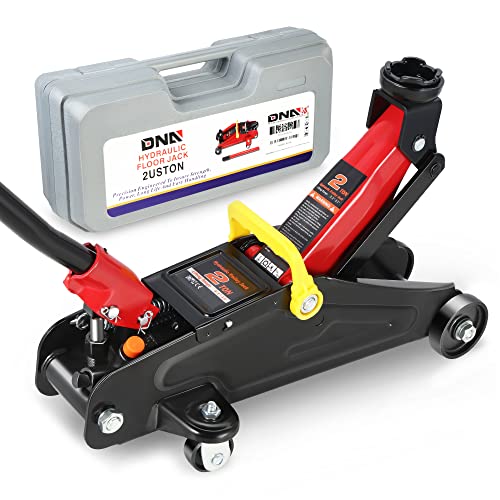

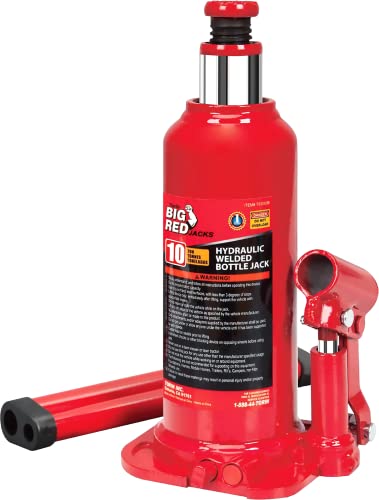

Floor Jack vs Bottle Jack at a Glance
| Attribute | Floor Jack | Bottle Jack |
|---|---|---|
| Hydraulic Orientation | Horizontal cylinder with pivoting lift arm | Vertical direct-action hydraulic cylinder |
| Minimum Entry Height | 3.35 in (85 mm) to 5.1 in | 7.38 in to 8.81 in |
| Maximum Lifting Height | 13.0 in to 14.96 in (380 mm) | 14.31 in to 17.63 in |
| Rated Capacity Range | 2 tons (4,000 lbs) to 2.5 tons (5,500 lbs) | 4 tons (8,000 lbs) to 10 tons (20,000 lbs) |
| Chassis Mobility | Steel wheels and rear swivel casters | Stationary flat steel base |
| Unit Weight | 13.6 kg (VEVOR S385) | 7.1 lbs to 10.4 lbs |
| Extension Mechanism | Hydraulic stroke only | Adjustable screw top extension |
| Vehicle Contact Saddle | Large saddle with optional rubber pad | Compact serrated heat-treated steel saddle |
| Safety System | Built-in safety overload release valve | Integrated oil-bypass and overload valve |
| Best For | Garage service and low-clearance vehicles | High-clearance trucks, heavy loads, and roadside kits |
Minimum Clearance and Vehicle Entry
Minimum clearance determines whether a lifting tool can physically slide beneath a vehicle’s approved jacking points before hydraulic pressure is ever applied. Modern passenger sedans, hatchbacks, and performance sports cars often feature factory ground clearance under five inches, especially when sitting on a flat tire. A floor jack addresses this challenge through a low, elongated profile where the hydraulic assembly rests horizontally, allowing the forward lift arm to drop almost flush with the workshop floor.
The VEVOR 2.5 Ton Low Profile Heavy-Duty Steel Racing Floor Jack demonstrates this advantage with a minimum height of just 3.35 inches (85 mm), while the DNA Motoring TOOLS-00234 trolley jack starts at 5.1 inches. In sharp contrast, a bottle jack places its hydraulic fluid reservoir, pump cylinder, and lifting ram directly on top of one another. The YELLOW JACKET 4 Ton AS90404CS requires at least 7.38 inches of open space, and the BIG RED 10 Ton TAM91003B demands an 8.81-inch entry gap.
Choosing a bottle jack for a low-profile passenger car usually creates an immediate bottleneck: the tool will not fit beneath the frame rails or pinch welds. Unless you intend to drive your tires onto raised wooden blocks before every service job, floor jack minimum height specifications make low-profile trolley units mandatory for standard passenger automobiles.
Edge: Floor jack because its horizontal chassis geometry achieves starting heights as low as 3.35 inches to fit passenger vehicles that bottle jacks cannot clear.
Lifting Capacity and Hydraulic Efficiency
Hydraulic power density defines how much raw tonnage a tool can raise relative to its overall footprint. In a bottle jack, the pump pressurizes hydraulic fluid directly beneath an upright vertical piston, pushing the load straight up with minimal mechanical dissipation. Floor jacks operate through a pivoting lever arm driven by a horizontal ram, which introduces mechanical leverage trade-offs that necessitate heavier, reinforced side plates to manage torsional strain.
This structural difference explains the dramatic contrast in rated output. The compact BIG RED TAM91003B delivers a massive 10-ton (20,000-pound) load capacity, making it capable of lifting commercial equipment, loaded heavy-duty pickups, and structural building beams. Even the lightweight YELLOW JACKET model supports 4 tons (8,000 pounds). Meanwhile, representative consumer floor jacks are rated for 2 tons (4,000 pounds) on the DNA Motoring model and 2.5 tons (5,500 pounds) on the VEVOR unit. For readers balancing lifting muscle against shop requirements, our review of the pittsburgh 3 ton vs torin big red examines how high-capacity shop tools compare under heavy vehicle loads.
When selecting a floor jack or bottle jack for truck service, the bottle jack weight capacity provides a far wider margin of safety for heavy commercial axles, motorhomes, and agricultural trailers. While a 2-ton to 2.5-ton floor jack safely handles single corners on standard midsize vehicles, heavy solid-axle rigs demand the superior hydraulic tonnage native to the bottle configuration.
Edge: Bottle jack because its direct vertical hydraulic piston effortlessly produces between 4 and 10 tons of lifting force in a remarkably small footprint.
Mobility, Maneuverability, and Garage Positioning
How a jack moves across a workshop surface dictates both speed of use and operational stability. When a floor jack raises a car, the lifting pad travels along a slight arc rather than in a purely vertical line. To prevent side-loading or slipping off the vehicle’s lift point, the entire jack rolls forward slightly on its steel wheels as the cantilever arm swings upward.
The VEVOR model excels in this environment thanks to its rigid steel wheels, rear universal swivel casters, and long 31.5-inch two-piece handle that provides smooth leverage and precise steering under deep chassis crossmembers. Similarly, the DNA Motoring service jack integrates smooth swivel casters to let users position the saddle without wrestling the chassis. A bottle jack, conversely, sits on a wide, static base plate. Once set on the concrete, units like the Torin BIG RED remain fixed in place, requiring you to bend down, crawl, and manually center the pad directly underneath the lift point.
In a standard automotive workshop, floor jack vs bottle jack for garage maintenance is rarely a contest. As detailed in our comparison of the daytona 3 ton vs torin big red, mobile trolley jacks save substantial time during multi-wheel rotations and brake services because you can glide the lift pad from corner to corner without repeatedly lifting and carrying the entire tool.
Edge: Floor jack because its integrated rolling wheels and swivel casters allow effortless alignment and automatically compensate for the lifting arm arc.
Lifting Height and Stroke Extension
Maximum lift height determines whether a tool can lift vehicle tires clear off the ground, particularly on vehicles with soft, long-travel suspensions that droop substantially before the wheels leave the pavement. Evaluating a floor jack or bottle jack for suv applications requires examining both total vertical reach and how that extension is achieved.
The BIG RED TAM91003B reaches a maximum lifting height of 17.63 inches (17-5/8 inches), starting from an 8.81-inch collapsed state. It achieves this generous stroke through an adjustable screw top extension collar that threads out from the piston head, allowing mechanics to bridge the empty air gap between the jack and the vehicle frame before pumping hydraulic fluid. The YELLOW JACKET bottle jack achieves a maximum elevation of 14.31 inches. Among rolling options, the VEVOR floor jack offers a 14.96-inch (380 mm) ceiling, while the DNA Motoring model tops out at 13 inches.
While the bottle jack offers higher ultimate reach on paper, it relies heavily on manual adjustment of the threaded screw extension. As explored in our analysis of the daytona 3 ton vs pittsburgh 3 ton, floor jacks deliver continuous, uninterrupted hydraulic stroke across their entire travel span, eliminating the need to pre-adjust threaded collars under dirty vehicle chassis.
Edge: Bottle jack because its integrated screw top extension combined with vertical hydraulic stroke achieves a higher peak height of up to 17.63 inches.
Portability, Weight, and Emergency Storage
A lifting tool provides zero utility if it is too heavy or cumbersome to bring to the job site. Floor jacks achieve stability and rolling strength through dense alloy steel frames, resulting in significant physical bulk. The VEVOR steel unit weighs 13.6 kg (nearly 30 pounds) and measures 22.2 inches long by 8.7 inches wide, making it difficult to store in compact vehicle trunks or carry across uneven terrain.
Bottle jacks strip away the wheels, extended chassis side plates, and long pump arms to isolate the hydraulic core. The YELLOW JACKET model weighs only 7.1 pounds with exterior dimensions of 11.02 x 6.5 x 4.33 inches and includes a molded carrying case for organized vehicle storage. The 10-ton BIG RED weighs 10.4 pounds and measures 4.88 x 4.13 x 8.81 inches, allowing it to rest neatly inside a truck storage bin, under a rear bench seat, or inside an off-road recovery drawer.
For drivers wondering is a bottle jack worth it for emergency roadside recovery, the answer comes down to stowage efficiency. Just as compact home maintenance gear keeps utility closets tidy-a dynamic explored in our robot vacuum vs stick vacuum guide-a compact bottle jack provides heavy lifting capability without occupying valuable cargo space.
Edge: Bottle jack because weighing between 7.1 and 10.4 pounds with included cases makes it vastly easier to store and transport than a 30-pound floor jack.
Vehicle Protection and Built-in Safety Features
Lifting thousands of pounds of vehicle weight creates substantial risk for both the mechanic and the automotive bodywork. A quality lift system must prevent structural overload, seal against internal hydraulic fluid leaks, and prevent marring delicate undercarriage components such as painted pinch welds and sheet-metal rocker panels.
The VEVOR floor jack addresses vehicle protection directly by including a 360-degree rotatable rubber saddle pad and a foam handle bumper that prevents metal-on-metal gouging if the handle leans against an exterior car fender. It also carries international compliance with ASME PALD-2014, CE, and UKCA safety standards alongside an internal overload system. DNA Motoring equips its trolley unit with a wide saddle and an automatic safety release valve. Both bottle jacks feature drop-forged alloy steel construction with fully welded inner and outer structures to eliminate leak paths, backed by built-in oil-bypass valves on the BIG RED and internal air-pressure balance valves on the YELLOW JACKET.
However, bottle jacks feature compact, serrated steel saddles intended to grip bare axle tubes. When placed against unibody pinch welds or painted subframes, those narrow steel teeth can dent sheet metal unless aftermarket adapters are used. Furthermore, DNA Motoring explicit product notes remind users that any hydraulic jack is engineered strictly for lifting, never for holding loads for prolonged periods without dedicated jack stands.
Edge: Floor jack because its broad rotatable saddle, protective rubber pad, and foam handle bumper guard unibody sheet metal against gouging and accidental damage.
Pros and Cons
Floor Jack

Pros
- Low entry clearance down to 3.35 inches
- Rolling steel wheels for fast garage positioning
- Protective rubber saddle guards vehicle pinch welds
- Wide rectangular chassis provides excellent lifting stability
Cons
- Heavy unit weight around 13.6 kg
- Lower maximum capacity capped at 2.5 tons
- Bulky frame requires significant storage space
View DNA Motoring TOOLS-00234 Low Profile Hydraulic on Amazon
Bottle Jack

Pros
- Immense lifting capacity up to 10 tons
- Compact body weighs between 7.1 and 10.4 pounds
- Adjustable screw top extension maximizes vertical reach
- Available with dedicated molded storage case
Cons
- High minimum starting height over 7 inches
- Static base cannot roll to track lifting arcs
- Narrow steel saddle lacks protective rubber padding
View BIG RED 10 Ton (20 000 on Amazon
Who Should Buy Each One
Choose the Floor Jack If
- You service low-clearance sedans, sports cars, or standard family crossovers that require entry heights under 5 inches.
- You do most of your wrenching on smooth garage floors where rolling steel casters make positioning beneath subframes fast and easy.
- You want built-in vehicle protection features like rotatable rubber saddles and foam handle bumpers to safeguard pinch welds.
- You perform frequent multi-corner jobs such as tire rotations and brake pad replacements where rapid maneuvering saves significant effort.
Choose the Bottle Jack If
- You own a high-clearance truck, solid-axle SUV, or heavy commercial vehicle with ample frame clearance above 8 inches.
- You require extreme lifting capacities between 4 and 10 tons for heavy-duty work, farm equipment, or structural leveling.
- You need a lightweight emergency recovery tool weighing under 11 pounds that fits inside a toolbox or vehicle storage compartment.
- You value the extra vertical reach provided by an adjustable threaded screw top extension to bridge tall frame clearances.
Final Verdict
For most vehicle owners working inside a home garage, the floor jack is the superior overall choice. Its low starting clearance down to 3.35 inches on models like the VEVOR 2.5-ton racing jack ensures broad compatibility across passenger cars, wagons, and crossovers. The integrated steel casters, wide stabilizing chassis, and protective rubber saddle create a controlled, user-friendly lifting platform that tracks vehicle movement safely on concrete and preserves delicate undercarriage paint.
On the other hand, the bottle jack remains the undisputed champion when extreme load capacity and portable storage are paramount. Products like the BIG RED 10-ton hydraulic jack provide industrial-grade lifting tonnage in a compact 10.4-pound package that stows easily in a truck cab. For owners of lifted pickups, heavy commercial chassis, and off-road vehicles with solid axles, a bottle jack delivers the high reach, screw extension, and brute force needed where a consumer floor jack cannot compete.
FAQ
Can a bottle jack replace a floor jack for everyday garage maintenance?
A bottle jack cannot fully replace a floor jack for general automotive work because its high minimum entry clearance prevents it from fitting beneath standard passenger cars and unibody crossovers. Additionally, bottle jacks lack rolling wheels to compensate for vehicle arc during lifting, making them less convenient and less stable on concrete garage floors for frequent tire and brake service.
Why do floor jacks have lower weight capacities than bottle jacks?
Floor jacks utilize a horizontal hydraulic cylinder that drives a pivoting cantilever arm, which introduces mechanical leverage losses and structural twisting forces across the frame. Bottle jacks use an upright vertical ram that pushes straight upward against the load, transferring hydraulic pressure directly into vertical lift without mechanical deflection.
Can you use a bottle jack on a low-profile car?
You cannot use a bottle jack directly on a low-profile car because bottle jacks feature minimum collapsed heights between 7.38 and 8.81 inches, which exceeds the ground clearance of most modern sedans. Using one would require driving the vehicle onto auxiliary ramps or wood planks first to create sufficient clearance for the jack to slide underneath.
Is a bottle jack or floor jack safer for lifting a vehicle?
Both jack styles are inherently safe when used strictly within their rated load capacities on flat, level surfaces, but a floor jack offers greater baseline stability due to its wide rectangular footprint and rolling wheels that prevent side-loading. Neither tool is safe for holding a vehicle during maintenance; both require the immediate placement of rated jack stands before any work begins.
Can a bottle jack be operated horizontally?
Most traditional hydraulic bottle jacks function strictly in an upright vertical orientation because tilting them moves hydraulic oil away from the internal pump intake. However, specialized models like the YELLOW JACKET 4 Ton feature multi-directional welded designs engineered to function horizontally for pushing and spreading tasks.
Do I still need jack stands when using a floor jack or bottle jack?
You must always use secondary jack stands whenever working around or beneath a vehicle raised by either a floor jack or a bottle jack. Hydraulic jacks rely on pressurized fluid seals and internal bypass valves that can leak or fail suddenly, and manufacturers explicitly state that hydraulic jacks are designed solely for vertical lifting, never for prolonged static load support.


