Choosing between the PowerColor AMD RX 6750 XT and the PowerColor AMD RX 6950 XT comes down to compute density versus electrical requirements. The top-tier graphics card features an array of 5120 stream processors and a massive 16GB memory frame designed to sustain demanding 4K rendering pipelines, whereas its sibling deploys 2560 stream processors clocked significantly higher to achieve responsive gaming at lower system wattages.
If your setup is built around high-refresh 1440p gaming and a standard power supply, the RX 6750 XT is the logical match. If you intend to drive 4K displays or heavy compute tasks and have the 950W power infrastructure to support it, the RX 6950 XT is the definitive choice.

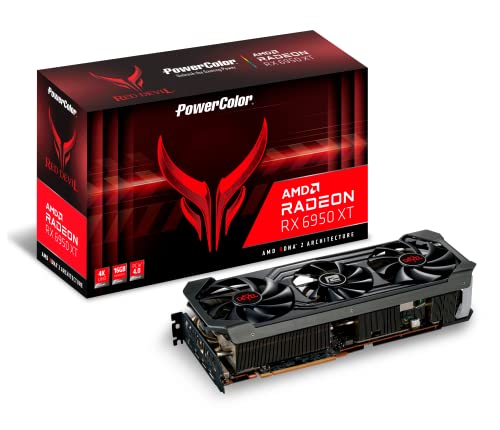
AMD RX 6750 XT vs RX 6950 XT at a Glance
| Attribute | AMD RX 6750 XT | AMD RX 6950 XT |
|---|---|---|
| Stream Processors | 2560 | 5120 |
| Video Memory (VRAM) | 12GB GDDR6 | 16GB GDDR6 |
| Memory Interface Bus | Not listed | 256-bit |
| Memory Clock Speed | 18.0 Gbps | 18.0 Gbps (18000 MHz) |
| Game Clock (OC / Silent) | 2633 MHz / 2593 MHz | 2226 MHz / 2116 MHz |
| Boost Clock (OC / Silent) | 2713 MHz / 2689 MHz | 2435 MHz / 2324 MHz |
| Minimum System Power | 700W | 950W |
| Power Connectors | Not listed | 3 x 8-pin PCI Express |
| Physical Dimensions | 13.19″L x 5.75″W | 13.07″L x 6.42″W |
| Best For | High-refresh 1440p gaming | Uncompromising 4K gaming |
Compute Engine and Stream Processors
The internal compute engine forms the core architectural dividing line when evaluating these two graphics cards. In the RX 6750 XT vs 6950 XT stream processors comparison, the difference is an exact doubling of compute resources. The RX 6750 XT is built with 2560 stream processors, which provide sufficient compute lanes to handle complex shaders, modern geometry pipelines, and compute-heavy rasterization in contemporary game engines. For builders examining an amd rx 6700 xt vs 6750 xt upgrade path, the 6750 XT represents an optimized configuration that extracts maximum performance from its silicon footprint.
The RX 6950 XT scales this architecture to enthusiasts’ limits by packing 5120 stream processors onto the die. This massive parallelism fundamentally alters how the graphics card processes dense workloads. When rendering complex particle physics, volumetric fog, and heavy post-processing passes simultaneously, doubling the active execution units ensures that mathematical throughput remains fluid. Games that stall or drop frames due to compute bottlenecks on smaller chips continue to run smoothly across the broader array of the flagship processor.
While the RX 6750 XT attempts to balance this disparity by driving its stream processors at elevated clock rates, clock frequency cannot overcome a 100 percent deficit in physical compute hardware. For heavy compute tasks and uncompromised frame delivery during dense in-game combat sequences, the 5120 stream processors on the flagship provide sheer computational headroom that cannot be matched by smaller silicon.
Edge: AMD RX 6950 XT provides twice the compute hardware with 5120 stream processors compared to 2560 on the 6750 XT.
Memory Capacity and VRAM Bandwidth
Video memory determines whether a graphics processor can store high-resolution textures, frame buffers, and ray tracing structures locally without spilling into slower system memory. Looking at the RX 6750 XT vs 6950 XT VRAM configurations, the cards offer distinct memory allocations aimed at different target resolutions. The PowerColor RX 6750 XT features 12GB of GDDR6 memory operating at an 18.0 Gbps memory clock speed. This 12GB frame provides an ample buffer for high-fidelity assets at 1440p, preventing the stuttering and asset pop-in that can occur on cards with smaller memory banks.
The PowerColor RX 6950 XT increases the memory capacity to 16GB of GDDR6 memory. The manufacturer listing also explicitly identifies a wide 256-bit memory interface operating alongside the 18.0 Gbps (18000 MHz) memory clock speed. The memory bus width on the RX 6750 XT listing is not specified, but the 256-bit bus on the 6950 XT guarantees that massive amounts of texture data move across the interconnect per clock cycle. That extra 4GB of capacity becomes pivotal when running modern simulation titles, extreme texture modifications, or resolutions pushing up toward the cards’ maximum supported 7680×4320 display limits.
For builders comparing options such as the amd rx 6750 xt vs 6800 xt, moving past 12GB into a 16GB memory buffer delivers essential longevity. The 16GB buffer on the RX 6950 XT ensures that future titles with higher memory footprints will not saturate the local frame buffer, eliminating one of the most common performance bottlenecks in high-resolution rendering.
Edge: AMD RX 6950 XT takes the category with a larger 16GB GDDR6 memory capacity and a verified 256-bit memory bus.
Power Supply and System Electrical Demands
A graphics card’s compute performance is directly tied to its electrical intake, and system requirements differ dramatically between these two models. In any direct RX 6750 XT vs 6950 XT power supply analysis, power supply unit planning must take center stage. The PowerColor RX 6750 XT specifies a minimum system power requirement of 700W. This places it comfortably within reach of mainstream power supplies found in standard gaming builds, allowing builders to install the card without necessarily replacing their power infrastructure.
The PowerColor RX 6950 XT demands far more substantial electrical delivery, specifying a 950W minimum system power requirement. To feed this immense demand, the listing confirms that the 6950 XT requires three 8-pin PCI Express power connectors. This requirement introduces significant cabling demands inside the chassis, as using three independent 8-pin PCIe cables from a robust power supply is mandatory to ensure voltage stability and eliminate transient power trip-outs under heavy graphical loads.
The electrical trade-off between these models impacts your overall system planning. While those upgrading along the amd rx 6800 xt vs 6950 xt line expect extreme power draws, users transitioning from lower-tier hardware may find the 950W minimum requirement restrictive. The RX 6750 XT offers a much easier drop-in upgrade experience by operating cleanly within a 700W envelope.
Edge: AMD RX 6750 XT wins on efficiency and system compatibility, requiring only a 700W power supply compared to the 950W requirement and triple 8-pin cables of the 6950 XT.
Clock Frequencies and Dual BIOS Profiles
Operating clock frequencies reveal contrasting engineering priorities between these two GPUs. The RX 6750 XT prioritizes exceptionally aggressive core clock rates to maximize performance from its 2560 compute units. In its Overclocking (OC) profile, the card reaches a Game Clock of 2633 MHz and a Boost Clock of 2713 MHz. Even when switched over to the Silent mode BIOS, the card sustains a Game Clock of 2593 MHz and a Boost Clock of 2689 MHz. These frequency numbers are among the highest factory-rated clocks in the entire product generation.
Because the RX 6950 XT drives a chip with twice the compute core density, its operational clocks are tuned lower to maintain thermal balance. The 6950 XT operates with a Game Clock of 2226 MHz and a Boost Clock of 2435 MHz in OC mode, scaling back to a 2116 MHz Game Clock and a 2324 MHz Boost Clock in Silent mode. While these frequencies are robust for a flagship-tier processor, they lag behind the raw megahertz figures delivered by the 6750 XT.
For builders assessing cards in comparisons like the amd rx 6650 xt vs 6750 xt, the elevated clock rates of the 6750 XT translate to snappy responsiveness in games that prioritize single-thread throughput and pure clock speed over massive parallel compute. The dual-BIOS toggle on both Red Devil units provides valuable acoustic flexibility, but the 6750 XT pushes the upper limits of silicon frequency.
Edge: AMD RX 6750 XT leads in clock frequency with a 2713 MHz Boost Clock versus the 2435 MHz maximum of the 6950 XT.
Target Display Resolutions and In-Game Performance
Display resolution is the defining factor when choosing between the RX 6750 XT or RX 6950 XT for 1440p versus the RX 6750 XT or RX 6950 XT for 4k. The RX 6750 XT is engineered as an ideal high-refresh-rate 1440p (2560×1440) graphics engine. At this resolution, the balance of 2560 stream processors, ultra-high 2713 MHz boost clocks, and a 12GB GDDR6 memory buffer keeps modern game engines running smoothly without overtaxing the GPU pipeline. Any comprehensive RX 6750 XT review will highlight its balanced execution at 1440p, where it avoids memory exhaustion and delivers fluid frame pacing.
When you step up display expectations to native 4K (3840×2160) or multi-monitor configurations, the computational demands quadruple. This is where an RX 6950 XT review reveals the value of enthusiast hardware. The 5120 stream processors and 16GB GDDR6 buffer on the 6950 XT are purpose-built to sustain the heavy pixel fill-rates and immense texture maps inherent to 4K gaming. As highlighted in comparisons like the amd rx 6700 xt vs amd rx 6950 xt, smaller compute matrices lose ground rapidly when processing dense 4K render targets.
So, is the RX 6950 XT worth it for display scaling? If your gaming station centers on a native 4K monitor, the flagship card provides the foundational hardware needed to maintain fluid visual fidelity. The RX 6750 XT can output up to the maximum 7680×4320 digital resolution supported by its display ports, but its 2560 stream processors are optimized for 1440p rather than sustained 4K rendering.
Edge: AMD RX 6950 XT dominates for 4K display resolutions due to its doubled compute array and expanded memory framework.
Form Factor, Physical Dimensions, and Cooling Architecture
Both models in this comparison are PowerColor Red Devil editions, meaning they incorporate robust aftermarket engineering, substantial metal heatsinks, and triple-fan cooling assemblies designed to dissipate heavy thermal loads. The RX 6750 XT measures 13.19 inches in length and 5.75 inches in width. The three fans pull air through dense aluminum fin stacks to keep the high-clocked silicon within stable thermal boundaries while operating in either OC or Silent mode.
The RX 6950 XT features slightly altered physical dimensions, measuring 13.07 inches in length and 6.42 inches in width. While it is fractionally shorter than the 6750 XT by roughly a tenth of an inch, it is notably wider across the chassis slot boundary. That extra width accommodates an expanded heatsink base designed to handle the substantial heat dissipation generated by a 950W-class system component. Both cards require a spacious desktop chassis with substantial clearance along the primary PCIe slot area.
Display connectivity is equally comprehensive across both cards, though listed with slight variations in detail. The RX 6750 XT listing outlines one HDMI 2.1 port and three DisplayPort 1.4 outputs. The RX 6950 XT lists DisplayPort and HDMI outputs, with both GPUs supporting a maximum digital resolution of 7680×4320. Because both models utilize premium three-fan coolers with dual-BIOS switches and expansive footprints, physical accommodation requires careful measurement in either scenario.
Edge: Tie. Both cards feature massive triple-fan Red Devil cooling assemblies exceeding 13 inches in length.
Pros and Cons
AMD RX 6750 XT

Pros
- High 2713 MHz boost clock
- 12GB GDDR6 video memory
- Moderate 700W power supply requirement
- Triple fan cooling setup
Cons
- 2560 stream processors limits 4K compute
- Memory bus width not specified in listing
AMD RX 6950 XT

Pros
- 5120 stream processors for massive parallel compute
- 16GB GDDR6 memory buffer
- Wide 256-bit memory interface
- Triple fan cooler with dual BIOS modes
Cons
- Demands heavy 950W minimum system power
- Requires three 8-pin PCIe power connectors
- Wider card profile at 6.42 inches
Who Should Buy Each One
Choose the AMD RX 6750 XT If
- You primarily game on a 1440p high-refresh display where clock speed and 12GB of VRAM excel.
- Your current desktop features a standard 700W power supply and cannot support a 950W monster.
- You want high factory boost clocks up to 2713 MHz straight out of the box.
- You prefer an easier installation without routing three separate 8-pin PCIe power cables.
Choose the AMD RX 6950 XT If
- You demand uncompromising frame rates and visual fidelity at native 4K resolution.
- Your power supply delivers at least 950W and offers three dedicated 8-pin PCIe power leads.
- You require a 16GB GDDR6 memory buffer with a verified 256-bit bus for heavy asset rendering.
- You want maximum parallel compute power backed by 5120 stream processors.
Final Verdict
When reviewing the overall AMD RX 6950 XT vs 6750 XT landscape, the PowerColor Red Devil RX 6950 XT stands as the clear performance victor. With 5120 stream processors, 16GB of GDDR6 memory on a 256-bit bus, and an architecture built for high-resolution graphics, it easily powers through dense workloads that challenge lesser hardware. For gamers with a native 4K panel and a capable 950W electrical foundation, the flagship card offers the processing muscle and memory headroom required to preserve high visual standards.
On the other hand, the PowerColor Red Devil RX 6750 XT represents a focused, sensible design for mainstream enthusiasts. By delivering blazing boost clocks up to 2713 MHz and 12GB of high-speed memory within a manageable 700W power supply envelope, it hits the ideal sweet spot for 1440p gaming. If you do not plan to game at 4K or upgrade your existing power supply, the RX 6750 XT provides exceptional performance without the extreme electrical and thermal burdens of the flagship model.
FAQ
Can the AMD RX 6750 XT handle 4K gaming?
The RX 6750 XT supports display resolutions up to 7680×4320 through its HDMI 2.1 and DisplayPort 1.4 outputs, but its 2560 stream processors and 12GB memory buffer are optimized for 1440p. While it can run games at 4K, high-fidelity settings will present substantial performance challenges compared to the 5120 stream processors found on the RX 6950 XT.
What size power supply is needed for the RX 6750 XT vs 6950 XT?
According to the manufacturer specifications, the PowerColor RX 6750 XT requires a minimum system power supply of 700W. In contrast, the PowerColor RX 6950 XT demands a 950W minimum power supply along with three dedicated 8-pin PCI Express power connectors to ensure reliable operation.
How much VRAM do both graphics cards have?
The PowerColor RX 6750 XT features 12GB of GDDR6 memory operating at 18.0 Gbps. The PowerColor RX 6950 XT steps up to 16GB of GDDR6 memory operating at 18.0 Gbps across a 256-bit memory bus, providing a larger capacity buffer for high-resolution textures.
Will either of these graphics cards fit into a compact PC case?
Both graphics cards are long, enthusiast-class cards that require a spacious desktop chassis. The RX 6750 XT measures 13.19 inches long and 5.75 inches wide, while the RX 6950 XT measures 13.07 inches long and 6.42 inches wide. You should measure your PC case internal clearance carefully before purchasing either model.
What is the difference between OC and Silent modes on these Red Devil cards?
Both PowerColor models include dual-BIOS functionality. On the RX 6750 XT, OC mode boosts clock speeds up to 2713 MHz, while Silent mode lowers the boost ceiling to 2689 MHz for quieter fan operation. On the RX 6950 XT, OC mode targets a 2435 MHz boost, whereas Silent mode runs up to 2324 MHz to prioritize lower acoustic levels.
Does the RX 6950 XT require specialized power cabling?
Yes, the PowerColor Red Devil RX 6950 XT listing specifies three 8-pin PCI Express power connectors. To ensure stable power delivery, you must connect three separate 8-pin PCIe cables directly from a compatible 950W or higher power supply rather than daisy-chaining a single split cable.