The fundamental dividing line between the Samsung T7 and the Samsung T7 Shield is environmental resilience versus pocket-friendly minimalism. While both solid-state drives share identical internal transfer architectures capable of hitting sequential read speeds up to 1,050 MB/s and write speeds up to 1,000 MB/s over USB 3.2 Gen 2, the T7 Shield wraps those internals in a heavy-duty elastomer shell boasting an official IP65 ingress rating and 9.8-foot drop protection. In contrast, the standard T7 relies on a sleek aluminum unibody engineered for daily travel that provides fall resistance up to 6 feet but lacks certified protection against rain and airborne grit.
Choose the Samsung T7 if your storage demands focus on office commutes, classroom lectures, or compact tech kits where a smooth metal chassis slips effortlessly into tight pockets. Opt for the Samsung T7 Shield if you capture media outdoors, travel across unpredictable weather conditions, or demand dynamic thermal management alongside certified dust and water defense.

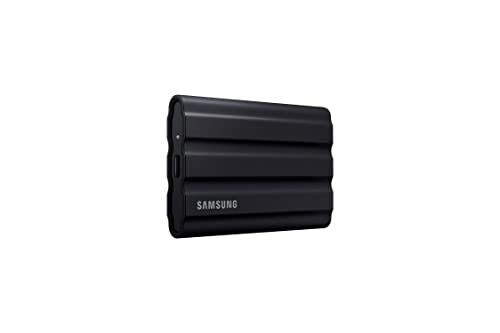
Samsung T7 vs Samsung T7 Shield at a Glance
| Feature | Samsung T7 | Samsung T7 Shield |
|---|---|---|
| Maximum Read Speed | 1,050 MB/s | 1,050 MB/s |
| Maximum Write Speed | 1,000 MB/s | 1,000 MB/s |
| Interface & Protocol | USB 3.2 Gen 2 (PCIe NVMe) | USB 3.2 Gen 2 (PCIe NVMe) |
| Drop Resistance | Up to 6 feet | Up to 9.8 feet |
| Ingress Protection (IP Rating) | Not listed | IP65 (dust-tight, water-jet resistant) |
| Exterior Housing Material | Solid aluminum unibody | Outer elastomer shell over chassis |
| Thermal Management | Not listed in features | Dynamic Thermal Guard |
| Drive Management Software | Not listed | Samsung Magician software support |
| Hardware Encryption | Not listed in specs | Listed |
| Weight | 2.08 ounces | Not listed |
| Best For | Everyday productivity, classroom, and office travel | Outdoor fieldwork, rough shoots, and harsh conditions |
Durability and Environmental Protection
Physical protection defines the core architectural separation between these two external drives. The Samsung T7 utilizes a solid aluminum unibody construction engineered to endure everyday accidents, officially rated for fall protection and shock resistance from drops up to 6 feet. This metal shell provides rigid structural integrity against typical bumps inside a commuter backpack or accidental knocks off an office desk. However, the standard enclosure features exposed seams around the port perimeter and lacks gasket seals, meaning the manufacturer provides no formal rating for defense against liquids or dust particles.
The Samsung T7 Shield addresses demanding field conditions by wrapping its underlying structure in an advanced outer elastomer layer. This ruggedized skin cushions physical shocks, increasing the manufacturer drop protection threshold up to 9.8 feet. More importantly, the drive carries a certified IP65 rating tested against active dust exposure for 8 hours under 2kPa pressure and low-pressure water projected from a nozzle at 100kPa for 3 minutes. For creators comparing rugged storage against alternatives like the samsung t7 shield vs sandisk extreme pro portable, this formal IP65 certification guarantees the enclosure stops harmful dust intrusion and survives sudden rain showers during outdoor shoots.
Choosing between them on physical toughness comes down to where you work. The standard T7 survives the routine hazards of indoor life and transit, but exposing it to beach sand, muddy worksites, or downpours risks port contamination and drive failure. The T7 Shield absorbs noticeably higher impacts and locks out particulate matter, ensuring your files remain secure when working outside controlled environments.
Edge: Samsung T7 Shield due to its superior 9.8-foot drop threshold and verified IP65 water and dust resistance.
Thermal Management and Sustained Performance
Both models share identical peak transfer capabilities on paper, using PCIe NVMe technology over a USB 3.2 Gen 2 interface to hit sequential read figures of 1,050 MB/s and media write speeds of 1,000 MB/s. These metrics represent roughly double the throughput of older SATA-based portable drives like the T5. However, moving dozens of gigabytes of footage or running multi-track video editing sessions generates substantial heat inside compact solid-state enclosures, making internal heat dissipation vital for maintaining peak transfer speeds without sudden throttling.
The Samsung T7 relies on passive heat transfer through its aluminum shell. While bare metal naturally conducts heat away from internal controllers, the listing does not specify advanced active throttling management hardware. Under sustained workloads, metal unibody designs can become warm to the touch, and if controller temperatures reach internal limits, the drive must throttle transfer rates to protect NAND flash integrity. Shoppers weighing next-generation options such as the samsung t7 vs t9 often examine how thermal efficiency influences sustained transfer rates across prolonged file offloads.
The Samsung T7 Shield explicitly integrates Samsung’s Dynamic Thermal Guard technology alongside its thick elastomer exterior. Dynamic Thermal Guard monitors controller heat and automatically manages operational temperatures to prevent steep performance drops during extended read and write cycles. Despite the rubber coating acting as an insulating layer, the specialized thermal management system ensures the drive maintains stable throughput while offloading large archives or editing directly from the volume.
Edge: Samsung T7 Shield because its integrated Dynamic Thermal Guard prevents extreme thermal throttling during heavy sustained writes.
Video Production and Direct Camera Recording
Content creators handling modern camera workflows require external storage that maintains swift, uninterrupted write speeds while mounted to camera rigs or mobile devices. Both the standard T7 and the T7 Shield natively support direct high-resolution recording, including capturing Apple ProRes 4K footage at 60 frames per second straight from an iPhone 15 Pro or Pro Max. Utilizing high-speed USB-C connections, both drives allow filmmakers to bypass internal mobile storage bottlenecks entirely and record uncompressed media directly to external media.
In a controlled studio environment, the standard T7 performs this task admirably. Its slim profile mounts cleanly into mobile clamps without adding unnecessary bulk, and its 1,000 MB/s maximum write capability easily clears the bandwidth threshold demanded by 4K ProRes 60fps streams. For editors working at stationary desks, reviewing footage directly off the T7 provides seamless timeline scrubbing in editing suites. Those evaluating advanced workflows might also compare the samsung t7 shield vs t9 to determine whether higher sequential ceilings provide tangible benefits for complex timeline exports.
When productions move into field environments, the practical reality of filming shifts the advantage toward the T7 Shield. Outdoor run-and-gun shoots expose camera rigs to moisture, dirt, and mechanical vibrations. The grippy elastomer shell of the Shield prevents the drive from slipping out of rigging brackets or wet hands, while the IP65 seal shields the connection interface from mist or dirt. Furthermore, the T7 Shield data sheet explicitly verifies compatibility extending across both iPhone 15 and iPhone 16 series hardware, ensuring broad utility across evolving camera setups.
Edge: Samsung T7 Shield for offering equivalent direct 4K ProRes capture alongside superior physical security on unpredictable video shoots.
Form Factor, Weight, and Daily Portability
Portability takes two very different forms across these units. The classic Samsung T7 is celebrated for its sleek, pocketable silhouette. Weighing just 2.08 ounces, it feels barely noticeable when placed in a front pocket, shirt pocket, or organizer pouch. The smooth, anodized aluminum unibody slides smoothly into compact sleeves without snagging on fabric or lining, making it an exceptional companion for students carrying lightweight laptops or professionals transitioning between boardrooms.
The Samsung T7 Shield trades that featherweight, slippery profile for enhanced grip and shock absorption. The outer elastomer coating adds tactile ridges that make the drive easy to hold with wet or gloved hands, reducing the likelihood of accidental drops in the first place. However, that same rubberized finish adds physical dimension and creates surface friction against cloth, meaning the T7 Shield does not slip into slim pockets as smoothly as the bare-metal original. The listing also leaves the exact product weight unlisted, reflecting its heavier, reinforced construction.
For individuals who keep their drive exclusively on a clean workspace or inside a commuter bag, the added bulk and rubberized exterior of the Shield offer little everyday benefit. The standard T7 delivers the refined, ultra-compact aesthetic that traditional portable drive users prefer. Users researching slim storage across brands often look at matchups like the samsung t7 vs sandisk extreme pro portable to balance pocketability against rugged protective bumpers.
Edge: Samsung T7 due to its verified 2.08-ounce lightweight build and smooth aluminum profile that fits effortlessly into tight pockets.
Software Utilities and Security Features
Long-term drive ownership requires clear insight into drive health, firmware updates, and reliable data security. The Samsung T7 Shield listing explicitly specifies support for Samsung Magician software. This dedicated utility suite allows users to monitor real-time drive conditions, track total bytes written, update internal firmware, verify component authenticity, and configure security settings. The T7 Shield feature sheet also highlights built-in hardware encryption support to keep sensitive project data shielded from unauthorized access if the physical unit is misplaced.
The standard Samsung T7 documentation highlights comprehensive multi-platform usability across PC, Mac, Android, and gaming hardware, emphasizing its seamless plug-and-play capability right out of the box with supplied USB Type-C to Type-C and Type-C to Type-A cables. However, the listing does not specify native hardware encryption features or bundled Samsung Magician integration in its key specifications table. While third-party software tools can format and manage partitions, having factory diagnostic utilities explicitly confirmed gives users greater control over preventative maintenance.
For business travelers and production teams hauling valuable digital assets, having native software diagnostics and certified hardware encryption adds meaningful peace of mind. The ability to check drive health before a major project prevents unexpected data losses in the field, making the T7 Shield a more complete end-to-end package for managing sensitive client files.
Edge: Samsung T7 Shield because its specifications explicitly include Samsung Magician optimization tools and hardware encryption support.
Gaming Console and Cross-Platform Compatibility
Modern gaming consoles place heavy demands on external solid-state storage for expanding game libraries and reducing load times. The Samsung T7 explicitly documents support for Microsoft Xbox Series X, Xbox Series S, and Sony PlayStation 5 consoles, alongside standard PC, Mac, and Android ecosystems. With maximum read and write speeds reaching 1,050 MB/s and 1,000 MB/s, the T7 delivers the rapid data transfer rates needed to store massive console installations and back up complex gaming directories quickly without waiting on mechanical drive read speeds.
The Samsung T7 Shield matches these operational characteristics, noting comprehensive compatibility across gaming consoles, PC, Mac, tablets, and mobile devices. Because both drives share the same USB 3.2 Gen 2 controller and PCIe NVMe architecture, gaming performance in terms of raw transfer throughput and game launch latency is functionally indistinguishable between the two models. Neither drive has an innate performance advantage when serving as an external storage repository for a living room entertainment console.
The choice for gaming setups ultimately rests on hardware placement. The standard T7 includes both USB Type-C to Type-C and Type-C to Type-A cables directly in the box, ensuring instant out-of-the-box connectivity whether your console uses rectangular Type-A ports or oval Type-C ports. The standard T7’s slim footprint also rests cleanly behind entertainment consoles without drawing attention, while the T7 Shield’s ruggedized bumper provides no functional benefit sitting next to a television.
Edge: Tie, as both drives deliver matching 1,050 MB/s transfer speeds across PlayStation and Xbox gaming hardware.
Pros and Cons
Samsung T7

Pros
- Lightweight at 2.08 ounces
- Smooth aluminum unibody construction
- Includes USB-C and USB-A cables
- Drop resistant up to 6 feet
- Speeds up to 1,050 MB/s
Cons
- No IP water or dust rating
- Lacks Dynamic Thermal Guard
- Lower drop protection than Shield
Samsung T7 Shield

Pros
- IP65 certified water and dust resistance
- Drop resistant up to 9.8 feet
- Dynamic Thermal Guard heat control
- Shock-absorbing outer elastomer shell
- Supports Samsung Magician software
Cons
- Elastomer exterior adds bulk
- Rubber finish snags inside tight pockets
View Samsung T7 Shield on Amazon
Who Should Buy Each One
Choose the Samsung T7 If
- You work primarily indoors across offices, classrooms, libraries, or home studios where water and dust exposure are non-factors.
- You prioritize extreme pocketability and want a lightweight drive weighing just 2.08 ounces that slides into pockets without friction.
- You need both USB-C and USB-A connection cables supplied inside the box for seamless switching between legacy PCs and newer laptops.
- You prefer a clean, solid aluminum unibody aesthetic that complements modern laptops and monitors on your desk.
Choose the Samsung T7 Shield If
- You shoot video, capture photography, or back up data outdoors where rain, mud, grit, and changing weather occur.
- You require certified IP65 water and dust resistance to protect mission-critical client files against environmental contamination.
- You want elevated impact resistance capable of withstanding drops from heights up to 9.8 feet onto hard surfaces.
- You run continuous, heavy read/write operations and need Dynamic Thermal Guard to keep drive temperatures balanced.
Final Verdict
When comparing the Samsung T7 and the Samsung T7 Shield, the better drive for most shoppers is the Samsung T7 Shield. Even though both devices produce identical sequential performance ratings of 1,050 MB/s read and 1,000 MB/s write over USB 3.2 Gen 2, the T7 Shield provides vital real-world safety nets that the original lacks. Its certified IP65 water and dust resistance, enhanced 9.8-foot fall protection, rubberized exterior shock absorption, and integrated Dynamic Thermal Guard deliver comprehensive hardware insurance against accidents and sustained write heat.
The standard Samsung T7 remains an exceptional piece of hardware for users who operate exclusively in clean indoor environments. Its featherweight 2.08-ounce aluminum frame is undeniably slimmer, sleeker, and easier to slide into a pants pocket than the ribbed rubber body of the Shield. If you never take your storage into wet or dusty environments and prize compact elegance above outdoor durability, the original T7 delivers top-tier transfer performance in a refined, minimalist chassis.
FAQ
Can I record 4K 60fps ProRes video directly to both the T7 and T7 Shield?
Yes. Both the Samsung T7 and the Samsung T7 Shield support direct Apple ProRes 4K recording at 60 frames per second when connected to compatible devices such as the iPhone 15 Pro series. The drives deliver maximum write speeds up to 1,000 MB/s over USB 3.2 Gen 2, easily satisfying the high data transfer bandwidth required for continuous uncompressed video capture.
What is the difference in drop protection between these two SSDs?
The standard Samsung T7 features fall protection engineered to withstand drops up to 6 feet thanks to its rigid aluminum unibody housing. The Samsung T7 Shield increases that protection threshold up to 9.8 feet by surrounding its core assembly with an energy-absorbing outer elastomer coating that cushions heavy impacts against hard surfaces.
Is the Samsung T7 waterproof?
No. The standard Samsung T7 does not carry an ingress protection rating and is not water or dust resistant. In contrast, the Samsung T7 Shield holds an official IP65 rating, meaning it has been tested to withstand pressurized water flow of 100kPa for 3 minutes and resist active dust exposure under 2kPa pressure for 8 hours.
Are both drives compatible with gaming consoles like the PS5 and Xbox Series X?
Yes. Both models support gaming consoles via USB 3.2 connectivity. The Samsung T7 explicitly lists compatibility with the PlayStation 5, Xbox Series X, and Xbox Series S, while the T7 Shield specifies broad gaming console support. Both drives deliver identical transfer speeds up to 1,050 MB/s, making them equally suited for external game storage.
Does the Samsung T7 include cables in the box?
Yes. The Samsung T7 listing explicitly includes both a USB Type C-to-C cable and a USB Type C-to-A cable in the box, allowing you to connect to both modern Type-C ports and legacy Type-A ports without purchasing separate adapters. The T7 Shield listing notes that using the included SSD cable is recommended for optimal performance.
What storage capacities are available for these two models?
Both the Samsung T7 and the Samsung T7 Shield are manufactured in storage capacities reaching up to 4TB, giving users substantial space for high-resolution video archives, large photo catalogs, and extensive gaming libraries.


