When selecting between Noctua’s top-tier 120mm cooling solutions, the deciding factor comes down to impeller engineering and rotational ceiling: the newer model uses liquid crystal polymer construction to spin up to 2000 RPM with an ultra-tight tip clearance, whereas the established alternative uses a stator vane frame operating at 1500 RPM to direct concentrated airflow straight through restrictive obstacles.
Choose the Noctua NF-A12x25 if you want an all-round cooling solution that delivers higher top-end rotational speeds and uniform efficiency across both chassis intake positions and liquid-cooling radiators. Choose the Noctua NF-F12 if your system relies on focused, directional air delivery tailored specifically for tower heatsinks and moderate-speed cooling setups.
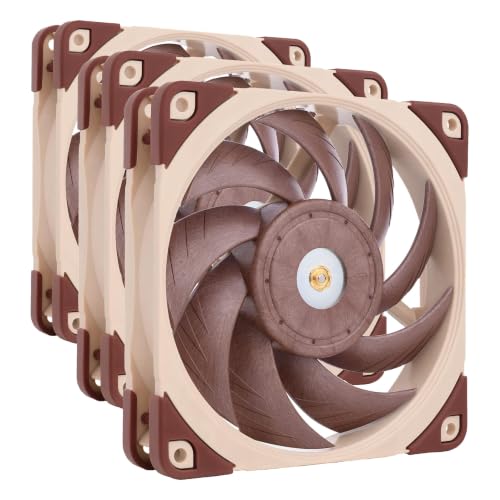

Noctua NF-A12x25 vs Noctua NF-F12 at a Glance
| Attribute | Noctua NF-A12x25 | Noctua NF-F12 |
|---|---|---|
| Impeller & Frame Material | Sterrox LCP | Fibre-glass reinforced PBT |
| Maximum Rotational Speed | 2000 RPM (1700 RPM with LNA) | 1500 RPM (1200 RPM with LNA) |
| PWM Speed Range | Listing does not specify minimum | 300 – 1500 RPM |
| Acoustical Noise Level | 22.6 dB(A) | 22.4 dB(A) |
| Air Flow Capacity | Not listed | 93.4 m³/h |
| Aerodynamic Frame Design | AAO Frame with Flow Acceleration Channels | Focused Flow Frame with Guide Vanes |
| Tip Clearance | 0.5 mm | Not listed |
| Hub & Bearing Housing | Metal-reinforced hub & metal bearing shell | Not listed |
| Included Radiator Gasket | Yes (Silicone gasket included) | No |
| MTTF & Warranty | >150,000 hours / 6 years | >150,000 hours / 6 years |
| Best For | Universal PC builds, radiators, and high-airflow cases | Dedicated tower heatsinks and targeted fin arrays |
Impeller Material and Tip Clearance
The core structural divergence between these two fans lies in the composition of their fan blades and the precision of the gap separating those blades from the outer frame. In typical fan operation, centrifugal force and thermal load can cause plastic blades to stretch outward over time. To avoid housing collisions, conventional fans require generous clearance margins. The A12x25 tackles this engineering challenge by utilizing Sterrox liquid crystal polymer (LCP), an industrial-grade compound with extreme tensile strength and thermal stability. This allows the blades to maintain their exact geometry under centrifugal stress, enabling a record-tight 0.5mm tip clearance between the blade tips and the inner frame wall.
By contrast, the NF-F12 utilizes fibre-glass reinforced PBT (polybutylene terephthalate). While fibre-glass reinforcement makes PBT significantly more rigid than standard plastics, the listing does not claim sub-millimeter tolerances comparable to the newer LCP model. In practical application, reducing tip clearance to 0.5mm directly limits air leakage around the perimeter of the blades. When air cannot backflow between the blade edge and the frame, the fan pushes a higher volume of air forward against backpressure rather than letting it circulate harmlessly inside the housing. The A12x25 further reinforces this assembly with a metal-reinforced motor hub and an all-metal bearing shell to maintain absolute rotational axis alignment under heavy continuous load.
For builders assessing long-term mechanical reliability, the Sterrox construction prevents creeping blade elongation even after years of continuous high-speed rotation. While the fibre-glass reinforced PBT of the older design has proven exceptionally robust over its long product lifespan, the modern material science deployed in the flagship model represents a clear step forward in aerodynamic efficiency. Readers considering other premium alternatives often explore our Noctua NF-A12x25 vs Arctic P12 technical breakdown to see how high-end materials compare against budget-oriented impellers.
Edge: Noctua NF-A12x25 due to its dimensionally stable Sterrox LCP material and ultra-tight 0.5mm tip clearance.
Rotational Speed and Cooling Overhead
When selecting a cooling fan for intensive hardware configurations, rotational speed ceiling defines how much reserve thermal capacity your system holds. The NF-A12x25 features a maximum rotational speed of 2000 RPM, which can be throttled down to 1700 RPM when utilizing the included Low-Noise Adaptor (LNA). The NF-F12 tops out at 1500 RPM in standard PWM mode, dropping down to a maximum of 1200 RPM when connected via its respective Low-Noise Adaptor. This creates a substantial 500 RPM operating delta at standard full-load operation.
That extra 500 RPM margin provides critical cooling overhead during peak thermal events. If an overclocked processor or a high-wattage graphics card spikes under full rendering or gaming loads, the 2000 RPM ceiling of the flagship model allows it to generate significantly more pressure and volume to pull temperatures down quickly. In contrast, the 1500 RPM limit of the older model is reached much earlier, leaving no additional mechanical overhead if your enclosure experiences heat soak on a warm day. Both fans support 4-pin PWM control, meaning your motherboard can modulate their curves dynamically down to whisper-quiet velocities during desktop idling.
The broader operating envelope of the A-series model makes it far more versatile for automated PWM profiles. It can idle silently at low percentage signals while retaining the capability to blast away heat when requested by aggressive fan curves. The F12 specifies a defined control range of 300 to 1500 RPM, which is well-suited for stable, continuous tower cooler duty, but simply cannot match the upper-register throughput of its 2000 RPM sibling. Those weighing different sizing options for case ventilation may also want to review our Noctua NF-A12x25 vs Arctic P14 comparison to examine how 120mm rotational speed balances against larger 140mm fan diameters.
Edge: Noctua NF-A12x25 because its 2000 RPM maximum speed delivers 500 RPM of additional cooling headroom.
Static Pressure Architecture and Frame Aerodynamics
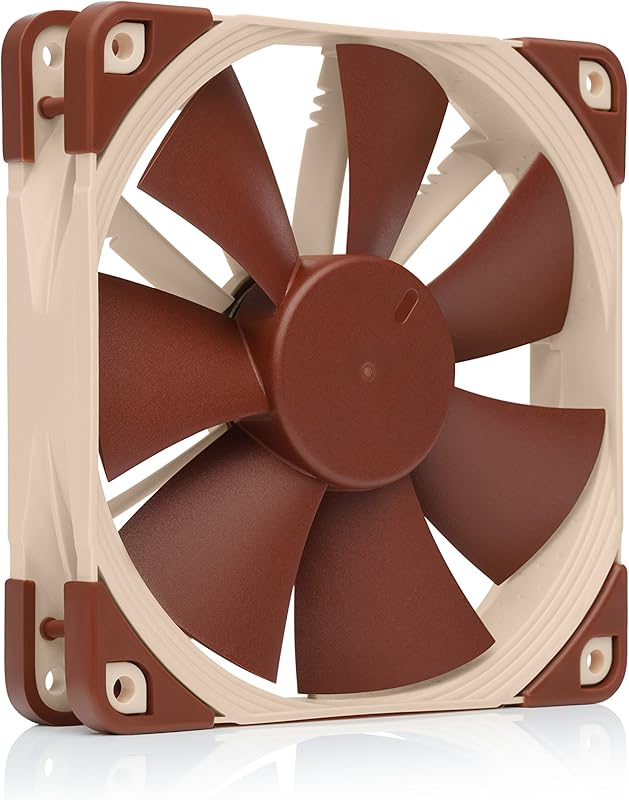
Airflow resistance varies drastically depending on where a fan is mounted. A fan facing an open honeycomb mesh encounters minimal impedance, while a fan bolted directly to a dense fin stack or a watercooling radiator faces heavy resistance. The NF-F12 was purpose-built from the ground up for focused static pressure, incorporating Noctua’s proprietary Focused Flow frame. This design integrates eleven stator guide vanes on the exhaust side of the frame, paired with specially angled impellers. These stationary vanes straighten the swirling turbulence generated by the spinning blades, projecting the exhaust airflow in a tight, cylindrical column directly through fin arrays.
The NF-A12x25 approaches resistance from a different aerodynamic angle, employing Noctua’s Advanced Acoustic Optimisation (AAO) frame and Flow Acceleration Channels on the blades themselves. Rather than using large rear guide vanes to focus the air column, the A-series model uses channel grooves on the suction side of the blade tips to accelerate airflow in critical outer zones. This speeds up boundary layer separation, reducing vortex shedding while simultaneously generating high static pressure across the entire surface plane of the fan. The listing highlights this next-generation design as an all-round solution specifically engineered to bridge the gap between high airflow and high static pressure performance.
In real-world deployment, this structural difference defines where each fan excels. The Focused Flow frame of the older model is exceptionally capable on standard tower heatsinks-such as the classic Noctua NH-U12 series-because the straight air column drives deep into parallel aluminum fins without dispersing laterally. However, on wide liquid cooling radiators or open mesh panels, the uniform pressure field and curved blade geometry of the modern A-series fan sweep more air across the entire face of the surface. For builders balancing CPU cooler options, our analysis of the Noctua NH-D15 vs NH-D15 G2 illustrates how Noctua’s evolving aerodynamic designs impact overall system temperatures.
Edge: Noctua NF-A12x25 for overall static pressure versatility across varied resistance types.
Acoustic Profile and Noise Output
Acoustic management is a primary consideration for builders investing in premium fans, and the manufacturer specifications for these two units present an intriguing technical comparison. The NF-F12 carries an official noise rating of 22.4 dB(A) running at its maximum speed of 1500 RPM. The NF-A12x25 carries an official noise rating of 22.6 dB(A) when spinning at its full 2000 RPM. This represents a mere 0.2 dB(A) acoustic difference on paper despite the A12x25 spinning a massive 500 RPM faster.
The secret behind the acoustic efficiency of the A-series unit is its refined blade resonance tuning and aerodynamic integration. Because the Sterrox material is exceptionally rigid, it does not produce the high-frequency harmonic flutter often heard when flexible plastic blades flex under backpressure. Furthermore, the AAO frame incorporates integrated anti-vibration pads along with stepped inlet designs and inner surface microstructures that soften the tonal signature of incoming air. When throttled down to matching rotational speeds-or when capped at 1700 RPM with the supplied Low-Noise Adaptor-the A12x25 operates with a noticeably softer acoustic footprint than the F12 at comparable output levels.
The NF-F12 is by no means an obnoxious fan; its 22.4 dB(A) rating at 1500 RPM remains very quiet for a dedicated high-pressure unit. However, the stator guide vanes on its Focused Flow frame can produce a slightly more pronounced hum when mounted directly flush against restrictive honeycomb intake patterns due to shear turbulence as air passes over the stationary struts. If sound signature matters more than sheer decibel numbers, the broadband acoustic profile of the flagship model blends far more unobtrusively into background ambient room noise. System builders comparing noise-focused units frequently cross-reference our Noctua NF-F12 vs Arctic P12 guide to evaluate acoustic trade-offs against other popular configurations.
Edge: Noctua NF-A12x25 for achieving virtually identical 22.6 dB(A) acoustics while delivering 500 higher RPM.
Radiator Sealing and Included Accessories
Included hardware often determines how seamlessly a cooling fan integrates into a PC enclosure. Both models arrive with Noctua’s generous accessory assortment, including a 4-pin Y-cable for operating two PWM fans from a single motherboard header, a 30cm extension cable, four fan screws, and four vibration-damping silicone mounts. Both packages also supply a dedicated Low-Noise Adaptor to mechanically limit maximum RPM for ultra-quiet operation.
The critical difference in packaging comes down to liquid cooling integration. The NF-A12x25 package includes a specialized silicone anti-vibration radiator gasket. When bolting a 120mm fan onto a watercooling radiator or an all-in-one (AIO) liquid cooler, minute gaps between the fan frame and the metal radiator housing often allow pressurized air to escape backward instead of forcing its way through the dense cooling fins. The included silicone gasket replaces the standard corner pads, creating an airtight perimeter seal around the entire frame edge. This prevents pressure loss and boosts heat dissipation efficiency through the radiator matrix.
The NF-F12 does not include this full-frame silicone radiator gasket, relying instead on its standard corner-mounted anti-vibration pads. While those corner pads isolate vibrational noise effectively, they leave the gaps along the straight edges of the frame unsealed. If you plan to install your fans on an AIO or custom liquid-cooling loop, the out-of-the-box hardware of the A12x25 provides an immediate performance advantage without requiring aftermarket gaskets or tape modifications. Those exploring modern chassis builds with aesthetic considerations can also read our Noctua NF-F12 vs Lian Li Uni Fan SL120 matchup to examine how traditional frame hardware stacks up against modular inter-locking designs.
Edge: Noctua NF-A12x25 for including a dedicated silicone radiator gasket for superior liquid cooling integration.
Chassis Versatility and Airflow Dispersion
When deploying fans throughout a computer chassis, air dispersion patterns dictate cooling efficacy. A standard case fan needs to move a broad swath of air across motherboards, memory modules, and expansion cards, whereas a cooler fan must push air in a straight line. The NF-F12 was designed primarily as a static pressure specialist. Its 93.4 m³/h air flow capacity is concentrated into a narrow, parallel beam by the rear Focused Flow guide vanes. When used as an open case intake or exhaust fan, this narrow beam can leave dead zones around motherboard VRMs and graphics cards because it does not spread ambient air broadly across the interior compartment.
The NF-A12x25 features an impeller profile that balances static pressure with wide volumetric airflow. As an A-series fan, its flow geometry generates an expansive, continuous air cone that sweeps effectively across wide chassis spaces while retaining enough core thrust to penetrate dust filters and restrictive front fascia panels. It serves equally well whether mounted on the front intake of a mid-tower chassis, the rear exhaust port, or clamped to an air cooler.
Standardizing on a single fan model throughout an entire chassis simplifies maintenance, fan curves, and acoustic tuning. Because the A12x25 excels in free-air intake, free-air exhaust, heatsink cooling, and radiator pushing duties, you can fill every slot in your case with identical fans that share the exact same acoustic profile and PWM response curve. The F12 remains an effective specialized tool for tower fin stacks, but it lacks the chameleon-like versatility of the A-series flagship. For additional perspectives on high-performance cooling builds, check out our Noctua NF-F12 vs Arctic P14 review to see how specialized 120mm pressure fans perform relative to larger case fans.
Edge: Noctua NF-A12x25 for universal airflow dispersion across both open chassis mounts and restricted heatsinks.
Pros and Cons
Noctua NF-A12x25

Pros
- Rigid Sterrox LCP construction
- Record-tight 0.5mm blade tip clearance
- Higher 2000 RPM rotational ceiling
- Dedicated silicone radiator gasket included
- Metal-reinforced hub and bearing shell
Cons
- 68 watt power consumption at full speed
- Slightly higher 22.6 dB(A) rated noise ceiling
View Noctua NF-A12x25 on Amazon
Noctua NF-F12
Pros
- Focused Flow frame directs air column
- Rated 93.4 m³/h maximum airflow capacity
- Quiet 22.4 dB(A) full-speed acoustic rating
- Defined 300 to 1500 RPM PWM range
- Durable fibre-glass reinforced PBT build
Cons
- Rotational speed capped at 1500 RPM
- Silicone radiator gasket not included
- Narrow airflow column less ideal for open cases
Who Should Buy Each One
Choose the Noctua NF-A12x25 If:
- You need a versatile 120mm fan that delivers peak performance across liquid cooling radiators, tower heatsinks, and unrestricted chassis mounts.
- You want 2000 RPM of cooling overhead to protect hardware during extreme workloads or summer heat spikes.
- You are mounting fans to an AIO or custom liquid-cooling radiator and need the airtight seal provided by the included silicone gasket.
- You prioritize cutting-edge material engineering, specifically the dimensional rigidity and zero-flutter characteristics of Sterrox LCP.
Choose the Noctua NF-F12 If:
- You are replacing a worn-out fan on a dedicated tower CPU heatsink such as the Noctua NH-U12S.
- Your cooling strategy relies on straight, focused columns of air delivered directly into dense, deep fin arrays via stator guide vanes.
- You operate within a strict 300 to 1500 RPM fan curve and have no need for a 2000 RPM high-speed ceiling.
- You prefer a proven, battle-tested cooling design manufactured from durable fibre-glass reinforced PBT.
Final Verdict
For the vast majority of PC builders and cooling enthusiasts, the Noctua NF-A12x25 is the superior choice. Its state-of-the-art Sterrox LCP impeller construction, microscopic 0.5mm tip clearance, and metal-reinforced motor hub represent the gold standard in modern fan engineering. Delivering a 2000 RPM rotational ceiling while remaining rated at an exceptionally quiet 22.6 dB(A), the flagship model provides superior thermal headroom, broad airflow dispersion, and unparalleled versatility across any PC mounting location.
The Noctua NF-F12 still retains a clear, focused purpose in specific computing environments. If you are servicing an existing single-tower CPU heatsink with dense fin spacing-such as the classic Noctua NH-U12 series-the Focused Flow stator guide vanes do an exceptional job of channeling air directly through the heatsink without wasted lateral dispersion. However, for complete system builds, liquid-cooling radiator setups, and maximum cooling flexibility, the NF-A12x25 remains the undisputed winner.
FAQ
Between the NF-A12x25 or NF-F12 for radiator setups, which model performs better?
The Noctua NF-A12x25 is distinctly better suited for liquid cooling radiators and all-in-one (AIO) coolers. In addition to its higher 2000 RPM rotational ceiling and tight 0.5mm tip clearance that prevents backpressure air leakage, the A-series fan includes a specialized silicone radiator gasket in the box. This gasket creates an airtight seal around the entire frame perimeter to prevent pressure bleed against restrictive radiator fins.
Can the Noctua NF-F12 be used effectively as a standard case fan?
While the NF-F12 can function as a standard case fan, it is not optimized for that role. Its Focused Flow frame and rear stator vanes are engineered to direct air into a narrow, straight column to penetrate dense obstacles. In an open chassis intake or exhaust role, this narrow beam does not disperse fresh air broadly across peripheral components like memory modules and graphics cards as effectively as the wider air cone produced by the NF-A12x25.
What does the Sterrox LCP material do for the Noctua NF-A12x25?
Sterrox is a liquid crystal polymer that boasts extreme tensile strength, low thermal expansion, and exceptional rigidity. In the NF-A12x25, this advanced material prevents the fan blades from stretching outward under centrifugal force at 2000 RPM. This rigidity allowed Noctua engineers to design the fan with an ultra-tight 0.5mm clearance gap between the blade tips and frame wall, dramatically reducing pressure loss and aerodynamic turbulence.
Do both fans include speed-reducing Low-Noise Adaptors?
Yes, both models include Noctua’s Low-Noise Adaptor (LNA) in their accessory bundles. When connected to the NF-A12x25, the adapter reduces maximum rotational speed from 2000 RPM down to 1700 RPM. When connected to the NF-F12, the adapter reduces the maximum rotational ceiling from 1500 RPM down to 1200 RPM for ultra-quiet operation.
How does the Noctua NF-A12x25 vs NF-F12 static pressure focus differ?
The NF-F12 achieves its static pressure through directional focusing, utilizing eleven rear stator guide vanes to straighten airflow and drive it forward like a cylinder. The NF-A12x25 achieves its static pressure through aerodynamic blade curvature, Flow Acceleration Channels, and an ultra-tight 0.5mm tip clearance that stops air from escaping backward, resulting in high static pressure across a wider surface area.
Is the NF-F12 worth it if you already own a Noctua NH-U12 cooler?
The NF-F12 remains a dependable direct replacement fan for Noctua NH-U12 series tower coolers if your original fan has worn out or if you want to set up a dual-fan push-pull configuration at 1500 RPM. However, upgrading to the NF-A12x25 will provide additional cooling headroom thanks to its 2000 RPM ceiling and quieter acoustic profile under load.


