The core difference that decides the choice between these two reciprocating saws is physical clearance versus aggressive cutting throughput. The DeWalt DCS367 is engineered with a compact 14.5-inch frame designed explicitly to fit between standard 16-inch framing studs, while the Milwaukee 2822-20 delivers a longer 1-1/4-inch stroke and app-connected motor customization built to tear through heavy material on unrestricted demolition jobs.
Choose the DeWalt DCS367 if your daily work involves tight plumbing chases, electrical rough-ins, or precision framing cuts where a full-length saw cannot physically maneuver. Select the Milwaukee 2822-20 if you run commercial tear-outs, manage inventory across fleet toolboxes, and need high-volume material removal backed by digital tracking.


DeWalt DCS367 vs Milwaukee 2822-20 at a Glance
| Feature | DeWalt DCS367 | Milwaukee 2822-20 |
|---|---|---|
| Motor Type | Brushless | Brushless |
| Stroke Length | 1-1/8 inches | 1-1/4 inches |
| Stroke Speed | Up to 2,900 SPM (2,800 RPM in specs) | Customizable via ONE-KEY app |
| Bare Tool Weight | 5.4 pounds (5 lbs in listing highlights) | 6.8 pounds |
| Overall Length | 14.5 inches | Not listed |
| Blade Clamp Style | Keyless 4-position clamp | Lever-action quick-lock (anti-corrosion) |
| Connected Features | Not listed | ONE-KEY tracking, management, and control |
| Cut Safety Features | Variable speed trigger | Selectable cut brake |
| Storage Hook | Not listed | Integrated hang hook |
| Best For | Tight-space remodeling and framing | Heavy demolition and fleet jobsite tracking |
Tool Dimensions and Tight-Space Maneuverability
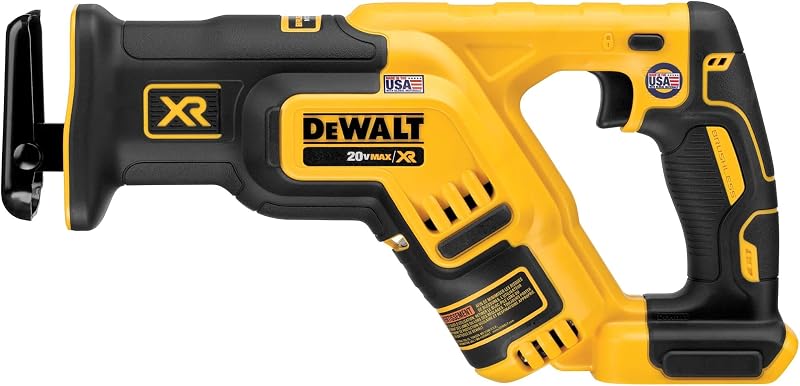
Reciprocating saws spend a surprising amount of their working lives stuffed inside wall cavities, under floor joists, and between tightly spaced mechanical lines. In these environments, overall tool length determines whether you can square the blade against a pipe or are forced to cut at an awkward, blade-snapping angle. The compact layout of the DCS367 is designed around the American building standard of 16-inch on-center studs. At 14.5 inches in overall length, you can hold the motor body completely within a single stud bay without wedging the battery foot or blade housing against adjacent 2x4s. This compact geometry shifts the center of gravity closer to your hands, giving you exceptional control when trimming plumbing stacks or notching framing plates.
By contrast, the 2822-20 is built on Milwaukee’s full-size M18 FUEL chassis. While the manufacturer listing does not state the exact tip-to-tail length, full-size Sawzall frames are substantially longer than compact-class tools. When working in an attic crawlspace or between closely spaced ceiling ties, a full-sized reciprocating saw forces the operator to tilt the saw sideways or use bent, over-extended blades. For trades considering dewalt dcs367 vs milwaukee 2720-20 configurations or looking at the dewalt dcs380 vs milwaukee 2822-20 matchup, physical reach and chassis length remain the primary hurdle in confined retrofits. Choosing between the dewalt dcs367 or milwaukee 2822-20 for tight spaces makes the physical layout an instant deciding factor.
Working in cramped spots also highlights how tool balance affects operator fatigue over an eight-hour shift. The DeWalt comes in at 5.4 pounds according to its technical specifications (noted as 5 pounds in feature bullet points), whereas the Milwaukee registers at 6.8 pounds. That difference of nearly a pound and a half is immediately noticeable when making overhead cuts into ceiling drywall or holding the machine level inside a utility trench. The reduced leverage strain from a lighter, shorter body means you can complete repetitive cuts in awkward positions without straining your forearms or shoulders.
Edge: DeWalt DCS367 because its 14.5-inch compact chassis easily slips between 16-inch framing studs where full-size demolition saws cannot fit.
Stroke Length and Cutting Performance
Stroke length determines how many cutting teeth pass across the workpiece with every single cycle of the motor. A longer stroke clears chips and sawdust faster, prevents heat buildup in the kerf, and chews through dense structural lumber with less down-force from the operator. The DeWalt DCS367 offers a respectable 1-1/8-inch stroke length paired with a variable speed trigger capable of up to 2,900 strokes per minute. This combination delivers aggressive cutting for a compact saw, outpacing older, short-stroke compact tools that often lingered around 7/8 of an inch. In any hands-on dewalt dcs367 review evaluation, users find that this 1-1/8-inch throw allows aggressive plunge cuts and swift wood demolition without bogging down the brushless motor.
The Milwaukee 2822-20 steps up the cutting dynamics by providing a full 1-1/4-inch stroke length. That extra eighth of an inch might seem negligible on paper, but in active demolition, it dramatically changes material removal rates. Each pass engages more teeth on a standard 24-tooth blade, pulling out larger chips from wet framing lumber and tearing through heavy-gauge metal pipes much faster. The listing description notes that the 1-1/4 in. stroke length removes more material with each stroke, directly supporting high-speed structural demolition. When readers ask if the dewalt dcs367 or milwaukee 2822-20 for demolition is the stronger platform, the 2822-20 demonstrates clear mechanical advantages for pure processing speed.
The difference in stroke dynamics comes with a distinct trade-off in control. While the Milwaukee’s 1-1/4-inch stroke devours lumber, that longer travel can create violent chatter if you are cutting thin sheet metal or conduit without firmly planting the shoe. The DeWalt’s 1-1/8-inch stroke length strikes a balanced compromise: it provides plenty of clearance to keep thick wood cuts moving, yet remains stable enough for delicate electrical conduit work or surgical cuts in finished cabinetry. However, for sheer removal volume on a jobsite demolition line, the larger stroke stroke of the 2822-20 remains superior.
Edge: Milwaukee 2822-20 because its longer 1-1/4-inch stroke length drives more tooth travel per cycle to clear material noticeably faster during heavy demo.
Blade Clamping and Orientation Flexibility
Blade clamp systems dictate how easily you can swap broken blades with work gloves on, as well as how flush you can cut against finished walls and floors. The DCS367 features DeWalt’s signature keyless 4-position blade clamp. Instead of mounting a blade exclusively facing up or down, this mechanism lets you mount the blade pointing up, down, left, or right. When cutting a sill plate flush with subflooring or trimming a pipe that exits directly parallel to a wall stud, you simply insert the blade sideways. This eliminates the need to bend the blade against the shoe or tilt the motor at an angle, drastically extending blade life and keeping cuts straight and true.
The Milwaukee 2822-20 relies on a heavy-duty lever-action quick-lock blade clamp. Milwaukee prioritizes extreme durability in abusive jobsite conditions, outfitting this tool with an anti-corrosion blade clamp designed to resist binding from rust, slurry, and fine drywall grit. Blade changes are straightforward: lifting the exterior lever unlocks the tang instantly, allowing quick one-handed blade removal even if the blade has snapped off near the collar. This mechanism is built for punishing demolition environments where dirt and rust frequently ruin internal spring-loaded collars.
However, the 2822-20 listing does not claim multi-directional blade positions. While traditional Sawzall clamps allow upside-down blade mounting for flush undercuts, they do not support 90-degree sideways mounting. That leaves the operator having to tilt the entire 6.8-pound tool flat against the ground to cut flush to a deck. DeWalt’s 4-position mechanism gives the DCS367 unmatched practical utility for remodelers and plumbers who routinely cut in tight, obstructed corners where tool rotation is impossible. While comparing different tool designs like the dewalt dcs380 vs milwaukee 2720-20, tradespeople regularly find that blade positioning flexibility saves more time than pure motor speed.
Edge: DeWalt DCS367 because its 4-position blade clamp allows 90-degree flush cutting against walls and ceilings without bending blades.
Smart Connectivity, Speed Control, and Braking
Modern jobsite demands have shifted past basic mechanical power into digital tool management and safety automation. The DCS367 maintains a classic, straightforward approach: it relies on a mechanical variable speed trigger that scales motor output smoothly from zero up to 2,900 SPM. This gives the operator instant tactile feedback, allowing you to feather the cut when starting a notch before pulling the trigger fully back for raw speed. For many professionals, this purely analog control is desirable because there are no electronic menus to navigate, no firmware to sync, and no apps required to operate the saw at its peak potential.
The Milwaukee 2822-20 is on an entirely different technological tier due to integrated ONE-KEY compatibility. Through the ONE-KEY digital app, users gain access to unlimited customization of cut speed and trigger ramp-up profiles. If you are cutting heavy cast iron pipe all day, you can dial down the maximum stroke speed to match the specific blade metal, preventing teeth from burning up within seconds. Furthermore, the 2822-20 features a selectable cut brake. This sensor-driven safety system actively monitors mechanical load on the blade throughout the cut and automatically stops the motor as the blade exits the material, preventing accidental kickback or punching through unseen pipes behind drywall.
Digital management on the 2822-20 extends into tool security and asset management. The ONE-KEY system tracks tool performance, monitors tool location across job sites, and allows tool lockouts if a unit goes missing from a gang box. In any milwaukee 2822-20 review, commercial mechanical contractors highlight this tracking capability as a major operational asset. Readers wondering is milwaukee 2822-20 worth it will find that for large commercial crews managing dozens of shared tools, the digital control and anti-theft tracking justify the platform completely.
Edge: Milwaukee 2822-20 because ONE-KEY integration provides digital cut speed customization, cloud tool tracking, and an automated cut brake.
Jobsite Durability and Convenience Features
When working on scaffolding, ladders, or unfinished framing, secondary convenience features drastically affect work efficiency. The Milwaukee 2822-20 includes an integrated heavy-duty hang hook. When you are standing on a step ladder cutting overhead conduit or notching joists, you do not have to set the saw down on the floor or balance it precarious on a wall plate; you simply fold out the hook and hang the machine directly over a 2×4 or pipe. Combined with its anti-corrosion clamp and rugged M18 FUEL housing, the 2822-20 is purpose-built to withstand the rigors of heavy commercial jobsites where tools are subjected to drops, moisture, and rough handling.
The DeWalt DCS367 focuses its convenience features on low-light visibility and runtime optimization. It features a bright, forward-facing LED light positioned to illuminate the line of cut directly in front of the shoe, casting minimal shadows into dark stud bays. The listing specifies that its brushless motor design yields up to 2.5 times more runtime compared to legacy brushed platforms (specifically tested using a DCB205 battery versus a DC385 saw with a DC9096 battery cutting 2×4 wood). This extended runtime makes the DCS367 an exceptionally efficient tool when running standard 20V MAX battery packs, letting users cut all day without carrying heavy high-capacity batteries that would ruin its compact balance.
Both tools incorporate LED lighting to illuminate dark cutting areas, which is critical when working under sinks or inside unpowered building shells. However, the absence of an integrated rafter hook on the DCS367 is an inconvenience when working at height. You must set the DeWalt down on a flat surface or hold it while repositioning materials. The Milwaukee’s combination of an integrated hang hook, ruggedized chassis, and built-in cut brake makes it a noticeably more accommodating tool for harsh, multi-story demolition environments. For trades comparing broader tool lines like the dewalt dcs570 vs milwaukee 2830-20, jobsite-ready hanging and mounting features consistently influence workflow speed.
Edge: Milwaukee 2822-20 because of its integrated rafter hang hook, anti-corrosion components, and ruggedized commercial-grade chassis.
Weight and Ergonomic Fatigue
The physical toll of running a reciprocating saw becomes apparent during overhead work, wall plunge cuts, or extended conduit-cutting sessions. In these applications, tool weight is not just a comfort metric-it dictates how long you can cut accurately before your arms shake and cut quality degrades. The DeWalt DCS367 lists a tool-only weight of 5.4 pounds (highlighted as 5 pounds in key features), placing it among the lightest full-capability brushless reciprocating saws available. Its mass is concentrated directly around the D-handle and central motor housing, allowing you to operate the saw one-handed if necessary to steady a workpiece with the other.
The Milwaukee 2822-20 weighs 6.8 pounds bare tool. Adding an M18 battery pack pushes the total operating weight higher, creating a substantially heavier package. When cutting downward through timber beams or horizontal structural members, this extra weight can actually assist the cut by applying natural downward pressure without requiring muscle force. However, as soon as your cutting trajectory shifts to horizontal wall work, ceiling joists, or holding the saw above shoulder level, that additional mass becomes a significant liability, causing early forearm and shoulder exhaustion.
For remodelers, electrical installers, and HVAC technicians who constantly reposition themselves throughout a structure, the lighter footprint of the DCS367 pays massive dividends. You can carry it on a tool belt or holster without feeling weighed down, and maneuvering it through ceiling grids requires far less physical exertion. While the Milwaukee handles structural muscle work with authority, the DeWalt is the undisputed champion of ergonomic maneuverability and day-long user comfort.
Edge: DeWalt DCS367 because it is nearly 1.5 pounds lighter with a tight center of mass that minimizes fatigue during overhead and one-handed cuts.
Pros and Cons
DeWalt DCS367
Pros
- Compact 14.5-inch length fits between studs
- Keyless 4-position blade clamp for flush cuts
- Lightweight 5.4-pound frame reduces arm fatigue
- Long runtime brushless motor design
- Bright integrated LED work light
Cons
- Shorter 1-1/8-inch stroke than the Milwaukee
- No integrated hang hook for staging
- Lacks digital tracking and smart app controls
Milwaukee 2822-20

Pros
- Aggressive 1-1/4-inch stroke clears material rapidly
- ONE-KEY digital speed control and tool tracking
- Selectable cut brake stops blade upon exit
- Integrated hang hook for staging on jobsite
- Anti-corrosion lever action quick-lock clamp
Cons
- Heavier 6.8-pound bare tool weight
- Larger chassis limits clearance in tight framing
- Lacks 4-position blade mounting capability
View Milwaukee 2822-20 on Amazon
Who Should Buy Each One
Choose the DeWalt DCS367 If
- You regularly work inside 16-inch on-center stud bays, cramped attic spaces, or plumbing crawlspaces.
- You need 4-position blade flexibility to make flush cuts along floors and ceilings without bending blades.
- You prioritize low tool weight (5.4 pounds) to reduce physical fatigue during extensive overhead cutting.
- You already use the DeWalt 20V MAX battery ecosystem and want an efficient brushless motor offering long runtime.
Choose the Milwaukee 2822-20 If
- You manage commercial tear-outs and need the fastest material removal rate provided by a 1-1/4-inch stroke.
- You want ONE-KEY digital tracking, tool locking, and custom speed profiles across your tool fleet.
- You cut in hazardous conditions where the automated selectable cut brake prevents dangerous over-travel.
- You work on ladders or scaffolding and require an integrated hang hook for convenient tool staging.
Final Verdict
The choice between the DeWalt DCS367 and the Milwaukee 2822-20 comes down to the physical space you work in and the type of cuts you make most often. The DeWalt DCS367 is the superior tool for general remodelers, plumbers, and residential electricians. Its compact 14.5-inch length lets you position the saw squarely between wall framing, while the 4-position blade clamp provides unmatched utility for flush-cutting pipes and sill plates. Combined with an agile 5.4-pound bare tool weight and a capable 1-1/8-inch stroke length, the DCS367 delivers the agility and versatility that everyday renovation tasks demand.
On the other hand, the Milwaukee 2822-20 is the undisputed heavy-hitter for structural demolition, mechanical contracting, and commercial crew management. Its aggressive 1-1/4-inch stroke length plows through wood and metal faster than compact models can manage. Furthermore, its advanced ONE-KEY digital infrastructure, selectable cut brake, and built-in rafter hook make it exceptionally capable on harsh industrial jobsites where power, safety, and inventory control are paramount. If raw cutting throughput and smart fleet management outweigh tight-space maneuverability, the Milwaukee 2822-20 is the clear winner.
FAQ
Can the DeWalt DCS367 fit between standard wall studs?
Yes. The DeWalt DCS367 has an overall length of 14.5 inches, specifically designed to fit within standard 16-inch on-center stud bays with enough room to maneuver and square your cut.
What is the primary benefit of the Milwaukee 2822-20 cut brake feature?
The selectable cut brake actively monitors the mechanical load on the blade as you cut. When it senses that the blade has fully exited the cut material, it automatically stops the motor, preventing accidental damage to hidden wiring or pipes behind the work surface.
How do the stroke lengths compare between these two reciprocating saws?
The DeWalt DCS367 features a 1-1/8-inch stroke length, whereas the Milwaukee 2822-20 provides a 1-1/4-inch stroke length. Milwaukee’s longer stroke removes more material per cycle, resulting in faster cutting through thick lumber and demolition waste.
Can I mount the blade sideways on the Milwaukee 2822-20?
No. The Milwaukee 2822-20 uses a lever-action quick-lock blade clamp designed for standard inline blade mounting. In contrast, the DeWalt DCS367 features a 4-position keyless clamp that allows blades to be inserted facing up, down, left, or right for flush cutting.
What makes the Milwaukee ONE-KEY system useful on the 2822-20?
ONE-KEY allows you to connect the saw to a mobile app to customize cut speeds, adjust trigger ramp-up times, monitor tool inventory, and track the physical location of the tool across various job sites.
Do both saws feature brushless motors?
Yes. Both the DeWalt DCS367 and the Milwaukee 2822-20 are equipped with brushless motors, providing improved power delivery, lower maintenance, and extended runtime compared to older brushed reciprocating saws.