The choice between a blender processor combo and a dedicated food processor hinges on motor design and blade mechanics: blender processor combos utilize high-velocity vertical vortex blades powered by high-wattage bases to pulverize ice and liquefy fibrous produce into drinkable smoothies, while dedicated food processors employ lower-speed, wide-bottom bowls fitted with horizontal slicing discs and S-blades engineered to dice, slice, and shred firm vegetables without liquefying them.
Select a blender processor if you prepare daily morning protein shakes, frozen fruit smoothies, and iced drinks but still desire occasional vegetable chopping or dough mixing from one shared motor base. Choose a dedicated food processor if your weekly routine centers on grating blocks of cheese, slicing vegetables for salads, and making coarse salsas with consistent knife-like precision.


Blender Processor vs Food Processor at a Glance
| Feature | Blender Processor | Food Processor |
|---|---|---|
| Motor Wattage | 1200W to 1500W (up to 1600 peak watts) | 300W to 450W |
| Primary Pitcher or Bowl Capacity | 72 oz (64 oz max liquid capacity) or 8-cup bowl | 5 cups to 10 cups |
| Single-Serve Blending Cups | Included (18 oz to 24 oz) | Not listed |
| Feed Chute Design | Feed chute with 2-part pusher (select models) | Large feed chute or wide-mouth feed tube |
| Slicing and Shredding Discs | Reversible slicing/shredding and grating discs (select models) | Reversible slicing and shredding discs |
| Bowl Scraper Mechanism | Built-in tamper on personal bowl (select models) | Built-in side-to-side bowl scraper (select models) |
| Speed Control Settings | 4 manual speeds to 7 Auto-iQ preset programs | 1 to 2 speeds plus manual pulse control |
| Ice Crushing Capability | Total Crushing technology turns ice to snow | Not rated for crushing ice cubes |
| Best For | Smoothies, icy cocktails, nut butters, and hybrid prep | Uniform vegetable slicing, shredding cheese, and fresh salsas |
Motor Wattage and Ice Crushing Performance
Motor power dictates how well an appliance breaks down stubborn cell walls, dense frozen fruits, and hard ice cubes. In a typical blender processor review, motor power stands out as the most noticeable mechanical specification. Blenders rely on rapid rotational velocity to pull solids down through spinning blades, which requires high continuous wattage and peak torque. When evaluating food processor vs blender performance on hard ingredients, standard food processors take an entirely different engineering path. They utilize geared-down motors focused on rotational cutting force rather than pure speed, which allows them to slice dense sweet potatoes or block cheese without overheating despite operating at a much lower wattage rating.
The differences in the raw specifications demonstrate this performance gap. The Ninja Foodi Power Blender & Processor System, SS401 features a 1200-watt motor base delivering a 1600-peak-watt power-dense motor equipped with smartTORQUE to power through heavy loads without stalling. Similarly, the Ninja UltraCrush Pro Kitchen System, BP401 utilizes a 1500-watt, 2-horsepower motor base with Total Crushing Technology designed to crush ice to snow in seconds. By contrast, dedicated prep machines operate with significantly lower electrical draws; the Hamilton Beach Food Processor & Vegetable Chopper, 70730 runs on a 450-watt motor, while the compact Cuisinart 5-Cup Chop & Shred Food Processor, FP-5 operates with a 300-watt motor. Understanding these motor tiers is similar to evaluating baseline hardware thresholds in our ninja bl660 vs ss351 comparison.
This wide gap in blender vs food processor wattage dramatically impacts kitchen utility. The 1200-to-1500-watt blender bases blast through trays of solid ice cubes, transforming them into powdery frozen drinks, chilled slushies, and thick smoothie bowls with minimal liquid added. If you attempt to crush dry ice cubes in a 300W or 450W food processor, the dry horizontal blades will crack the cubes into uneven chunks rather than snow, while the lower wattage motor risks excessive wear. However, for everyday soft food chopping and vegetable prep, the 300W to 450W motors deliver ample torque while consuming far less electricity and generating less high-pitched motor noise.
Edge: Blender processor because its 1200W to 1500W motor systems crush ice cubes to snow and power through frozen items that lower-wattage food processors cannot handle.
Slicing, Shredding, and Produce Prep Precision
Dry food preparation requires blade geometry that cuts cleanly through produce rather than battering it. A dedicated food processor is engineered specifically around a wide work bowl and overhead feed tube where vegetables can be guided steadily into a rotating disc. This mechanical layout ensures that every cucumber round, carrot stick, or cabbage shred maintains a consistent thickness. When you need uniform cuts for gratins, stir-fries, or coleslaw, the physical shape of the container and the proximity of the cutting edge to the feed opening make all the difference in achieving culinary presentation.
Dedicated units showcase this design advantage clearly in their core architecture. The Hamilton Beach 70730 features a generous 10-cup BPA-free bowl with a large feed chute that reduces the need to pre-cut whole vegetables, paired with a stainless steel reversible slicing/shredding disc. The Cuisinart FP-5 incorporates a wide-mouth feed tube and a reversible disc configured for fine and medium shredding, allowing cooks to grate blocks of mozzarella or cheddar directly into its 5-cup work bowl. In contrast, standard blenders only chop from the bottom, causing ingredients at the base to turn into paste while top pieces remain untouched. Similar disc handling differences appear across multiple kitchen systems, as detailed in our ninja bn701 vs ss351 analysis.
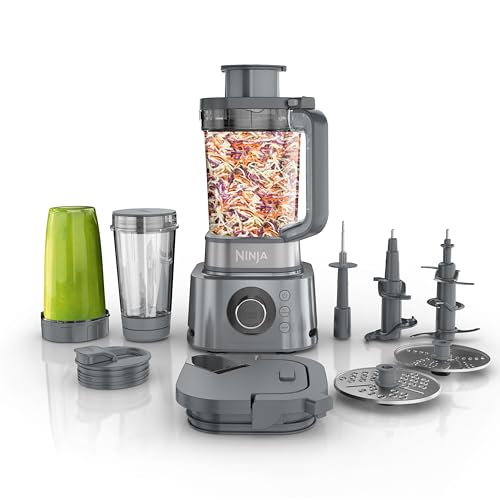
Hybrid blender processor systems attempt to close this functional gap with specialized attachments. The Ninja SS401 provides an enhanced processing lid complete with a feed chute and a 2-part pusher, along with a reversible slicing/shredding disc and a separate grating disc. This setup brings real dry prep capability to the blender ecosystem, making blender vs food processor for grating cheese a legitimate competition. However, other combo models like the Ninja BP401 only include an 8-cup precision processor bowl with a bottom chopping blade, completely omitting feed chutes and slicing discs. When slicing discs are absent, a combo machine cannot produce uniform slices. Even when discs are present, dedicated food processors offer broader bowls that spread out shredded ingredients more evenly.
Edge: Food processor due to wider feed chutes, specialized reversible shredding discs as standard equipment, and work bowls optimized for uniform vegetable slicing.
Drinkable Purees and Smoothies
Liquid blending is the traditional home territory of the blender, requiring a deep, tapered container that creates a continuous downward vortex. When making fruit smoothies or nutrient-dense green drinks, ingredients like kale stems, strawberry seeds, frozen berries, and fibrous apples must circulate repeatedly through the blade path. High rotational blade speed breaks these cellular structures apart, aerating the liquid and suspending microscopic particles in an emulsion. Without a vortex, solids float to the top or collect around the perimeter of the container.
When asking whether to choose a blender or food processor for smoothies, the equipment included with blender processors gives them an insurmountable advantage. The Ninja SS401 includes a 24-ounce Nutrient Extraction Cup fitted with a Hybrid Edge Blade Assembly to extract vitamins and nutrients from whole fruits, alongside an 18-ounce XL Smoothie Bowl Maker featuring a built-in tamper for low-liquid frozen mixtures. The Ninja BP401 includes an 18-ounce single-serve cup with spout lid and Pro Extractor Blades Assembly, as well as an extra-large 72-ounce pitcher with a 64-ounce maximum liquid capacity. These high-speed vessels force liquids through tight tolerances at thousands of revolutions per minute, similar to the vortex dynamics examined in our ninja ss351 vs tb401 breakdown.
Dedicated food processors struggle when asked to create drinkable purees. The Hamilton Beach 70730 and Cuisinart FP-5 have wide, flat-bottomed work bowls designed for lateral movement rather than vertical circulation. When filled with liquids, the flat spinning S-blade pushes liquid against the outer bowl walls instead of pulling it down into the blades. This leaves raspberry seeds intact, creates a gritty texture with fibrous leafy greens, and can cause liquid to seep past the center post or lid seals if filled beyond low capacities. Food processors make acceptable dips, but they cannot produce smooth, emulsified drinks.
Edge: Blender processor because its high-velocity extraction blades and tapered single-serve cups create silky, seed-free drinkable smoothies that wide food processor bowls cannot duplicate.
Salsa, Chopping, and Wet Puree Texture Control
Controlling particle size when prepping wet ingredients is the ultimate test of blade modulation. Making fresh salsa, chunky pico de gallo, or minced aromatics like garlic and onions requires quick cutting pulses that sever produce cleanly without bruising the cell walls. When ingredients are bruised rather than chopped, they release excessive water, leaving you with a watery liquid layer separating from finely shredded pulp. In any thorough food processor review, evaluating the consistency of wet chopping is paramount.
This is where dedicated food processors demonstrate superior mechanical finesse. When deciding between a blender or food processor for salsa, the food processor consistently wins on texture control. The Hamilton Beach 70730 offers 2 speeds plus pulse along with an innovative built-in bowl scraper. This scraper lets you clear stuck ingredients from the bowl walls by moving a handle side-to-side while the machine is running or off, eliminating the need to stop and open the lid with a spatula. The Cuisinart FP-5 provides simple paddle controls for On and Off/Pulse with a durable universal chopping blade that spins at moderate speeds, delivering crisp diced onions and evenly chopped tomatoes with minimal effort.
Blender processor systems can handle salsa, but they require extreme care to avoid over-processing. The Ninja BP401 features an 8-cup precision processor bowl with a dedicated chopping blade and four manual speed settings (Low, Medium, High, Max). The Ninja SS401 includes Auto-iQ preset programs for chopping and food processing. However, because blender motors generate rapid acceleration and immense torque, holding the pulse button for even one second too long can transform a batch of fresh salsa into a smooth tomato gazpacho. The taller stacked blade assemblies found in some blender pitchers also tend to chop the bottom layer into paste while leaving large tomato chunks sitting on top.
Edge: Food processor because lower rotational speeds, flat S-blades, and built-in bowl scrapers produce uniform, chunky salsas without accidentally liquefying the ingredients.
Dough Mixing and System Versatility
Mixing bread dough, pizza crust, and thick cookie batters requires an appliance capable of handling heavy resistance. Dough develops gluten through steady kneading, which presents dense, elastic friction that can cause small appliance motors to stall, overheat, or strip internal gears. Beyond raw power, handling dough requires a work vessel with sufficient horizontal space for the ball of dough to roll, fold, and stretch across the floor of the bowl as the blade sweeps through it.
When asking is a blender processor combo worth it for baked goods, the answer lies in motor engineering and container geometry. The Ninja SS401 is engineered specifically with smartTORQUE, a motor management system designed to maintain blade speed under thick loads and never stall. It features a preset Auto-iQ dough program and a dedicated 72-ounce Power Blender & Processor Pitcher to mix up to 4.5 pounds of dough. The Ninja BP401 provides an 8-cup precision processor bowl with a specialized chopping blade that mixes dough using its lower manual speed settings. The versatility of these high-wattage bases across various food prep chores is a recurring highlight in our ninja bn701 vs tb401 guide.
Dedicated food processors can also mix dough, but their capabilities depend heavily on motor wattage and bowl capacity. When considering a blender or food processor for dough, the 450-watt Hamilton Beach 70730 can mix pastry crusts and pizza dough in its 10-cup bowl using its S-blade on low speed, but dense bread doughs push its motor close to its working limits. The 300-watt, 5-cup Cuisinart FP-5 is sized primarily for chopping and shredding, lacking the bowl volume and continuous motor wattage required to knead standard-sized bread recipes. For households that want an appliance that covers thick dough batches, nutrient extraction cups, and high-capacity blending jars on a single base, the multi-vessel blender system provides greater overall utility.
Edge: Blender processor due to high-wattage smartTORQUE motors that resist stalling under heavy dough loads and larger multi-use vessels.
Pros and Cons
Blender Processor

Pros
- 1200W to 1500W motors crush ice to snow
- Includes single-serve cups for drinkable smoothies
- Auto-iQ preset programs automate blending textures
- SmartTORQUE motor technology powers through heavy dough
Cons
- Risk of over-processing delicate vegetable chops
- Multiple pitcher attachments require substantial storage space
- Tall pitcher profile can struggle under low cabinets
View Ninja Foodi Power Blender & Processor on Amazon
Food Processor

Pros
- Reversible discs deliver uniform slicing and shredding
- Wide feed chutes accommodate whole vegetables easily
- Built-in bowl scraper clears sides without stopping
- Lower wattage motors run quieter during daily prep
Cons
- Cannot crush ice cubes into frozen snow
- Cannot create smooth seed-free drinkable smoothies
- Lacks portable single-serve to-go drink cups
View Hamilton Beach Food Processor & Vegetable on Amazon
Who Should Buy Each One
Choose the Blender Processor If
- You make daily fruit smoothies, green protein shakes, or nutrient extractions using whole frozen fruits and fibrous vegetables.
- You want the ability to crush ice cubes into frozen snow for resort-style drinks and frozen margaritas in an XL pitcher.
- You prepare dense smoothie bowls and nut butters that benefit from dedicated containers with built-in tampers.
- You want a single powerful motor base that can switch between personal to-go cups, large blending pitchers, and food processing bowls.
Choose the Food Processor If
- Your home cooking routines involve frequent vegetable slicing for salads, stir-fries, gratins, and coleslaw.
- You regularly shred blocks of cheddar, parmesan, or mozzarella cheese and want a reversible shredding disc with an overhead feed tube.
- You prioritize controlled pulse chopping for chunky fresh salsas, pestos, and dips that turn watery in high-speed blenders.
- You have limited cabinet space and prefer a compact prep appliance with nesting blades and integrated cord storage.
Final Verdict
For most households, the blender processor combo represents the more versatile, complete kitchen investment. High-performance models like the Ninja SS401 and BP401 bridge the gap between liquid beverage preparation and dry kitchen tasks. Their 1200-to-1500-watt motors easily handle heavy frozen fruits, turn ice to snow, and power through thick dough without stalling. With specialized attachments like feed-chute lids, single-serve extraction cups, and dedicated processing bowls, these systems fulfill the daily smoothie needs of busy mornings while still handling dinner vegetable chopping from a single motorized base.
However, the dedicated food processor remains the undisputed master of precise vegetable preparation, shredding, and delicate texture control. If you rarely make drinkable smoothies or iced beverages, a blender processor’s immense power becomes a drawback that risks pulverizing fresh vegetables into unappealing mush. Dedicated units like the Hamilton Beach 70730 and Cuisinart FP-5 deliver clean, uniform cuts, hassle-free cheese shredding via wide feed chutes, and convenient bowl-scraping mechanisms that save substantial hands-on prep time. If your primary kitchen bottleneck is slicing produce and chopping herbs, choose a dedicated food processor.
FAQ
Can a blender replace a food processor for chopping onions and herbs?
A standard tall blender cannot cleanly replace a food processor because its high-speed bottom blades tend to puree the bottom layer of onions into liquid while leaving the top layers whole. However, a blender processor combo equipped with a dedicated food processing bowl and a flat chopping blade-such as the 8-cup precision bowl on the Ninja BP401 or the processing lid on the SS401-can chop onions and herbs effectively using short manual pulses.
Can you make drinkable fruit smoothies in a food processor?
While you can puree soft fruits in a food processor, it cannot produce the smooth, drinkable texture of a high-speed blender. Food processors feature wide bowls and lower-RPM motors designed for chopping, meaning they lack the vertical vortex necessary to break down leafy greens, berry seeds, and frozen ice cubes. The resulting drink will remain chunky, textured, and prone to liquid separation.
Is a blender processor combo worth it for small kitchens?
Yes, a blender processor combo is particularly well-suited for kitchens with limited storage because it eliminates the need to house two separate heavy motor bases. A single system provides the high wattage required for crushing ice and blending drinks while using interchangeable bowls, discs, and feed chutes to handle traditional food processor tasks like slicing and chopping.
Which appliance is better for grating cheese?
A dedicated food processor is significantly better for grating cheese. Models like the Hamilton Beach 70730 and Cuisinart FP-5 feature overhead feed chutes and stainless steel reversible shredding discs that grate entire blocks of cheddar or parmesan into uniform shreds in seconds. Standard blenders cannot shred cheese, though advanced hybrid combos with dedicated grating discs like the Ninja SS401 can accomplish the task.
Can a food processor crush ice cubes into snow?
No, standard food processors operating with 300-to-450-watt motors should not be used to crush hard ice cubes without liquid. Their flat S-blades and wide plastic bowls are designed to chop vegetables and puree soft foods; processing hard ice can crack the plastic bowl, dull the cutting edges, and strain the motor. To turn ice into snow, choose a high-wattage blender system equipped with Total Crushing blades.
Why are food processor wattages so much lower than blender wattages?
Food processors operate with lower-wattage motors (typically 300W to 500W) because they use internal gearing to maximize mechanical torque rather than blade speed. They cut ingredients cleanly at lower rotational velocities. Blenders require 1000 watts or more because they rely on ultra-high RPMs to create a fluid vortex and pulverize cell walls through sheer kinetic force.