Choosing between the Rode NT-USB+ and the HyperX QuadCast S comes down to whether you prioritize studio-grade onboard digital signal processing for solo voice recording or multi-pattern acoustic versatility paired with dynamic visual feedback. The NT-USB+ integrates dedicated APHEX audio hardware inside the microphone to sculpt a broadcast vocal tone directly at the hardware stage, while the QuadCast S delivers four switchable pickup patterns, an integrated shock mount, and customizable lighting to accommodate varied streaming and multi-person recording environments.
Solo broadcasters, podcasters, and voice artists seeking immediate vocal polish with zero setup complexity should choose the Rode NT-USB+. Content creators, gamers, and interviewers who require flexible pickup configurations for group sessions or interactive desk presentations should choose the HyperX QuadCast S.
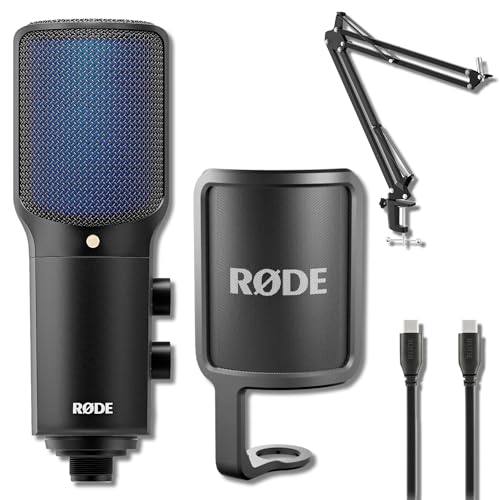

Rode NT-USB+ vs HyperX QuadCast S at a Glance
| Feature | Rode NT-USB+ | HyperX QuadCast S |
|---|---|---|
| Polar Patterns | Cardioid | Cardioid, Omnidirectional, Bidirectional, Stereo |
| Audio Resolution | 24-bit / 48 kHz | 32-bit / 192 kHz |
| Capsule Configuration | 1/2-inch studio condenser | Large diaphragm condenser (4 channels) |
| Internal Signal Processing | Hardware APHEX DSP (Compressor, Gate, High-Pass, Aural Exciter, Big Bottom) | Not listed |
| Microphone Preamplifier | High-gain, ultra-low-noise Revolution Preamp | Not listed |
| Onboard Monitoring Controls | Independent 3.5 mm headphone volume and mic-to-playback mix dials | Multifunction knob (gain, headphone volume, monitor mix, polar pattern) |
| Quick Mute Control | Not listed | Tap-to-mute sensor with LED status indicator |
| Visual Feedback | Not listed | Over 100 aRGB LEDs, LED VU meter, control mode indicators |
| Included Mounting Hardware | StreamEye BOOMARM1 27-inch aluminum desktop boom arm | Pre-attached vibration-dampening shock mount and desktop stand |
| Connectivity | USB Type-C | USB Type-C |
| Best For | Solo voice-over, studio streaming, and single-mic podcasting | Multi-person podcasting, gaming broadcasts, and interactive streams |
Acoustic Capsule Design and Polar Pattern Flexibility
The acoustic architecture of a microphone determines how sound waves enter the capsule and how effectively unwanted ambient noise gets rejected from the final recording. In a studio or home streaming space, polar pattern selection defines whether the microphone isolates a single speaker in front of the desk or captures a wider acoustic field comprising room reflections, mechanical keyboard clatter, or additional participants sitting across the table.
The hyperx quadcast s vs audio-technica at2020 debate often highlights pattern flexibility, and that same distinction is central here. The HyperX QuadCast S polar patterns include four distinct hardware options: cardioid, omnidirectional, bidirectional, and stereo. Operating across four channels, this array allows users to switch modes mechanically to accommodate solo commentary, two-person face-to-face interviews across a table, round-table discussions, or wide musical capture. Conversely, the Rode NT-USB+ polar pattern is strictly fixed to a tight cardioid response utilizing a 1/2-inch studio condenser capsule. This fixed approach rejects off-axis sound from the rear and sides, keeping direct acoustic focus on the voice speaking into the front of the unit.
If your production workflow involves hosting guests on the same microphone or capturing wide ambient sound, the QuadCast S offers four times the functional flexibility. However, for dedicated vocal isolation where multi-person pickup is unnecessary, the single-pattern design of the NT-USB+ eliminates acoustic compromises inherent in multi-capsule arrays. For multi-role versatility across different seating arrangements, the HyperX microphone covers significantly more ground.
Edge: HyperX QuadCast S for offering four switchable polar patterns to handle multi-person interviews, roundtables, and solo broadcasts.
Internal Audio Processing and Digital Signal Chain
The journey from an analog acoustic pressure wave to a digital audio stream relies on preamplification, analog-to-digital conversion, and dynamic signal processing. Standard USB microphones pass raw audio straight to the computer operating system, forcing the host CPU to process noise gates, EQ filters, and compression through third-party software, which often introduces latency in live monitoring streams.
This criterion marks the core technological divergence in any Rode NT-USB+ review. The NT-USB+ integrates a high-gain, ultra-low-noise Revolution Preamp alongside onboard hardware DSP powered by APHEX. Through companion apps such as RØDE Connect, RØDE Central, or RØDE Reporter, creators can engage internal hardware-level processing including a high-pass filter, noise gate, compressor, and proprietary Aural Exciter and Big Bottom algorithms. Because this Rode NT-USB+ APHEX DSP runs directly on the microphone hardware, it delivers processed, broadcast-ready vocals with zero host latency and without consuming computer CPU cycles during intense gaming or rendering tasks. The digital conversion operates at 24-bit / 48 kHz, matching professional broadcast standards.
The QuadCast S approaches digital resolution from a high-sample-rate angle, providing 32-bit / 192 kHz conversion capability, a 90 dB signal-to-noise ratio, and 94 dB audio sensitivity. Customization is managed via the HyperX NGENUITY software. However, the listing does not specify onboard hardware DSP for dynamic vocal processing, noise gating, or harmonic enhancement. When deciding between the rode nt-usb+ vs elgato wave 3 or comparing it against HyperX, the inclusion of dedicated internal studio hardware processors gives the Rode a massive advantage in vocal tone shaping before the signal ever reaches the recording software.
Edge: Rode NT-USB+ for its integrated hardware APHEX DSP suite and ultra-low-noise Revolution Preamp that process broadcast vocal effects internally.
Onboard Hardware Controls and Monitoring Ergonomics
Live broadcasting and high-stakes voice recording demand immediate physical control over audio levels. Having tactile dials directly on the microphone body prevents creators from alt-tabbing out of a live game or software session just to balance game sound against mic monitoring or quickly silence an unexpected cough.
The QuadCast S provides a comprehensive physical control suite led by its top-mounted tap-to-mute capacitive sensor. Tapping the top instantly cuts the audio feed, accompanied by an immediate visual confirmation as the internal LED array extinguishes. Beneath the capsule, a multifunction knob allows creators to select and adjust microphone gain, headphone volume, monitor mix levels, and the active polar pattern. Furthermore, the QuadCast S features an onboard LED VU meter and mode indicators to show the user exact volume levels, mute status, and polar configurations in real time, making a HyperX QuadCast S review highly favorable for live streamers.
The NT-USB+ focuses its tactile hardware exclusively on zero-latency 3.5 mm headphone monitoring. It features two dedicated smooth-turn dials on its side: one for overall headphone output volume, and a second dedicated mix dial that blends direct microphone input with computer audio playback. Because the 3.5 mm jack is wired before the digital conversion path, monitoring has no software round-trip delay. As explored in comparisons like the elgato wave 3 vs hyperx quadcast s, quick-mute accessibility is critical for live production; the NT-USB+ listing does not specify a dedicated hardware mute button or tap sensor, requiring creators to mute through software.
Edge: HyperX QuadCast S for its responsive tap-to-mute sensor, LED VU metering, and multifunction knob controlling gain and patterns.
Mounting Hardware, Mechanical Isolation, and Desk Integration
Condenser capsules are exceptionally sensitive instruments that easily capture low-frequency vibrations, such as desk thumps, keyboard keystrokes, and floorboard creaks. Effective mechanical isolation and proper capsule positioning relative to the speaker’s mouth are critical for professional audio quality.
The NT-USB+ bundle includes the StreamEye BOOMARM1, a 27-inch aluminum alloy desktop boom arm with a sturdy desk clamp mount. This boom arm provides 27 inches of horizontal reach, allowing users to suspend the microphone directly in front of the mouth at proper speaking distance without cluttering desk space. The aluminum alloy construction maintains positioning without sagging, and the external tension springs adjust silently without mechanical creaks during live broadcasts. Suspending the mic in the air decouples it from the desk surface entirely, addressing vibration transmission at the source.
The QuadCast S approaches mechanical stability through an included desktop stand paired with a pre-attached, vibration-dampening shock mount. This shock mount uses suspension cords to absorb desk vibrations and is detachable via spring-loaded pins. The shock mount joint incorporates native threading compatible with both 3/8-inch and 5/8-inch boom arm threads, though an arm itself is not included in the package. In comparisons like the rode nt-usb+ vs podmic usb, physical placement is paramount; having a dedicated 27-inch boom arm included directly in the box gives the Rode package a distinct operational edge over a baseline desktop stand.
Edge: Rode NT-USB+ for including a 27-inch aluminum boom arm that elevates the capsule off the desk surface right out of the box.
Visual Presentation and Streaming Aesthetics
For on-camera streamers, YouTubers, and content creators, a microphone serves as a prominent visual prop in every video frame. Aesthetic integration, lighting compatibility, and visual feedback often weigh heavily in production design decisions.
The QuadCast S is engineered specifically for dynamic visual impact. It features an illuminated internal display containing over 100 individually customizable addressable RGB (aRGB) LEDs capable of rendering more than 16 million colors. Managed through HyperX NGENUITY software, users can configure intricate lighting gradients, dynamic pulses, or solid color schemes that match the rest of their battlestation lighting. The lighting also functions as an unambiguous broadcast tally light: when the tap-to-mute sensor is triggered, the entire aRGB display shuts off, eliminating any doubt about whether the mic is hot.
The NT-USB+ features a traditional, understated broadcast aesthetic. Constructed from durable metal with a clean black finish, it blends seamlessly into executive podcasts, voice-over recording booths, and minimalist home studios. It intentionally omits RGB lighting elements to maintain a distraction-free visual presentation. In the broader landscape of broadcast gear, such as in the rode podmic usb vs hyperx quadcast s matchup, creators seeking camera-ready RGB spectacle will favor HyperX, while those wanting classic broadcast sobriety will lean toward Rode.
Edge: HyperX QuadCast S for its dynamic display of over 100 customizable aRGB LEDs that integrate seamlessly into camera-facing setups.
Pros and Cons
Rode NT-USB+

Pros
- Hardware-level APHEX DSP vocal processing
- Ultra-low-noise Revolution Preamp
- Dedicated hardware monitor mix controls
- Bundled 27-inch aluminum boom arm
- Studio-grade 1/2-inch condenser capsule
Cons
- Fixed cardioid pattern with no multi-pattern options
- No hardware tap-to-mute sensor
- Lacks dynamic RGB lighting display
HyperX QuadCast S

Pros
- Four selectable polar pickup patterns
- Instant capacitive tap-to-mute sensor
- Over 100 customizable aRGB LEDs
- Pre-attached vibration-dampening shock mount
- 32-bit 192 kHz high-resolution conversion
Cons
- No internal hardware DSP vocal processing
- Desktop boom arm not included
- Larger desk footprint using desktop stand
View HyperX QuadCast S on Amazon
Who Should Buy Each One
Choose the Rode NT-USB+ If
- You record solo voice projects such as podcasts, audiobooks, voice-overs, or solo live streams and want studio-quality vocal clarity.
- You want onboard APHEX DSP hardware to run compression, noise gating, and high-pass filtering without loading your computer CPU.
- You need an immediate boom arm setup, as the included 27-inch StreamEye aluminum arm clamps directly to your desk.
- You prefer physical hardware dials to balance your live microphone monitor mix against computer audio playback with zero latency.
Choose the HyperX QuadCast S If
- You record multi-person interviews, round-table discussions, or stereo soundscapes requiring four switchable polar patterns.
- You stream on camera and want over 100 addressable RGB LEDs to sync with your room lighting and battlestation design.
- You require a physical tap-to-mute capacitive sensor on the mic body with instant visual LED status feedback.
- You want high-resolution 32-bit / 192 kHz recording capabilities combined with an integrated vibration-dampening shock mount.
Final Verdict
Choosing between the Rode NT-USB+ and the HyperX QuadCast S depends entirely on whether your workflow centers on dedicated solo voice processing or multi-role visual versatility. The Rode NT-USB+ is the superior tool for solo voice artists, narrators, and focused streamers. By integrating the ultra-low-noise Revolution Preamp, a studio 1/2-inch condenser capsule, and onboard APHEX DSP hardware, it delivers clean, compressed, and gated broadcast audio directly out of the USB port without consuming host computer processing power. The inclusion of the 27-inch StreamEye aluminum boom arm further cements it as a complete, ready-to-record voice workstation.
The HyperX QuadCast S wins when flexibility, live gaming usability, and on-camera visual flair take precedence. Its four selectable polar patterns make it capable of capturing two-person interviews, full-room conferences, and stereo environments that the fixed cardioid capsule of the Rode cannot accommodate. Backed by an instantaneous tap-to-mute sensor, multifunction control dial, built-in shock mount, and more than 100 customizable aRGB LEDs, the QuadCast S remains the premier choice for creators building an interactive, visually stunning gaming broadcast.
FAQ
Does the Rode NT-USB+ offer multiple polar patterns?
No. The Rode NT-USB+ features a fixed tight cardioid polar pattern. It is engineered specifically to capture audio from the front of the 1/2-inch studio condenser capsule while rejecting sound from the sides and rear. If you require omnidirectional, bidirectional, or stereo recording, the HyperX QuadCast S provides those modes natively.
Can the HyperX QuadCast S be mounted on an aftermarket boom arm?
Yes. The HyperX QuadCast S comes with a pre-attached vibration-dampening shock mount that features a joint compatible with both 3/8-inch and 5/8-inch standard threading. While it comes mounted to a desktop stand, it can be detached and screwed directly onto standard boom arms.
How does the Rode NT-USB+ APHEX DSP work during live streams?
The APHEX processing on the NT-USB+ is handled directly on an internal hardware chip inside the microphone. Using compatible apps such as RØDE Connect or RØDE Central, you can activate the high-pass filter, noise gate, compressor, Aural Exciter, and Big Bottom effects. Because the processing occurs on the microphone hardware before reaching the computer, it adds no perceptible latency to your monitoring feed and uses no host CPU resources.
Is the HyperX QuadCast S suitable for podcast interviews with two people?
Yes. By switching the multifunction control to the bidirectional polar pattern, the QuadCast S captures sound from both the front and rear of the capsule while rejecting noise from the sides. This allows two people sitting opposite each other at a desk to record an interview using a single microphone.
Which microphone handles headphone monitoring better?
Both microphones feature 3.5 mm headphone outputs with zero-latency monitoring, but they manage controls differently. The Rode NT-USB+ provides two dedicated physical dials: one for headphone volume and one for blending the direct microphone signal with computer audio playback. The QuadCast S manages headphone levels and monitor mixing through its multifunction knob and companion NGENUITY software.
Is HyperX QuadCast S worth it for competitive gaming?
The QuadCast S is well suited for competitive gaming due to its rapid tap-to-mute capacitive sensor and clear LED status indicators. Being able to mute your mic with a light tap on the top without looking away from your monitor, combined with the visual confirmation of the aRGB lights shutting off, provides excellent control during live matches.
Is Rode NT-USB+ worth it for voice-over and audiobook production?
The Rode NT-USB+ is exceptionally well suited for voice-over, podcasting, and audiobook production. Its studio-grade 1/2-inch condenser capsule, ultra-low-noise Revolution Preamp, and onboard APHEX dynamic processing provide the warmth, presence, and dynamic control required for professional voice capture without needing an external audio interface.


